
How to A/B Test Facebook Ad Creatives: A Beginner Guide to Statistical Confidence and Faster Winners
You launched three ad variations, waited two days, picked the one with the lowest CPA, and scaled it. Sound familiar? That's not A/B testing — that's guessing with extra steps.
Most beginner media buyers waste 20-40% of their testing budget because they don't know when results are statistically meaningful versus random noise. They kill winners too early and scale losers too long.
This guide teaches you how to A/B test Facebook ad creatives properly: how to set up tests, determine sample sizes, understand statistical significance (without a math degree), and use a practical 3-phase framework to find winners faster.
What A/B Testing Actually Means for Facebook Ad Creatives
A/B testing (or split testing) means showing two or more creative variations to similar audiences and measuring which one performs better based on a specific metric.
The key word is "similar." If variation A runs to women aged 25-34 and variation B runs to men aged 45-54, you're not testing creatives — you're testing audiences. For a valid creative test, everything except the creative itself must stay constant:
- Same audience (same ad set or equivalent targeting)
- Same budget per variation
- Same time period (run simultaneously, not sequentially)
- Same optimization event (purchase, add to cart, etc.)
- One variable changed (image, headline, video, or hook — not all at once)
When you change multiple elements between variants, you can't tell which change caused the performance difference. This is the single most common mistake beginners make.
What to Test First
Not all creative elements have equal impact. Here's a priority order:
- Visual format — Video vs. static image vs. carousel. This is the highest-impact variable.
- Hook / first 3 seconds (video) or primary image (static) — What stops the scroll.
- Headline — The text below the creative that drives clicks.
- Primary text — The body copy above the creative.
- CTA button — Learn More vs. Shop Now vs. Sign Up.
Start at the top. Don't bother testing CTA buttons until you've found a winning visual format and hook.
Minimum Budget and Sample Size for Valid Results
The number one question: "How much do I need to spend?" The answer depends on what you're measuring.
Sample Size Rules of Thumb
For conversion-based metrics (purchases, signups):
- You need at least 50-100 conversions per variation before drawing conclusions
- With a $20 CPA, that means $1,000-$2,000 per variation minimum
- If you can't afford this, test on upper-funnel metrics first
For click-based metrics (CTR, CPC):
- You need at least 1,000 clicks per variation for reliable CTR comparisons
- This is more affordable but less directly tied to revenue
For engagement metrics (ThruPlay rate, video views):
- At least 5,000 impressions per variation for stable engagement rates
Budget Allocation Formula
A practical formula for testing budget:
Test budget per variation = Target CPA × 50 (minimum) to 100 (ideal)
Total test budget = Budget per variation × Number of variations
Example: If your target CPA is $15 and you're testing 3 variations:
- Minimum: $15 × 50 × 3 = $2,250 total
- Ideal: $15 × 100 × 3 = $4,500 total
If that's too expensive, reduce the number of variations to 2 or test on a cheaper metric first (link clicks instead of purchases).
Statistical Significance Explained Without the Math PhD
Statistical significance answers one question: "Is the performance difference between my variations real, or could it just be random luck?"
The Basics
When you see variation A with a 2.1% CTR and variation B with a 2.4% CTR, the difference looks real. But with 200 clicks each, that difference could easily be random. With 5,000 clicks each, it's almost certainly real.
Confidence level is expressed as a percentage:
- 90% confidence = 10% chance the result is random noise
- 95% confidence = 5% chance the result is random noise
- 99% confidence = 1% chance the result is random noise
For Facebook ad testing, 90-95% confidence is the sweet spot. Higher than 95% requires significantly more data (and budget) with diminishing practical returns.
How to Check Statistical Significance
You don't need to do math. Use free online calculators:
- Go to a split test calculator (search "AB test significance calculator")
- Enter the number of visitors/clicks for each variation
- Enter the number of conversions for each variation
- The tool tells you the confidence level
Rule: Don't call a winner until confidence hits at least 90%. Below that, keep the test running.
Common Trap: Peeking Too Early
Checking results every few hours and calling a winner as soon as one variation looks ahead is called "peeking bias." In the first 24-48 hours, results swing wildly. Early leads often reverse.
Set a minimum test duration (3 days) and a minimum sample size. Don't touch anything until both conditions are met.
How Many Creative Variations to Test at Once
More variations = more chances to find a winner. But also = more budget needed and longer time to significance.
Budget under $50/day: Test 2 variations only. This gives each variant enough budget to learn.
Budget $50-$150/day: Test 3-4 variations. The sweet spot for most advertisers.
Budget $150+/day: You can test 4-6 variations, but group them into themes (e.g., 3 video hooks or 3 different value propositions).
Never test more than 6 variations at once. With 6+ variations, each gets so little budget that reaching significance takes weeks, and the learning phase never exits.
CBO vs ABO for Creative Testing
This is one of the most debated topics in media buying. Here's the clear answer for testing purposes.
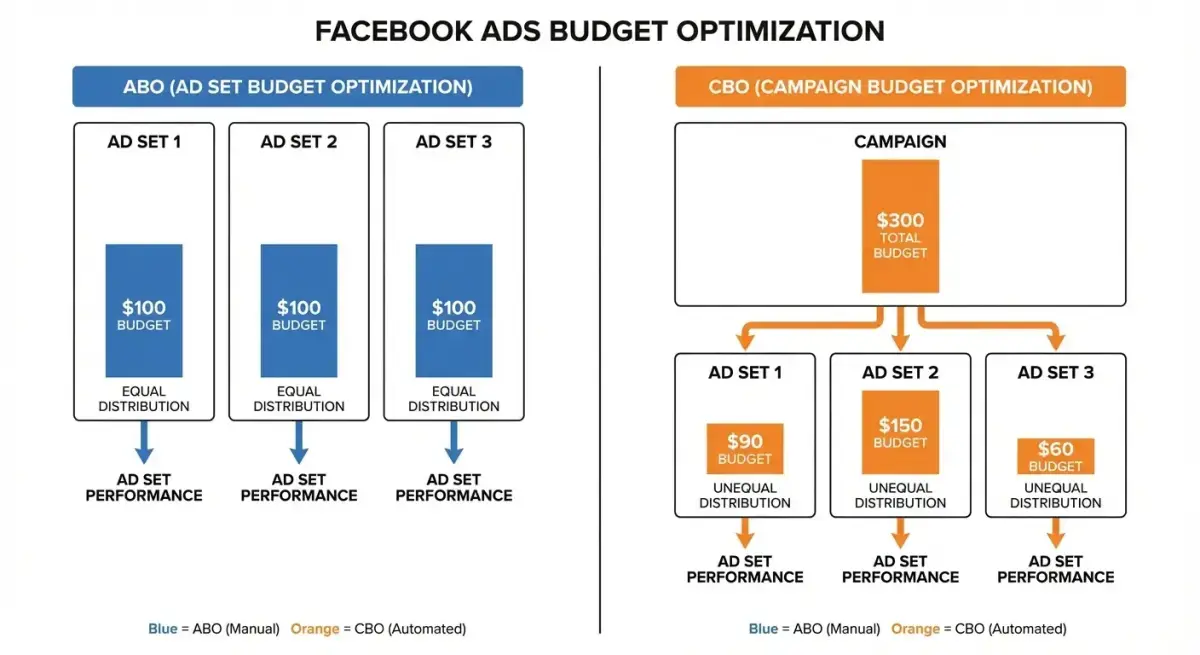 CBO vs ABO: when to use each for creative testing
ABO (Ad Set Budget Optimization) — Best for Testing
With ABO, you set the budget at the ad set level. Each ad set (and its creative) gets exactly the budget you assign.
Why ABO wins for testing:
- Equal spend per variation — no premature favoritism
- You control when to cut a loser
- Easier to calculate per-variation metrics
- Clearer statistical comparison
CBO (Campaign Budget Optimization) — Best for Scaling
With CBO, Meta distributes the budget across ad sets based on predicted performance. Great for scaling winners, terrible for fair testing.
Why CBO fails for testing:
- Meta picks favorites within hours — underperformers get starved of budget
- A creative might get 80% of the budget before you have meaningful data on the others
- You can't tell if a variation lost because it's actually worse or because it never got enough budget
The rule: Use ABO for testing, CBO for scaling proven winners.
Pro tip: Before spending on tests, use Adligator to find proven creative patterns from competitors — creatives running 30+ days are likely winners worth studying.
The 3-Phase Testing Framework: Explore, Validate, Scale
Instead of random testing, follow this structured approach:
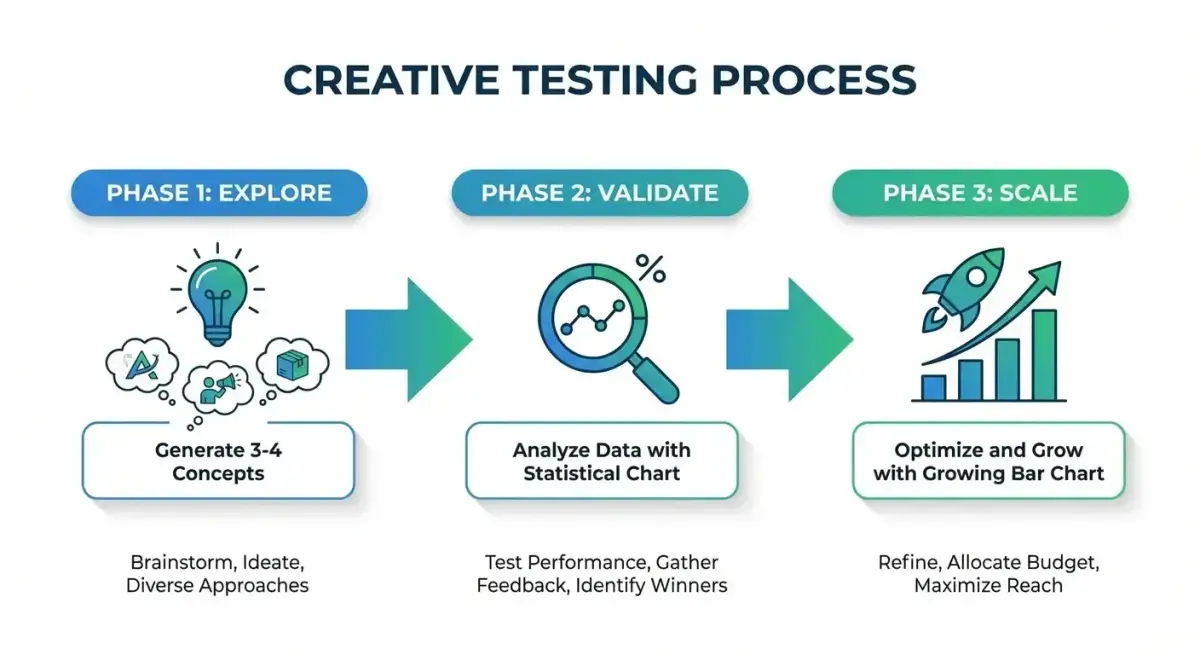 The 3-phase testing framework: explore → validate → scale
Phase 1: Explore (3-5 days)
Goal: Find promising creative directions.
- Test 3-4 fundamentally different creative concepts
- Use ABO with equal budgets
- Optimize for a mid-funnel event (Add to Cart or Initiate Checkout) if purchases are too few
- Budget: 1-2× your target CPA per variation per day
- Success metric: Which concepts show the best CTR and cost-per-result trend?
At the end of this phase, you should have 1-2 concepts that clearly outperform the others.
Phase 2: Validate (5-7 days)
Goal: Confirm the winner with statistical significance.
- Take the top 1-2 concepts from Phase 1
- Create 2-3 minor variations of each (different headlines, slightly different hooks)
- Run with higher budget (2-3× your target CPA per variation per day)
- Wait for 90%+ statistical significance before declaring a winner
- Optimize for your actual conversion event (Purchase)
This phase is where most beginners skip. They jump from Phase 1 directly to scaling and wonder why performance drops.
Phase 3: Scale (ongoing)
Goal: Maximize volume from validated winners.
- Move winners to CBO campaigns
- Increase budget gradually (20-30% every 2-3 days)
- Monitor frequency and creative fatigue
- Start a new Phase 1 test cycle every 2-3 weeks to find new winners before the current ones fatigue
Critical: Never stop testing. Even your best creative will fatigue. Most Facebook ad creatives have a lifespan of 2-6 weeks before performance degrades.
How to Track Test Results
Create a simple spreadsheet for every test round:
| Variation | Spend | Impressions | Clicks | CTR | Conversions | CPA | ROAS | Confidence |
|---|---|---|---|---|---|---|---|---|
| A (video hook 1) | $150 | 12,000 | 180 | 1.5% | 6 | $25 | 2.0 | — |
| B (video hook 2) | $150 | 11,500 | 220 | 1.9% | 9 | $16.67 | 3.0 | 87% |
| C (static image) | $150 | 13,000 | 130 | 1.0% | 4 | $37.50 | 1.3 | — |
Update daily. After 3+ days, run significance calculations on top performers. This forces discipline — you see the actual numbers instead of relying on Ads Manager's UI, which can be misleading.
Document your learnings after each test cycle. Over time, you build a knowledge base of what creative patterns work for your audience, making each subsequent test cycle faster and cheaper.
Common A/B Testing Mistakes That Burn Budget
Mistake 1: Ending Tests Too Early
You see one variation performing 30% better after 24 hours and scale it. Two days later, performance tanks. The early lead was random noise.
Fix: Never call a winner before reaching your minimum sample size AND at least 72 hours of data.
Mistake 2: Testing Too Many Variables at Once
Changing the image, headline, and CTA between variations means you don't know which change mattered.
Fix: Isolate one variable per test. Change only the image OR only the headline, never both.
Mistake 3: Using Different Audiences for Different Creatives
Running variation A to lookalike audiences and variation B to interest-based audiences isn't a creative test.
Fix: Same targeting, same placement, same optimization for all variations.
Mistake 4: Ignoring Creative Fatigue
A test winner from 3 weeks ago isn't necessarily still a winner. Performance changes as audiences saturate.
Fix: Monitor frequency metrics. When frequency exceeds 2.5-3.0, creative fatigue is likely setting in. Time to rotate.
Mistake 5: Not Testing Against a Control
Every new test should include your current best performer as a "control." This prevents false positives where a new creative looks good but is actually worse than what you already have.
Fix: Always include your current best as one of the variations.
Tools to Track and Analyze Creative Tests
Meta's Built-in A/B Test Tool
Meta offers a native A/B test feature in Ads Manager. It creates a controlled experiment with proper audience splitting.
Pros: Proper statistical methodology, automatic significance calculation, no audience overlap. Cons: Requires higher minimum budgets, less flexibility in setup, longer minimum durations.
Manual Split Testing
Create separate ad sets with identical targeting and manually compare results.
Pros: More control, works with any budget, easy to set up. Cons: Possible audience overlap, you need to calculate significance manually, requires more discipline.
Competitive Intelligence
Before spending your own budget on testing, research what's already working. Tools like Adligator let you browse competitor ad creatives and filter by how long they've been running.
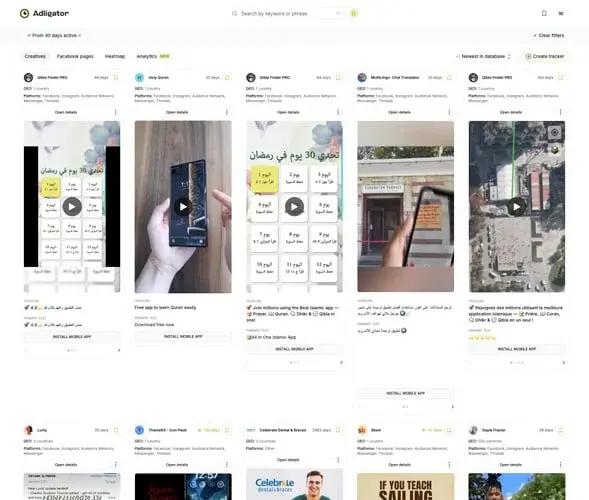 Use Adligator to find competitor creatives that have been running 30+ days — a strong signal of a winning ad
A creative that's been live for 30+ days is almost certainly profitable — advertisers don't keep paying for losing ads. Study these winning patterns (format, hook style, offer structure) and use them as starting points for your own tests. This can save you entire rounds of Phase 1 exploration.
Meta A/B Test Tool vs Manual Split Testing
| Feature | Meta A/B Test Tool | Manual Split Test |
|---|---|---|
| Audience isolation | Guaranteed (no overlap) | Possible overlap |
| Statistical calculation | Automatic | Manual (use calculator) |
| Minimum budget | Higher ($100+/day recommended) | Any budget |
| Flexibility | Limited test parameters | Full control |
| Learning phase | Shared across test | Separate per ad set |
| Best for | Large budgets, definitive answers | Small budgets, quick exploration |
Recommendation for beginners: Start with manual split testing (cheaper, more flexible). Once you're spending $100+/day and want definitive answers, use Meta's A/B test tool.
FAQ
How long should I run a Facebook ad A/B test?
Run each test until you reach at least 100 conversions per variation (or 1,000+ link clicks for top-of-funnel metrics). This typically takes 3-7 days depending on your budget and audience size. Never make decisions based on less than 72 hours of data.
How many ad variations should I test at once?
Test 2-4 variations at a time. More than 4 splits your budget too thin and delays statistical significance. Start with 2 if your daily budget is under $50. Use 3-4 if you have $50-$150/day to spend on testing.
Should I use CBO or ABO for creative testing?
Use ABO (Ad Set Budget Optimization) for testing so each creative gets equal spend. CBO lets Meta pick favorites too early, which can kill potential winners before they get enough data. Switch to CBO only when you're scaling validated winners.
What is a good confidence level for Facebook ad tests?
Aim for 90-95% confidence before calling a winner. Below 90%, you risk making decisions based on random noise rather than real performance differences. 95% is ideal for high-spend decisions. Use a free A/B test calculator to check.
Conclusion
A/B testing Facebook ad creatives isn't complicated — it just requires discipline. The difference between good and bad testing comes down to three things: proper sample sizes, patience to wait for statistical significance, and a structured framework.
Here's your action plan:
- Start small. Test 2 variations with ABO and equal budgets.
- Set rules before you start. Define your minimum sample size and test duration. Don't touch anything until both are met.
- Follow the 3-phase framework. Explore broadly, validate your best ideas, then scale with confidence.
- Check significance. Use a free calculator. Don't trust your gut on whether a 15% difference is "real."
- Never stop testing. Even winners fatigue. Keep your creative pipeline flowing.
The fastest way to shorten your testing cycles? Start with patterns that are already proven. Study what competitors run longest, learn from their creative approaches, and build your tests on a foundation of real-world data rather than blind guessing.
Ready to shortcut your creative testing? Use Adligator to find proven creative patterns before you spend on testing.
Start discovering winning creatives for free
Related Reading
- Facebook Ad Creative Testing Framework: How to Validate Winners Faster Using Competitor Intelligence
- How Many Ad Creatives Do You Need for Facebook Ads? A Data-Driven Framework by Budget Level (2026)
- How to Use Ad Spy Data to Scale Facebook Campaigns: From Testing to Six-Figure Spend
- Facebook Ad Account Structure and Naming Conventions: A Scaling Framework for Media Buyers
