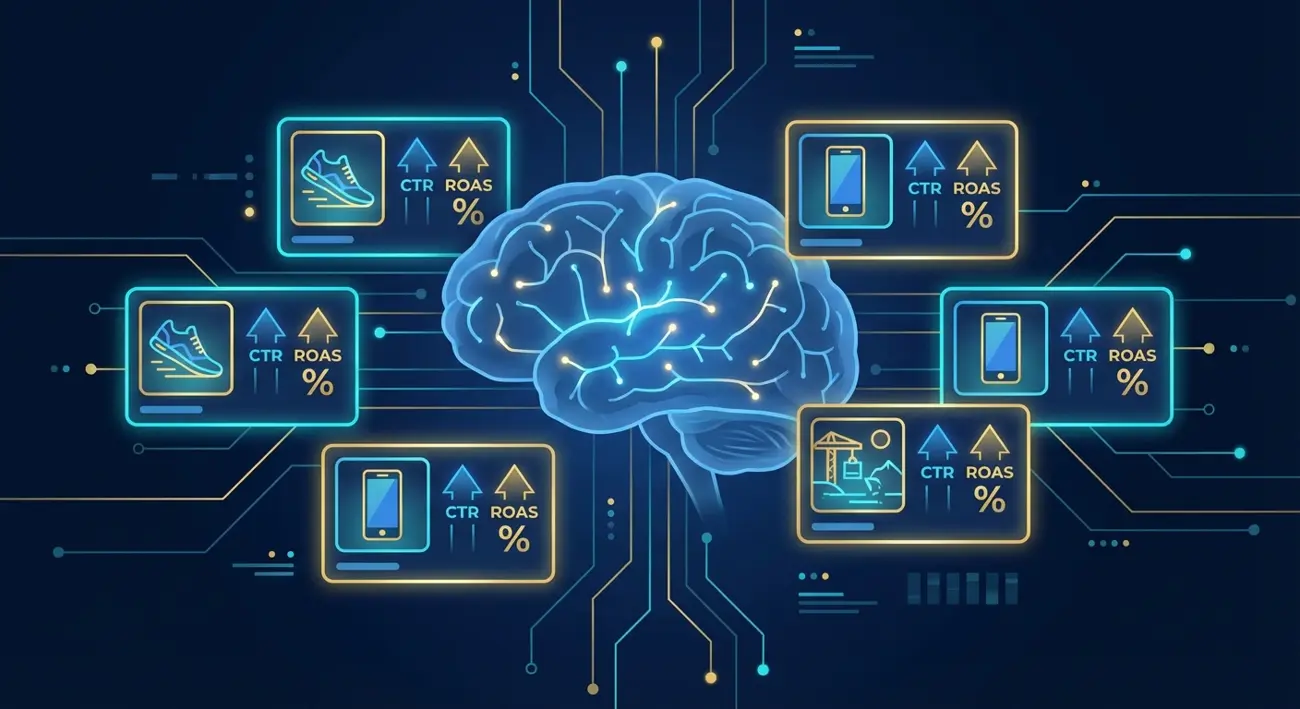
How to Use AI-Powered Ad Intelligence to Predict Winning Facebook Creatives Before You Spend
Most media buyers still launch creative tests based on instinct. They scroll through competitor ads, pick what looks promising, and hope their next batch outperforms the last. The problem: this reactive approach burns budget on creatives that never had a real chance.
AI ad intelligence changes the equation. Instead of guessing which creatives might work, you can analyze patterns across thousands of competitor ads to identify what's already winning — and use those signals to predict performance before you spend a dollar on testing.
This guide walks you through a practical framework for using AI-powered ad intelligence to predict winning Facebook creatives. Whether you're a solo media buyer or running a creative team, you'll learn how to shift from reactive testing to data-driven creative decisions.
The Shift from Reactive to Predictive Ad Intelligence
Traditional competitive research follows a simple loop: see what competitors run, make something similar, test it, iterate. The problem isn't the process — it's the speed. By the time you spot a trend manually, launch your version, and gather data, the window may have closed.
Predictive ad intelligence flips this. Instead of reacting to what's working now, you use data patterns to anticipate what's likely to work next. The difference is subtle but powerful:
- Reactive: "That ad has been running for 30 days, so it probably works. Let me copy the approach."
- Predictive: "Ads with this combination of format, hook style, and visual treatment have a 3x higher longevity rate in this vertical. Let me build around those signals."
The shift requires two things: enough data to identify patterns, and tools smart enough to surface them. Manual analysis can handle the first few competitors. But when you're tracking hundreds of advertisers across multiple geos and formats, you need AI doing the pattern recognition.
This isn't about replacing creative judgment. It's about giving your judgment better inputs. The best media buyers combine gut instinct with data — predictive intelligence just makes the data layer dramatically better.
How AI Analyzes Ad Creative Patterns
AI-powered ad intelligence tools process creatives across multiple dimensions simultaneously. Understanding what they analyze helps you interpret their signals correctly.
Visual Pattern Recognition
Modern AI can identify visual elements that correlate with ad performance:
- Color dominance: Which color palettes appear most frequently in long-running ads within a vertical
- Composition patterns: Whether top-performing ads favor close-up product shots, lifestyle scenes, or graphic-heavy designs
- Format trends: The ratio of video to static to carousel among winning creatives
- Thumbnail appeal: For video ads, which opening frames generate the strongest engagement signals
Copy and Hook Analysis
Beyond visuals, AI examines the text layer:
- Hook patterns: Common opening structures in high-performing ads (questions, statistics, bold claims, pain points)
- CTA language: Which call-to-action phrases appear most in ads with strong longevity
- Emotional triggers: Whether a vertical's winners lean on urgency, curiosity, social proof, or aspiration
- Copy length: Optimal text length for the specific audience and placement
Performance Signal Extraction
The most valuable AI analysis happens with performance proxies. Since you can't see competitors' actual ROAS, AI tools use indirect signals:
- Ad longevity: Ads running 14+ days likely have positive ROI (advertisers kill losers fast)
- Geographic expansion: Ads expanding to new countries suggest scaling success
- Creative duplication: When multiple advertisers adopt similar creative approaches, it signals a proven pattern
- Active days trajectory: Whether an ad's reach is growing, stable, or declining
Clustering and Trend Detection
AI excels at finding patterns humans miss. By clustering thousands of creatives, it can identify:
- Emerging visual trends before they become obvious
- Creative fatigue signals (when a once-popular approach starts losing traction)
- Vertical-specific winning formulas that differ from general best practices
- Seasonal creative patterns that repeat annually
What AI Can and Cannot Predict
Setting realistic expectations is critical. AI ad creative analysis is powerful, but it has clear boundaries.
What AI Does Well
- Pattern identification at scale: Spotting trends across thousands of ads that no human could process manually
- Creative clustering: Grouping similar approaches to identify dominant strategies in a vertical
- Longevity prediction: Ads matching certain pattern combinations have statistically higher chances of running longer
- Format recommendations: Identifying which ad formats (video, static, carousel) perform best for specific verticals and geos
- Fatigue detection: Flagging when a creative approach is becoming saturated
What AI Cannot Do
- Guarantee winners: No model can promise a specific ad will succeed. Too many variables (offer, landing page, audience, timing) exist outside the creative itself.
- Replace creative quality: AI identifies what patterns work, but producing genuinely compelling creative still requires human skill
- Account for brand context: A winning pattern for a DTC skincare brand may fail for a B2B SaaS product, even if the AI identifies it as "high potential"
- Predict platform changes: Algorithm updates, policy changes, and auction dynamics are outside the model's scope
The Right Mental Model
Think of AI ad intelligence as a research analyst, not an oracle. It narrows the field of possibilities dramatically. Instead of testing 20 creative directions, you test 5 — and those 5 are informed by data from thousands of ads. Your hit rate improves, but you still need to test.
The media buyers who get the most from AI prediction are those who use it as an input to their creative process, not a replacement for it.
Combining Spy Data with AI Analysis
Raw spy data and AI analysis are powerful individually. Combined, they create a prediction system that's greater than either part alone.
Step 1: Build Your Competitive Dataset
Start by defining your monitoring scope:
- Direct competitors: 5–10 advertisers selling similar products to similar audiences
- Adjacent competitors: Brands in related verticals that target overlapping demographics
- Aspirational benchmarks: Top-performing advertisers in your space, even if they're much larger
Use an ad spy tool to track these advertisers consistently. The key is historical depth — you need at least 30 days of data to identify meaningful patterns, and 90 days for seasonal trend detection.
Step 2: Filter for Signal
Not all competitor ads are informative. Filter your dataset to focus on:
- Ads running 7+ days: Eliminates quick failures and tests
- Ads in your target geos: Performance patterns vary dramatically by market
- Ads on your target platforms: Facebook feed behavior differs from Instagram Stories
- Active ads only: Historical data matters, but current winners matter more
Step 3: Layer AI Pattern Analysis
With a filtered dataset, apply AI analysis to identify:
- What visual and copy patterns dominate among the longest-running ads
- Which creative formats (video length, static composition, carousel structure) correlate with longevity
- How the winning approach has evolved over the past 30/60/90 days
- Where gaps exist — creative angles competitors haven't explored
Step 4: Generate Prediction Hypotheses
Based on the patterns, formulate specific hypotheses:
- "Short-form video (under 15 seconds) with product-in-use opening frames has 2.5x the average longevity in our vertical"
- "Comparison-style static ads with split-screen layouts are gaining traction — up 40% in the last 30 days"
- "Carousel ads with social proof in the first card outperform product-first carousels"
Each hypothesis becomes a creative brief for your team.
Ready to surface these patterns automatically? Use Adligator's AI-powered filters to surface winning creative patterns
Building a Predictive Creative Testing Framework
 A predictive creative testing framework: spy, analyze, score, test, refine.
A framework turns ad-hoc prediction into a repeatable system. Here's how to structure it.
The Prediction Scorecard
Create a scoring system for creative concepts before you produce them:
| Signal | Weight | Score (1–5) |
|---|---|---|
| Matches top longevity patterns | 30% | — |
| Uses trending format for vertical | 20% | — |
| Addresses gap in competitor coverage | 20% | — |
| Aligns with current seasonal trends | 15% | — |
| Novel angle (not yet saturated) | 15% | — |
Score each creative concept before production. Only produce concepts scoring 3.5+ out of 5. This simple filter eliminates the weakest ideas before you spend on production or testing.
Weekly Prediction Cycle
Build a weekly cadence:
- Monday: Update competitor monitoring data. Review new ads from tracked advertisers.
- Tuesday: Run AI pattern analysis on the updated dataset. Identify new trends, fading patterns, and emerging opportunities.
- Wednesday: Score creative concepts against the prediction scorecard. Select top 3–5 for production.
- Thursday–Friday: Produce and launch test creatives.
- Following Monday: Review test results. Update the prediction model with what actually worked.
Feedback Loop Integration
The framework only improves if you feed results back in. Track:
- Which prediction signals correlated with actual performance
- Which signals were misleading (high-confidence predictions that flopped)
- How quickly the competitive landscape shifts (do patterns hold for weeks or days?)
After 4–6 weeks, you'll have enough data to weight your prediction signals based on actual results, not just theory.
Tools with AI-Powered Creative Intelligence
Not all ad spy tools offer the same level of AI-powered analysis. Here's what to look for and how current tools compare.
Essential AI Features
When evaluating tools for predictive creative intelligence, prioritize:
- Smart filtering: Ability to filter by ad longevity, format, geo, platform, and recency simultaneously
- Pattern surfacing: Automated identification of trending creative approaches
- Creative clustering: Grouping similar ads to spot dominant strategies
- Temporal analysis: Tracking how creative trends evolve over time
- Export and integration: Getting data out for your own analysis
Adligator
Adligator provides AI-powered filters across the full Meta ecosystem — Facebook, Instagram, Messenger, Audience Network, and Threads. Its strength for predictive analysis lies in the combination of granular filters and scale:
- Filter by ad longevity (days active) to isolate proven winners
- Cross-reference by geo, platform, format, CTA type, and language
- Track specific advertisers via Facebook page ID monitoring
- Live filter trackers save search configurations for ongoing monitoring
- 234 countries covered with real-time creative updates
 Adligator's filter system lets you surface winning creative patterns across thousands of competitor ads.
For predictive workflows, the combination of days-active filtering with format and geo cross-referencing lets you quickly identify which creative patterns have staying power in specific markets.
What to Watch For in Any Tool
Regardless of which tool you use, verify:
- Data freshness: How quickly do new ads appear in the database?
- Historical depth: Can you analyze trends over 30/60/90 days?
- Filter granularity: Can you isolate specific creative patterns or just browse?
- Scale of coverage: How many advertisers and ads are in the database?
The tool matters less than the framework. A disciplined prediction process with a basic tool will outperform random browsing with the best tool.
Measuring Prediction Accuracy Over Time
A prediction framework is only valuable if you measure how well it actually predicts. Here's how to build accountability into the system.
Tracking Prediction Hit Rate
For every creative you launch based on AI-predicted patterns, track:
- Predicted outcome: What you expected based on pattern analysis (e.g., "should achieve 14+ day longevity" or "expected CTR above vertical average")
- Actual outcome: What actually happened after 7 and 14 days
- Confidence level: How strong the prediction signals were (high/medium/low)
- Contributing signals: Which specific patterns informed the prediction
Key Metrics to Monitor
- Prediction accuracy rate: Percentage of predictions that were directionally correct (the creative performed in the top 50% of your test batch)
- Time-to-kill reduction: Are you killing losing creatives faster because predictions help you identify weak concepts earlier?
- Creative production efficiency: Are you producing fewer creatives while maintaining or improving overall performance?
- Cost per winning creative: Total creative production cost divided by number of creatives that achieved positive ROI
Calibration Cycle
Every 30 days, review your prediction performance:
- Which signal categories had the highest accuracy?
- Which predictions failed despite high confidence — and why?
- Has the competitive landscape shifted enough to update your pattern library?
- Are there new creative formats or approaches emerging that your model doesn't account for?
Adjust signal weights in your prediction scorecard based on real performance data. Over time, your prediction accuracy should improve from roughly 30–40% (slightly better than random) to 50–60% (meaningfully better, with compounding efficiency gains).
When Predictions Fail
Failed predictions are as valuable as successful ones. Common failure modes:
- Context blindness: The pattern works for competitors but doesn't fit your brand, offer, or audience
- Timing miss: The pattern was valid but the trend already peaked by the time you launched
- Execution gap: The pattern was right but your creative execution didn't capture what made the original effective
- Platform shift: Algorithm changes altered what gets distribution, invalidating historical patterns
Document failures and their causes. They sharpen your prediction model faster than successes.
FAQ
Can AI really predict which Facebook ads will win?
AI cannot guarantee winners, but it can significantly improve your odds by identifying patterns in successful competitor creatives — such as common formats, hooks, color schemes, and CTAs — that correlate with longevity and engagement. Think of it as informed prediction, not fortune-telling.
What data does AI use to analyze ad creatives?
AI-powered ad intelligence tools analyze visual elements (colors, composition, format), copy patterns (hooks, emotional triggers, CTA language), performance signals (ad longevity, geographic spread, platform placement), and competitive context (how many advertisers use similar approaches).
How is AI ad intelligence different from regular ad spy tools?
Traditional ad spy tools show you what competitors are running. AI-powered intelligence goes further by automatically identifying patterns, clustering similar creatives, and surfacing signals that indicate which creative approaches are gaining traction — saving hours of manual analysis.
Conclusion
Using AI ad intelligence to predict winning Facebook creatives isn't about finding a crystal ball. It's about building a systematic advantage: better data inputs, faster pattern recognition, and more disciplined creative decisions.
The framework is straightforward: build a competitive dataset, filter for meaningful signals, layer AI pattern analysis, score creative concepts before production, and measure prediction accuracy over time. Each cycle sharpens your model.
The media buyers who win in 2026 aren't the ones with the biggest budgets — they're the ones who test smarter. Predictive creative intelligence is how you get there.
Ready to start predicting winners? Use Adligator's AI-powered filters to surface winning creative patterns automatically
Start analyzing competitor creatives for free
Related Reading
- How to Use Ad Spy Data to Scale Facebook Campaigns: From Testing to Six-Figure Spend
- Facebook Ad Benchmarks by Industry in 2026: What Ad Spy Data Reveals
- How to Build a Facebook Ad Creative Testing Framework Using Competitor Spy Data
- Facebook Ad Spy for SaaS and B2B: How to Research Competitor Campaigns Beyond Ecommerce
