
How to Use AI for Writing Facebook Ad Copy: Prompts, Workflows, and Best Practices
AI facebook ad copy is no longer an experiment — it's standard practice for performance teams in 2026. Media buyers who still write every variation by hand are leaving money on the table while competitors test 50 copy variants in the time it takes to craft 5.
The bottleneck isn't writing one good ad. It's writing 50 variants for split testing, adapting them across 5 audiences and 3 languages, and shipping all of it before creative fatigue sets in. That's where AI ad copywriting changes the game.
This guide covers the exact prompts, workflows, and quality control processes that performance teams actually use. Plus — how feeding competitor copy data from Adligator into your AI prompts dramatically improves output quality.
Why AI Ad Copywriting Is a Game Changer for Media Buyers
Manual ad copywriting has hard limits that no amount of talent can overcome:
- Speed. A skilled copywriter produces 5-10 ad variations per day. Proper A/B testing demands 20-50.
- Scale. When managing 10+ campaigns simultaneously, manual writing becomes the bottleneck that slows everything down.
- Diversity. Humans unconsciously repeat patterns. AI can generate fundamentally different approaches to the same offer — different hooks, different frameworks, different emotional angles.
- Multilingual coverage. Adapting copy to 3-5 languages multiplies the time investment by the same factor.
- Speed to market. By the time a human copywriter finishes a batch, the winning creative from last week may already be fatigued.
What AI Does Well
- Generates dozens of variations in minutes — 50 variants in 30 minutes instead of 5 in a full day
- Maintains structure and format (headline + primary text + CTA) with character-level precision
- Adapts tone across different audiences from a single prompt
- Translates and localizes across languages with cultural adaptation
- Follows copywriting frameworks (AIDA, PAS, BAB, Feature-Benefit) consistently
- Combines elements from different reference texts into new unique combinations
- Creates winning-text variations that preserve structure while changing details
What AI Does Poorly (Without Oversight)
- Fabricates statistics and case studies
- Falls back on cliché phrases ("Unlock your potential," "Don't miss out," "Game-changing solution")
- Misses brand voice nuances without detailed prompting
- Can violate Meta Advertising Standards (overclaims, health promises, discrimination)
- Doesn't understand cultural context across markets without explicit guidance
The takeaway: AI is a powerful draft generator, not a replacement for editorial judgment. Your job is building a system where AI handles 80% of the volume and humans handle 20% of the quality control. The best results come from teams that combine competitive intelligence (gathered through spy tools) with AI generation and human quality control.
Best AI Tools for Facebook Ad Copy in 2026
General-Purpose AI
| Tool | Strengths | Weaknesses | Price |
|---|---|---|---|
| ChatGPT (GPT-4o) | Best price/quality ratio, extremely flexible | No ad-specific templates | $20/mo (Plus) |
| Claude (Sonnet/Opus) | Excellent instruction-following, long context | More expensive at scale via API | $20/mo (Pro) |
| Gemini | Google ecosystem integration, multimodal | Less predictable style consistency | Free / $20/mo |
Specialized Ad Copy Tools
| Tool | Strengths | Weaknesses | Price |
|---|---|---|---|
| Jasper | Pre-built ad templates, Brand Voice feature | Expensive for small teams | $49/mo+ |
| Copy.ai | Fast generation, many ad formats | Less flexible than ChatGPT | $49/mo+ |
| Anyword | Predictive performance scoring | Narrow specialization | $49/mo+ |
| AdCreative.ai | Combined text + visual generation | Limited creative control | $29/mo+ |
 AI copywriting tools comparison for media buyers
Which One to Pick?
For most media buyers, ChatGPT Plus is the optimal starting point. It's affordable, flexible, and lets you create custom prompts without template restrictions. Once your process is dialed in, scale through the API (OpenAI or Anthropic) for automation.
Ready-to-Use Prompts for Different Ad Formats
AI prompts for ads are your most valuable asset when working with AI. Prompt quality determines 90% of output quality. Here are battle-tested prompts for the main Facebook ad formats.
Primary Text Prompt
You are a senior performance copywriter for Facebook Ads.

Product: [name and description]
Target audience: [detailed description]
Offer: [what we're offering]
Tone: [conversational / professional / provocative]
Framework: PAS (Problem → Agitate → Solution)

Write 5 Primary Text variations for a Facebook Ad.
Each: 2-4 sentences (under 125 chars for preview, under 300 total).
Start with a scroll-stopping hook — the first sentence must grab attention.
End with a clear CTA.
DO NOT use: clickbait, false promises, "unlock," "don't miss out," "game-changing."
Headline Prompt
Write 10 Facebook Ad Headlines.
Product: [description]
Offer: [description]
Length: strictly under 40 characters each.
Mix:
- 3 with numbers/stats
- 3 with a question
- 2 with social proof
- 2 with urgency
Carousel Cards Prompt
Create copy for a 5-card Facebook carousel ad.
Topic: [description]
Per card:
- Headline (under 40 chars)
- Description (under 20 chars)
Cards must tell a sequential story.
Last card = CTA.
Advanced Prompt with Competitor Context
Analyze these 5 competitor ad texts:
1. [competitor text 1]
2. [competitor text 2]
3. [competitor text 3]
4. [competitor text 4]
5. [competitor text 5]

Based on your analysis:
1. Identify common patterns (hooks, CTAs, tone, frameworks).
2. Find gaps — what competitors are NOT doing.
3. Write 5 Primary Text variations that:
   - Use the best patterns found
   - Fill the identified gaps
   - Are unique in approach
Few-Shot Prompt with Winning Texts
Here are 3 of my best-performing ad texts (CTR > 3%):

Example 1: [your winning text]
Example 2: [your winning text]
Example 3: [your winning text]

Analyze the patterns (hooks, structure, length, CTA style).
Generate 10 new variations following these patterns but with different angles.
Product: [description]
Offer: [description]
Building an AI-Assisted Copywriting Workflow
The strongest approach to ChatGPT ad copy isn't "open ChatGPT and ask it to write an ad." It's a systematic workflow where AI receives high-quality data as input and humans provide quality control as output.
Step 1: Gather Competitive Intelligence
Open Adligator and find competitor ads in your niche:
- Filter by keywords related to your product
- Sort by days active (long-running = validated winners)
- Copy the 10-15 best-performing ad texts
Adligator shows the full text of each ad: Primary Text, Headline, Description, and CTA button. This is the ideal input for your AI prompts.
Step 2: Analyze Patterns
Feed the collected texts into ChatGPT with the competitor analysis prompt (see "Advanced Prompt with Competitor Context" above). The AI will identify:
- What hooks competitors use most frequently
- Which copywriting frameworks dominate (AIDA, PAS, BAB)
- Which CTAs appear most often
- What nobody is doing — your differentiation opportunity
Step 3: Generate Variations
Based on the analysis, generate 30-50 text variations. Use different prompts for different approaches:
- 10 variations with PAS framework
- 10 variations with question-based hooks
- 10 variations with social proof leads
- 10 variations with urgency-driven copy
Step 4: Human Review and Edit
From 40 variants, select the top 10-15. Check each for:
- Brand voice consistency
- No false claims or overclaims
- Meta Advertising Standards compliance
- Grammar and natural flow
- Character count within limits
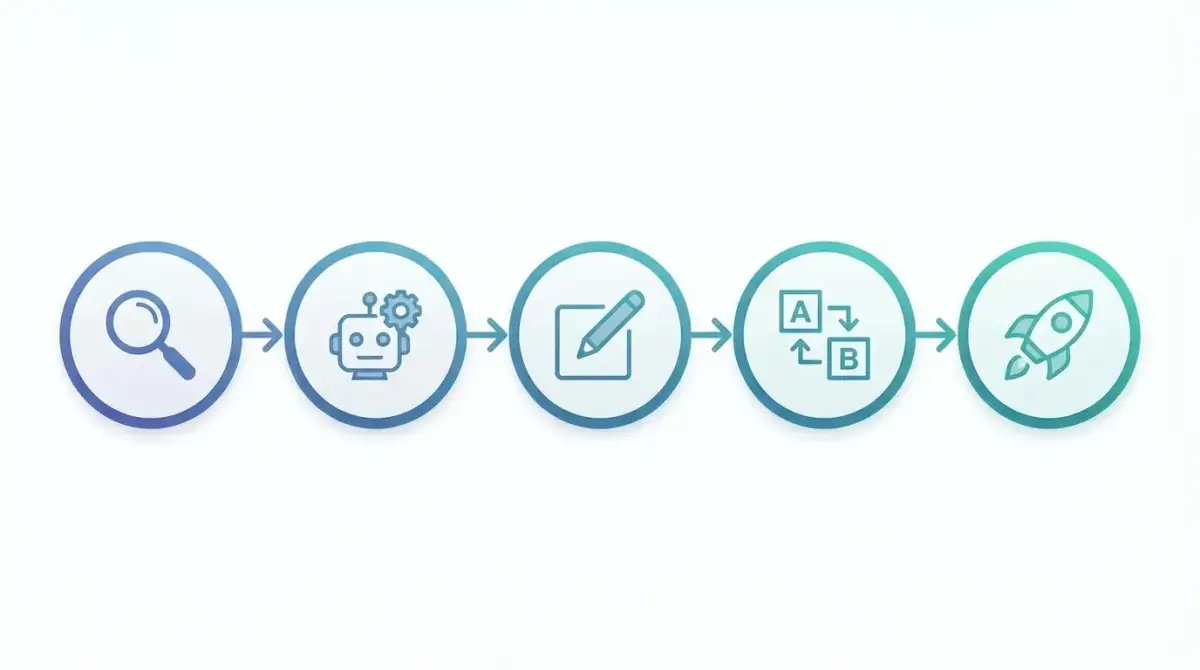 The complete AI-assisted ad copywriting workflow from research to testing
Combining Spy Data with AI: Competitor-Informed Copy
This is where AI ad copywriting goes from good to exceptional. Instead of prompting AI in a vacuum, you feed it real market data.
The process:
- Use Adligator to find ads that have been running 7+ days in your vertical
- Export the Primary Text, Headline, and Description
- Include these as context in your AI prompt
- Ask the AI to analyze patterns and generate superior alternatives
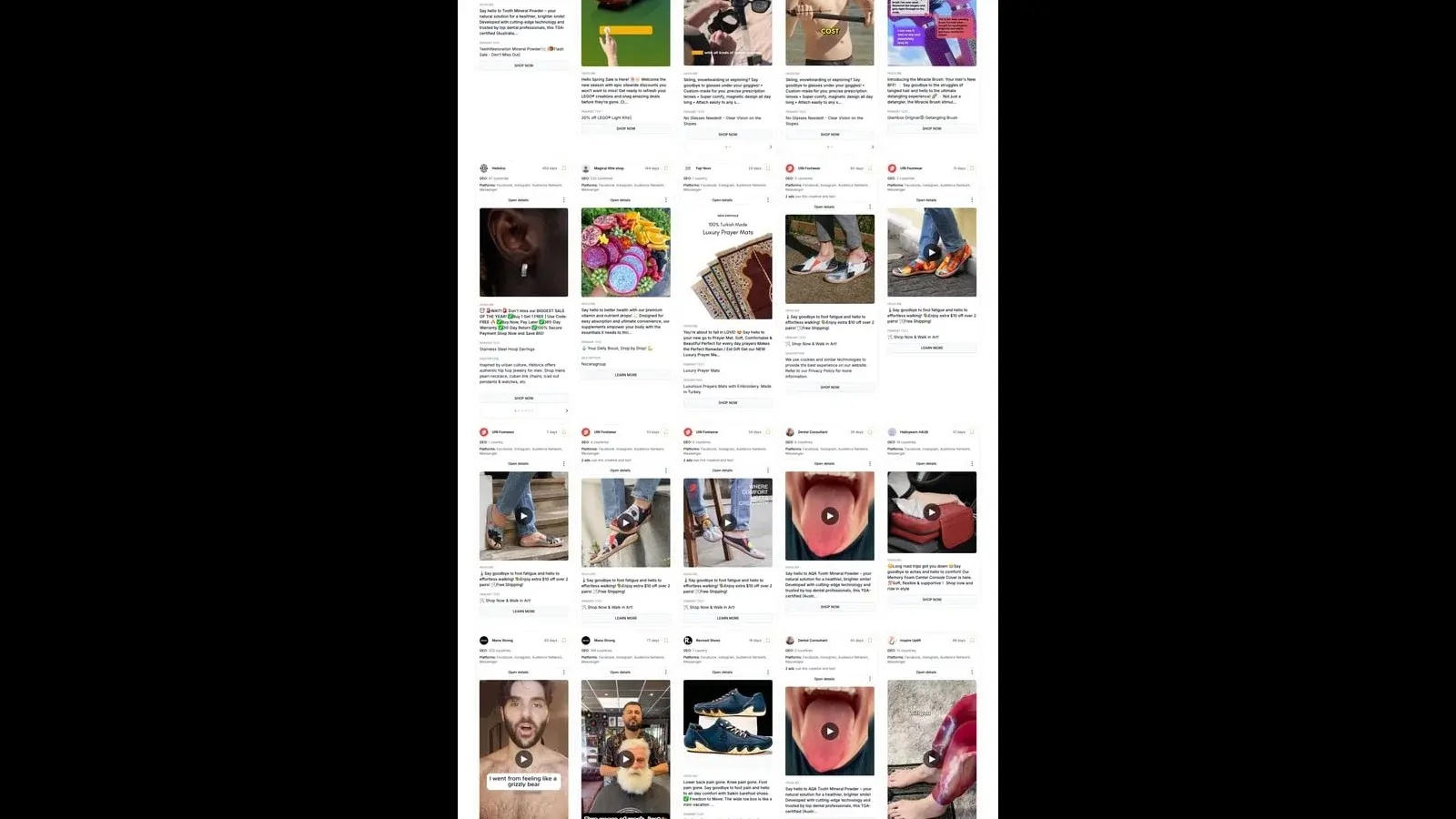 Analyzing competitor ad copy patterns in Adligator
Why this works: Long-running ads are market-validated. They've survived Meta's algorithm, audience fatigue, and budget reviews. When your AI understands what's already working, it produces copy that's competitive from day one rather than starting from scratch.
What to Look For in Competitor Copy
When analyzing competitor ads through Adligator, focus on these specific elements:
- Hook patterns. How do top performers start their Primary Text? Question, statistic, bold claim, story, or direct address?
- Proof elements. Do winning ads use numbers, testimonials, authority badges, or social proof?
- CTA language. Soft CTAs ("Learn more") vs hard CTAs ("Buy now") vs curiosity CTAs ("See how it works") — what dominates in your vertical?
- Text length. Do winners tend to be short (under 125 chars, no "See more") or long (full story format)?
- Emotional angle. Fear of missing out, aspiration, pain avoidance, or practical benefit — which emotional lever appears most in long-running ads?
Document these patterns before building your AI prompts. The more specific your competitive insights, the better your AI output will be.
Feed real competitor ad data into your AI prompts — research with Adligator free
Quality Control: How to Edit and Validate AI-Generated Copy
Without quality control, AI produces generic and sometimes dangerous content. One overclaim can get your ad rejected or your account restricted.
Pre-Launch Checklist
- Hook verified. Does the first sentence actually stop the scroll?
- No overclaims. AI loves "guaranteed results" and "best in the world" — both violate Meta policy.
- Facts checked. If AI mentions numbers, verify them.
- CTA is clear. Does the user know exactly what to do next?
- Length optimized. Primary Text: under 125 chars visible without "See more," under 300 total.
- Tone matches audience. B2B and B2C need different styles.
- No prohibited content. Health claims, financial promises, before/after — check Meta Advertising Standards.
- Uniqueness. The text doesn't copy a competitor word-for-word.
Common AI Output Problems and Fixes
| Problem | Example | Fix |
|---|---|---|
| Generic opening | "In today's world..." | Require specific hook in prompt |
| Overclaim | "Guaranteed to increase sales 300%" | Explicitly ban guarantees in prompt |
| Bland tone | "Our solution helps you achieve" | Specify a persona and style |
| Run-on sentences | 3-line sentences | Set character limits per sentence |
| Clichés | "Don't miss out," "Unique opportunity" | Add a banned phrases list |
A/B Testing AI Copy vs Human Copy: What the Data Shows
Does AI-generated copy actually outperform human-written copy? The answer depends on your testing rigor.
Test Structure
- Control: 5 texts written by a human copywriter
- Test: 5 texts generated by AI and edited by a human
- Same conditions: identical visual, audience, budget, timing
- Metrics: CTR, CPC, conversion rate, ROAS
- Minimum duration: 7 days or 10,000+ impressions per variant
What the Data Shows
Based on multiple tests from performance agencies in 2025-2026:
- CTR: AI texts often show +10-25% higher CTR due to greater hook diversity
- CPC: Virtually no difference when CTR is equal — Meta's algorithm prices on quality, not source
- Conversion rate: Human copy often wins by 5-10% due to better audience intuition
- Total ROI: AI wins on aggregate ROI through speed and volume — 40 variants/day vs 5 manually
- Creative fatigue: AI-powered teams refresh copy 3-5x more frequently, reducing ad fatigue
The winning formula: AI generates → Human selects and edits → A/B test picks the winner → Winning copy feeds back into future prompts.
How to Structure Your A/B Tests
Don't test everything at once. Use a systematic approach:
Week 1-2: Test hooks. Keep the offer and CTA identical, change only the opening line across 5 variants. This isolates the single highest-impact element — what stops the scroll.
Week 3-4: Test frameworks. Take the winning hook and pair it with different body structures: PAS, AIDA, social proof-first, story-driven, data-driven. This reveals which persuasion logic resonates with your specific audience.
Week 5-6: Test CTAs. Take the winning hook + body and swap only the call-to-action. "Start free trial" vs "See pricing" vs "Get your report" can produce dramatically different conversion rates with identical everything else.
Ongoing: Refresh and iterate. Use your winning library as few-shot examples, generate new batches weekly, retire fatigued copy before performance drops below your threshold.
AI for Multilingual Ad Copy and Localization
For teams running ads across multiple GEOs, a facebook ad copy generator powered by AI becomes even more valuable for multilingual adaptation. One winning English text can be adapted to 5 languages in under 10 minutes, producing 25 variants for testing.
Localization Prompt
Here's an ad text in English:
[text]

Adapt (NOT literally translate) to:
1. Spanish (Latin America) — warm, emotional
2. German — professional, specific
3. Portuguese (Brazil) — casual, friendly

For each language:
- Adapt cultural context
- Use local idioms where appropriate
- Preserve offer meaning and CTA
- Length: under 300 characters
Critical Localization Rules
- Don't translate — localize. Word-for-word translation kills conversion. Humor, metaphors, and idioms don't transfer.
- Validate with native speakers. Or at minimum, use a second AI pass with the prompt "find errors and unnatural phrases."
- Account for length variation. German text runs 20-30% longer than English. Spanish 15-20%. Plan your ad real estate accordingly.
- Currency and number formatting. $19.99 (US) vs 19,99 € (Europe) vs R$99,90 (Brazil).
- Seasonal relevance. Adapt holiday references: Black Friday (US), Singles Day (China), back-to-school (September vs February in Southern Hemisphere).
Common AI Copywriting Mistakes That Kill Conversions
Avoid these traps — each costs time, money, or account health:
- Context-free prompts. "Write an ad for my product" → generic output. Minimum 100 words of context in every prompt.
- No editing pass. Pasting AI output directly into Ads Manager = rejected ads and low CTR. Every text goes through a human. No exceptions.
- Same prompt on repeat. AI will produce similar results each time. Rotate frameworks (PAS → AIDA → BAB), change styles, use different angles.
- Ignoring competitive data. AI without market context generates copy in a vacuum. Use Adligator to collect real competitor texts as input.
- Volume over quality. 100 bad variants are worse than 10 good ones. Dial in the prompt on 5-10 variants first, then scale.
- Overclaims and policy violations. AI doesn't know Meta's rules. Add an explicit banned-claims list to your prompts.
- Missing character limits. Facebook shows the first 125 characters of Primary Text before "See more." If your hook exceeds that, nobody sees it.
- No storage system. Generated 50 variants, tested, found 3 winners — then lost them in ChatGPT history. Keep a winning copy database in Sheets or Notion.
Scaling Creative Production with AI
Once the process is proven, it's time to scale. Here's how top performance teams move from artisanal copy production to systematic creative operations.
API Automation
For teams managing 10+ campaigns simultaneously, manually chatting with ChatGPT becomes the bottleneck it was supposed to eliminate:
- Build a pipeline: Adligator (data collection) → Python script with OpenAI/Anthropic API (generation) → Google Sheets (team review) → Ads Manager (Bulk Import upload).
- Batch generation: Send 10-20 parallel requests through the API. Cost: ~$0.01-0.05 per variation set — orders of magnitude cheaper than human copywriting.
- Template prompts: Create JSON templates with variable substitution (product, audience, offer, language, format). One template serves hundreds of campaigns.
- Auto-scoring: Use a second AI call to rate generated texts before human review. This pre-filters the 20% of output that's clearly subpar.
- Scheduled generation: Set up daily or weekly automated runs that produce fresh copy batches, ready for review each morning.
Process Optimization
- Build a prompt library organized by format (Primary Text, Headline, Description, Carousel), framework (PAS, AIDA, BAB), audience temperature (cold, warm, hot), and tone (professional, casual, urgent)
- Track results systematically: which prompts yield the best CTR, which frameworks convert in your specific niche, which hooks get the highest scroll-stop rate
- Update prompts monthly based on A/B test data and fresh competitive insights from Adligator — the market moves fast and your prompts should move with it
- Maintain a winning copy database as few-shot examples for future prompts — this is your most valuable asset and significantly boosts generation quality over time
- Document anti-patterns — which phrases Meta rejects, which texts showed worst CTR, which tones alienate your specific audience
ROI Calculation for AI Copywriting
To determine if AI copywriting pays off for your team, use this simple formula:
Savings = (Copywriter hours/month × Hourly rate) − (AI tool cost + Editor hours × Hourly rate)
Example: A copywriter spent 40 hours/month × $40/hour = $1,600. With AI: $20 (ChatGPT Plus) + 10 hours editing × $40 = $420. Monthly savings: $1,180 at equal or greater output volume. Over a year, that's $14,160 reinvested into ad spend or other creative efforts.
FAQ
Can AI write Facebook ad copy that actually converts?
Yes. ChatGPT, Claude, and specialized tools generate effective ad copy when given proper prompts with audience context, offer details, and competitive insights. The key is human editing and A/B testing — AI handles the volume, humans ensure quality. Teams using this approach typically see 3-5x more creative variants tested per month.
What's the best AI tool for writing Facebook ads?
ChatGPT (GPT-4) and Claude are the most versatile for general ad copywriting. Jasper and Copy.ai offer pre-built ad templates that speed up initial setup. For most media buyers, ChatGPT Plus at $20/month is the optimal starting point. Scale to API access when volume justifies it.
How do I make AI-generated ad copy unique and not generic?
Use competitor ad data (from tools like Adligator) as context input, provide detailed audience descriptions in prompts, request multiple copywriting frameworks (PAS, AIDA, BAB), and always edit the final output manually. The more specific your prompt context, the more unique the output.
Conclusion
AI facebook ad copy isn't a magic button — it's a force multiplier that increases copywriting throughput 5-10x when implemented correctly. The key is high-quality prompts, competitive data as context, and a systematic workflow: gather competitor intelligence → generate variations → edit and validate → test → optimize.
Start with the ready-to-use prompts in this guide. Collect competitor ad texts through Adligator, feed them into ChatGPT as context, and generate variations grounded in real market data rather than AI imagination.
Ready to feed real competitor data into your AI copywriting workflow? Try Adligator free
Related Reading
- How to Write High-Converting Facebook Ad Copy Using Competitor Spy Data: A Copywriting Framework for Media Buyers
- How to A/B Test Facebook Ad Creatives: A Beginner Guide to Statistical Confidence and Faster Winners
- How to Use Ad Spy Tools for Affiliate Marketing: Find Winning Facebook Offers Before Your Competition
- How to Use Ad Spy Tools for eCommerce: Find Winning Products and Scale Facebook Campaigns Faster
