
AI-Generated Ad Creatives on Facebook in 2026: How to Identify, Analyze, and Outperform Them Using Spy Tools
If you've been running Facebook ads for more than a few months, you've noticed the shift. Feeds are flooded with polished, almost-too-perfect creatives that look like they rolled off an AI assembly line. Because they did.
In 2026, AI-generated ad creatives are no longer an experiment — they're the default for a growing number of advertisers. Tools like Midjourney, DALL-E, Flux, and Meta's own Advantage+ creative suite have made it trivially easy to produce dozens of ad variations in minutes.
For media buyers, this creates both a problem and an opportunity. The problem: more noise, faster creative fatigue, and rising CPMs in saturated niches. The opportunity: AI-generated creatives follow predictable patterns, and spy tools reveal exactly what those patterns are. This guide shows you how to spot AI creatives, analyze their performance signals, and build strategies to outperform them.
The AI Creative Explosion: What Changed in 2025-2026
The shift from "some advertisers use AI" to "AI is the baseline" happened faster than most predicted. Several factors converged:
- Meta's Advantage+ Creative. Meta now auto-generates creative variations for advertisers who opt in, including AI backgrounds, text overlays, and format adaptations. This means even advertisers who didn't choose AI are running AI creatives.
- Cost of human creative production. A single professional ad shoot costs $2,000-10,000+. An AI tool generates 50 variations for $20/month. The math is obvious.
- Testing velocity. AI enables testing 10-20x more creative variants in the same timeframe. Performance marketers optimizing for speed adopted AI first.
- Quality parity. For straightforward product imagery (e-commerce, apps), AI-generated visuals are now visually competitive with photography.
The result: in categories like dropshipping, supplements, and mobile apps, AI creatives now make up an estimated 40-60% of active ads. In more brand-conscious verticals (luxury, automotive, financial services), the ratio is lower but growing.
How to Identify AI-Generated Creatives in the Wild
There's no single giveaway that marks a creative as AI-generated, but a combination of signals makes the pattern clear. Here's what to look for when analyzing competitors through spy tools:
Visual Tells
- Uncanny smoothness. AI images often have an unnatural level of polish — skin looks plastic, products lack realistic imperfections, lighting is too even.
- Detail inconsistencies. Look closely at hands, text on products, background elements. AI still struggles with these. Warped fingers, nonsensical text, and blurred secondary objects are red flags.
- Style uniformity. When an advertiser runs 20+ creatives that all share the same visual "feel" despite showing different products or scenarios, that's likely a single AI model's output.
- Generic compositions. AI tends toward safe, centered compositions. Real photography has more variety in framing, angles, and intentional imperfections.
Behavioral Tells (via Spy Tools)
- High volume from a single page. An advertiser running 50+ active creatives simultaneously almost certainly uses AI for generation or variation.
- Rapid iteration. New creatives appearing every 1-2 days from the same page suggests automated production.
- Short lifespan clustering. AI-heavy advertisers often have many creatives with 2-5 day lifespans — they test fast and kill fast.
- Identical copy patterns. The same headline structure repeated across dozens of creatives with only the visual changed.
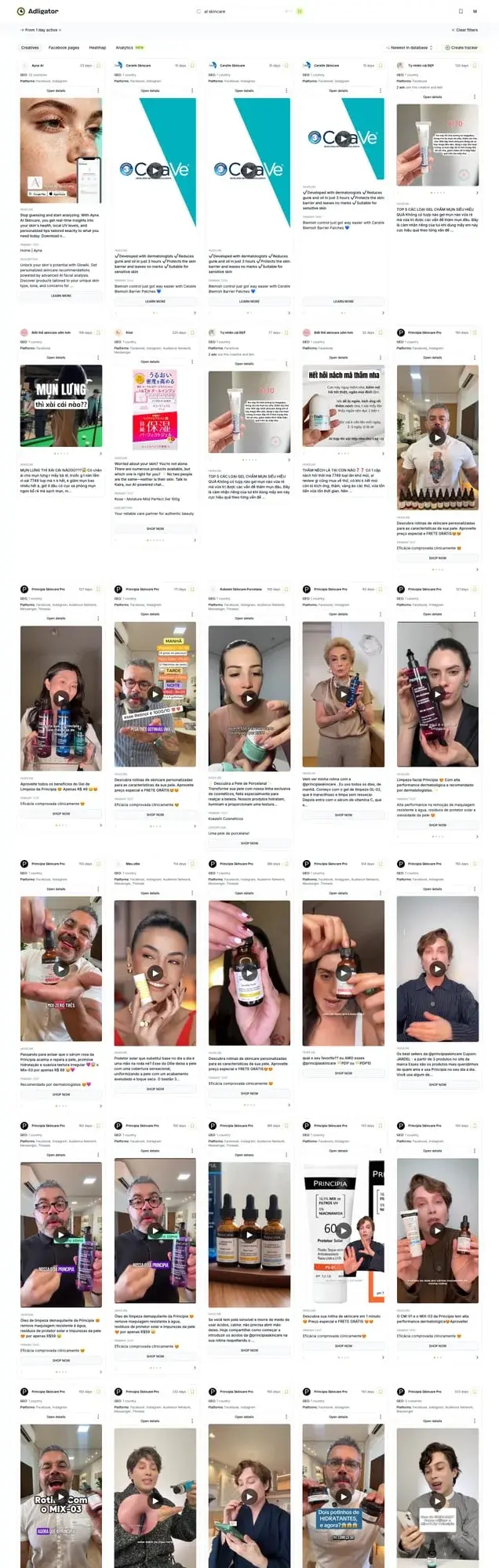 High-volume creative output from a single advertiser — a common AI-generated pattern visible in spy tools
Using Adligator to Spot AI Patterns
While no spy tool has an explicit "AI filter," Adligator's features make pattern detection practical:
- Search by Facebook page ID of a suspected AI-heavy competitor.
- Sort by "Newest in database" to see their creative velocity.
- Check the ad count — "X ads use this creative and text" reveals duplication patterns.
- Filter by Days Active — AI creatives with < 5 days active are likely failed tests. Those surviving 14+ days are worth studying.
AI vs Human Creatives: What Spy Data Reveals
Analyzing thousands of creatives through spy tools reveals clear performance pattern differences between AI-generated and human-crafted ads.
AI Creative Strengths
- Volume advantage. AI advertisers can test 5-10x more variations, increasing their odds of finding a winner through brute force.
- Speed to market. Trending topics can be turned into creatives in hours, not days.
- Cost efficiency. Per-creative production cost approaches zero, allowing unlimited experimentation.
- Format flexibility. AI can generate image, carousel, and even video variations from a single brief.
AI Creative Weaknesses
- Creative fatigue acceleration. Similar-looking AI creatives saturate audiences faster. When everyone uses the same tools, outputs converge.
- Authenticity gap. In niches where trust matters (health, finance, education), AI creatives often feel generic and fail to build credibility.
- Shorter winner lifespan. Spy data shows AI creatives that become "winners" tend to burn out faster (7-14 days) vs human creatives (14-30+ days) in the same niche.
- Copy-visual mismatch. AI-generated visuals paired with human-written copy can create subtle dissonance that reduces CTR.
 Key differences between AI-generated and human-crafted ad creatives based on spy data analysis
The Hybrid Advantage
The most effective advertisers in 2026 aren't purely AI or purely human — they're hybrid. Spy data shows that advertisers combining:
- AI for volume testing and variation generation
- Human creative direction for winning concepts
- Real photography/video for hero creatives
...consistently maintain longer-running creatives and appear to sustain better performance over time.
Want to see which creatives last longest in your niche? Try Adligator Free — filter by Days Active to find proven winners.
Analyzing AI Creative Performance Through Spy Signals
Since spy tools don't show direct performance metrics (CTR, ROAS), you need to read indirect signals. Here's a framework for evaluating AI creatives:
The Longevity Test
The single most reliable signal. If an AI-generated creative runs for 14+ days, it's performing. Period. No rational media buyer keeps a losing creative active that long.
How to check in Adligator:
- Filter by competitor's Facebook page ID
- Set Days Active minimum to 14
- Compare the surviving creatives against their full catalog — what's different about the winners?
The Duplication Signal
When you see "X ads use this creative and text" with a high number, it means the advertiser is scaling that creative across multiple ad sets. This is a strong positive signal.
The GEO Expansion Pattern
Winning creatives get expanded to new GEOs. If you see the same creative appearing in additional countries over time, that's confirmation of performance.
The Iteration Pattern
Watch for sequential improvements to the same concept. If an advertiser launches a creative, then 3-5 days later launches a very similar one with subtle changes (different CTA button, adjusted headline, modified background), they're iterating on a proven concept. The latest version is usually the best performer.
Building Your Counter-Strategy
Understanding AI creative patterns gives you a strategic edge. Here's a practical workflow for outperforming AI-heavy competitors:
Step 1: Map the AI Landscape in Your Niche
Use Adligator to:
- Search your primary keywords
- Identify the top 10 advertisers by creative volume
- Classify each as likely "AI-heavy" (50+ creatives, rapid iteration) or "human-led" (fewer, longer-running creatives)
- Note which approach correlates with longer creative lifespans
Step 2: Find the Authenticity Gaps
AI creatives tend to cluster around similar visual styles. Look for what's missing:
- Real people (user-generated content style)
- Behind-the-scenes footage
- Imperfect, authentic imagery
- Specific, detailed copy that couldn't be generic
These gaps are your opportunity. When every competitor's ads look the same, being different is the strategy.
Step 3: Study the AI Winners
Not all AI creatives fail. The ones that survive 14+ days in competitive niches are worth reverse-engineering:
- What visual style did they use?
- What messaging angle?
- What CTA button type?
- What format (image, video, carousel)?
Step 4: Build a Hybrid Creative Pipeline
Combine AI efficiency with human strategy:
- Use spy data to identify winning concepts and angles (Adligator)
- Generate initial variations with AI tools (Midjourney, DALL-E)
- Apply human creative direction — refine the best AI outputs with real product shots, genuine testimonials, brand-specific elements
- Test at volume but track longevity, not just initial CTR
- Double down on winners with higher production value versions
 A practical workflow for outperforming AI-heavy competitors
Step 5: Monitor and Adapt Weekly
The AI creative landscape changes fast. Set up a weekly check:
- Are new AI-heavy competitors entering your niche?
- Are existing competitors shifting from AI to human (or vice versa)?
- What new creative patterns are emerging?
- Which of your creatives are outlasting the competition?
Common Mistakes When Competing Against AI Creatives
Mistake 1: Trying to Out-Volume AI
You can't beat AI at its own game. If a competitor generates 100 creatives per week with AI, don't try to match that manually. Instead, focus on creative quality and longevity.
Mistake 2: Ignoring AI Entirely
The opposite extreme is equally dangerous. Pretending AI creatives don't exist means missing competitive intelligence. Even if you don't use AI to generate, you should use spy tools to analyze AI competitors.
Mistake 3: Copying AI Aesthetic
If you see a winning AI creative and recreate it with the same AI style, you're just adding to the noise. The strategic move is to study what makes it work (angle, offer, CTA) and express that through a different, more authentic visual approach.
Mistake 4: Overreacting to Short-Term Trends
AI creative trends move fast. A visual style that dominates for two weeks might burn out completely. Use spy tool longevity data to distinguish lasting trends from temporary spikes.
Mistake 5: Neglecting Copy Quality
AI visual generation has improved dramatically, but AI copy still reads generic to trained eyes. Superior copywriting — specific, benefit-driven, voice-consistent — remains a durable competitive advantage.
FAQ
How can you tell if a Facebook ad creative is AI-generated?
Look for telltale signs: hyper-polished visuals with uncanny smoothness, inconsistent small details (hands, text, backgrounds), repetitive style patterns across multiple ads from the same page, and unusually high creative volume from a single advertiser. No single sign is definitive — it's the combination that reveals the pattern.
Do AI-generated ad creatives perform better than human-made ones?
It depends on the niche. AI creatives often win on volume and testing speed but tend to have shorter lifespans. Spy tool data shows human-crafted creatives in complex niches (finance, SaaS) often outperform AI on longevity metrics. The best performers in most niches use a hybrid approach.
Can spy tools filter specifically for AI-generated creatives?
No spy tool currently has an explicit "AI-generated" filter. However, you can identify AI patterns by analyzing creative volume per advertiser, visual style consistency, and lifespan data. In Adligator, filtering by Facebook page ID and sorting by newest reveals creative velocity patterns that correlate strongly with AI usage.
Conclusion
AI-generated ad creatives have fundamentally changed the Facebook advertising landscape in 2026. They've lowered the floor for creative production while simultaneously raising the noise level across every niche.
For media buyers, the winning strategy isn't to fight AI or blindly adopt it — it's to understand it. Spy tools give you the data to see exactly which AI creatives work, which fail, and where the gaps are.
The advertisers who thrive in this environment are those who combine AI efficiency with human insight: using spy data to map the competitive landscape, AI tools for volume testing, and human creativity for the winning concepts that outlast everything else.
Ready to analyze AI creatives in your niche? Try Adligator Free — 5 searches per day, no credit card required.
Related Reading
- Facebook Video Ad Spy: How to Analyze Competitor Video Creatives and Extract Winning Hooks
- How to Estimate Competitor Facebook Ad Spend Using Spy Tools and Ad Library Data
- Facebook Ad Format Analysis: What Spy Tools Reveal About Carousel vs Video vs Static Performance in 2026
- How to Localize Facebook Ad Creatives for Different GEOs: A Media Buyer's Playbook
