
How to Analyze Facebook Ad Creatives by GEO and Vertical: A Data-Driven Approach for Media Buyers
The fastest way to burn budget when scaling internationally is assuming your home-market creatives will work everywhere. They won't. Facebook ad creative analysis by country reveals that what converts in the US often falls flat in Germany, Southeast Asia, or Brazil — not because of language, but because of fundamentally different creative preferences, buying behaviors, and competitive landscapes.
Media buyers who analyze ad creatives by GEO before expanding make better localization decisions, launch with higher-performing creative, and avoid the expensive learning phase of testing blind in unfamiliar markets. This guide shows you exactly how to do it: systematically analyzing competitor creative patterns by country and vertical using ad intelligence tools.
Why GEO-Level Creative Analysis Matters for Scaling
When you scale a campaign to a new country, everything changes — not just the language.
Creative preferences vary by culture. UGC-style ads dominate the US and UK markets. Polished, aspirational creative performs better in parts of Asia and the Middle East. Direct-response, discount-heavy ads work in price-sensitive markets like Southeast Asia and LATAM. These aren't stereotypes — they're observable patterns in the data.
Competitive density differs by market. A skincare niche might have 200 active advertisers in the US but only 15 in Poland. Lower competition means different creative strategies: you don't need to be as differentiated when you're one of 15 versus one of 200.
Format performance shifts by GEO. Video ads may crush it in Brazil but underperform against static images in Japan. Carousel ads might dominate in e-commerce verticals in Germany but rarely appear in the same vertical in India. These patterns aren't intuitive — you need data.
Vertical-specific patterns compound GEO differences. A gambling ad that works in Tier 1 English-speaking countries will look completely different from one targeting Eastern Europe. The offer structure, visual style, and compliance requirements all shift.
The bottom line: GEO expansion without creative analysis is guesswork with a budget attached. A systematic approach to Facebook ad creative analysis by country turns that guesswork into informed decisions.
The Manual Way: Meta Ad Library Country Filters
The Meta Ad Library does let you filter by country. Here's what you can do and what you can't.
What the Ad Library offers:
- Filter active ads by a single country at a time
- See current ads from specific advertisers
- Basic category filtering (social issues, elections, or all ads)
What it doesn't offer:
- No cross-country comparison (you can't view US and Germany side by side)
- No historical data (only currently active ads)
- No format, CTA, or language filtering within results
- No longevity data (you can't see how long ads have run)
- No trend detection over time
- No vertical or niche filtering
The manual workflow looks like this:
- Open Ad Library, select Country A, search for a competitor
- Screenshot or note the creative patterns
- Change to Country B, search for the same competitor
- Try to mentally compare patterns across countries
- Repeat for every competitor in every target GEO
This becomes unworkable beyond 2-3 countries and 3-4 competitors. You're comparing screenshots from different sessions, trying to spot patterns with no structured framework. There's no way to filter by ad format, CTA type, or longevity — all of which are critical for creative analysis.
For a quick sanity check on a single competitor in a single country, the Ad Library works. For systematic GEO-level creative analysis across verticals, you need better tooling.
What You Can Learn from GEO-Specific Ad Patterns
Before diving into the how, let's clarify what you're looking for. GEO-specific creative analysis reveals five categories of insights:
1. Dominant creative formats Which ad formats are most common in your target GEO and vertical? Some markets skew heavily toward video, others toward static images or carousels. Knowing this before you produce creative saves time and budget.
2. Messaging patterns What hooks do competitors lead with in each GEO? Discount-first? Problem-solution? Social proof? Aspirational lifestyle? The dominant messaging approach tells you what the local audience responds to — and where the gaps are.
3. Visual style preferences UGC vs. studio-produced. Bright colors vs. muted tones. Text-heavy vs. visual-only. These preferences vary significantly by region and influence creative production decisions.
4. CTA and funnel patterns Which CTA buttons dominate in each market? "Shop Now" might be universal in e-commerce, but "Learn More" versus "Sign Up" ratios tell you about funnel preferences and buyer readiness by GEO.
5. Ad longevity benchmarks How long do winning ads typically run in each GEO? Markets with high competition have faster creative burnout. Understanding longevity norms helps you plan creative production schedules for each market.
How Ad Spy Tools Supercharge GEO Creative Research
Ad spy tools solve the fundamental limitations of manual Ad Library research by providing:
Multi-GEO filtering: Search for ads targeting specific countries, or compare ads across multiple GEOs in a single session. No more switching between Ad Library country views.
Format and CTA filtering: Narrow results to specific ad formats (video, image, carousel) or CTA types (Shop Now, Learn More, etc.) to see format preferences by market.
Longevity data: See how long ads have been running — the single most important signal for identifying winners. An ad running 20+ days in a specific GEO is likely profitable there.
Language filtering: Separate ads by the language of the ad copy, which is critical for multilingual markets where the same GEO might have ads in multiple languages.
Historical data: See ads that have stopped running, giving you trend data over time rather than just a snapshot of what's active right now.
Domain filtering: Filter by landing page domain to understand which business models are active in each GEO (e.g., .com.br domains for Brazil-focused businesses).
Try Adligator free — filter ads by 50+ countries and spot winning creative patterns in any GEO
Step-by-Step: Analyzing Creatives by Country and Vertical with Adligator
Here's the practical workflow for using Adligator to analyze Facebook ad creatives by country and vertical.
Step 1: Define your analysis parameters
- Target GEO(s): Which countries are you expanding to?
- Vertical: What niche are you in? (e-commerce, SaaS, finance, health, etc.)
- Competitors: Who's already advertising in that GEO + vertical?
- Keywords: What terms describe your product/offer in the target market?
Step 2: Run GEO-filtered searches In Adligator, use the GEO filter to select your target country. Combine with keyword search to narrow to your vertical. For example:
- Keyword: "skincare" + GEO: US → See what skincare ads look like in America
- Same keyword + GEO: DE → Compare to the German market
- Same keyword + GEO: BR → See how Brazil differs
Step 3: Apply format and CTA filters Within each GEO search, filter by:
- Display format: Check the ratio of image vs. video vs. carousel
- Button type: See which CTAs dominate (Shop Now, Learn More, etc.)
- Days active: Filter for 10+ days to see only proven performers
Step 4: Analyze the top performers For each GEO, examine the ads with the longest run times:
- What visual style do they use?
- What hook/headline approach?
- What CTA and landing page strategy?
- Are they running in multiple GEOs or just this one?
Step 5: Cross-GEO comparison Compare your findings across GEOs. Build a comparison table:
| Attribute | US | Germany | Brazil | Japan |
|---|---|---|---|---|
| Dominant format | Video (65%) | Image (55%) | Video (70%) | Image (60%) |
| Top hook style | UGC/testimonial | Product-focused | Discount/offer | Aesthetic/lifestyle |
| Primary CTA | Shop Now | Learn More | Shop Now | Learn More |
| Avg. ad lifespan | 18 days | 25 days | 12 days | 30 days |
| Competition level | Very high | Moderate | High | Low |
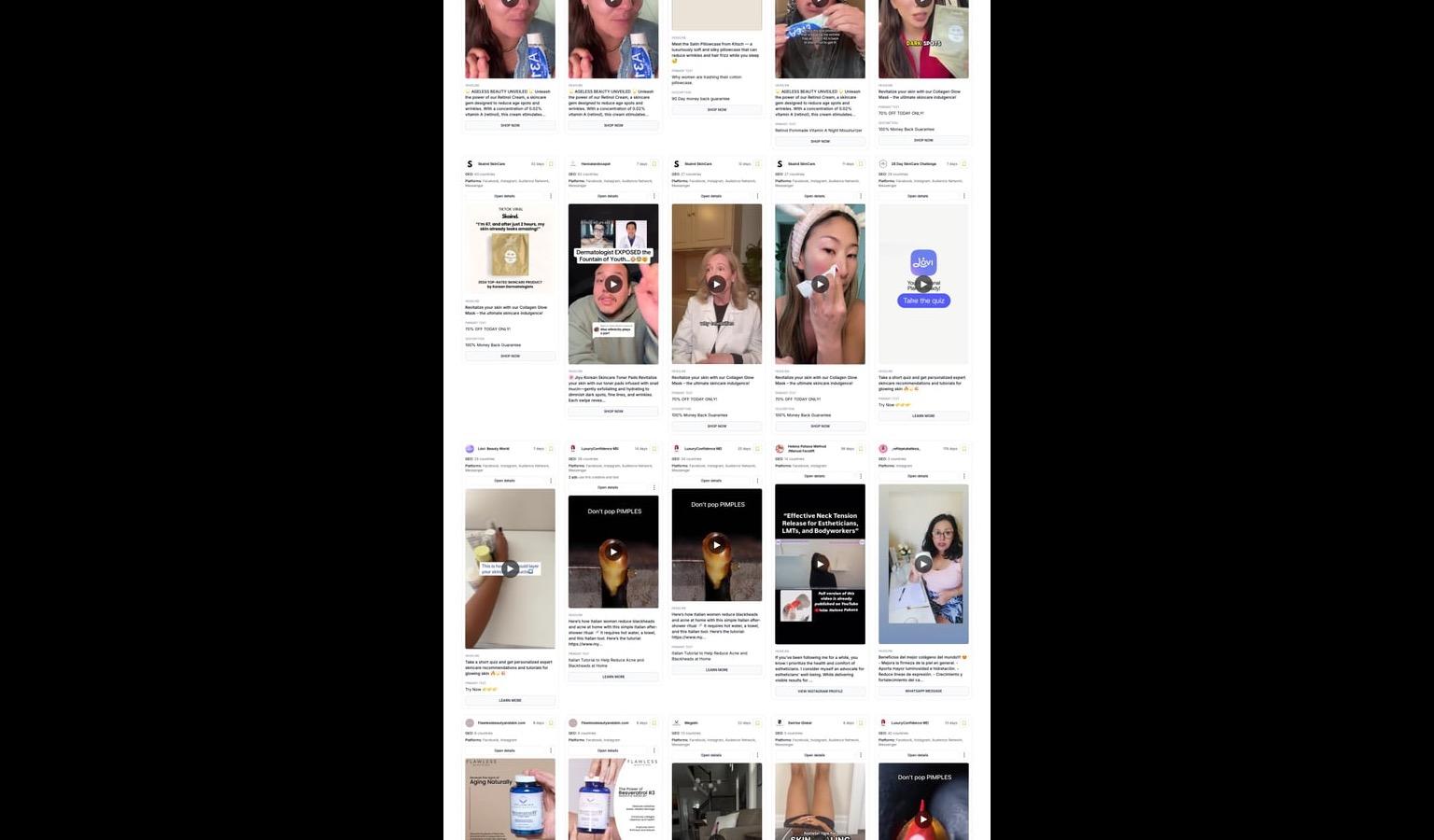 Adligator's GEO filter lets you instantly compare ad creative patterns across 234 countries.
Step 6: Document insights and plan creative production Based on your cross-GEO comparison, create a creative brief for each target market that reflects local patterns while maintaining your brand identity.
GEO Creative Analysis Framework: What to Track
Use this framework to standardize your GEO creative analysis across all markets and verticals.
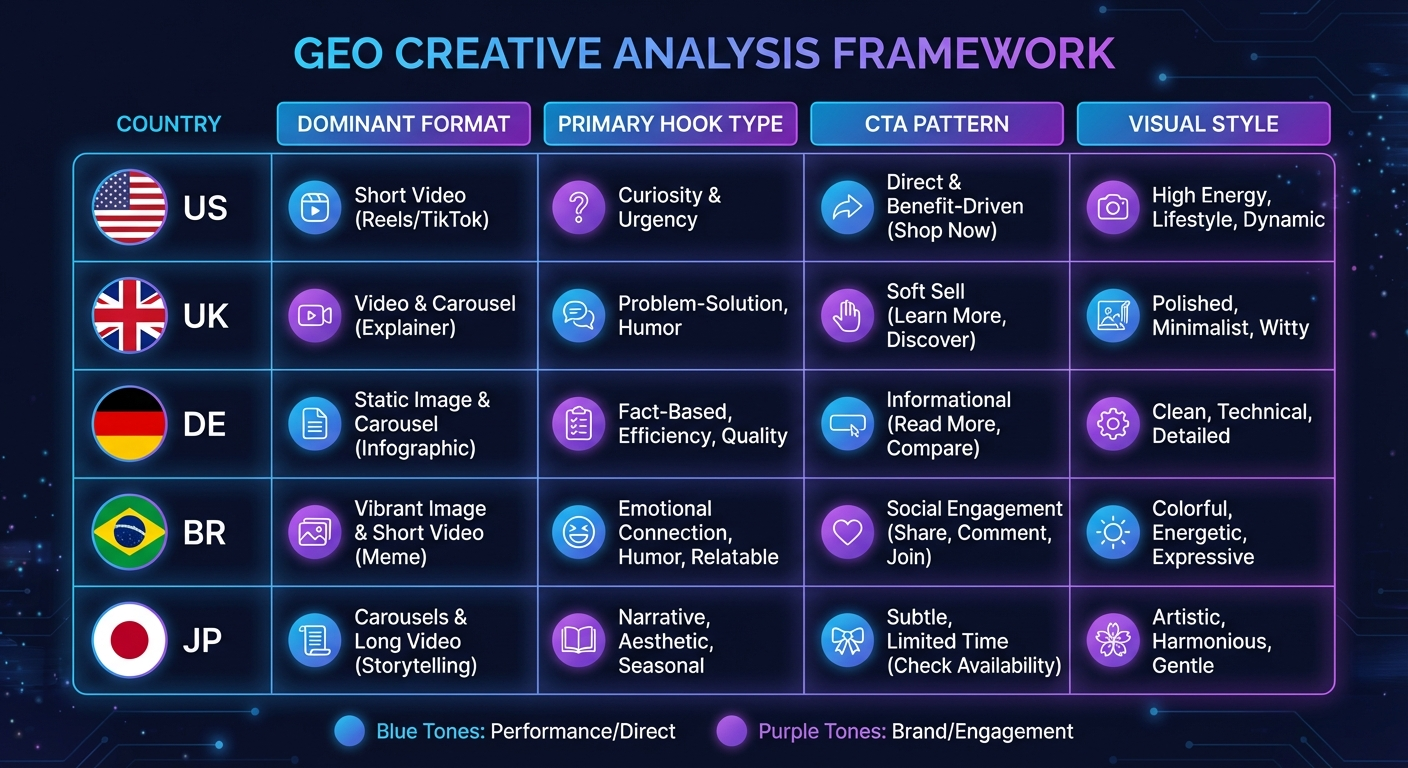 A systematic framework for tracking creative patterns across GEOs and verticals.
For each GEO + vertical combination, track:
Market structure:
- Number of active advertisers
- Top 5 advertisers by ad volume
- Market concentration (do a few players dominate or is it fragmented?)
- New entrant rate (how many new advertisers per month?)
Creative patterns:
- Format distribution (% image, video, carousel, other)
- Average ad lifespan for top performers
- Dominant visual style (UGC, studio, graphic design, text-heavy)
- Most common hook types (1st line of ad copy)
- Color and aesthetic preferences
Tactical data:
- CTA button distribution (Shop Now, Learn More, Sign Up, etc.)
- Landing page patterns (product page, lead form, app store)
- Language mix (especially in multilingual markets)
- Platform placement preferences (Facebook, Instagram, Messenger)
- OS targeting patterns (iOS vs. Android — indicates audience purchasing power)
Timing and trends:
- Average creative rotation speed
- Peak ad launch days (do advertisers cluster launches on specific days?)
- Seasonal patterns (holiday spikes, local events)
- Year-over-year trend shifts
Update frequency: Review and update your GEO analysis monthly for active expansion markets, quarterly for monitoring markets.
Common Mistakes When Scaling Creatives Across GEOs
Mistake 1: Direct translation only Translating ad copy without adapting the creative concept is the most common failure. A problem-solution hook that works in English might not resonate culturally in Japan, even with perfect translation. Always analyze local creative patterns first, then adapt your concepts — don't just translate.
Mistake 2: Ignoring format preferences If 70% of winning ads in your target GEO are video, launching with only static images means you're fighting against market preferences. Check format distribution before producing creative for a new market.
Mistake 3: Applying Tier 1 production standards to all markets High-production-value studio creative might be the standard in the US, but UGC-style content often outperforms in emerging markets where it feels more authentic. Don't over-produce for markets that prefer raw, relatable content.
Mistake 4: Testing one GEO at a time Analyzing GEOs in isolation means you miss comparative insights. Always analyze at least 2-3 GEOs simultaneously so you can identify which creative elements are universal versus GEO-specific.
Mistake 5: Skipping the competitive density check Launching into a GEO with 200+ active competitors requires very different creative than one with 20 competitors. High-competition markets need more differentiated creative; low-competition markets can succeed with proven concepts from other GEOs.
Mistake 6: Ignoring OS targeting signals In many GEOs, the iOS vs. Android split tells you about audience purchasing power. If competitors in a GEO predominantly target iOS, they're going after higher-value users. If Android dominates, the market is likely more price-sensitive. This should influence your creative messaging and offer strategy.
Building a Repeatable GEO Expansion Workflow
A repeatable workflow turns one-off research into a competitive advantage. Here's the process for every new market expansion:
Phase 1: Research (1-2 days)
- Run GEO creative analysis using the framework above
- Identify top 5 competitors in the target GEO
- Document creative patterns, format preferences, and messaging norms
- Assess competitive density and market maturity
Phase 2: Creative Planning (1 day)
- Compare target GEO patterns to your existing creative library
- Identify which existing creatives might work with localization
- Brief new creatives based on local patterns and identified gaps
- Prioritize: adapt 2-3 existing winners + create 2-3 GEO-specific creatives
Phase 3: Localization Production (2-3 days)
- Translate and culturally adapt selected existing creatives
- Produce new GEO-specific creatives based on local pattern analysis
- Ensure all CTAs, landing pages, and funnels are localized
- QA: have a native speaker review all copy and cultural references
Phase 4: Launch and Monitor (ongoing)
- Launch localized creatives in the target GEO
- Compare initial performance to GEO benchmarks from your analysis
- Monitor competitor changes weekly using saved trackers
- Update your GEO analysis monthly with new data and learnings
Scaling the workflow across multiple GEOs:
- Create a shared GEO analysis database (spreadsheet or Notion)
- Use saved search trackers for each target GEO + vertical
- Assign GEO analysis to specific team members for accountability
- Run monthly cross-GEO review meetings to share insights
The goal: every new GEO expansion starts with data, not assumptions. Over time, your GEO analysis database becomes a competitive asset that makes each subsequent expansion faster and more successful.
FAQ
Do Facebook ad creative styles really differ by country?
Significantly. Ad creative preferences vary by culture, language, purchasing behavior, and local competition. For example, UGC-style ads dominate in the US and UK, while polished studio creative performs better in parts of Asia. Discount-led messaging works in price-sensitive markets like Southeast Asia and LATAM, while value-based messaging resonates more in Western Europe. The differences become even more pronounced when you layer in vertical-specific patterns.
How many GEOs should I analyze before expanding?
At minimum, analyze 3-5 competitors in your target GEO before launching. For high-budget expansions, analyze 5-10 competitors across both the new GEO and your current GEO to understand the creative differences. The whole point is avoiding the assumption that what works at home will work everywhere. One afternoon of structured GEO analysis can save weeks of wasted ad spend.
Can I use the same ad creatives in every country?
You can test it, but performance will almost always be lower than localized creative. At minimum, translate the copy and adjust cultural references. For best results, analyze what's already working in each target GEO and create new assets that match local creative patterns while maintaining your brand identity. The data consistently shows that GEO-adapted creative outperforms direct translations by 30-60% in most verticals.
Conclusion
Facebook ad creative analysis by country is the foundation of successful international scaling. The patterns are there in the data: format preferences, messaging styles, CTA behaviors, and competitive density all vary meaningfully by GEO and vertical. Media buyers who analyze these patterns before expanding make better creative decisions, launch faster, and waste less budget on learning phases.
The framework is straightforward: analyze your target GEO's creative landscape, compare it to your current market, identify what needs to change, and produce localized creative based on data. Whether you're expanding from the US to Europe, from Europe to LATAM, or from established markets to emerging ones, the process is the same.
Start with your next planned GEO expansion. Run the analysis before you produce a single creative. The insights will change your approach.
Ready to analyze ad creatives across any GEO? Try Adligator free — filter ads by 50+ countries and spot winning creative patterns in any GEO
Analyze ad creatives across 234 countries
Related Reading
- Facebook Ad Compliance Guide for Media Buyers: How to Avoid Account Bans While Running Aggressive Creatives in 2026
- How to Write High-Converting Facebook Ad Copy Using Competitor Spy Data: A Copywriting Framework for Media Buyers
- Facebook Ad Performance Benchmarks by Vertical in 2026: CPM, CTR, and Creative Lifespan Data for Media Buyers
- How Many Ad Creatives Do You Need for Facebook Ads? A Data-Driven Framework by Budget Level (2026)
