Best Ad Spy Tools for Dropshipping: Facebook, TikTok & Instagram Compared (2026)
Finding winning products is the single hardest part of dropshipping. You can have a polished store, optimized checkout, and solid supplier — but if you're running ads for the wrong product, none of it matters. That's why the best ad spy tools for dropshipping have become essential infrastructure for serious sellers.
Ad spy tools let you see what your competitors are running, how long they've been running it, and where they're targeting. Instead of guessing which products might work, you can identify products that are already working — based on real ad performance signals like run duration and geographic spread.
This guide compares the top dropshipping spy tools across Facebook, TikTok, and Instagram. Not feature lists copied from marketing pages — actual capabilities that matter for the dropshipping product discovery workflow. You'll know exactly which tool fits your platform, budget, and business model by the end.
Why Dropshippers Need Ad Spy Tools in 2026
The dropshipping landscape in 2026 is faster and more competitive than ever. Three factors make ad spy tools more critical than before:
Product lifecycles are shorter. A winning product that could sustain 6 months of profitable sales in 2022 now saturates in 6–8 weeks. You need to discover winners earlier and move faster.
Testing costs are higher. Meta CPMs continue to rise in Tier-1 markets. Testing 20 products at $50–100 each to find one winner means $1,000–2,000 in discovery costs. If an ad spy tool helps you identify winners with a 30% higher hit rate, it pays for itself in a single testing cycle.
Creative quality requirements have increased. The Meta algorithm increasingly favors high-quality, engaging creatives. Understanding what creative formats and hooks perform for dropshipping — by analyzing what's already running — gives you a significant advantage over competitors who test blindly.
Multi-platform selling is standard. Most successful dropshippers run ads on both Meta (Facebook + Instagram) and TikTok. Each platform has different creative norms, audience behaviors, and winning product signals. You need intelligence across platforms.
The manual alternative (and why it fails):
Without spy tools, dropshippers rely on:
- Scrolling the Meta Ad Library manually — no run duration or engagement filters, so you can't distinguish tests from winners
- Browsing TikTok's Creative Center — limited filtering, heavily weighted toward brand advertisers
- Following "product research" YouTube channels — by the time a product is featured, it's already saturated
- AliExpress trending pages — lagging indicator, not leading
These methods work for beginners. They break down when you need to consistently find winners before they peak.
What to Look for in a Dropshipping Ad Spy Tool
Not every ad spy tool is built for dropshipping. Here's what matters specifically for product discovery:
Run duration filter. This is the #1 feature for dropshippers. An ad running for 14+ days is almost certainly profitable — advertisers don't keep spending on losers. If a tool doesn't let you filter by run duration, it's significantly less useful for product research.
E-commerce/landing page detection. Can the tool identify Shopify, WooCommerce, or other e-commerce platforms as the destination URL? This helps you quickly confirm whether an ad is promoting a dropshipping-style product.
Video ad support. Most winning dropshipping creatives in 2026 are video. The tool should display video ads natively and let you filter by format.
GEO filtering. Dropshipping margins vary dramatically by country. Being able to filter by specific target GEOs (or see how many countries an ad targets) helps you identify products validated across markets.
Domain/URL filtering. Filtering by domain extensions (.com, .store, .shop, .xyz) helps surface dropshipping stores specifically, since many use non-standard TLDs.
Price and search limits. Dropshippers typically do focused research sessions daily. A tool with 5–50 searches per day at an affordable price point is more practical than unlimited searches at $150/month for a solo operation.
Fresh data. For trending products, data freshness matters. A 48-hour delay in seeing new ads means missing the early adoption window.
Best Facebook Ad Spy Tools for Dropshipping
Facebook remains the primary traffic source for most dropshippers in 2026. Here are the top tools for Facebook ad intelligence:
Adligator
Best for: Deep Meta-focused research with advanced filtering
Adligator is built exclusively for the Meta ecosystem (Facebook, Instagram, Messenger, Audience Network, Threads), which means its filtering depth for Facebook ads exceeds general-purpose tools.
Why dropshippers love it:
- Days active filter — Set minimum 14 or 30 days to only see proven winners
- GEO filter with count — See how many countries target each ad; set minimum geo count to find globally-scaled products
- Domain zone filter — Filter by .com, .store, .shop, .xyz to surface dropshipping stores
- Display format filter — Isolate video ads (the dominant format for dropshipping)
- CTA button filter — Filter by "Shop Now" to focus on direct-purchase ads
- 234 countries — widest Meta coverage, important for finding products in emerging GEOs
- Live trackers — Save searches to get notified when new matching ads appear
Limitations: Meta only — no TikTok coverage. If you split spend across platforms, you'll need a second tool.
Pricing: Free (5/day) → Pro $32/mo (100/day) → Team $65/mo (300/day)
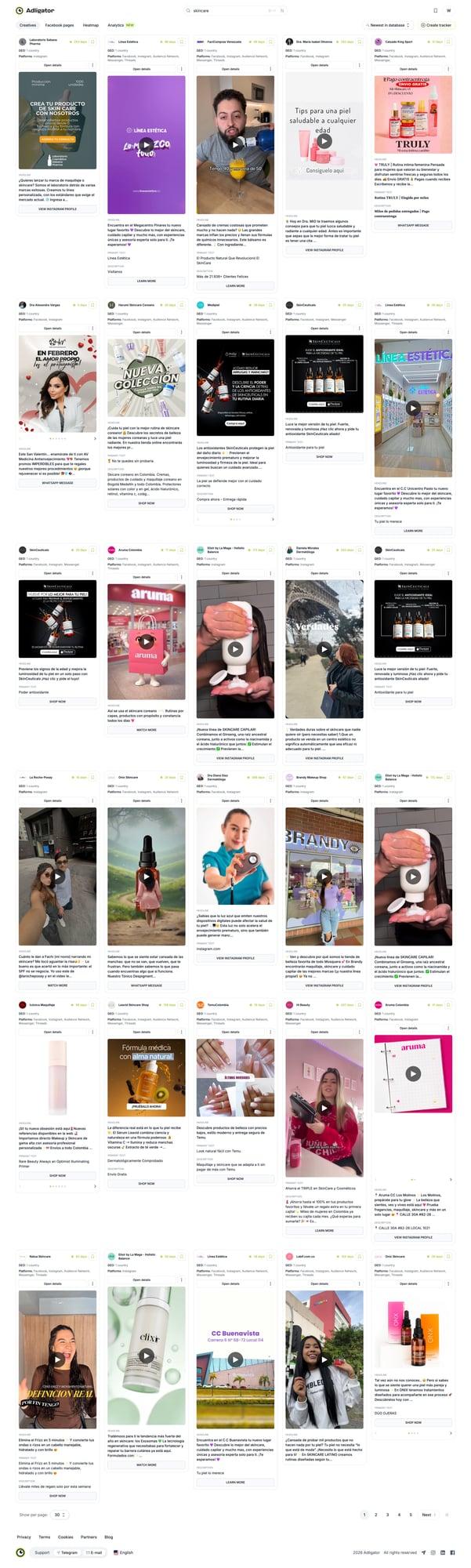 Adligator's filters surface long-running dropshipping creatives — the strongest signal of a winning product.
Dropispy
Best for: Dedicated dropshipping research on Facebook
Dropispy is built specifically for the dropshipping niche. It indexes Facebook ads and focuses on e-commerce-related creatives with Shopify store detection.
Key features:
- Shopify store detection and analysis
- E-commerce focused filters
- Ad creative download
- Landing page screenshots
- Competitor store tracking
Limitations: Facebook-only coverage. Smaller database than broader tools. Higher pricing relative to features.
Pricing: From $29/mo (basic) to $249/mo (premium)
BigSpy
Best for: Budget-conscious dropshippers who want multi-platform coverage
BigSpy covers Facebook plus 8 other platforms, making it the broadest option available.
Key features:
- 9+ platform coverage
- Large database (100M+ ads)
- Free tier available
- Creative download
- Basic e-commerce filters
Limitations: Filtering for dropshipping-specific signals is less granular. Data freshness varies. Free tier is very limited (3 searches/day).
Pricing: Free → Basic $9/mo → Pro $99/mo
AdSpy
Best for: Experienced dropshippers who need the largest Facebook ad database
AdSpy has one of the oldest and largest social ad databases, making it strong for historical research and niche-specific searches.
Key features:
- Massive historical database
- Facebook + Instagram coverage
- Engagement metrics (comments, likes, shares)
- Landing page tracking
- Advanced keyword search
Limitations: Expensive for solo dropshippers ($149/mo). No TikTok coverage. No free tier.
Pricing: $149/mo (single plan)
Best TikTok Ad Spy Tools for Dropshipping
TikTok is the second-largest ad platform for dropshippers in 2026. These tools specialize in TikTok ad intelligence:
PiPiADS
Best for: TikTok-first dropshippers and product discovery
PiPiADS is the leading TikTok ad spy tool, with strong product-level tracking and Shopify store detection.
Key features:
- Best-in-class TikTok ad database
- Product-level tracking (see trending products across advertisers)
- Shopify store detection and revenue estimates
- Daily trending products feed
- Growing Facebook coverage
Limitations: TikTok-focused — Facebook/Instagram coverage is secondary. Higher pricing. Not designed for non-e-commerce verticals.
Pricing: Starter $77/mo (TikTok) → VIP $155/mo (TikTok + FB) → Pro $263/mo (full)
Minea
Best for: Multi-platform dropshipping research with product focus
Minea covers TikTok, Facebook, Instagram, and Pinterest with a specific focus on product discovery for e-commerce.
Key features:
- Multi-platform coverage (TikTok, FB, IG, Pinterest)
- Product tracking and trend analysis
- Influencer marketing spy (see which products influencers promote)
- Chrome extension for quick research
- Shopify integration
Limitations: Jack-of-all-trades approach means less filtering depth per platform. Influencer features add cost. Database smaller than specialized tools.
Pricing: Starter $49/mo → Premium $99/mo → Business $399/mo
TikTok Creative Center (Free)
Best for: Basic TikTok trend research with zero budget
TikTok's own Creative Center shows trending ads, top products, and creative patterns — all for free.
Key features:
- Free and official
- Trending hashtags and audio
- Top-performing ads showcase
- Creative insights and benchmarks
Limitations: Heavily weighted toward brand advertisers. No filtering by run duration. No competitor tracking. No dropshipping-specific features. You'll see what's trending but have no way to quantify how long an ad has been profitable or compare it to other advertisers in the same niche.
Pricing: Free
Which TikTok Tool to Pick?
For serious TikTok dropshippers, PiPiADS is the clear leader — its product-level tracking and Shopify detection are unmatched. Minea is a good second choice if you also need Pinterest coverage. TikTok Creative Center works as a free supplement but shouldn't be your primary research tool.
The key TikTok-specific signal to watch: products where the same creative appears across 5+ different advertisers. This indicates a product with strong viral potential that multiple sellers have validated independently.
Best Instagram Ad Spy Tools for Dropshipping
Instagram sits within the Meta ecosystem but has distinct creative norms — particularly Stories, Reels, and shopping-focused formats.
Adligator (Instagram via Meta)
Since Adligator indexes the full Meta ecosystem, it covers Instagram ads with the same filtering depth as Facebook. Filter by platform to isolate Instagram-only creatives and identify format trends specific to Instagram audiences.
PowerAdSpy
PowerAdSpy covers Instagram alongside Facebook and other social platforms, with engagement data visible per ad. Useful for seeing which creatives generate the most visible social proof on Instagram.
Pricing: From $69/mo
Social Ad Scout
A smaller tool focused on Facebook and Instagram ads with basic filtering and competitive pricing. Suitable for beginners who want Instagram coverage without premium pricing.
Pricing: From $147/mo
Side-by-Side Comparison Table
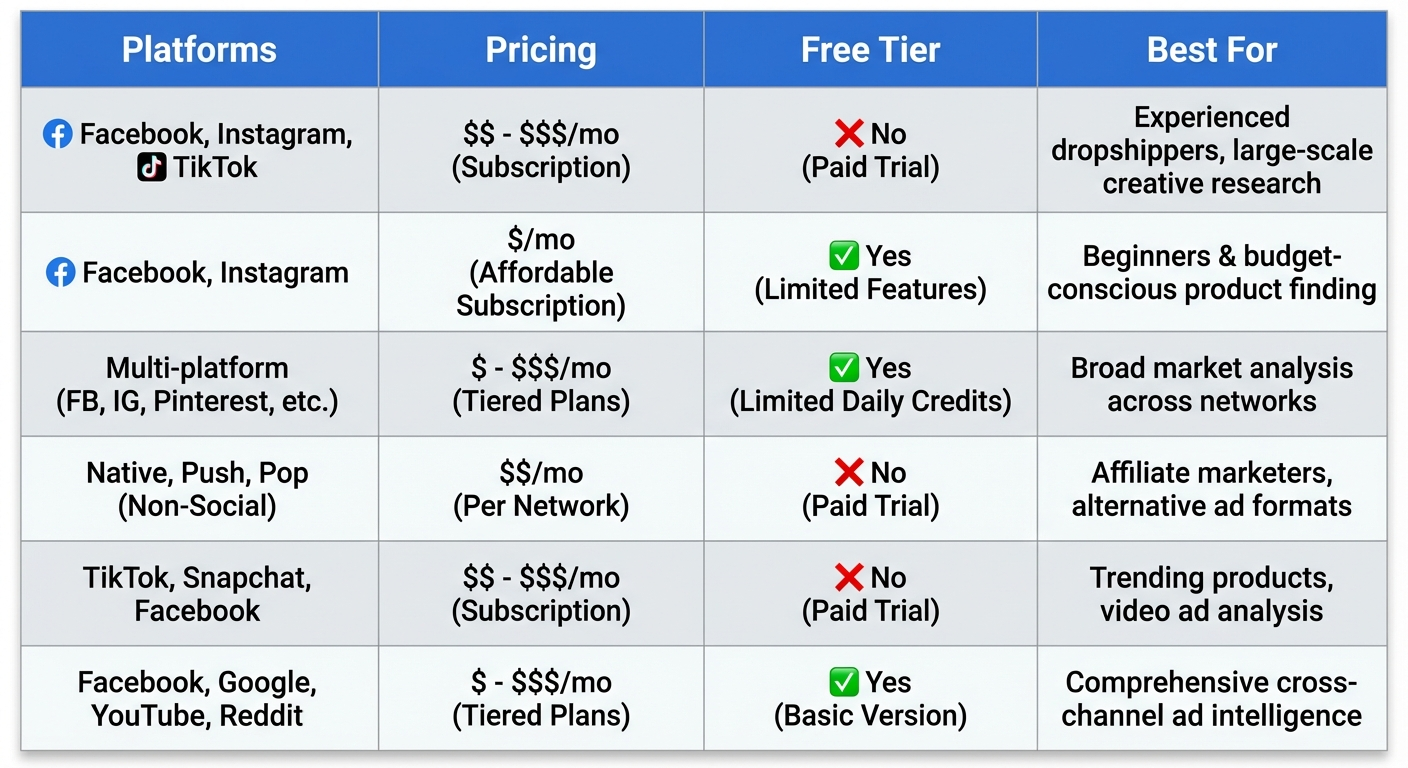 Quick comparison of the top dropshipping spy tools by platform, pricing, and key features.
| Tool | Platforms | Run Duration Filter | Shopify Detection | Free Tier | Starting Price | Best For |
|---|---|---|---|---|---|---|
| Adligator | FB, IG, Messenger, AN, Threads | Yes | Via domain filter | Yes (5/day) | $32/mo | Meta-focused research |
| Dropispy | Limited | Yes | No | $29/mo | Dedicated DS research | |
| BigSpy | 9+ platforms | Limited | No | Yes (3/day) | $9/mo | Budget multi-platform |
| AdSpy | FB, IG | Yes | Via URL filter | No | $149/mo | Largest FB database |
| PiPiADS | TikTok, FB | Yes | Yes | No | $77/mo | TikTok product discovery |
| Minea | TikTok, FB, IG, Pinterest | Limited | Yes | No | $49/mo | Multi-platform product |
Try Adligator free — find winning dropshipping creatives in under 5 minutes
How to Use Ad Spy Data to Find Winning Products
Having a spy tool is step one. Knowing how to use it for product discovery is where the money is. Here's the workflow that turns ad intelligence into validated products:
Step 1: Set Your Search Parameters
- Keyword: Search by product category (e.g., "skincare," "phone case," "posture corrector")
- Days active: Minimum 14 days (signals profitability)
- Format: Video (dominant format for dropshipping)
- CTA: Shop Now (direct purchase intent)
- GEO: Your target market or 2+ countries (signals scalability)
Step 2: Analyze the Ad Creative
For each promising result, evaluate:
- Hook: What stops the scroll? Product demo? Before/after? Unboxing?
- Value proposition: What problem does the product solve?
- Price signals: Is pricing shown? Discount structure?
- Social proof: Testimonials? Review counts? User-generated content?
Step 3: Check the Destination
Click through to the landing page:
- Is it a Shopify store? (Common dropshipping indicator)
- What's the retail price?
- How professional is the store? (Quality benchmark)
- What's the conversion mechanism? (Single product page vs. collection)
Step 4: Validate the Product
Before committing to test:
- Check AliExpress/CJ Dropshipping for the product. Calculate your margin at the ad price minus product cost minus shipping.
- Target margin: Minimum 3x markup (sell at $30+ for a $10 product cost)
- Check saturation: How many other advertisers are running ads for this exact product? If 20+ stores sell it, it may be saturated.
- Check trends: Is search interest rising or falling? Google Trends gives a quick read.
Step 5: Create Your Creative Variation
Don't copy the winning ad — adapt its structure:
- Use the same hook type but with your own footage
- Follow the same copy framework but with your brand voice
- Test the same CTA approach but with your store's URL
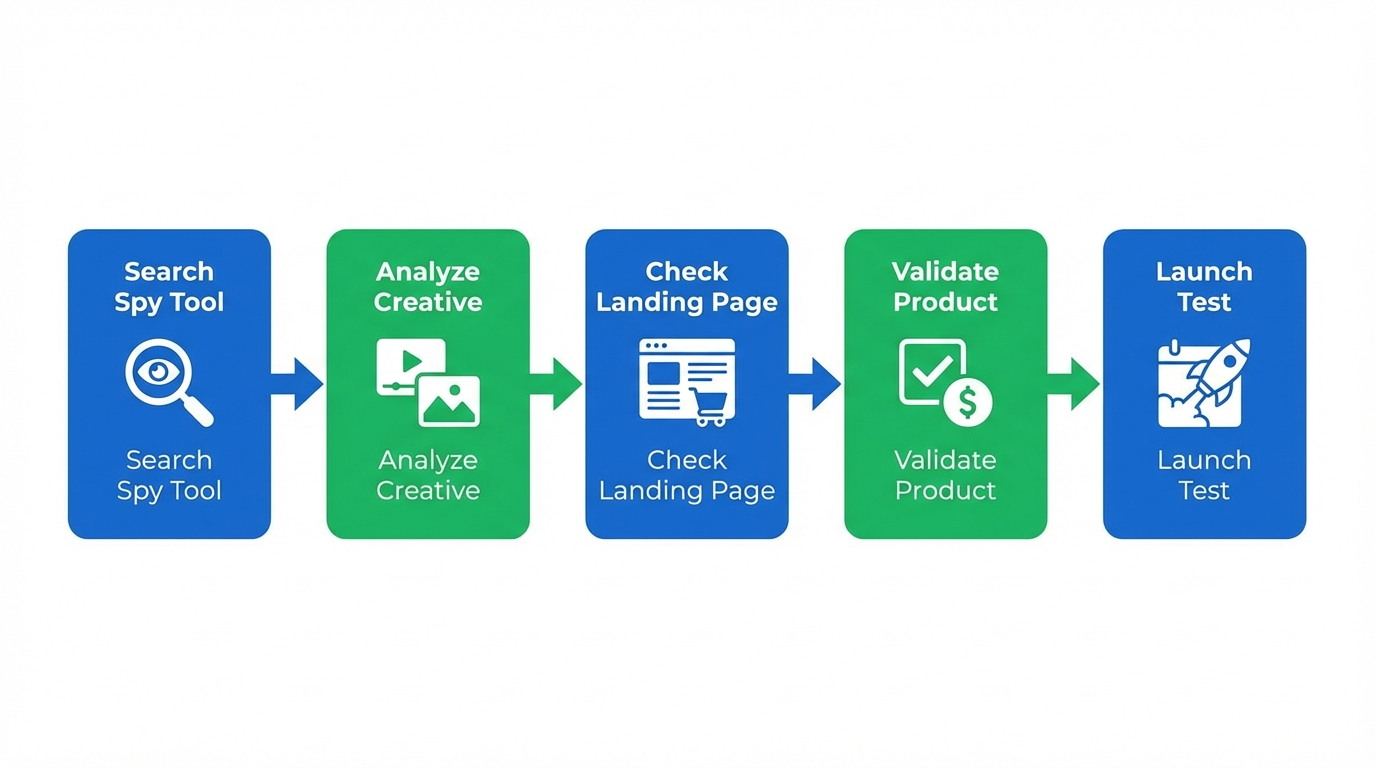 The ad-to-product validation pipeline that separates serious dropshippers from guessers.
Step 6: Scale or Kill Within 48 Hours
Once you launch your test ad:
- Day 1–2: Evaluate click-through rate (CTR) and cost per click (CPC). If CTR is below 1% on Facebook or 0.5% on TikTok, the creative isn't working — regardless of the product.
- Day 2–3: Look at add-to-cart rate. If people click but don't add to cart, the landing page or pricing isn't converting.
- Day 3–5: Evaluate purchases. If cost per purchase exceeds your break-even ROAS, kill the ad. If it's profitable, begin scaling.
The spy tool's role doesn't end at product discovery. Use it to monitor your niche during the testing phase. If a competitor suddenly scales a similar product, check their creative approach and consider whether you need to differentiate or accelerate.
Building a Product Research Calendar
Structure your spy tool research into a weekly rhythm:
Monday: Review trackers and new creatives from the weekend. Identify 5–10 product candidates.
Tuesday–Wednesday: Validate candidates using the 5-step workflow above. Narrow to 2–3 products worth testing.
Thursday: Source products, negotiate with suppliers, and prepare product pages.
Friday: Brief creatives — use hooks and structures identified from spy tool analysis. Film or source UGC content.
Weekend: Launch test campaigns and let them run into the next week.
This rhythm ensures you're consistently feeding your testing pipeline with spy-tool-validated products rather than doing ad hoc research when you "feel like it."
Common Mistakes
Avoid these errors that waste research time and testing budget:
Chasing saturated products. If a product has been running for 90+ days across 50+ advertisers, you're late. Look for products in the 14–45 day range with 2–5 advertisers.
Ignoring creative quality. A great product with a terrible ad will fail. Don't just validate the product — study what makes the winning creative work and ensure you can match that quality.
Only checking one platform. A product trending on TikTok may not yet be on Facebook (and vice versa). Cross-platform research reveals timing advantages.
Copying instead of adapting. Running the exact same ad creative as a competitor gets you penalized by the algorithm and sued by the creative owner. Extract the structure and angle, then create original assets.
Skipping margin math. A product can be a "winner" for a competitor who sources at $3 and loses money for you at $7. Always calculate your specific margins before testing.
Not tracking research results. Keep a spreadsheet of products researched, tested, and results. Over time, you'll identify which research signals correlate most strongly with winners in your niche.
Researching without testing. Spy tools are research tools, not guarantee machines. You still need to test. The goal is a higher hit rate, not a perfect hit rate. Budget for 10 product tests per research cycle.
Using only one search angle. Don't just search by product keyword. Also try:
- Searching by competitor store's Facebook page ID
- Filtering by domain extension (.store, .shop, .xyz)
- Searching by CTA type (Shop Now) combined with long run duration
- Exploring different GEOs for product ideas that haven't reached your market
Neglecting creative iteration. Your first creative for a validated product will rarely be your best. Plan to create 3–5 variations from the start, testing different hooks, formats, and copy approaches. Use the spy tool to study how successful advertisers iterate on their own creatives over time.
Overcomplicating the research. Some dropshippers spend 3 hours daily in spy tools instead of testing products. Set a timer: 30–45 minutes of focused research per session. Find candidates, validate quickly, and move to testing. Research without action is just entertainment.
FAQ
What is the best free ad spy tool for dropshipping?
Adligator offers a free tier with 5 searches per day including all filters — enough for daily product research. BigSpy has a 3 searches/day free plan. The Meta Ad Library is unlimited but lacks run duration and engagement filters critical for identifying winning dropshipping products. For TikTok, TikTok Creative Center is free but limited in filtering.
How do dropshippers use ad spy tools to find winning products?
Filter for ads running 14+ days with video or carousel format in e-commerce niches. Long run duration signals profitability. Check the destination URL for Shopify stores, then evaluate the product's margin potential before testing. The key is using run duration as a proxy for profitability — since you can't see actual ROAS data, time-in-market is the next best signal.
Is PiPiADS or Adligator better for dropshipping?
PiPiADS excels at TikTok ad intelligence with Shopify detection and product-level tracking. Adligator excels at Meta (Facebook/Instagram) with deeper GEO and format filtering across 234 countries. If you run ads on both platforms, using both tools together gives the most complete picture. For Facebook-only dropshippers, Adligator at $32/mo is more cost-effective. For TikTok-only, PiPiADS is the better choice.
Conclusion
The best ad spy tools for dropshipping in 2026 depend on where you run ads and what stage your business is at. For Facebook and Instagram dropshipping, Adligator offers the deepest filtering at the most accessible price point. For TikTok, PiPiADS leads with product-level intelligence. For multi-platform coverage on a budget, BigSpy or Minea provide breadth without premium pricing.
The tool matters less than the workflow. Use the five-step product discovery process outlined above, and any decent spy tool will help you find winners faster than manual research. The real competitive advantage is consistency — doing systematic research weekly, tracking results, and iterating on what works.
Pick one tool, master the workflow, and commit to weekly research sessions. Within 2–3 testing cycles, you'll see the difference between data-driven product selection and blind testing. The dropshippers who scale in 2026 are the ones who treat product research as a system, not a one-time activity.
Stop guessing. Start with data.
Ready to find winning dropshipping creatives? Try Adligator free
Related Reading
- How to Use Ad Spy Tools for eCommerce: Find Winning Products and Scale Facebook Campaigns Faster
- How to Use Ad Spy Tools for Affiliate Marketing: Find Winning Facebook Offers Before Your Competition
- Best AdSpy Alternatives for Meta Ad Intelligence in 2026
- TikTok Ads vs Facebook Ads: Platform Comparison for Performance Marketers
