Competitor Landing Page & Funnel Analysis: How to Decode Facebook Ad Funnels
Most media buyers stop their competitive research at the ad creative. They screenshot a few competitor ads, note the hooks, maybe save some headline ideas — and move on.
That's leaving 80% of the intelligence on the table.
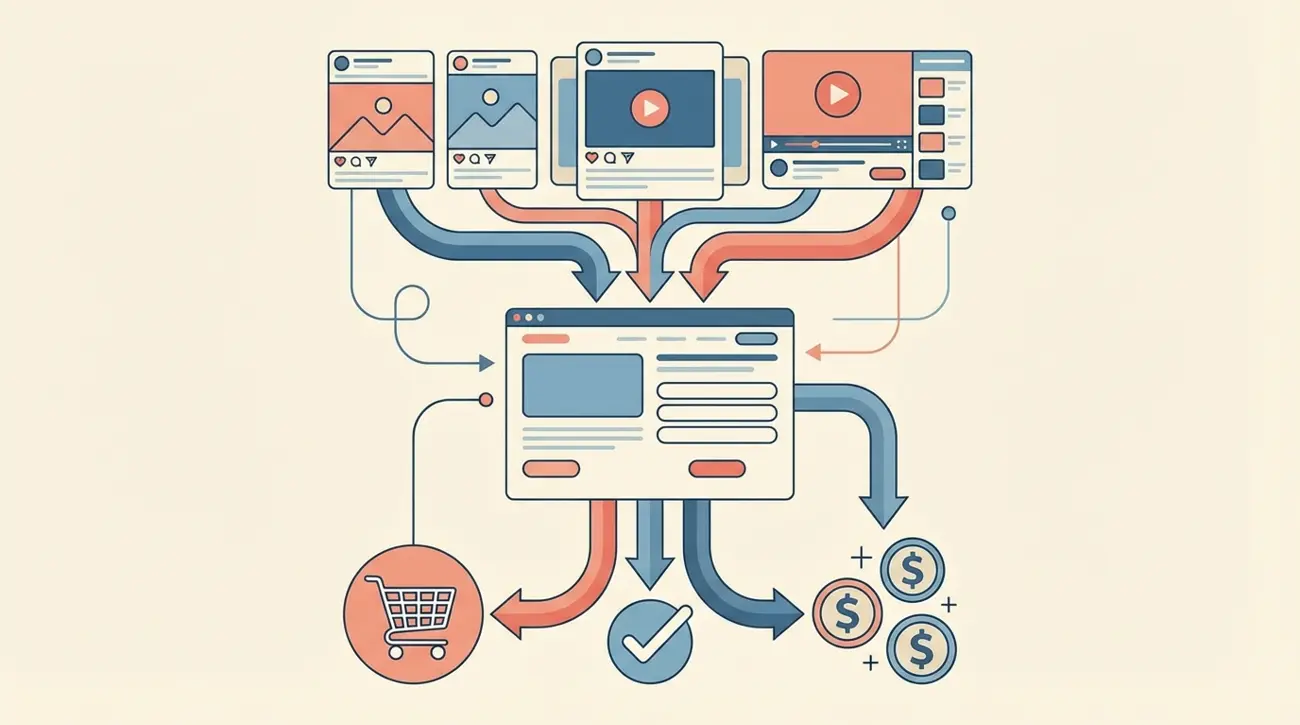
The real insight isn't in what ad your competitor runs. It's in where that ad sends traffic, how the landing page converts, what the retargeting sequence looks like, and how the entire funnel fits together. Competitor landing page analysis for Facebook ads gives you the complete picture — from the first impression to the final conversion.
This guide is for media buyers, affiliate marketers, and agencies who want to reverse-engineer competitor funnels systematically. You'll get a practical framework for mapping the full ad-to-conversion chain, along with the tools and workflows to do it efficiently.
Why Funnel Analysis Matters More Than Ad Analysis Alone
Ad creatives get all the attention. They're visible, they're easy to screenshot, and they feel like the "secret sauce" of a successful campaign. But here's the problem: an ad is only the entry point.
Consider what happens after the click:
- The landing page determines whether a visitor stays or bounces. A brilliant ad driving traffic to a weak page is just expensive entertainment.
- The offer and positioning on the landing page reveal the actual value proposition — often different from what the ad implies.
- The retargeting sequence shows how the competitor handles non-converters, which is where the real volume often hides.
- The full funnel architecture exposes the monetization model: front-end offer, upsells, email sequences, and lifetime value strategy.
When you only analyze ads, you're seeing the wrapper. Competitor funnel analysis lets you see the entire machine.
This matters especially now. As CPMs continue rising across Meta platforms, the margin between profitable and unprofitable campaigns increasingly depends on post-click conversion efficiency. Understanding how competitors structure their funnels gives you an unfair advantage in designing yours.
The bottom line: Two advertisers can run identical creatives. The one with the better funnel wins. Every time.
The Ad-to-Funnel Framework: What to Map
Before diving into tools and tactics, you need a clear framework for what to actually analyze. Random observations won't help. Structured mapping will.
Here's the four-stage framework for competitor funnel analysis:
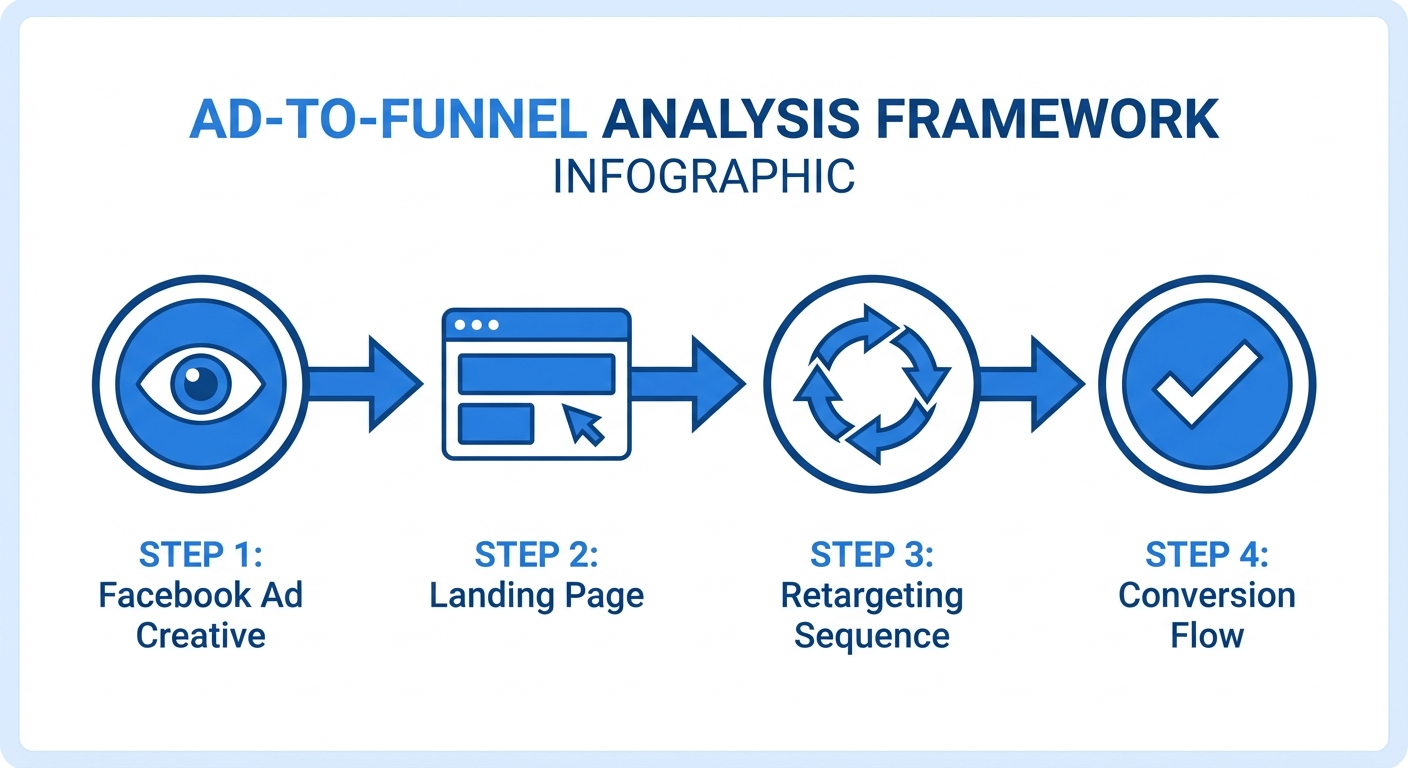 The four-step ad-to-funnel framework: Creative → Landing Page → Retargeting → Conversion
Stage 1: Ad Creative Layer
Start by documenting the ad itself:
- Hook type — emotional, curiosity, social proof, problem-agitation, or direct offer?
- Format — image, video, carousel, or collection?
- CTA button — Shop Now, Learn More, Sign Up, or Download?
- Copy structure — short punchy text or long-form story?
- Target signals — language, geo indicators, OS hints
Stage 2: Landing Page Layer
This is where most of the intelligence lives:
- URL structure — custom domain, subfolder, or landing page builder?
- Page type — product page, lead capture, long-form sales page, quiz funnel, or listicle?
- Offer positioning — what's the headline promise vs. what the ad promised?
- Social proof — testimonials, review counts, trust badges, media mentions?
- CTA design — button copy, placement, urgency elements?
- Tech stack — what platform (Shopify, ClickFunnels, WordPress, custom)?
Stage 3: Retargeting Layer
After visiting the landing page, watch for:
- Pixel-based retargeting ads — do you see follow-up ads within 24-72 hours?
- Sequence changes — does the messaging shift from awareness to urgency?
- Email follow-up — if you opted in, what's the email cadence and content?
- Cross-platform retargeting — ads appearing on Instagram after visiting via Facebook?
Stage 4: Conversion Flow Layer
Map the actual conversion mechanics:
- Checkout process — how many steps? What payment options?
- Upsell/cross-sell — post-purchase offers, order bumps?
- Follow-up — confirmation emails, onboarding sequences?
- Pricing strategy — discounts, bundles, subscription options?
Document each stage in a spreadsheet or dedicated funnel mapping tool. The goal is to build a complete picture, not just collect random data points.
How to Find Competitor Landing Pages from Their Ads
The first practical challenge is actually getting from a competitor's ad to their landing page. There are two main approaches, and the difference in efficiency is massive.
The Manual Approach: Meta Ad Library
Meta's Ad Library (facebook.com/ads/library) lets you search any advertiser's active ads. Here's the workflow:
- Search for a competitor's Facebook page name
- Browse their active ads
- Click on individual ads to see the creative
- Click the CTA button to land on their destination page
- Screenshot and document everything
The problem: This works for one or two competitors, but it breaks down at scale. You can't filter by niche, you can't see historical ads, you can't sort by longevity (which indicates winners), and you're clicking through ads one by one. For a thorough competitor analysis covering 10+ advertisers, this approach takes days.
The Scalable Approach: Ad Spy Tools
Ad spy tools solve the discovery problem by aggregating ads across the Meta ecosystem and making them searchable and filterable.
With a tool like Adligator, you can:
- Search by keyword to find all advertisers in a niche — not just the ones you already know about
- Filter by geo, platform, language, and ad format to narrow results to your exact market
- Sort by days active to surface proven winners (ads running for weeks usually mean positive ROI)
- See the destination URL directly on each ad card — no clicking through required
- Track changes with saved searches and tracker alerts
 Adligator search results for 'skincare' — each card shows ad details, platforms, and destination URLs
Clicking into any individual creative reveals the full detail view: ad launch date, days active, geo targeting, platform placement, CTA button type, and the destination link.
 Creative detail view in Adligator — showing ad dates, geo targeting, platform, CTA button, and landing page link
This detail view is where competitor landing page analysis from Facebook ads truly starts. You can see exactly where each ad sends traffic, then visit that URL to begin your landing page evaluation.
Pro tip: Sort by "days active" descending to find long-running ads. These are almost certainly profitable — nobody keeps paying for ads that lose money for weeks. Their landing pages are worth studying closely.
Discover competitor ads and their landing pages with Adligator — start free
Analyzing Landing Page Elements (Offer, Social Proof, CTA)
Once you've collected competitor landing page URLs, the real analysis begins. Don't just glance at the page — use a structured evaluation checklist.
 Landing page analysis checklist: the key elements to evaluate on every competitor page
Headline and Message Match
The first thing to check: does the landing page headline match the ad's promise?
Strong funnels maintain tight message continuity. If the ad says "50% Off Premium Skincare," the landing page headline should reinforce that exact offer. When there's a disconnect, it signals either poor funnel design or intentional bait-and-switch (which usually means high bounce rates).
What to document:
- Ad headline vs. landing page headline
- Does the value proposition carry through?
- Is the tone consistent (playful ad → playful page, or jarring shift)?
Offer Structure
Analyze what they're actually selling and how they position it:
- Primary offer — what's the main product/service/lead magnet?
- Price anchoring — do they show a "was" price? Compare to retail?
- Bundling — are they pushing bundles vs. single items?
- Risk reversal — money-back guarantees, free trials, free shipping?
- Urgency — countdown timers, limited stock, seasonal deadlines?
Social Proof Inventory
Catalog every trust element on the page:
- Customer testimonials (text, video, or both?)
- Star ratings and review counts
- "As seen in" media logos
- User-generated content or before/after photos
- Number of customers served
- Certifications or awards
Pay attention to specificity. "10,000+ happy customers" is weaker than "Rated 4.8/5 from 12,847 verified reviews." The level of detail in social proof signals how mature the funnel is.
CTA Design and Placement
Map every call-to-action on the page:
- Button copy — "Buy Now" vs. "Get My Free Sample" vs. "Start My Trial"
- Button color and size — does it contrast with the page? Is it above the fold?
- Number of CTAs — how many times does the button appear?
- Micro-commitments — do they use multi-step forms or quizzes before the main CTA?
- Exit intent — do they trigger a popup when you try to leave?
Technical Elements
Use browser developer tools or extensions to check:
- Page load speed — slow pages kill conversions. Use PageSpeed Insights.
- Mobile optimization — test the full flow on mobile, since most Facebook traffic is mobile.
- Tracking pixels — open your browser console and check for Meta Pixel, Google Analytics, and other tracking scripts. This reveals their measurement sophistication.
- Tech stack — use BuiltWith or Wappalyzer to identify their platform (Shopify, WordPress, ClickFunnels, Webflow, custom).
Building a Comparison Matrix
For each competitor, create a row in your spreadsheet with columns for:
| Element | Competitor A | Competitor B | Competitor C | Your Page |
|---|---|---|---|---|
| Headline match score (1-5) | ||||
| Primary offer type | ||||
| Price point | ||||
| Risk reversal | ||||
| Social proof depth | ||||
| CTA count | ||||
| Page load speed | ||||
| Mobile experience |
This matrix makes patterns visible. If three out of five competitors use video testimonials and you don't, that's a gap worth testing.
Mapping the Full Funnel: Retargeting, Email, Upsells
Landing page analysis is the middle of the story. To complete your competitor funnel analysis, you need to map what happens both before and after the main conversion event.
 A complete competitor funnel map connecting ad variations to landing pages, retargeting sequences, and conversion flows
Trigger the Retargeting Sequence
To map a competitor's retargeting funnel:
- Clear your browser cookies or use a fresh browser profile
- Click the competitor's ad and visit their landing page
- Don't convert — browse the page, maybe add to cart, but don't complete the purchase
- Continue browsing Facebook and Instagram normally for the next 3-7 days
- Screenshot every retargeting ad you see from that advertiser
What to watch for in the retargeting sequence:
- Timing — when does the first retargeting ad appear? (Usually 1-24 hours)
- Message shift — does the copy change from "discover" to "don't miss out"?
- Offer escalation — do they introduce a discount or bonus in retargeting?
- Creative rotation — do they use different images/videos in retargeting vs. cold traffic?
- Duration — how many days does the retargeting sequence last?
Map the Email Sequence
If the competitor offers a lead magnet or newsletter, opt in with a dedicated email address:
- Sign up using the competitor's opt-in form
- Track every email for the next 30 days
- Document: send time, subject line, content type, CTA, and offer
Common email funnel patterns you'll discover:
- Welcome sequence (3-7 emails introducing the brand)
- Nurture content (educational emails building authority)
- Sales sequence (direct pitch with urgency triggers)
- Abandonment recovery (if you left items in cart)
- Re-engagement (emails after a period of inactivity)
Identify the Upsell and Cross-sell Strategy
If you complete a purchase (even a small one), document the post-purchase experience:
- Order bump — was there an add-on offered during checkout?
- One-click upsell — after payment, did they present another offer?
- Post-purchase emails — what products do they promote after delivery?
- Loyalty/referral program — do they incentivize repeat purchases?
This full-funnel mapping reveals the competitor's actual customer lifetime value strategy — not just their acquisition play.
The Manual Limitation
Here's where the manual approach hits a wall. Tracking landing page changes over time, identifying which ads drive to which funnel variants at scale, and monitoring retargeting sequence evolution across dozens of competitors is simply not sustainable manually. You need tooling that continuously monitors competitor ad activity and makes the data searchable.
Tools for Landing Page & Funnel Intelligence
No single tool covers the complete funnel. Here's a practical stack for each layer:
Ad Discovery & Landing Page URLs
| Tool | Strength | Limitation |
|---|---|---|
| Adligator | Fast keyword search, landing page URLs on each ad, days-active sorting, geo/platform filters, tracker alerts | Focused on Meta ecosystem |
| Meta Ad Library | Free, official, shows all active ads | No filters by niche, no historical data, no landing page URL in listing |
| Panoramata | Email and landing page tracking for DTC brands | Narrower ad coverage, higher price point |
Adligator is the strongest starting point for ad funnel reverse engineering on Facebook and Instagram because it combines ad discovery with direct landing page access. You can search by keyword, filter by country and platform, sort by ad longevity, and immediately see where each ad sends traffic — all from one interface.
Landing Page Analysis
- PageSpeed Insights — load speed and Core Web Vitals
- BuiltWith / Wappalyzer — tech stack detection
- Wayback Machine — historical landing page versions
- SimilarWeb — traffic estimates and referral sources
Retargeting & Pixel Detection
- Facebook Pixel Helper (Chrome extension) — detects Meta Pixel on any page
- Ghostery — shows all tracking scripts and ad networks
- AdBlock detector — reveals which ad networks the competitor uses
Email Funnel Tracking
- MailCharts — email intelligence for ecommerce
- A fresh email address — the cheapest and most accurate method
Building Your Funnel Swipe File
All this analysis is worthless if you can't retrieve and act on it later. Build a systematic funnel swipe file.
Structure Your Swipe File
Create a folder structure like this:
/funnel-swipe-file
  /competitor-name
    /ads
      cold-traffic-ad-01.png
      retargeting-ad-01.png
    /landing-pages
      main-lp-screenshot.png
      mobile-lp-screenshot.png
      checkout-flow.png
    /emails
      welcome-email-01.png
      sales-email-01.png
    funnel-map.md
    notes.md
What to Include in funnel-map.md
For each competitor, document:
- Traffic sources — Facebook, Instagram, both? Cold + retargeting split?
- Ad → Landing page mapping — which ad variations lead to which pages?
- Landing page → Conversion flow — steps from page to purchase
- Post-purchase sequence — upsells, email follow-up
- Key metrics observed — ad longevity, estimated spend signals, social proof numbers
- Strengths to adapt — what they do better than you
- Weaknesses to exploit — gaps or friction points in their funnel
Maintenance Cadence
- Weekly (15 min): Check your top 3-5 competitors for new ads using Adligator tracker alerts
- Monthly (1 hour): Review landing page changes for competitors showing new ad variations
- Quarterly (half day): Full funnel audit of 5-10 competitors, update your swipe file and comparison matrix
Turning Analysis into Action
The swipe file isn't a collection of ideas — it's a testing backlog. After each analysis session, pull out 2-3 specific hypotheses:
- "Competitor X added video testimonials and their ad longevity increased. Test adding video testimonials to our top landing page."
- "Three competitors shifted from single product pages to quiz funnels. Test a quiz entry point for our cold traffic."
- "Competitor Y's retargeting ads use a stronger discount (20% vs. our 10%). Test a 15% retargeting offer."
Each hypothesis goes into your testing queue with a clear success metric and timeline.
FAQ
What is competitor landing page analysis?
Competitor landing page analysis is the process of examining the destination pages that competitor ads drive traffic to. It involves evaluating their offer positioning, page structure, social proof elements, CTA design, and conversion flow to identify patterns you can adapt for your own campaigns.
How do I find competitor landing pages from Facebook ads?
You can find competitor landing pages by clicking through ads in Meta Ad Library, or by using ad spy tools like Adligator that show the destination URL directly on each ad creative. Spy tools are faster because they let you filter by niche, geo, and platform to find relevant ads at scale.
What tools can I use for competitor funnel analysis?
For ad discovery and landing page URLs, use Adligator or similar spy tools. For deeper funnel mapping, combine with tools like BuiltWith (tech stack detection), SimilarWeb (traffic estimates), and browser extensions that detect retargeting pixels. No single tool covers the entire funnel, so a stack approach works best.
How often should I analyze competitor funnels?
Run a comprehensive funnel audit quarterly, with lighter weekly checks on your top 3-5 competitors. Set up tracker alerts in your spy tool to catch new ads and landing page changes in real time.
Conclusion
Competitor landing page analysis for Facebook ads isn't about copying what works for others. It's about understanding the full conversion chain — from ad creative to landing page to retargeting to final sale — so you can build smarter funnels of your own.
The framework is straightforward: map the ad layer, analyze the landing page, trigger and track the retargeting sequence, and document the conversion flow. Do this systematically for your top competitors and you'll have an intelligence advantage that most media buyers never develop.
The biggest bottleneck is discovery and access. Manually clicking through Meta Ad Library works for casual research, but serious competitor funnel analysis requires tools that let you search by keyword, filter by market, and see landing page URLs directly.
Start with one competitor. Map their complete funnel using the framework in this guide. Then expand to five. Within a month, you'll spot patterns that reshape how you build your own campaigns.
Ready to decode competitor funnels? Discover competitor ads and their landing pages with Adligator — start free
See where competitor ads lead — try Adligator
Related Reading
- Copying Competitor Facebook Ads Is Quietly Killing Your ROAS — Here's What to Do Instead
- How to Estimate Competitor Facebook Ad Spend Using Spy Tools and Ad Library Data
- How I Found 3 Winning Dropshipping Products in One Weekend Using Competitor Facebook Ads
- Facebook Ads by Country: How to Research Competitor Creatives by GEO
- Inside monday.com's Facebook Ads Machine: What 1,880 Ads Reveal About B2B SaaS Creative Strategy
