How to Build a Creative Brief from Ad Spy Data: A Reusable Template for Media Buying Teams
You spend hours researching competitor ads. You save screenshots, bookmark landing pages, note down hooks that caught your eye. Then what? The research sits in a folder, and your design team gets the same vague brief they always get: "Make something like this, but different."
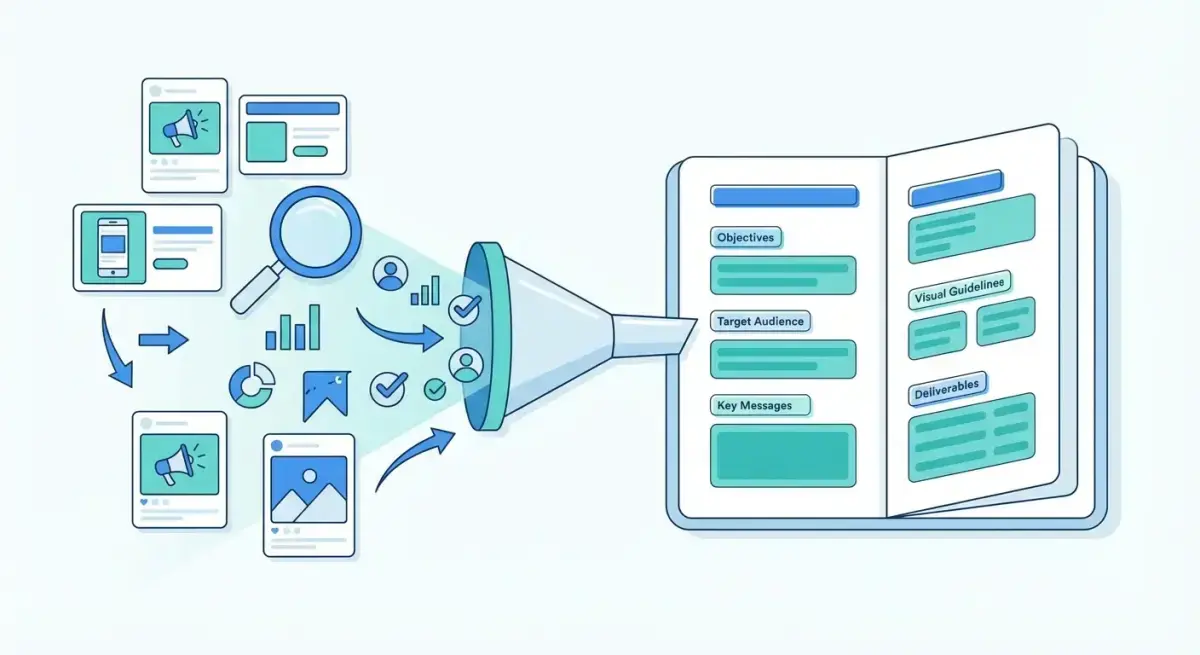
The gap between ad spy research and creative production is where most media buying teams lose their edge. Building a creative brief from ad spy data turns scattered competitor insights into structured, actionable direction that designers and copywriters can actually execute.
This guide gives you a reusable template and a step-by-step process for translating raw spy data into production-ready creative briefs — the kind that lead to ads worth testing, not another round of revisions.
Why Most Creative Briefs Fail (and How Spy Data Fixes Them)
The typical creative brief in a media buying team looks something like this: a paragraph of objectives, a vague audience description, and a few reference images pulled from a quick Google search. The design team interprets it however they want, the first round of creatives misses the mark, and everyone wastes a week on revisions.
This happens because most briefs are built on assumptions instead of data.
Ad spy research changes that equation. When you systematically analyze what competitors are running — which hooks they use, which formats get longevity, which CTAs they pair with specific offers — you replace guesswork with evidence. The brief stops being a wish list and starts being a blueprint.
Here's what spy-data-informed briefs do differently:
- Ground creative direction in market reality. You're not guessing what might work — you're building on patterns that are already performing.
- Give designers concrete visual references. Instead of "make it pop," you provide specific format examples, color patterns, and layout structures from proven ads.
- Reduce revision cycles. When the brief is specific and evidence-backed, the first draft is closer to final.
- Speed up testing velocity. Clearer briefs mean faster production, which means more variants in market sooner.
The key distinction: you're not copying competitors. You're using their public data to identify patterns, then adding your own differentiation layer. That's the difference between plagiarism and intelligence.
What to Extract from Competitor Ad Research
Before you can build a brief, you need to know what to look for. Not every competitor ad is worth analyzing, and not every data point matters equally.
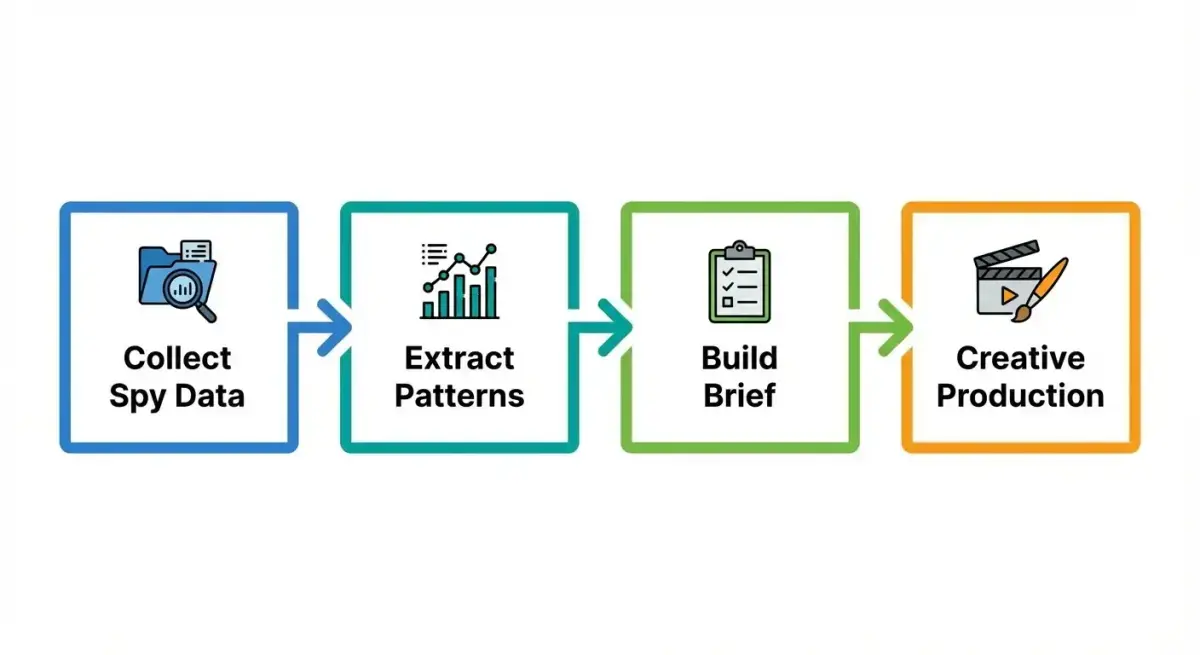 The four-step workflow from raw spy data to a production-ready creative brief.
Focus your extraction on these five categories:
Hooks and Opening Lines
The first line of ad copy determines whether someone stops scrolling. Track:
- Question hooks ("Tired of...?", "What if you could...?")
- Statistical hooks ("67% of marketers waste...")
- Story hooks ("Last month, our client...")
- Direct benefit hooks ("Get X without Y")
- Controversy/contrarian hooks ("Stop doing X")
Note which hook types appear most frequently among top performers (ads running 7+ days across multiple geos).
Visual Formats and Layouts
Categorize the ad formats you see performing:
- Single image with text overlay
- Before/after split
- Carousel walkthroughs
- UGC-style video stills
- Product demo screenshots
- Infographic-style static ads
Pay attention to dominant colors, text-to-image ratios, and whether faces appear in top performers.
CTA and Offer Structure
Map out how competitors structure their offers:
- What CTA buttons do they use? (Shop Now vs. Learn More vs. Sign Up)
- Do they lead with price, free trial, or value proposition?
- Is the CTA in the image, the copy, or both?
- What's the landing page promise vs. the ad promise?
Messaging Angles
Identify the core angles competitors use to position their offers:
- Pain point agitation ("Stop wasting budget on...")
- Aspiration ("Scale to 7 figures with...")
- Social proof ("Join 10,000+ media buyers who...")
- Urgency ("Limited spots" / "Price increases...")
- Education ("The complete guide to...")
Longevity Signals
Not all ads are winners. Filter for quality by tracking:
- Days active: Ads running 10+ days are likely profitable.
- Geo spread: Ads shown in multiple countries suggest scaling.
- Ad count: Multiple creatives with the same copy indicate systematic testing.
These five categories form the raw material for your creative brief.
The Creative Brief Template: Section by Section
Here's the template, designed to be filled directly from spy data analysis. Each section maps to a specific type of competitor insight.
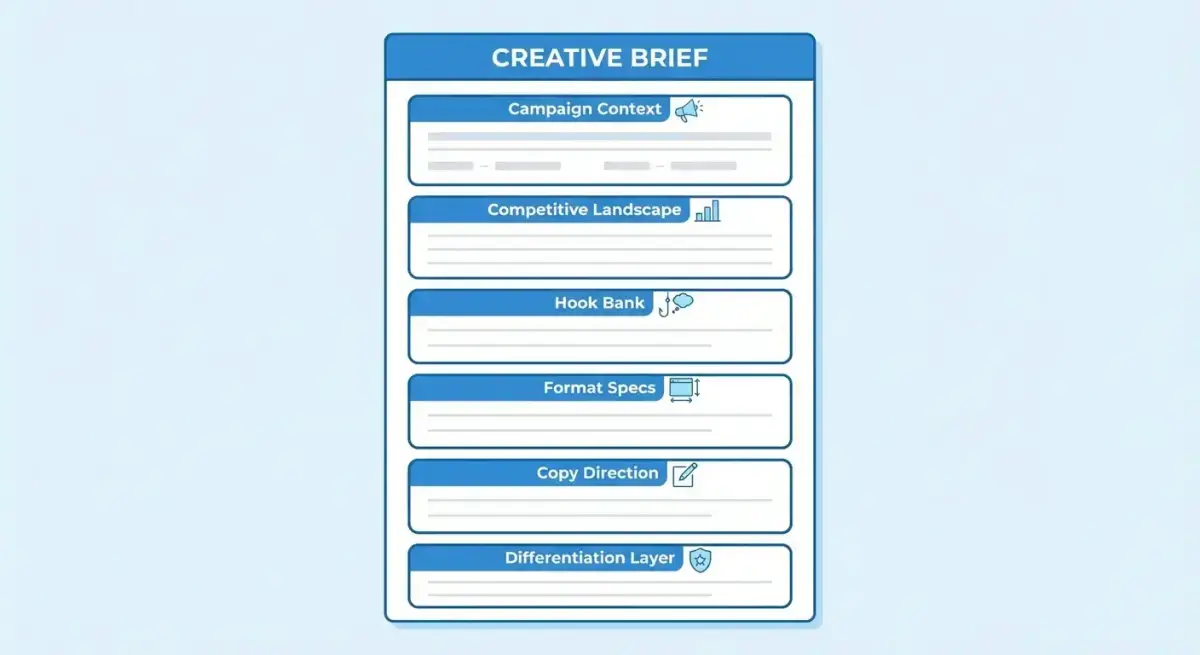 Each section of the creative brief maps directly to a specific type of spy data insight.
Section 1: Campaign Context
- Product/Offer: What you're advertising
- Objective: Conversions, leads, traffic, or awareness
- Target Audience: Demographics, interests, pain points
- Budget Range: Affects production complexity
- Timeline: Delivery deadline for creatives
This section isn't derived from spy data — it's your own campaign context. But it frames everything that follows.
Section 2: Competitive Landscape Summary
- Number of competitors analyzed: (aim for 3-5)
- Total ads reviewed: (aim for 30-50)
- Date range of analysis: When the research was conducted
- Top patterns identified: 3-5 bullet points summarizing what you found
- Gaps identified: What competitors are NOT doing that represents an opportunity
This is your research executive summary. It tells the creative team why the brief looks the way it does.
Section 3: Hook Bank
List 5-8 hook directions based on what you extracted, categorized by type:
| Hook Type | Example from Research | Our Adaptation |
|---|---|---|
| Question | "Still boosting posts?" | "Still guessing which creatives to test?" |
| Statistic | "80% of ad spend is wasted" | "Media buyers waste 12 hours/week on creative that doesn't convert" |
| Direct Benefit | "Scale ads in 48 hours" | "Go from spy data to live ads in one afternoon" |
The "Our Adaptation" column is critical. This is where you differentiate.
Section 4: Format Specifications
Based on your format analysis, specify:
- Primary format: The format type you want to lead with (e.g., single image with text overlay)
- Secondary format: A variant to test (e.g., carousel)
- Dimensions: 1080x1080, 1080x1350, 1200x628, etc.
- Text overlay rules: Max word count, font style direction
- Visual references: 3-5 specific competitor ad screenshots with notes on what to emulate and what to change
Section 5: Copy Direction
- Primary message: One sentence that captures the core value proposition
- Tone of voice: Based on what resonates in the market (casual, authoritative, urgent)
- CTA: Specific button text and where it leads
- Copy length guidance: Short (1-2 lines), medium (3-5 lines), or long-form
- Words/phrases to use: Pulled from high-performing competitor copy
- Words/phrases to avoid: Overused terms or competitor-specific language
Section 6: Differentiation Layer
This is the most important section and the one most teams skip:
- What competitors are all saying: The consensus message in your niche
- What none of them are saying: The gap you'll fill
- Our unique angle: How your creative will stand out
- Proof points: Data, testimonials, or features that support your differentiation
Without this section, you're just creating a slightly different version of what already exists.
Step 1: Pattern Identification from Spy Data
Start by collecting 30-50 ads from your top 3-5 competitors. Don't cherry-pick — grab a representative sample including both long-running ads and recent launches.
Create a simple tracking spreadsheet with these columns:
- Competitor name
- Ad format (image/video/carousel)
- Hook type
- Primary message angle
- CTA button type
- Days active
- Number of geos
- Notable visual elements
Once you've logged everything, look for clusters. You'll typically find that 2-3 hook types dominate, one or two formats appear more than others, and there's a consistent messaging angle across competitors.
These clusters are your baseline. They tell you what the market responds to — and what your brief should be built around.
Step 2: Angle and Hook Extraction
From your pattern analysis, pull the top-performing angles and hooks. "Top-performing" means ads with the longest run times and widest geo distribution — these are the ones competitors are scaling because they work.
For each hook you extract:
- Write it down verbatim. Capture the exact phrasing.
- Categorize it. Question, stat, story, benefit, or contrarian?
- Note the context. What offer was it paired with? What audience?
- Write your adaptation. Same hook structure, different content.
Aim for 8-10 hooks in your bank. Your creative team will use 3-5 in the first batch, and you'll have reserves for future iterations.
The goal isn't to find one perfect hook. It's to build a library of proven structures that your team can remix and test systematically.
Step 3: Format and Structure Decisions
Your format analysis should reveal clear winners. If 60% of long-running competitor ads are single images with bold text overlays, that's your primary format — not because you're copying, but because the market has validated that format for your audience.
Make specific format decisions for your brief:
- Lead format: The one you'll produce first and allocate most budget to
- Test format: A secondary format for A/B testing (often the second most common in your research)
- Experimental format: Something competitors aren't using that could be a differentiator
For each format, specify:
- Exact dimensions
- Text overlay rules (how many words, placement)
- Color palette direction (based on what stands out in the competitive landscape, not what blends in)
- Whether to include faces, products, or abstract visuals
Be specific enough that a designer could start working without asking follow-up questions. That's the benchmark for a good brief.
Step 4: Differentiation Layer
This is where most competitor research to creative brief workflows break down. Teams extract patterns, then just recreate them with their own branding. That produces mediocre ads.
Your differentiation layer needs three components:
1. Contrarian positioning. If every competitor leads with price, you lead with quality. If everyone uses urgency, you use authority. Find the zig to their zag.
2. Unique proof points. What can you say that no competitor can? Specific metrics, unique features, proprietary data, customer results. This goes directly into your copy direction.
3. Format innovation. If everyone runs static images, test video. If everyone does polished studio shots, try UGC. The format itself can be your differentiator.
Document all three in your brief. Without them, you're running the same creative as everyone else — and that's a race to the bottom on CPMs.
Putting It All Together: From Spy Data to Production-Ready Brief
Here's the complete workflow in a checklist you can reuse for every campaign:
- Define campaign context (product, objective, audience, budget, timeline)
- Select 3-5 competitors to analyze
- Collect 30-50 ads using spy tools (filter for 7+ days active)
- Log each ad in your tracking spreadsheet
- Identify pattern clusters (hooks, formats, angles, CTAs)
- Extract top 8-10 hooks and write adaptations
- Determine primary, secondary, and experimental formats
- Draft copy direction with tone, CTA, and length guidance
- Build differentiation layer (contrarian position + proof points + format innovation)
- Compile everything into the template
- Review with stakeholders before passing to creative team
- Set up tracking to measure which brief elements perform best
The entire process takes 2-4 hours for a thorough brief. That investment pays back in fewer revision cycles, faster production, and higher-performing first drafts.
Ready to speed up your competitor research? Start building data-driven creative briefs — try Adligator free
How Adligator Accelerates the Brief-Building Process
The manual approach to competitor ad research — screenshotting ads from Meta Ad Library, logging them in spreadsheets, manually tracking longevity — works for a handful of ads. It falls apart when you need to analyze dozens of competitors across multiple geos and formats.
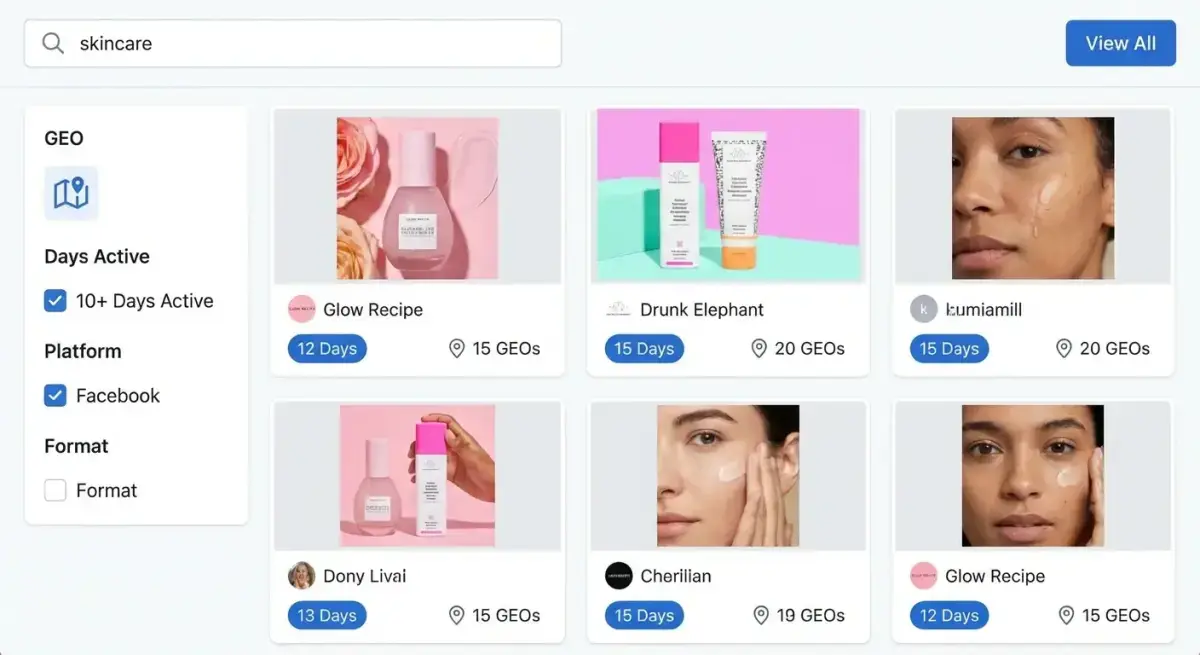 Adligator's filters let you isolate high-performing competitor ads by longevity, platform, and format.
Adligator compresses the research phase of brief building:
- Filter by days active to instantly surface long-running (likely profitable) ads — no manual tracking needed.
- Search by keyword or Facebook page ID to focus on specific competitors or niches.
- Filter by platform, format, and CTA button type to isolate exactly the ad patterns you need for each brief section.
- GEO filtering across 234 countries lets you see which creatives are scaling internationally — a strong longevity signal.
- Collections let you save and organize ads by campaign or brief, keeping your research structured instead of scattered across screenshots.
The pattern identification step that takes hours with manual methods takes minutes with proper filtering. You search for your competitor's page, filter for ads running 10+ days, and immediately see what's working. Sort by format, extract hooks, note CTAs — all from one interface.
For teams running multiple campaigns simultaneously, the time savings compound. Instead of rebuilding your research setup for every brief, you have a persistent, filterable database of competitor intelligence.
The result: briefs that are grounded in current market data, produced in a fraction of the time, and specific enough that creative teams can execute without guesswork.
FAQ
What should a creative brief include?
A strong creative brief includes the objective, target audience, key message, tone of voice, format specifications, visual references, and performance benchmarks. When built from ad spy data, it should also include competitor pattern analysis, hook examples, and differentiation notes that ensure your creatives are informed by market reality rather than assumptions.
How to use competitor research for creative briefs?
Extract recurring patterns from competitor ads — hooks, visual formats, CTAs, and messaging angles. Organize these into categories, identify what performs well based on longevity and geo spread, then use those insights to inform each section of your creative brief while adding your own differentiation layer. The key is systematic extraction, not random inspiration.
How many competitor ads should you analyze?
For a thorough creative brief, analyze at least 30-50 competitor ads across 3-5 direct competitors. Focus on ads that have been running for 7+ days, as longevity indicates performance. This gives you enough data to spot genuine patterns rather than one-off experiments.
Conclusion
Building a creative brief from ad spy data is the difference between creative direction based on evidence and creative direction based on gut feeling. The template and process in this guide give you a repeatable system: extract patterns, identify hooks, make format decisions, add differentiation, and hand off a brief your team can actually execute.
The teams that win at paid media aren't the ones with the biggest budgets or the flashiest creatives. They're the ones with the tightest feedback loop between market intelligence and creative production. A structured media buying creative workflow — from spy data to brief to production — is that feedback loop.
Ready to apply this workflow? Start building data-driven creative briefs — try Adligator free
Related Reading
- How to Analyze Facebook Ad Creatives by GEO and Vertical: A Data-Driven Approach for Media Buyers
- Facebook Ad Creative Testing Framework: How to Validate Winners Faster Using Competitor Intelligence
- How to Build a Facebook Ad Creative Testing Framework Using Competitor Spy Data
- How to Detect Ad Creative Fatigue Before It Kills Your ROAS: A Media Buyer's Checklist
