Creative Testing Velocity: How Many Ad Variations You Need Per Week at Every Budget Level
Creative testing velocity is the most underrated lever in performance marketing in 2026. Two teams running the same budget, on the same offer, with the same audience often see 2–3x different CAC — and the difference almost always traces back to one number: how many fresh ad creatives each team ships and tests per week.
This article gives you a concrete framework: how many ad variations to test at $1,000, $10,000, $50,000, and $100,000+ monthly Meta budgets; how to size creative output to algorithmic needs rather than designer capacity; where the right creative ideas come from; and the failure modes that show up at each budget tier.
It's written for in-house performance marketers, agency media buyers, and growth teams who have stopped scaling on bid strategies and audience targeting and now realize creative is the real growth lever — but aren't sure how much creative is enough.
Why creative volume is now the gating factor
Meta's algorithm changed shape between 2022 and 2026. Advantage+ campaigns now expect a continuous feed of new ad assets — the platform's own guidance suggests 10+ fresh creatives per week per active campaign. Below that threshold, the algorithm gets stuck reusing tired assets and CPMs climb.
At the same time, individual creative lifespan in saturated verticals has compressed from ~14 days in 2022 to 5–8 days in 2026. A winning creative that used to carry a campaign for two weeks now needs replacement after one. That means the system has two simultaneous demands: more creatives at any moment, and more fresh ones over time.
Most teams haven't recalibrated. They still treat creative as a side workflow handled by a single designer producing 3–5 variations a week. At $1k/mo budgets that's roughly right. At $30k/mo it's a structural bottleneck that's silently dragging your CAC up.
 The right number of weekly variations is a function of budget, not team size. Most teams test too few because they index on what their team can produce.
The budget-to-creative ratio: a concrete framework
Here's the table we use as a baseline with the teams we work with. Adjust ±25% for your vertical's specific volatility (gambling, dating, and crypto fatigue faster; B2B SaaS and finance lasts longer).
$1,000–$3,000/month (early-stage / single-product brands)
- Weekly fresh creatives: 3–6
- Active creatives at any time: 4–8
- Concept sources: 1 spy tool + manual review of own data
- Production: in-house, 1 person part-time
At this tier the goal isn't volume, it's signal. You're looking for a single repeatable creative angle that beats your control by 20%+. Don't chase variation count — chase clean tests. Each week you're shipping 1 new winner candidate and 2–3 iterations on what worked last week.
$5,000–$15,000/month (mid-tier brands, scaling agencies)
- Weekly fresh creatives: 12–20
- Active creatives at any time: 15–25
- Concept sources: spy tool + analytics dashboard + customer support inbox
- Production: 1 designer + 1 AI generator (Midjourney or Runway)
This is where most teams under-test. They're ready for 15+ weekly variations but stuck producing 5 because the workflow is brainstorm-bottlenecked. The fix is process: codify a Monday "concept" hour using your spy tool, hand the brief to a designer/AI stack, ship by Wednesday.
$20,000–$50,000/month (scaled DTC, performance-led agencies)
- Weekly fresh creatives: 25–50
- Active creatives at any time: 30–60
- Concept sources: spy tool + analytics + creative analytics platform (Pencil, Motion, Triple Whale Creative) + UGC pipeline
- Production: 1–2 designers + 1 video editor + AI generation layer
At this tier, creative becomes its own team function. Concepts come from data, production is templated and partly automated, and there's a creative review meeting separate from media buying. Teams that don't separate these two functions cap out around $25k/mo before CAC starts climbing.
$100,000+/month (large DTC, brand-performance teams)
- Weekly fresh creatives: 75–150
- Active creatives at any time: 80–200
- Concept sources: full creative intelligence stack + native UGC pipeline + influencer feed + iteration on winners
- Production: dedicated creative team (3–6 people) + AI tools + UGC creator network
At this scale you're effectively running a small in-house ad studio. The challenge isn't volume, it's quality control and avoiding cannibalization: are your 100 new variations actually testing different things, or just permutations of the same angle?
Tip: Whatever your tier, the right number is a starting point — not a target. Track three things: % of creatives reaching statistical significance (should be 50%+), median creative lifespan (should be 5–10 days in most verticals), and CAC trend (should be flat or improving over 30 days). If any of those are off, your velocity is wrong for your context. Start free with Adligator to pull the concept side of this equation from real competitor data instead of brainstorms.
Where creative ideas actually come from
The framework above is useless without a steady idea pipeline. Most teams burn out their designers because the creative process is "designer thinks of an angle, makes it, tests it" — which is unsustainable past 10–15 variations a week.
In 2026 the working idea funnel has four layered sources. Use them in this priority order:
1. Your own data (35% of new concepts). Last 30 days of your top performers. What hook patterns worked? What CTAs converted? Iterate on those — same angle, different visual or hook.
2. Competitor intelligence (30%). Real ads currently running in your vertical, in your GEO. This is where a spy tool earns its monthly fee — it gives you 50+ angles per week to evaluate, of which 5–10 are worth testing variations of.
3. Customer voice (20%). Support tickets, review mining, social comments, sales call transcripts. Direct customer language is undervalued — it almost always outperforms marketer-language hooks.
4. Industry/macro trends (15%). Cultural moments, format shifts (e.g. AI-generated UGC in 2026), platform changes (new placements). Lower hit rate but occasional outsized wins.
The biggest failure pattern: teams over-index on source #4 (chasing trends) and under-index on #2 (competitor reality). Trends are exciting but unproven; competitor data is boring but battle-tested.
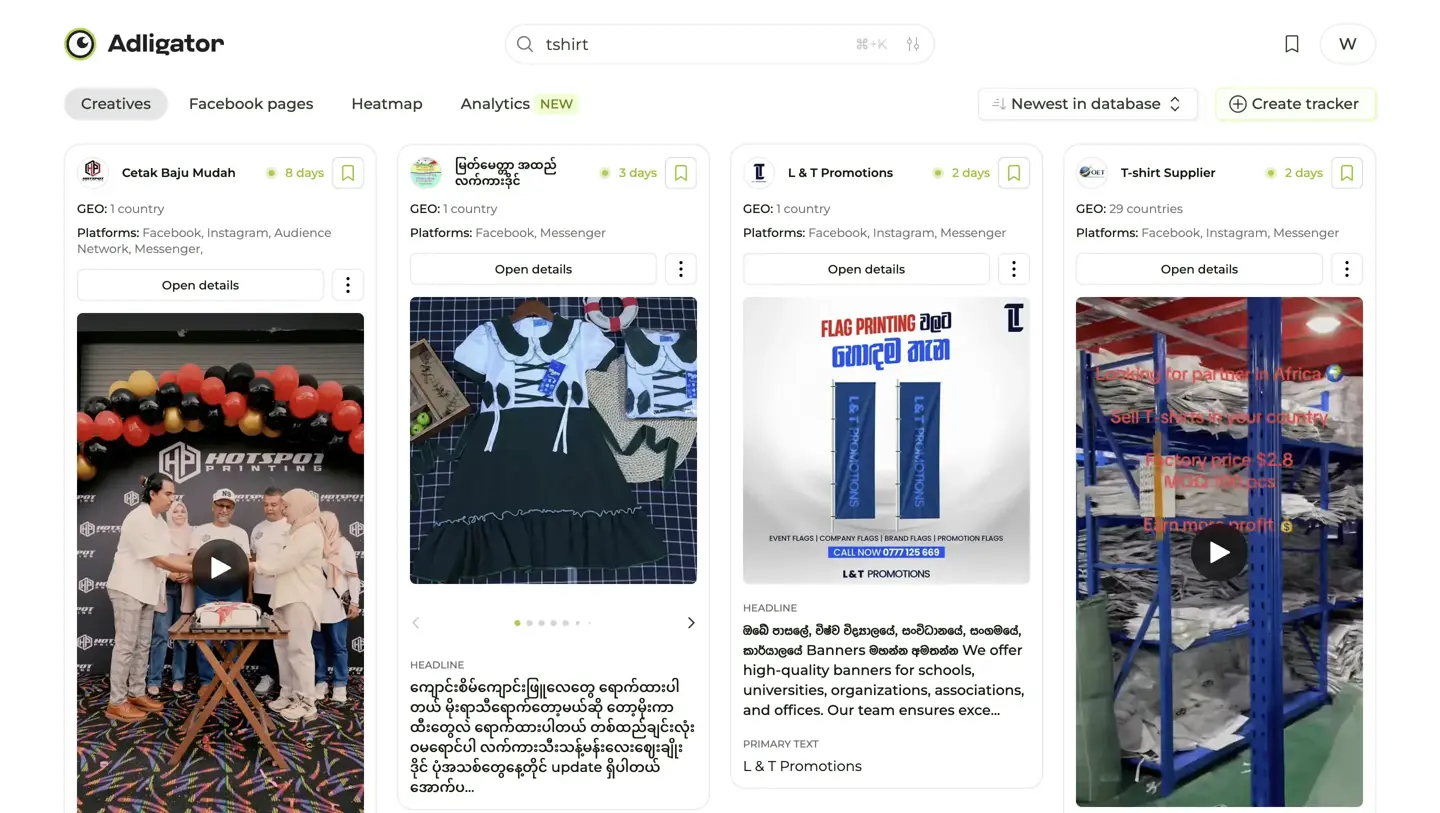 A product-keyword search like
 tshirt surfaces dozens of live POD/apparel advertisers in one view. Pull 30–50 active concepts per week from 3–5 mapped keywords per vertical (brands + product types + offer slang), then promote the best 5–10 into your testing queue. Searching the vertical name itself ("ecommerce", "POD") returns a tiny slice — real ads contain product and brand names, not category labels.
Common failure modes by budget tier
Sub-$5k tier — Testing without enough volume per cell. Splitting $1k/mo across 8 active creatives leaves each one with $125 to prove itself — not enough for a single conversion in most verticals. Fix: fewer cells, longer tests, ride winners harder.
$5k–$15k tier — Designer bottleneck. Concepts pile up faster than production can ship them. Fix: introduce AI for variations of winners; reserve designer time for original concepts only.
$20k–$50k tier — Variations that aren't actually variations. Same hook, same value prop, just different colors. The algorithm groups them and you get no learning. Fix: enforce one of the four levers (hook, format, value prop, CTA) must materially change for an ad to count as a test.
$100k+ tier — Cannibalization between ad sets. With 200 active creatives across 30 ad sets, you're competing against yourself in the auction. Fix: consolidate into Advantage+ campaigns, separate concept testing from scaled spend, use creative intelligence platforms to track overlap.
 Use this matrix to audit your current setup. If your team size says "tier 2" but your spend says "tier 3", creative volume is your bottleneck — not media buying.
Sizing the team and tooling stack
Here's what the supporting setup typically looks like at each tier in 2026:
- $1–3k: 1 part-time designer, 1 spy tool ($30–50/mo), spreadsheet for tracking. Total tooling cost: <$100/mo.
- $5–15k: 1 dedicated designer, 1 AI image tool (Midjourney $30/mo), 1 spy tool ($50–100/mo), basic creative analytics. Total: ~$200/mo + design salary.
- $20–50k: 1–2 designers + 1 video editor, AI stack (Midjourney + Runway + ChatGPT), spy tool ($100–300/mo), creative analytics platform (Motion / Pencil $500–1500/mo). Total tooling: ~$1.5–2k/mo + team salaries.
- $100k+: dedicated creative team (3–6), full AI generation pipeline + UGC creator network, enterprise creative intelligence (Motion enterprise tier, Pencil Pro, custom integrations). Total tooling: $5–10k/mo + team payroll.
The tooling spend roughly scales as 5–10% of media spend. Below that you're under-equipped; above that you're over-paying for capacity you can't use.
Common questions about creative testing volume
A few quick answers to questions that come up in every conversation about this topic.
"What about brand creative — does it count toward velocity?" Brand-led "always on" creatives count toward your active creatives number but not toward your weekly fresh testing target. Treat them as the baseline against which testing creatives compete.
"Should I keep losing creatives running?" No. Once a creative is statistically below your KPI by 15%+ over 3+ days, kill it. Letting it run drags your blended CAC and reduces the algorithm's learning rate on healthy creatives.
"How long should each test run before deciding?" Until each cell has enough data to be statistically significant for your KPI — usually 100+ conversions per cell for purchase optimization, 30+ for lead gen. In practice that means 3–7 days per test in most verticals. Killing too fast wastes the creative; running too long wastes spend.
FAQ
Is there a universal number of ad variations to test per week?
No. The right number scales with monthly budget, vertical, and how long your typical creative survives before fatigue. A solid rule of thumb in 2026: 3–5 fresh creatives per $1,000 of monthly Meta spend, weighted toward formats that match your top-performing assets. Going below that under-feeds the algorithm; going above that wastes creative budget on tests that can't learn statistically.
What counts as a 'fresh' creative variation?
A meaningful variation changes at least one of the four primary creative levers: hook (first 3 seconds), visual format (image, video, carousel, UGC), value proposition copy (headline + primary text angle), and call to action. Two ads with the same hook and different background colors are not separate variations — Meta's algorithm groups them as duplicates. Real variations should fail or win for clearly different reasons.
How do I keep creative output high without burning out my designer?
Two things. First, separate concept work from production work — concepts come from a tight loop with your spy tool and analytics; production is templated. Second, give AI tools the production load (Midjourney, Runway, Pencil) while your designer reviews, polishes, and owns the brand layer. Teams that split the work this way ship 4–5x the variations without growing headcount.
Conclusion: match creative volume to algorithm appetite, not team capacity
Creative testing velocity is the unsexy number that quietly decides which teams scale and which plateau in 2026. If you're at $10k/mo and shipping 5 creatives a week, your creative team isn't behind — your structure is wrong. The fix isn't more hours from your designer; it's a pipeline that pulls concepts from real market signal (your data + competitor reality), hands production to a templated stack (designer + AI), and lets the algorithm select winners from a steady stream of meaningful variations.
Sized correctly, creative becomes a flywheel: more variations → faster signal → better winners → lower CAC → more budget → more variations. Sized too small, it's a slow choke on growth that nobody can quite point at.
Ready to feed your creative pipeline from real market data? Start free with Adligator to see exactly which competitor angles are alive in your vertical right now — and turn 30 minutes of weekly research into 5–10 high-quality concept candidates for your next testing cycle.
See what's working in your vertical right now →
Related Reading
- Facebook Ad Creative Testing Framework: How to Validate Winners Faster Using Competitor Intelligence
- How Many Ad Creatives Do You Need for Facebook Ads? A Data-Driven Framework by Budget Level (2026)
- How to Use Ad Spy Data to Scale Facebook Campaigns: From Testing to Six-Figure Spend
- How to A/B Test Facebook Ad Creatives: A Beginner Guide to Statistical Confidence and Faster Winners
