Facebook Ad Account Structure and Naming Conventions: A Scaling Framework for Media Buyers
A well-structured Facebook ad account is the difference between scaling profitably and drowning in a mess of unnamed campaigns you created at 2 AM. If you've ever opened Ads Manager and spent 10 minutes just figuring out which campaign is which, your facebook ad account structure needs work.
This guide gives you a practical framework for organizing your Meta ad account — from campaign hierarchy and naming conventions to ad set segmentation and creative labeling. Whether you're a solo media buyer managing $10K/month or an agency running dozens of accounts, the principles are the same: clarity, consistency, and scalability.
As accounts grow and Advantage+ campaigns add new layers of automation, having a clean structure matters more than ever. Let's build one that won't break when you 10x your spend.
Why Account Structure Matters More Than You Think
Most media buyers don't think about facebook campaign structure until it's already a problem. When you have three campaigns, it doesn't matter. When you have thirty, everything matters.
A clean account structure directly impacts:
- Optimization speed. You can spot underperformers in seconds instead of minutes.
- Budget allocation. Clear segmentation prevents budget cannibalization between campaigns.
- Reporting accuracy. Standardized naming lets you pull reports without manual cleanup.
- Team collaboration. New team members can understand the account in their first hour.
- Algorithm performance. Meta's algorithm learns faster with properly consolidated campaign structures.
The cost of a messy account is invisible until you need to scale. Then it hits all at once — duplicated audiences, overlapping campaigns, creative tests buried inside scaling campaigns, and reporting that requires a PhD in spreadsheet archaeology.
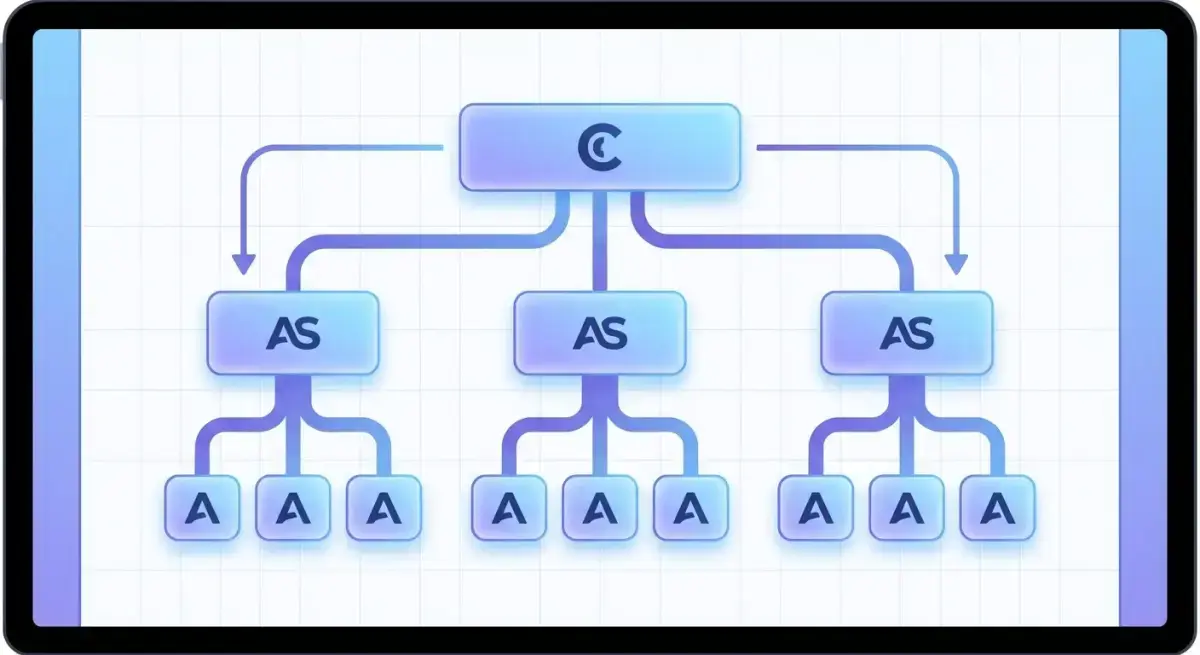
The Three-Tier Hierarchy: Campaign, Ad Set, Ad
Every Facebook ad account follows Meta's three-level hierarchy. Understanding what decisions belong at each level is fundamental to clean facebook ads organization.
Campaign Level
The campaign is where you set your objective. This is the strategic layer:
- Objective selection (Sales, Leads, Traffic, Awareness, Engagement, App Installs)
- Campaign budget optimization (CBO) toggle
- Advantage+ campaign settings
- Spending limits
Rule of thumb: One campaign per objective per funnel stage. Don't mix prospecting and retargeting in the same campaign unless you're using Advantage+ Shopping and letting Meta handle it.
Ad Set Level
The ad set is your tactical layer — targeting, scheduling, and placement decisions:
- Audience definition (custom audiences, lookalikes, interests, broad)
- Placement selection (automatic vs manual)
- Budget (if not using CBO)
- Schedule and dayparting
- Optimization event (purchases, leads, add to cart)
Ad Level
The ad is your creative execution layer:
- Creative asset (image, video, carousel)
- Primary text, headline, description
- CTA button
- Destination URL and UTM parameters
- Dynamic creative toggles
Keep each level focused on its domain. Audience decisions at the ad set level. Creative decisions at the ad level. Strategic decisions at the campaign level.
Campaign Structure Models: Testing vs Scaling vs Evergreen
There's no single "correct" structure. The right model depends on your phase and budget. Here are three proven approaches to meta ads account structure:
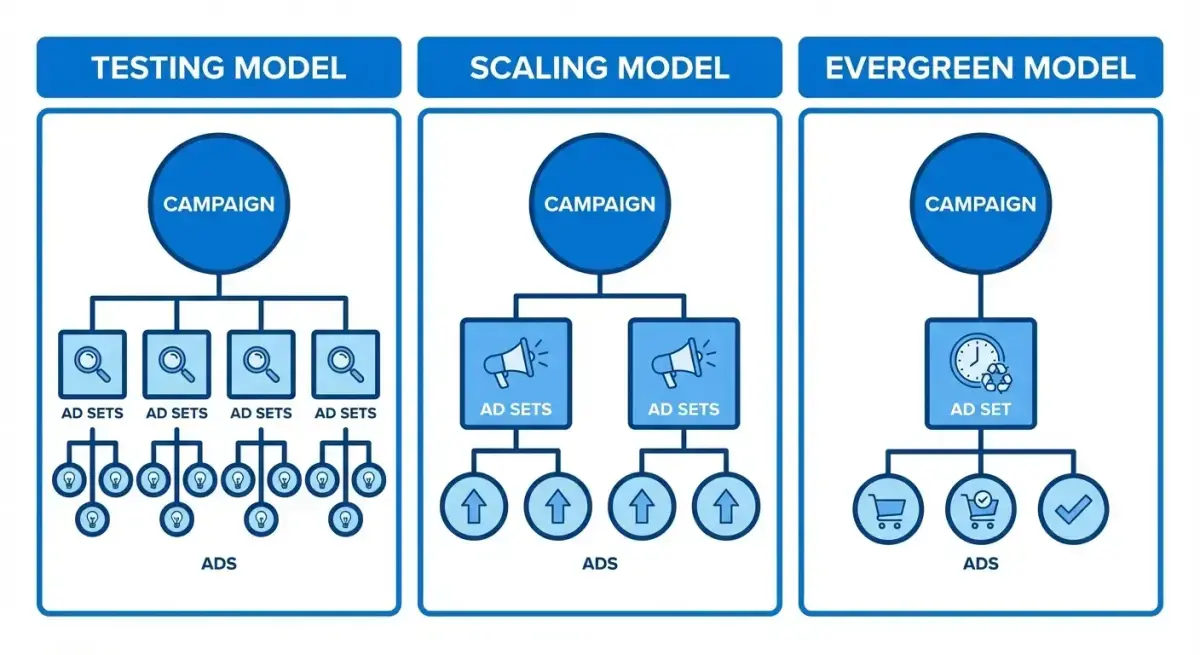 Three campaign structure models for different stages of your Facebook ads workflow
The Testing Model
Best for: Early-stage accounts, creative testing, new offers.
Structure:
- 1 Testing Campaign (CBO) — low daily budget ($50-100/day)
- 3-5 ad sets with different audiences
- 2-3 ad variants per ad set
- 1 Retargeting Campaign — website visitors, engagers
- 2-3 ad sets segmented by engagement recency
The testing model prioritizes learning. Keep budgets low, iterate fast, and graduate winners to a scaling campaign.
The Scaling Model
Best for: Proven offers with winning creatives.
Structure:
- 1 Broad Prospecting Campaign (CBO) — primary budget holder
- 1-3 ad sets (broad, LAL 1%, LAL 3%)
- Top 3-5 proven creatives per ad set
- 1 Interest-Based Campaign — secondary budget
- 3-5 interest-based ad sets
- Winning creatives only
- 1 Retargeting Campaign — 10-20% of total budget
- Segmented by funnel stage (visited, ATC, initiated checkout)
The scaling model consolidates spend into fewer, larger ad sets to give Meta's algorithm more data per optimization event.
The Evergreen Model
Best for: Always-on brands with consistent offers.
Structure:
- 1 Prospecting Campaign — ongoing top-of-funnel
- 1 Retargeting Campaign — ongoing mid-to-bottom funnel
- 1 Testing Campaign — creative/audience experiments
- 1 Seasonal/Promo Campaign — activated during sales periods
The evergreen model is the most common for mature accounts. It's predictable, easy to manage, and scales well.
Advantage+ Considerations
Meta's Advantage+ Shopping campaigns blur the traditional structure by handling audience targeting automatically. If you're using Advantage+:
- Treat it as its own campaign type — don't mix with manual campaigns
- Still separate by product line or offer if you need granular reporting
- Use the "existing customer" budget cap to control retargeting spend
- Name it clearly so you can distinguish its performance from manual campaigns
Naming Convention System: Templates and Examples
Consistent facebook ad naming conventions are the single highest-ROI organizational habit you can adopt. They take 30 seconds per campaign and save hours of reporting time.
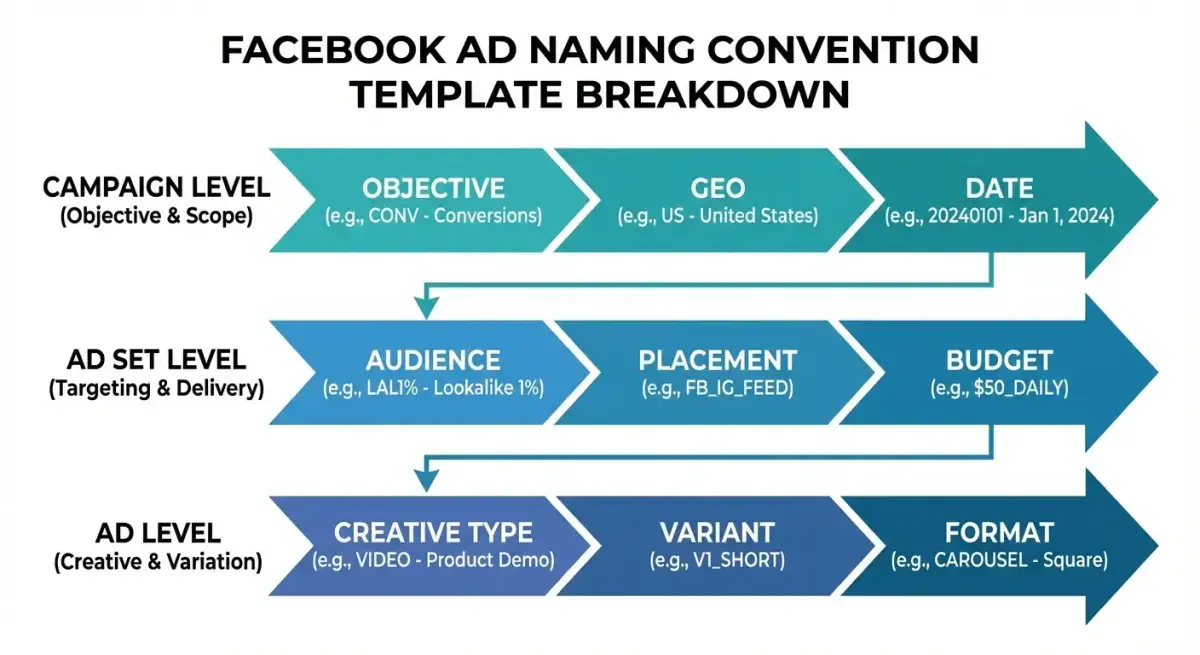 A standardized naming convention template for every level of your Facebook ad account
Campaign Naming Template
[Objective]_[FunnelStage]_[Geo]_[Product/Offer]_[Date]
Examples:
SALES_PROSP_US_MainOffer_2026Q2LEADS_RETARGET_UK_LeadMagnetA_2026MarTRAFFIC_TEST_Global_BlogContent_2026W14SALES_ASC_US_AllProducts_2026Q2(for Advantage+ Shopping)
Ad Set Naming Template
[AudienceType]_[AudienceDetail]_[Placement]_[Budget/BidStrategy]
Examples:
LAL_1pct_Purchase_Auto_CBOINT_FitnessEnthusiasts_FBInsta_Manual30BROAD_18to65_AllPlacements_CBORETARGET_ATC7d_FBFeed_CBO
Ad Naming Template
[CreativeFormat]_[Hook/Angle]_[Version]_[Date]
Examples:
VID_PainPoint_v2_Mar26IMG_Testimonial_v1_Feb26CAR_ProductShowcase_v3_Apr26UGC_Unboxing_v1_Mar26
Key Principles
- Use underscores, not spaces. Underscores are easier to parse programmatically.
- Abbreviate consistently. Create a legend: PROSP = Prospecting, RETARGET = Retargeting, etc.
- Include dates. You'll always want to know when something was created.
- Keep it scannable. You should be able to identify the campaign's purpose from the name alone.
- Align with UTMs. Your campaign names should map cleanly to your UTM_campaign parameter.
Ad Set Organization: Audiences, Budgets, and Placements
Ad set organization is where most media buyers make structural mistakes. The goal is to segment enough for useful reporting without fragmenting Meta's algorithm.
Audience Segmentation Rules
- Don't create one ad set per interest. Group related interests into themed ad sets (e.g., "Fitness" includes gym, CrossFit, yoga).
- Separate lookalike percentages. LAL 1%, LAL 3%, and LAL 5% should be different ad sets — they have meaningfully different audience quality.
- Keep retargeting windows logical. Segment by engagement recency: 3-day, 7-day, 14-day, 30-day.
- Exclude overlaps. Use audience exclusions to prevent retargeting audiences from appearing in prospecting campaigns, and vice versa.
Budget Distribution Framework
A practical starting point for budget allocation:
- 60-70% to prospecting (top of funnel)
- 20-30% to retargeting (mid/bottom of funnel)
- 10% to testing (new creatives, audiences)
Use CBO at the campaign level when you have 2-3 ad sets with similar audience sizes. Use ad set budgets (ABO) when you need precise control over spend distribution — common in testing phases.
Placement Decisions
For most advertisers, Advantage+ placements (automatic) outperform manual selection. However, there are valid reasons to separate:
- When creative varies by placement — Story-format content vs Feed content
- When performance differs dramatically — If Audience Network eats budget without converting
- For reporting purposes — When you need clean per-placement metrics
If separating, create distinct ad sets per placement group, not per individual placement.
Creative Naming That Makes Reporting Easy
Your ad-level naming convention is especially critical when you're testing dozens of creative variants. Here's a system that scales:
The Component System
Break every creative name into components:
- Format: IMG, VID, CAR, UGC, DPA
- Hook/Angle: The primary message or approach
- Variant: v1, v2, v3 for iterations
- Copy version: A, B, C for different text treatments
- Audience indicator: (optional) if running same creative to different audiences
Full example:
VID_PainPoint_v2_CopyB_Mar26
IMG_SocialProof_v1_CopyA_Apr26
CAR_BeforeAfter_v3_CopyC_Feb26
Why This Matters for Reporting
With consistent creative naming, you can:
- Filter by format to see which type (video vs image) performs best
- Filter by angle to identify which messaging resonates
- Compare versions to measure iterative improvement
- Track copy performance independently from visual performance
This is where studying competitor creative rotation patterns becomes valuable. If a competitor has been running the same carousel format for 90 days, that's a strong signal about what works.
Want to see how top advertisers structure their creative rotation? See how top advertisers structure their campaigns — research with Adligator free
Multi-Client Account Structure for Agencies
Agencies face a unique structural challenge: maintaining consistency across dozens of accounts with different team members.
Account-Level Organization
- One Business Manager per agency with sub-Business Managers per client (if needed)
- Separate ad accounts per client — never share ad accounts
- Standardized naming prefix per client:
[ClientCode]_[Campaign...] - Shared pixel/CAPI setup per client domain
Cross-Account Naming Standards
Create a naming convention document that every team member follows:
| Element | Format | Example |
|---|---|---|
| Client prefix | 3-4 letter code | ACME |
| Objective | Standard abbreviation | SALES, LEADS |
| Funnel stage | Standard abbreviation | PROSP, RETARGET, TEST |
| Geo | ISO country code | US, UK, DE |
| Date | Year + Quarter/Month | 2026Q2, 2026Mar |
Full agency campaign name: ACME_SALES_PROSP_US_MainOffer_2026Q2
Onboarding New Team Members
A clean structure should be self-documenting. If a new media buyer opens the account and can't understand the campaign organization within 10 minutes, your structure needs simplifying.
Include a one-page "Account Map" document for each client:
- Campaign list with purposes
- Naming convention legend
- Audience strategy summary
- Budget allocation rules
Tools for Enforcing Naming Conventions at Scale
Naming conventions only work if they're enforced. Here are practical approaches:
Built-In Meta Tools
- Campaign naming rules in Ads Manager (limited but useful for basic enforcement)
- Automated rules to pause campaigns that don't match naming patterns
- Custom report columns that parse campaign names into dimensions
External Tools
- UTM builders that auto-generate tracking parameters from campaign names
- Spreadsheet templates with data validation for name generation
- Ad management platforms (Revealbot, Madgicx) that enforce naming on creation
Competitive Intelligence
Understanding how successful advertisers structure their campaigns provides useful benchmarks. Tools like Adligator let you analyze competitor creative patterns — how many formats they test, how frequently they rotate creatives, and which ad types they run longest.
 Use Adligator to research how top advertisers structure and rotate their ad creatives
This data informs your own structure. If you see a competitor running 15 active creatives across 3 format types, you know their account probably uses a testing-plus-scaling model — and you can benchmark your own setup accordingly.
Common Structure Mistakes That Kill Performance
Avoid these structural pitfalls that sabotage even experienced media buyers:
1. Too Many Campaigns
The problem: 20+ active campaigns with $10-50/day each. Meta's algorithm needs ~50 conversion events per week per ad set to exit learning phase. Fragmented budgets make this impossible.
The fix: Consolidate to 3-7 campaigns. Merge similar objectives. Let CBO distribute budget to winning ad sets.
2. Mixing Objectives in One Campaign
The problem: Prospecting and retargeting ads in the same campaign compete for budget, making it impossible to control funnel-stage spending.
The fix: Always separate by funnel stage. One campaign for prospecting, one for retargeting.
3. Inconsistent or Missing Names
The problem: Campaigns named "Test 1," "New Campaign," or "Copy of SALES_US_2025Q4." Nobody knows what they are.
The fix: Enforce naming conventions from day one. Rename existing campaigns retroactively during your next audit.
4. Audience Overlap
The problem: The same user appears in multiple ad sets across different campaigns. This causes self-competition and inflated CPMs.
The fix: Use audience exclusions. Exclude purchasers from prospecting. Exclude retargeting custom audiences from broad campaigns.
5. Never Archiving Old Campaigns
The problem: Hundreds of paused campaigns cluttering the account, making navigation impossible.
The fix: Archive completed campaigns monthly. Use the date component in your naming convention to identify candidates.
6. Ignoring Advantage+ Campaign Types
The problem: Trying to force traditional structure onto Advantage+ Shopping campaigns, or not accounting for them in your naming scheme.
The fix: Give Advantage+ campaigns their own category in your naming convention (e.g., ASC_ prefix). Monitor their audience overlap with manual campaigns using the Audience Overlap tool.
Migrating a Messy Account to Clean Structure
If you're inheriting or fixing a disorganized account, here's a practical migration workflow:
Step 1: Audit the Current State
- Export all campaigns, ad sets, and ads to a spreadsheet
- Categorize each campaign by actual objective and funnel stage
- Identify overlapping audiences
- Note which campaigns are active, paused, or should be archived
Step 2: Design Your Target Structure
Using the models above, map out:
- How many campaigns you need
- What each campaign's purpose is
- Your naming convention template
- Audience segmentation plan
Step 3: Build New Campaigns (Don't Rename Old Ones)
Create fresh campaigns with your new naming convention rather than renaming existing ones. This gives you:
- A clean learning phase
- No confusion between old and new structure
- Easy before/after performance comparison
Step 4: Migrate Winning Assets
- Move your best-performing creatives to the new campaigns
- Duplicate (don't move) audiences to preserve social proof where possible
- Set up proper exclusions in the new structure
Step 5: Phase Out Old Campaigns
- Gradually reduce budget on old campaigns over 3-7 days
- Increase budget on new campaigns at the same rate
- Archive old campaigns once new ones stabilize
Step 6: Document Everything
Create your Account Map document while the structure is fresh. Future you (or your replacement) will thank you.
Common Migration Mistakes
Don't rush the transition. Cutting old campaigns instantly and launching new ones at full budget disrupts Meta's delivery system. Gradual migration over a week gives the algorithm time to calibrate on your new structure.
Don't change everything at once. If you're restructuring campaigns AND testing new creatives AND changing audiences simultaneously, you won't know what caused any performance shift. Migrate structure first, then optimize creatives within the new framework.
Don't forget pixel continuity. Your pixel data and conversion history carry over regardless of campaign structure, but custom conversions and event-based optimizations should be verified after migration.
Do preserve social proof. When possible, use the "Use Existing Post" feature to maintain likes, comments, and shares from high-performing ads. Social proof significantly impacts CTR and CPMs, especially in competitive markets.
Migration Checklist
- All campaigns follow naming convention
- Audiences are segmented without overlap
- Retargeting is separated from prospecting
- CBO vs ABO is intentionally chosen per campaign
- UTM parameters align with campaign names
- Testing campaigns are isolated from scaling campaigns
- Advantage+ campaigns have distinct naming
- Old campaigns are archived, not just paused
FAQ
What is the best Facebook ad account structure?
The best structure separates campaigns by objective (prospecting, retargeting, testing) with consistent naming conventions. Use three to five core campaigns with clearly segmented ad sets by audience type, and keep creative variants organized at the ad level.
How to name Facebook ad campaigns?
Use a standardized template like ObjectiveGeoAudience_Date. For example: PROSP_US_LAL1pct_2026Q2. Keep it consistent across your entire account so you can filter and report at a glance.
How many campaigns should I have in one ad account?
Most media buyers perform best with 3-7 active campaigns per account. Too few limits segmentation; too many fragments the algorithm's learning phase. Group by objective, not by individual product or offer.
How to organize Facebook ads for agencies?
Use separate ad accounts per client through Business Manager, standardize naming conventions across all accounts, and implement a shared naming template document. Assign consistent prefixes per client for easy cross-account reporting.
What naming convention should I use for Meta ads?
Use a hierarchical naming system: Campaign level includes objective, geo, and funnel stage. Ad Set level adds audience type and budget tier. Ad level specifies creative format, variant, and version number. Separate elements with underscores for easy parsing.
Conclusion
A well-organized facebook ad account structure isn't glamorous, but it's the foundation that makes everything else — scaling, reporting, collaboration, optimization — actually work. Start with a clear campaign hierarchy, enforce naming conventions from day one, and choose a structure model that matches your current phase.
The media buyers who scale fastest aren't the ones with the best creatives (though that helps). They're the ones who can identify what's working, kill what isn't, and communicate clearly across their team — all of which starts with structure.
Ready to see how top-performing advertisers organize their campaigns? See how top advertisers structure their campaigns — research with Adligator free
Related Reading
- How to Allocate Your Facebook Ads Budget for Testing: A Practical Framework for Solo Media Buyers
- Top 10 Facebook Ads Mistakes That Waste Budget: An Audit Checklist for Media Buyers (2026)
- Facebook Ad Compliance Guide for Media Buyers: How to Avoid Account Bans While Running Aggressive Creatives in 2026
- How to Write High-Converting Facebook Ad Copy Using Competitor Spy Data: A Copywriting Framework for Media Buyers
