Facebook Ad Benchmarks by Industry in 2026: What Ad Spy Data Reveals
If you're spending money on Facebook ads, you need context. Is a $15 CPM good or terrible? Should you refresh creatives every week or every month? How saturated is your vertical compared to others?
Facebook ad benchmarks by industry answer these questions — but most published benchmarks only cover platform-reported metrics like CPC and CTR. They miss what ad intelligence data uniquely reveals: how long creatives actually survive in the wild, how many advertisers crowd each vertical, and which industries see the fastest creative fatigue.
This guide combines publicly available benchmark data with insights that only ad spy tools can provide. You'll get CPM ranges, creative lifespan averages, and competition density signals across major verticals — plus a framework for tracking these metrics yourself.
Methodology note: Benchmark ranges in this article are based on aggregated data from industry reports (WordStream, Revealbot, AdEspresso), Meta's own published data, and observations from ad intelligence platforms. Exact numbers vary by targeting, geography, and campaign objective. Use these as directional guidance, not absolute targets.
Why Industry Benchmarks Matter for Media Buyers
Benchmarks aren't about hitting an exact number. They're about knowing where you stand relative to your market.
Setting realistic expectations. A $25 CPM in finance is normal. A $25 CPM in ecommerce signals a problem. Without industry context, you might optimize against the wrong baseline.
Identifying opportunity verticals. Lower competition density and CPMs in certain verticals can signal untapped opportunity — especially for agencies and affiliates looking for their next angle.
Planning creative refresh cadence. If the average creative lifespan in your vertical is 10 days, and you're refreshing monthly, you're leaving performance on the table.
Benchmarking against competitors, not averages. Platform averages include everything from poorly run campaigns to world-class media teams. Ad intelligence data lets you benchmark against what's actually winning in your space.
Methodology: How We Collected the Data
Transparency matters when presenting benchmarks. Here's how these numbers were compiled:
- CPM data: Aggregated from publicly available 2025-2026 benchmark reports by WordStream, Revealbot, and AdEspresso, cross-referenced with Meta's published advertising trends
- Creative lifespan data: Derived from ad intelligence platforms that track how long individual ads remain active — a strong proxy for creative performance
- Saturation indicators: Based on the volume and density of active advertisers observed in each vertical through ad spy tools
Important caveats:
- All CPM figures are approximate ranges, not exact measurements
- Creative lifespan varies significantly by creative quality, targeting, and budget
- Saturation is relative — a "high" saturation vertical can still be profitable with strong differentiation
- Geographic focus: primarily US/UK/EU data; other geos will differ
Want to see real-time data for your vertical? Track real-time industry benchmarks with Adligator — start free
CPM Benchmarks by Industry: Ecommerce, Finance, iGaming, SaaS, and More
Here are estimated CPM ranges for major verticals in 2026:
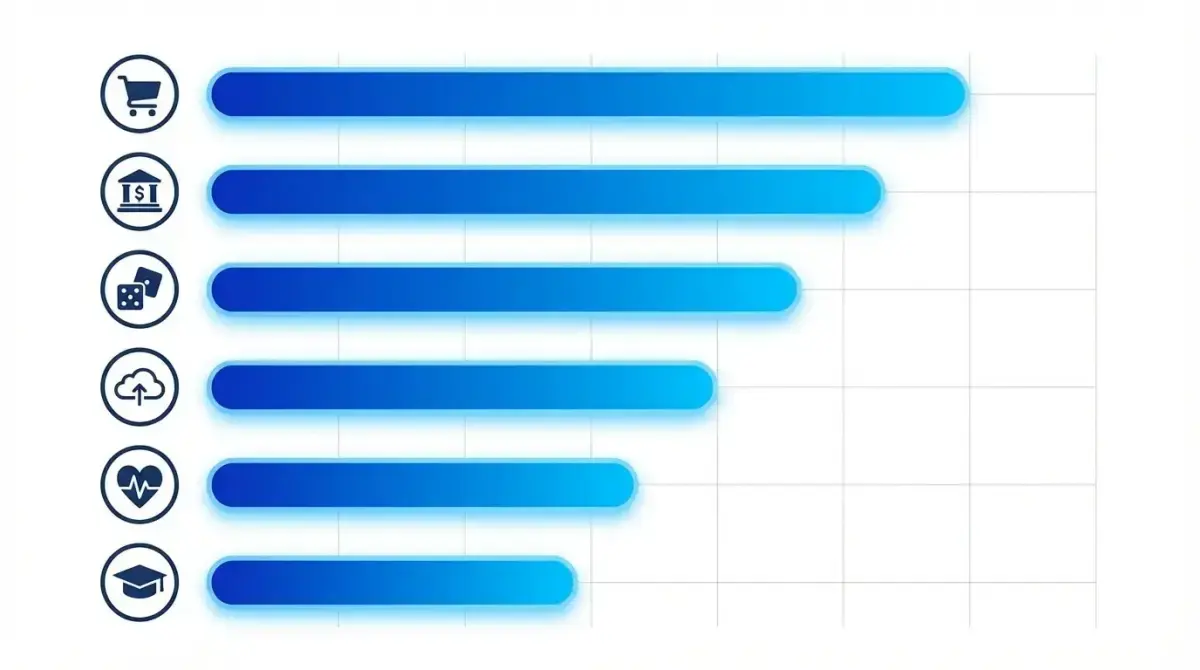 Estimated CPM ranges by industry for Facebook ads in 2026. Ranges based on aggregated industry reports and ad intelligence observations.
Ecommerce / Dropshipping: $8-18 CPM The broadest vertical with the widest range. Low-ticket dropshipping campaigns can achieve $8-12, while branded ecommerce with narrow targeting often hits $14-18. High seasonality — Q4 CPMs can spike 30-50%.
Finance / Insurance / Legal: $15-40 CPM Consistently the most expensive vertical on Facebook. High customer lifetime value justifies premium CPMs. Heavily regulated, which limits creative flexibility and increases compliance costs.
iGaming / Gambling: $12-28 CPM Highly geo-dependent. Tier 1 markets (US, UK, AU) see $18-28, while emerging markets drop to $12-18. Strict platform policies mean frequent ad rejections and account restrictions.
SaaS / B2B Software: $18-40 CPM High CPMs offset by high LTV. Performance varies dramatically between self-serve SaaS (lower CPMs, broader targeting) and enterprise solutions (higher CPMs, precise targeting).
Health & Wellness: $10-22 CPM Wide range depending on sub-niche. Supplements and fitness products sit at $10-16, while medical/pharmaceutical-adjacent campaigns push $18-22 due to policy restrictions.
Education / Online Courses: $8-16 CPM One of the more affordable verticals. Large addressable audiences keep CPMs moderate. Seasonal patterns around new year and back-to-school periods.
Dating / Relationships: $12-25 CPM Competitive in Tier 1 geos. High volume of advertisers, frequent creative fatigue, and strict platform policies on ad content.
Apps / Mobile Gaming: $6-14 CPM Lower CPMs due to broad targeting and high install volumes. The challenge isn't CPM — it's post-install retention and ROAS optimization.
Average Creative Lifespan by Vertical
Creative lifespan — how long an ad runs before the advertiser pauses or replaces it — is one of the most valuable benchmarks you can track. A long-running ad is almost certainly profitable.
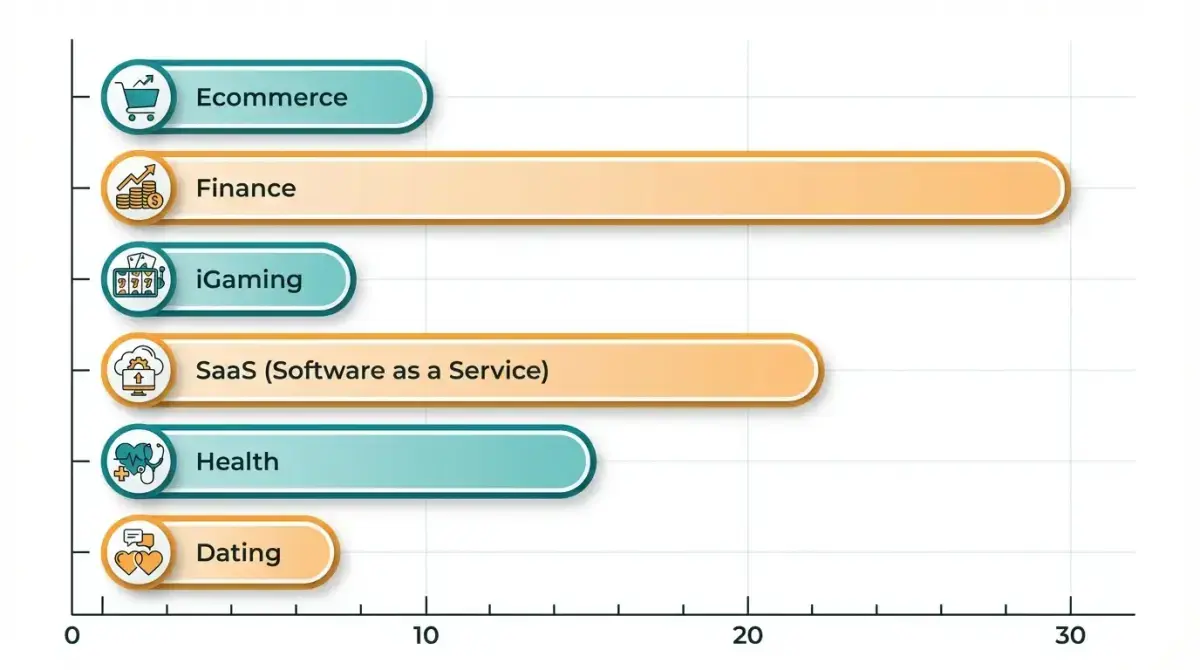 Average creative lifespan by vertical — longer-running ads typically signal strong performance.
Ecommerce: 7-14 days average Fast creative fatigue due to broad audiences and high ad frequency. Top performers can last 21-30 days, but most ecommerce creatives need refreshing biweekly.
Finance: 21-45 days average Longer lifespans because audiences are narrower and creative formats are more informational. Compliance requirements also slow the creative rotation cycle.
iGaming: 5-12 days average One of the shortest lifespans. High competition, frequent creative testing, and platform policy enforcements drive rapid rotation. Top verticals for studying high-velocity creative testing.
SaaS: 14-30 days average Moderate lifespan. Demo and trial-focused creatives last longer than promotional ones. Webinar and educational content ads tend to run the longest.
Health & Wellness: 10-21 days average Varies by sub-niche. Evergreen health tips run longer; seasonal supplement promotions fatigue faster.
Dating: 4-10 days average Among the shortest lifespans in any vertical. Audiences burn through creatives quickly, requiring constant rotation and testing.
What This Means for Your Creative Strategy
If your ads are dying faster than industry average, investigate:
- Is your audience too narrow (frequency too high)?
- Is your creative too similar to what competitors run (ad blindness)?
- Are you testing enough variations?
If your ads last longer than average, that's a competitive advantage — scale them while they perform.
Ad Saturation and Competition Density by Industry
Ad saturation measures how many advertisers compete in a vertical and how crowded the auction is. Higher saturation = more competition for attention and higher costs.
High saturation verticals:
- Finance / Insurance / Legal
- iGaming / Gambling
- Dating / Relationships
- Supplements / Weight Loss
Medium saturation verticals:
- Ecommerce (general)
- SaaS / B2B Software
- Education / Online Courses
Lower saturation verticals:
- Local services
- Niche hobby markets
- B2B industrial
Why saturation matters beyond CPM: In saturated verticals, creative differentiation becomes critical. When 50+ advertisers run similar-looking ads, the ones that break pattern — different format, unexpected hook, contrarian angle — outperform.
Ad intelligence tools let you measure saturation directly by counting unique advertisers and creatives in a keyword or niche category, giving you a data-backed view of competition density.
How to Use Benchmarks to Set Realistic Campaign Goals
Benchmarks are starting points, not targets. Here's how to apply them:
Step 1: Locate your vertical. Find your industry in the CPM and lifespan tables above. Note the range — you'll likely fall somewhere in the middle.
Step 2: Adjust for your geography. US/UK/AU CPMs are typically 30-60% higher than EU averages, and 2-4x higher than Southeast Asia or LATAM.
Step 3: Benchmark against your own data first. Your historical performance is the most relevant baseline. Industry benchmarks help you understand if your numbers are normal — not what they should be.
Step 4: Set creative refresh targets. If your vertical's average creative lifespan is 10 days, plan to have new creatives in testing by day 7. Don't wait for performance to drop.
Step 5: Monitor competitor activity. Benchmarks shift as competition changes. What was a $12 CPM vertical six months ago might be $18 now due to new entrants.
Tracking Industry Trends with Ad Intelligence Tools
Static benchmark reports go stale fast. CPMs shift quarterly, new competitors enter verticals, and creative trends evolve continuously. The most useful benchmarks are the ones you track in real time.
Here's what to monitor and how:
Track creative longevity in your niche. Use ad intelligence tools to filter competitors by days active. Sort by longest-running ads to find proven winners. This is impossible with Meta Ad Library alone.
Monitor new advertiser entries. A sudden spike in new advertisers in your niche means increased competition (and likely rising CPMs) ahead.
Watch creative format trends. If your vertical is shifting from static images to video or carousels, your benchmarks for engagement and lifespan will shift too.
Set up keyword trackers. Instead of manually checking competitors, set up persistent keyword monitors that alert you to new ads matching your niche terms.
How Adligator Helps You Monitor Industry-Level Metrics
Adligator is built specifically for Meta ad intelligence — Facebook, Instagram, Messenger, Audience Network, and Threads across 234 countries. Here's how it maps to benchmark tracking:
Keyword-based search across all advertisers. Search any niche term to see all active ads — instantly measure how many competitors are running and what formats they use. This gives you a real-time saturation read.
Days active filter. Filter ads by how long they've been running. Set "10+ days active" to find proven winners in any vertical. Set "1-3 days active" to see what's being tested right now.
GEO and language filters. Compare benchmark data across different markets. See how CPMs and competition differ between US and EU, or between English and Spanish-language ads.
Format filters. Track whether your vertical is shifting toward video, carousels, or other formats. Filter by display format to see what's dominant.
Live trackers (Pro plan). Save searches as persistent monitors. Get notified when new ads match your keywords or when competitors launch new campaigns — no manual checking required.
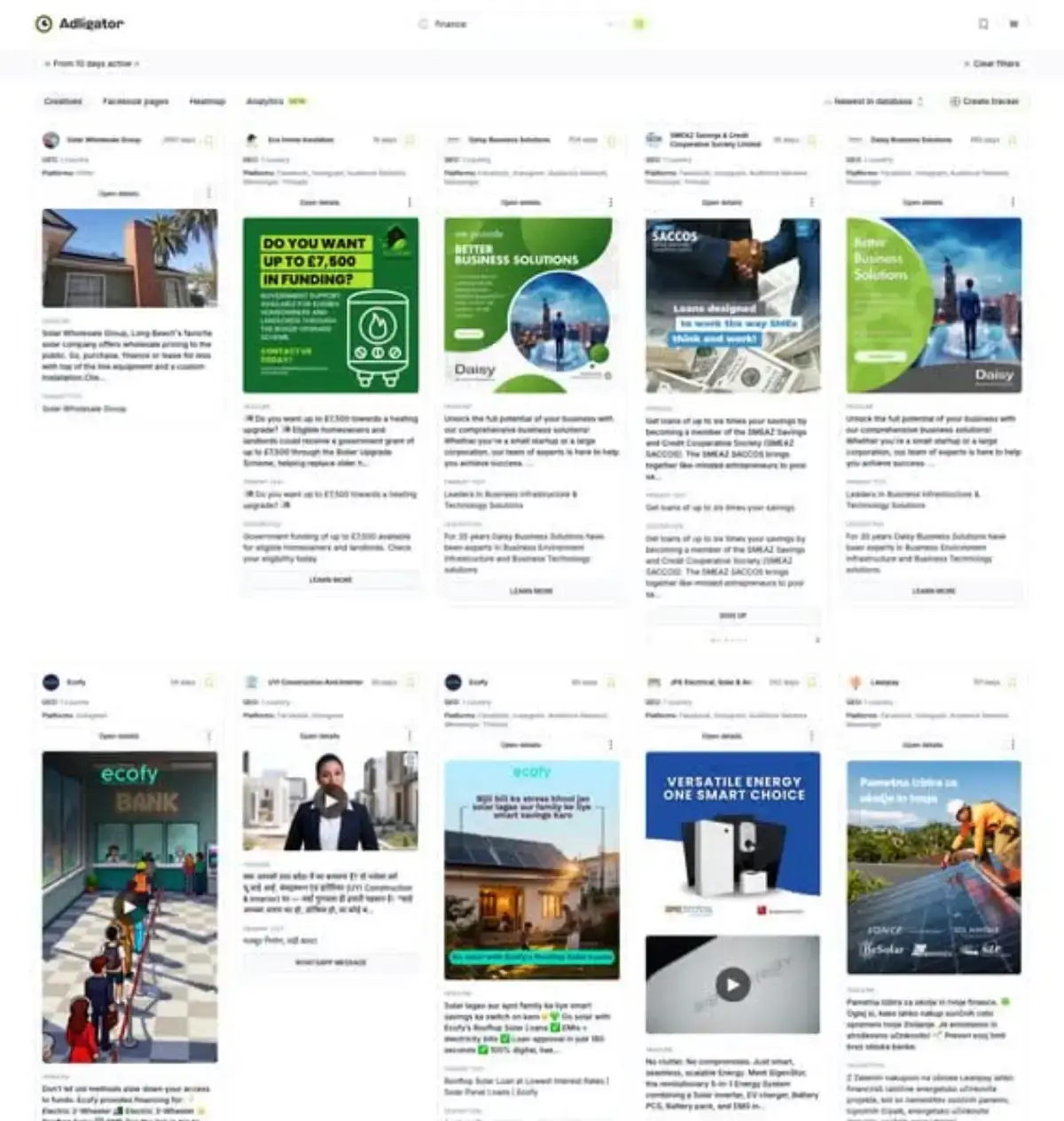 Using Adligator's filters to track ad longevity and competition density in specific verticals.
Instead of relying on quarterly benchmark reports that may be outdated by the time you read them, Adligator gives you the raw data to calculate your own benchmarks — updated in real time, specific to your exact vertical and geography.
FAQ
What is the average CPM for Facebook ads in 2026?
Average Facebook CPM in 2026 varies widely by industry: ecommerce typically sees $8-18, finance $15-40, iGaming $12-28, and SaaS $18-40. These are approximate ranges based on industry reports and ad intelligence data — your actual CPM depends on targeting, creative quality, and competition.
How long do Facebook ad creatives last?
Average creative lifespan varies by vertical: ecommerce creatives often fatigue in 7-14 days, while finance and SaaS ads can run 21-45 days before declining. Ad spy tools that track longevity help you benchmark your creative refresh rate against industry norms.
Which industry has the most competitive Facebook ads?
Finance, insurance, and legal verticals consistently show the highest competition density on Facebook, with high CPMs and shorter creative windows. iGaming and dating also have intense competition, particularly in Tier 1 geos.
Conclusion
Facebook ad benchmarks by industry aren't just vanity metrics — they're the context that turns raw campaign data into actionable decisions. Knowing that your $20 CPM is normal for SaaS (or alarming for ecommerce) changes how you allocate budget, plan creative, and evaluate performance.
The key insight from ad spy data that traditional benchmarks miss: creative lifespan and competition density matter as much as cost metrics. A low CPM means nothing if your creatives die in 5 days and you're competing against 100 other advertisers with the same angles.
Track these benchmarks continuously, not just quarterly. Your competitors aren't waiting for the next WordStream report — and neither should you.
Ready to track real-time benchmarks in your vertical? Track real-time industry benchmarks with Adligator — start free
Related Reading
- Facebook Ad Performance Benchmarks by Vertical in 2026: CPM, CTR, and Creative Lifespan Data for Media Buyers
- How to Use AI-Powered Ad Intelligence to Predict Winning Facebook Creatives Before You Spend
- Facebook Ads Frequency Benchmarks by Vertical: When Creative Fatigue Hits and What to Do (2026)
- How to Estimate Competitor Facebook Ad Spend Using Spy Tools and Ad Library Data
