
Facebook Ad Compliance Guide for Media Buyers: How to Avoid Account Bans While Running Aggressive Creatives in 2026
Losing a Facebook ad account is the nightmare scenario for every media buyer. One day you are scaling a profitable campaign; the next, your account is disabled with a vague "policy violation" notice and no clear path to recovery. The worst part: Meta's written policies are intentionally broad, leaving you guessing where the real boundaries are.
This facebook ad compliance guide takes a different approach. Instead of just listing Meta's rules (which you can read yourself), it focuses on practical compliance — the gap between what the policy says and what actually gets enforced. Using spy data from competitors in sensitive verticals, you can see which aggressive creative approaches survive Meta's review system for weeks and months, giving you a real-world reference for where the boundaries actually are.
Whether you run health supplements, financial services, gaming, or any vertical where aggressive creatives are the norm — this guide helps you push performance without risking your account.
Why Facebook Ad Accounts Get Banned
Before discussing prevention, let us understand the mechanisms that trigger bans:
The Violation Accumulation Model
Meta does not typically ban accounts for a single ad rejection. Instead, it uses a scoring system where violations accumulate over time. Think of it as a "trust score" — each rejection lowers your score, and when it drops below a threshold, account-level action follows.
This means:
- Occasional ad rejections are normal and recoverable
- Repeated rejections in a short period are dangerous
- Rejections in "sensitive" categories (health claims, financial promises, political content) carry more weight
- Successfully running compliant ads rebuilds your score over time
Common Ban Triggers
High rejection rate: If more than 10-15% of your ad submissions get rejected, Meta flags your account for review. This is especially dangerous when testing many creatives rapidly — each rejection counts against you.
Circumventing the review system: Editing approved ads to change their meaning, using cloaking (showing different content to reviewers vs. users), or submitting identical ads that were previously rejected. Meta's AI detection for these patterns has improved dramatically.
Misleading claims: Unsubstantiated health claims, unrealistic financial returns, fake scarcity, misleading before/after images. These are the most common triggers in ecommerce and health verticals.
Landing page violations: Your ad might pass review, but if your landing page contains content that violates policies (fake testimonials, hidden charges, misleading claims), Meta can ban your account retroactively.
Payment and identity issues: Suspicious payment patterns, mismatched business information, or using personal accounts for commercial purposes can trigger automated bans unrelated to ad content.
The Three Compliance Zones
Understanding where your creative falls on the compliance spectrum is the first step to avoiding bans:
 Understanding the three compliance zones helps you push boundaries without crossing lines.
Green Zone: Clearly Compliant
Creatives that will pass review consistently:
- Generic benefit statements without specific claims ("Support your wellness journey")
- Product demonstrations showing actual functionality
- Customer testimonials with proper disclosures
- Comparative claims backed by verifiable data
- Lifestyle imagery that does not imply guaranteed outcomes
Gray Zone: Enforcement Varies
Creatives that may or may not pass review depending on context, reviewer, and account history:
- Before/after imagery (compliant when showing product usage, risky when implying health transformation)
- Performance claims with qualifiers ("Results may vary," "Based on user surveys")
- Urgency tactics (countdown timers, limited stock claims)
- Competitive comparisons without naming competitors directly
- User-generated content with strong outcome claims
Red Zone: High Ban Risk
Creatives that will likely trigger rejections and potentially account-level action:
- Unsubstantiated health claims ("Lose 20 lbs in 2 weeks")
- Guaranteed financial returns ("Make $10,000/month guaranteed")
- Personal attribute targeting in ad copy ("Are you overweight?", "Struggling with debt?")
- Misleading functionality claims (fake UI elements, fake system notifications)
- Content that promotes circumventing platform rules
Using Spy Data as a Compliance Reference
This is where competitive intelligence becomes a compliance tool. By analyzing what aggressive creatives in your vertical have been running for 30+ days, you get real-world evidence of what Meta's review system approves in practice.
How to Build a Compliance Reference Library
- Search your vertical's keywords in a spy tool
- Filter by days active: 30+ — these ads passed initial review AND ongoing monitoring
- Focus on sensitive creatives — the ones that push boundaries (strong claims, dramatic visuals, aggressive CTAs)
- Screenshot and categorize by claim type, imagery approach, and copy structure
- Note what they avoid — the absence of certain claims is as informative as their presence
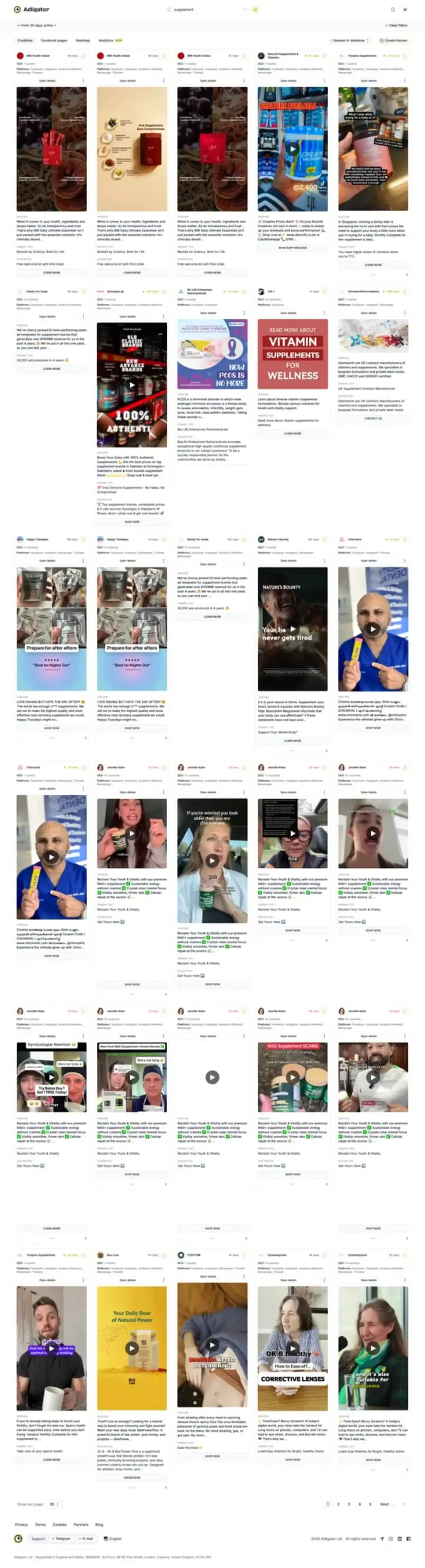 Long-running ads in sensitive verticals serve as real-world compliance references — Meta approved them.
What Long-Running Ads Tell You
If a supplement brand has been running an ad with a specific claim structure for 45 days, you know:
- The claim structure passed Meta's automated review
- It survived manual review (Meta randomly reviews approved ads)
- It has not been reported by users at a rate that triggers removal
- The advertiser's account is in good standing
This is not a guarantee that an identical approach will work for you — but it is a strong signal of practical compliance boundaries in your vertical.
Want to see which aggressive creatives Meta actually approves in your vertical? See what aggressive creatives Meta actually approves in your vertical
Compliance Strategies by Vertical
Health & Supplements
The most heavily moderated vertical on Meta. Key strategies:
- Replace claims with stories: Instead of "This supplement boosts energy by 300%," use "Here's how I changed my morning routine" — narrative framing avoids triggering claim-detection algorithms.
- Use qualifiers consistently: "May support," "designed to help," "as part of a balanced diet." Every outcome statement needs a qualifier.
- Avoid personal attributes: Never address the user's health status directly. "Support your wellness goals" is safe; "Fix your low energy" targets a personal attribute.
- Landing page alignment: If your ad is compliant but your landing page makes aggressive claims, you will get banned. Ensure end-to-end compliance.
Financial Services & Fintech
- No guaranteed returns: Any mention of guaranteed financial outcomes is an immediate red flag. Use past performance with disclaimers instead.
- Regulatory disclosures: Include required disclaimers for financial products. Missing disclosures trigger rejections more consistently than any other violation in this vertical.
- Avoid income claims in ads: Show the product/platform features, not user earnings. Testimonials about income are treated as claims.
Ecommerce & Dropshipping
- Product accuracy: Images and descriptions must match the actual product. Misleading product photos are a top ban trigger for ecommerce accounts.
- Shipping and pricing transparency: Hidden fees, unclear shipping times, and bait-and-switch pricing structures trigger both ad rejections and account reviews.
- Customer reviews: Fake reviews or reviews for different products are detectable by Meta's review system and carry heavy penalties.
Gaming & Apps
- Accurate gameplay: Ads must represent actual app functionality. Fake gameplay ads are a known enforcement priority for Meta.
- Age-gating: Games with gambling-adjacent mechanics need proper age restrictions in targeting.
- Reward claims: "Win real money" or "Earn rewards" claims require careful qualification and often need additional approvals.
Pre-Submission Compliance Checklist
Run through this checklist before submitting any aggressive creative:
 Run through this checklist before submitting any aggressive creative to Meta's review system.
Claims:
- ☐ All health/financial/performance claims include qualifiers
- ☐ No guaranteed outcomes stated or implied
- ☐ Testimonials include "results may vary" or equivalent
- ☐ Comparative claims are based on verifiable data
Imagery:
- ☐ Before/after images show realistic, non-deceptive transformations
- ☐ No fake UI elements (system notifications, message bubbles)
- ☐ Product images accurately represent the actual product
- ☐ No shocking or sensational imagery
Copy:
- ☐ No personal attribute targeting ("Are you...?")
- ☐ No deceptive urgency (fake countdown timers that reset)
- ☐ CTA matches the actual landing page action
- ☐ Required regulatory disclosures are included
Landing Page:
- ☐ Claims on landing page are consistent with (or weaker than) ad claims
- ☐ Pricing is transparent — no hidden fees
- ☐ Contact information and business identity are visible
- ☐ Privacy policy and terms are accessible
Account Health:
- ☐ Recent rejection rate is below 10%
- ☐ No pending policy violation notices
- ☐ Business verification is complete and up to date
Building a Compliance-First Creative Workflow
The best defense against account bans is a systematic approach to compliance built into your creative production process.
Step 1: Pre-Production Compliance Brief
Before any creative work begins, define the compliance boundaries for the campaign:
- List specific claims that are allowed and disallowed based on your vertical
- Define approved qualifier language ("may help," "designed to support," "results vary")
- Provide compliance reference examples from spy data — actual long-running ads in your vertical
- Specify landing page requirements
Step 2: Creative Review Before Submission
Every creative should pass through a compliance review before going to Meta. This is not just a legal review — it is a practical check against known enforcement patterns:
- Does the copy contain any personal attribute targeting language?
- Are all claims qualified appropriately?
- Do the visuals accurately represent the product or service?
- Would a conservative reviewer flag anything as misleading?
- Does the landing page align with ad messaging?
Step 3: Staged Rollout for Aggressive Creatives
Never launch aggressive creatives at scale immediately:
- Submit 1-2 aggressive variants alongside 3-4 clearly compliant creatives
- Wait 24-48 hours for review results
- If approved, run at low budget ($10-20/day) for 3-5 days
- Monitor for late-stage rejections (Meta can reject ads after initial approval)
- Only scale after 5+ days of stable delivery without issues
This staged approach protects your account health because:
- If aggressive creatives get rejected, your rejection rate stays low (diluted by compliant ads)
- Late-stage rejections are caught before significant spend
- Your account history shows a pattern of mostly compliant behavior
Step 4: Ongoing Monitoring
Even after creatives pass review:
- Check rejection rates weekly — keep below 10%
- Monitor for "Ad not delivering" warnings which can indicate stealth rejections
- Track competitor compliance patterns monthly — enforcement priorities shift
- Update your compliance brief quarterly based on new policy changes and enforcement patterns
Meta's Enforcement Trends for 2026
Understanding where Meta is tightening enforcement helps you stay ahead:
AI-driven review is getting smarter. Meta's automated review system now detects subtle policy violations including misleading implications in images, deceptive urgency patterns, and cloaking attempts. The days of sneaking borderline content through automated review are ending.
Landing page scanning is expanding. Meta increasingly scans landing pages not just at submission but periodically after approval. Changing your landing page after ad approval to add non-compliant content is a fast path to account termination.
User reporting carries more weight. High volumes of "misleading" or "scam" reports from users can trigger ad removal and account review even for ads that passed initial compliance screening. Creative quality and honest advertising reduce report rates.
Vertical-specific enforcement waves. Meta periodically intensifies enforcement in specific verticals (often coinciding with regulatory pressure or media attention). Health supplements, cryptocurrency, and political advertising have all been subject to enforcement waves. Spy data can help you detect these waves early — when you see many long-running competitors suddenly disappear, an enforcement shift is likely underway.
Business verification requirements are expanding. Meta is requiring more businesses to complete identity verification before running ads in sensitive categories. Complete verification proactively rather than waiting for a mandatory request.
Recovery: What to Do When You Get Banned
If prevention fails, here is the recovery playbook:
Step 1: Do not panic or create new accounts. Creating new accounts to circumvent a ban is itself a bannable offense that makes recovery harder.
Step 2: Submit an appeal immediately. Use Meta's appeal form with a clear, professional explanation. Acknowledge any violations, explain what you have changed, and reference specific policy sections.
Step 3: Review all active and recent ads. Identify any that might have contributed to the ban. Remove or pause anything questionable.
Step 4: Check your landing pages. Often the ban trigger is on the landing page, not the ad itself. Fix any compliance issues before appealing.
Step 5: Be patient but persistent. First appeals are often auto-rejected. Submit a second appeal with additional detail if the first is denied. Response times vary from 24 hours to 2+ weeks.
Step 6: Document everything. Keep records of all communications, policy changes you have made, and timeline of events. This documentation helps if you need to escalate through Meta's support channels.
FAQ
What triggers a Facebook ad account ban?
Common triggers include repeated policy violations (especially in health, finance, and political ads), circumventing the review process, using misleading before/after images, making unsubstantiated claims, and having a high ad rejection rate. A single violation rarely causes a ban — it is usually a pattern of behavior that triggers account-level action. Maintaining a low rejection rate and addressing violations quickly are the best preventive measures.
How can I check if my ad creative is compliant before submitting?
Use Meta's Ad Policy checklist as a baseline, then cross-reference with spy tool data to see what similar creatives in your vertical are running successfully. If competitors in your niche have been running similar content for 30+ days, Meta has implicitly approved that approach. Always start with a small budget test before scaling aggressive creatives, and monitor your rejection rate closely during the first 48 hours.
Can spy tools help with Facebook ad compliance?
Yes. By analyzing which creatives in sensitive verticals (health, finance, supplements) have been running for extended periods, you can identify the practical boundaries of Meta's enforcement. Long-running ads in your vertical serve as real-world examples of what passes review. This does not replace reading Meta's policies, but it fills the gap between written rules and actual enforcement.
Conclusion
Facebook ad compliance in 2026 is not about playing it safe — it is about playing it smart. The media buyers who succeed are not the ones avoiding aggressive creatives entirely; they are the ones who understand exactly where the boundaries are and build their creative strategy accordingly.
Use Meta's written facebook ad policies 2026 as your foundation. Use spy data to understand practical enforcement. Build a compliance reference library specific to your vertical. And always prioritize account health over short-term creative aggression — because the most expensive ad is the one that costs you your account.
Ready to see what aggressive creatives pass Meta's review in your vertical? See what aggressive creatives Meta actually approves in your vertical
Research compliant creative patterns with Adligator →
Related Reading
- How to Analyze Facebook Ad Creatives by GEO and Vertical: A Data-Driven Approach for Media Buyers
- Facebook Ad Account Structure and Naming Conventions: A Scaling Framework for Media Buyers
- How to Write High-Converting Facebook Ad Copy Using Competitor Spy Data: A Copywriting Framework for Media Buyers
- Facebook Ad Performance Benchmarks by Vertical in 2026: CPM, CTR, and Creative Lifespan Data for Media Buyers
- Meta's July 2026 Health & Wellness Policy Update: Before/After Is Back — Here's What Advertisers Are Already Running
- Nobody Is Making Threads Ads: What 3,000+ Long-Running Threads Placements Reveal — and Why That's Your Opening
