How to Write High-Converting Facebook Ad Copy Using Competitor Spy Data: A Copywriting Framework for Media Buyers
Most media buyers treat ad copywriting as a creative exercise — sit down, stare at a blank page, and try to come up with something clever. The result: inconsistent quality, slow production, and too many underperforming ads.
There's a better approach. A facebook ad copywriting framework built on competitor spy data replaces guesswork with proven structures. When you can see which hooks, body structures, and CTAs survive weeks of spending in your niche, you're not starting from zero — you're starting from validated patterns.
This guide gives you a repeatable framework for writing ad copy from spy data: extract the formula, adapt it with your differentiation, and produce copy that has a structural head start before it ever goes live.
Why Spy Data Makes You a Better Copywriter
Traditional copywriting advice tells you to "know your audience" and "write benefits, not features." That's true but useless when you're staring at an empty Google Doc at 9 AM with ten ad variants due by noon.
Ad copy competitor research gives you something concrete to work with:
- Proven hooks that stop the scroll in your niche
- Body structures that keep attention long enough to convert
- CTA patterns that match your audience's buying stage
- Tone and voice that resonates with your specific market
- Copy length that works (short vs. long-form)
You're not copying — you're extracting the structural formula and filling it with your own content. Like a musician who studies chord progressions: the structure is borrowed, the melody is original.
The Three-Part Copy Structure
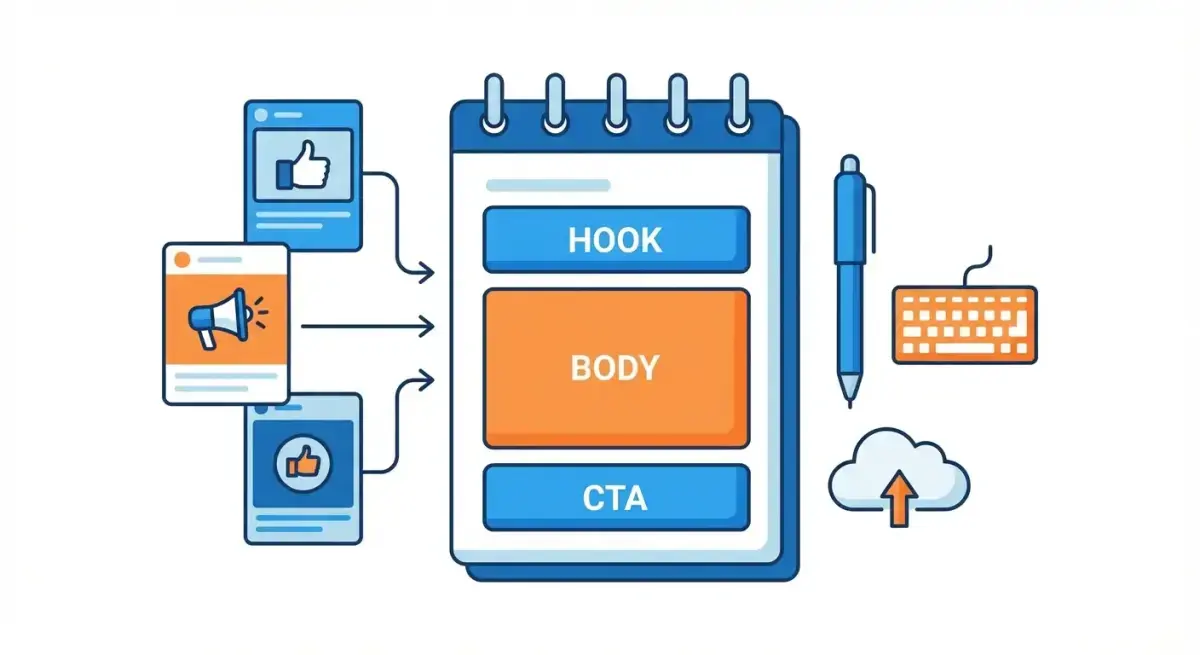
Every high-converting Facebook ad copy follows a three-part structure, regardless of niche or format.
 Every high-converting Facebook ad follows this three-part copy structure.
Part 1: The Hook (First 1-2 Lines)
The hook is the only part that matters on mobile. It's visible before the "See more" truncation. If it doesn't stop the scroll, the rest of your copy doesn't exist.
When analyzing competitor ads, pay attention to the first line only. That's the hook. Everything else is secondary.
Part 2: The Body (Expandable Content)
The body delivers on the hook's promise. It builds the case for action through:
- Pain point elaboration
- Benefit stacking
- Social proof or evidence
- Objection handling
Body copy length varies by niche and funnel stage. Spy data tells you what works: if competitors with 14+ day ads use 3 paragraphs, that's your benchmark.
Part 3: The CTA (Closing Line)
The CTA tells the reader exactly what to do next. It should align with:
- The ad's CTA button (Shop Now, Learn More, Sign Up)
- The landing page's primary action
- The reader's stage in the buying journey
When analyzing competitor copy, check whether the text CTA matches the button CTA. The strongest ads maintain perfect alignment.
Hook Formulas: The Six Types That Work
After analyzing thousands of Facebook ads, hook patterns cluster into six categories. When you study competitor ads, classify each hook into one of these types to build your formula library.
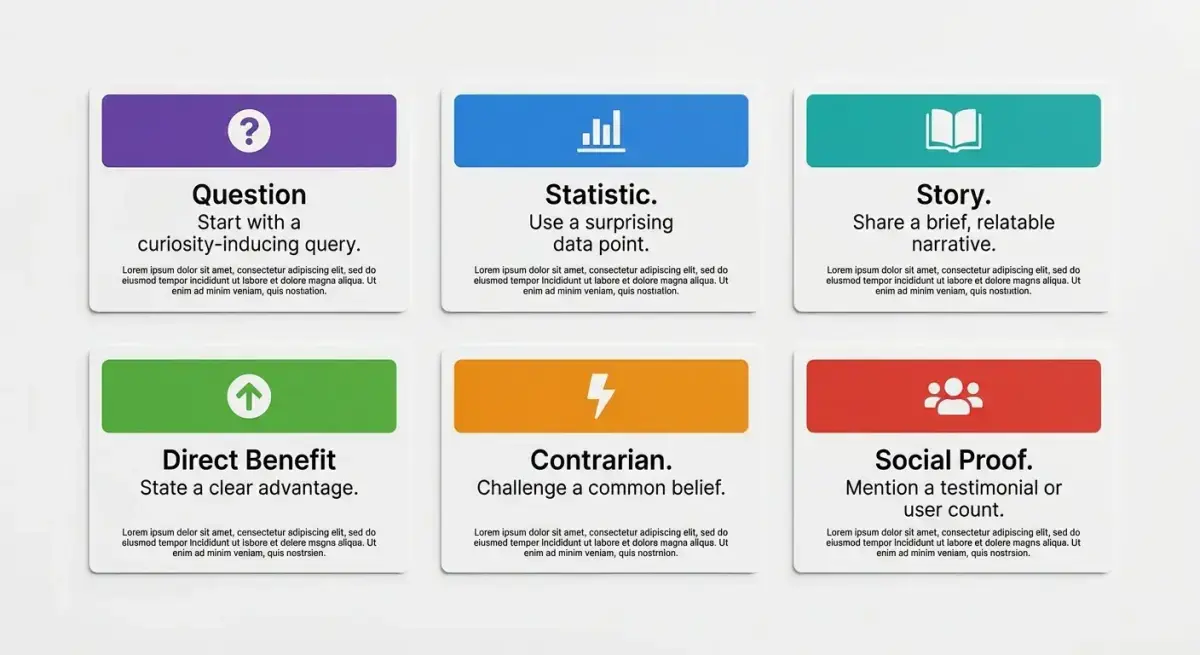 Six proven hook formulas you can extract from competitor ads and adapt for your own copy.
1. The Question Hook
Formula: Ask a question that makes the reader answer "yes" or "that's me."
Structure: "Pain point question?" or "Ever wondered curiosity gap?"
Why it works: Questions create a mental pause. The reader instinctively tries to answer, which breaks the scroll pattern.
Best for: TOFU awareness, emotional products, problem-solution positioning
2. The Statistic Hook
Formula: Lead with a specific, surprising number.
Structure: "X% of audience problem/opportunity" or "Number result in timeframe"
Why it works: Specific numbers feel credible and create curiosity about the source or solution.
Best for: B2B, SaaS, data-driven audiences, credibility-first positioning
3. The Story Hook
Formula: Start with a micro-narrative that the reader identifies with.
Structure: "Last timeframe, character situation..." or "I used to old behavior until..."
Why it works: Stories bypass the brain's ad-detection filter. The reader engages before realizing it's an ad.
Best for: UGC-style ads, testimonial-based campaigns, emotional products
4. The Direct Benefit Hook
Formula: State the primary benefit immediately, without preamble.
Structure: "Get specific result without common obstacle" or "Result in timeframe. No common requirement."
Why it works: For audiences with clear intent, directness beats cleverness. They know what they want — show them you have it.
Best for: BOFU direct response, clear product-market fit, price-sensitive audiences
5. The Contrarian Hook
Formula: Challenge a common belief or practice.
Structure: "Stop common practice" or "Common advice is wrong. Here's why."
Why it works: Contrarian statements create cognitive dissonance. The reader needs to resolve it, which means they keep reading.
Best for: Expert audiences, saturated markets, thought leadership positioning
6. The Social Proof Hook
Formula: Lead with evidence that others have already succeeded.
Structure: "Number+ people already result" or "Rated score by number audience type"
Why it works: Social proof reduces perceived risk. If others have done it, it feels safer.
Best for: Products with adoption curves, trust-sensitive categories, competitive markets
How to Extract Copy Patterns from Competitor Ads
The framework is only useful if you can fill it with data. Here's the step-by-step process for extracting facebook ad copy examples from competitor research:
Step 1: Collect 20-30 Long-Running Competitor Ads
Filter for ads running 10+ days. These are the proven performers. Collect the full ad copy text — hook, body, and CTA.
Step 2: Classify Each Hook
For every ad, identify the hook type (question, statistic, story, benefit, contrarian, or social proof). Create a tally: which types appear most frequently?
Step 3: Analyze Body Structure
Note:
- Copy length (short, medium, long-form)
- Number of paragraphs
- Use of bullet points or lists
- Emoji usage (none, light, heavy)
- Tone (formal, casual, urgent, authoritative)
Step 4: Map CTA Patterns
For each ad:
- What's the text CTA? (Last line of copy)
- What's the button CTA? (Shop Now, Learn More, etc.)
- Do they match?
Step 5: Build Your Formula Library
Create a spreadsheet with columns:
- Hook type | Hook formula | Body structure | Copy length | CTA pattern | Source competitor | Days active
After 20-30 entries, you'll see clear patterns. The top 3-5 formulas are your starting templates.
Writing Copy with the Framework
Now apply the framework. For each new ad variant:
- Choose a hook type from your top performers
- Write 3-5 hook variations using that formula with your product/offer
- Structure the body following the dominant pattern (length, format, tone)
- Write a CTA that aligns with your ad button and landing page
- Add differentiation — your unique angle, proof points, or offer that competitors don't have
Example workflow:
Spy data shows: Question hooks dominate in your niche, body copy is 3-4 lines with one emoji, CTA is a direct command.
Your template:
[Question hook — 1 line]

[Pain point elaboration — 1-2 lines]
[Benefit of your solution — 1 line]
[Social proof or specificity — 1 line]

[CTA — direct command with link/button alignment]
Fill in 5 variations in 20 minutes. That's the power of a framework versus blank-page writing.
Want to see what copy your competitors are running? Start analyzing competitor ad copy — try Adligator free
How Adligator Accelerates Copy Research
Manual copy research means scrolling through Meta Ad Library, copying text from individual ads, and losing track of what you've already analyzed. It's tedious and unscalable.
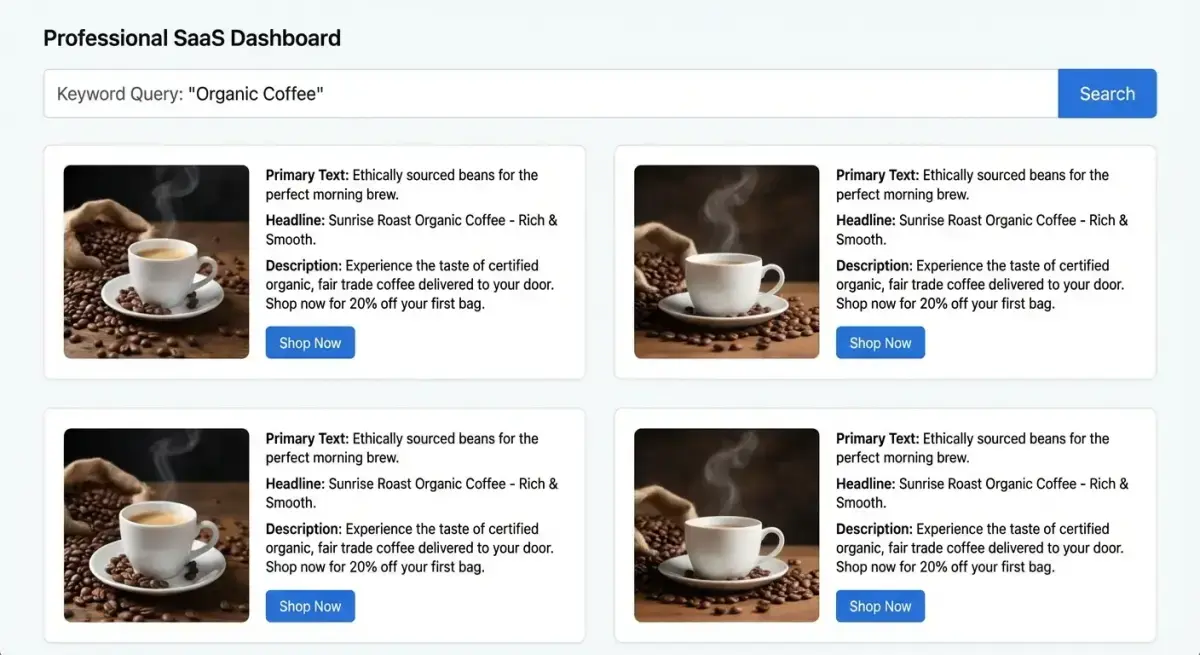 Adligator shows the full ad copy text on each card, making it easy to extract hook patterns and copy structures.
Adligator streamlines the copy research process:
- Full ad copy visible on each card — no need to click into individual ads. Scan hooks at a glance across dozens of results.
- Days active filter — instantly surface ads running 10+ days, eliminating unproven copy from your analysis.
- Keyword search — find all ads mentioning specific terms, pain points, or competitor names.
- CTA button filter — isolate ads by button type to analyze copy-to-CTA alignment patterns.
- Collections — save the best copy examples organized by hook type, niche, or campaign for quick reference.
- Text language filter — for multilingual campaigns, analyze copy patterns in specific languages.
The workflow: search your niche, filter for longevity, scan hooks across 30+ results, classify the top performers, and build your formula library. What takes hours manually takes 30 minutes with the right filters.
Common Copywriting Mistakes Spy Data Reveals
Writing What You Think Sounds Good
Your personal taste is irrelevant. What matters is what the market responds to. If every long-running competitor ad uses simple, direct language and your copy is clever and abstract — the data is telling you something.
Ignoring Copy Length Signals
If competitors succeed with 5-line copy and your ads have 3 paragraphs, you're fighting the market's attention pattern. Match the length that works, then test variations.
Hook Recycling
Using the same hook type for every ad creates fatigue. If you always lead with questions, test a statistic or contrarian hook. Your formula library should have 3-4 hook types ready.
CTA Mismatch
The text CTA says "Learn more about our approach" but the button says "Shop Now." This creates confusion. Spy data shows that top performers maintain tight alignment.
Copying Instead of Adapting
Lifting competitor copy word-for-word is plagiarism, and it doesn't work — your product is different. Extract the formula, not the content.
FAQ
How do you write Facebook ad copy that converts?
Start with a strong hook that stops the scroll, follow with body copy that addresses a specific pain point or desire, and close with a clear CTA. Use competitor spy data to identify which hook types and copy structures work in your niche, then adapt them with your own angle and differentiation.
How long should Facebook ad copy be?
It depends on your niche and audience. Spy data helps answer this: check whether long-running competitor ads use short copy (1-2 lines), medium (3-5 lines), or long-form (paragraph+). In general, TOFU ads benefit from shorter copy, while BOFU direct-response ads often perform well with longer copy.
How to use competitor ads for copywriting inspiration?
Extract the hook formula (not the exact words), identify the pain point or desire being addressed, note the CTA structure, and analyze the tone of voice. Then write your own version using the same structural formula but different content, angles, and proof points.
Conclusion
A facebook ad copywriting framework built on competitor spy data eliminates the blank-page problem. Instead of guessing what might work, you start with proven structures — hook formulas, body templates, and CTA patterns extracted from ads that have survived weeks of real spending.
The process is repeatable: collect long-running competitor ads, classify hooks, analyze body structures, map CTAs, and build your formula library. Then fill the templates with your own product, angle, and differentiation. Write ad copy from spy data consistently, and you'll produce more variants, faster, with a higher baseline quality.
Ready to build your copy formula library? Start analyzing competitor ad copy — try Adligator free
Related Reading
- How to Analyze Facebook Ad Creatives by GEO and Vertical: A Data-Driven Approach for Media Buyers
- Facebook Ad Account Structure and Naming Conventions: A Scaling Framework for Media Buyers
- How to Build a Facebook Ad Creative Testing Framework Using Competitor Spy Data
- Facebook Ad Performance Benchmarks by Vertical in 2026: CPM, CTR, and Creative Lifespan Data for Media Buyers
