Facebook Ad Creative Testing Framework: How to Validate Winners Faster Using Competitor Intelligence
Most media buyers test Facebook ad creatives the same way: brainstorm ideas, produce 10-15 variations, launch them all, and wait to see what sticks. The win rate on this approach sits around 10-15% for most teams — meaning 85-90% of your creative production budget goes toward losers.
There's a better approach. By integrating competitor intelligence into your facebook ad creative testing process, you can pre-validate concepts before spending a dollar on media. When you test creative angles that are already proven to work for competitors in your space, win rates jump to 20-30% or higher.
This guide walks through a complete ad creative testing framework that uses competitive intelligence as its foundation — from sourcing test candidates to reading results and scaling winners.
Why Most Creative Testing Fails
Before fixing the process, it helps to understand why the default approach produces low win rates.
The Blank Canvas Problem
When creative teams start from scratch — brainstorming in a conference room with no market data — they're essentially guessing. Even experienced media buyers can't reliably predict which creative concepts will resonate with cold audiences. The variables are too many: visual style, messaging angle, hook, format, CTA, and their interactions.
This isn't a talent problem. It's an information problem. Without data on what's currently working in the market, every creative test is a coin flip with worse odds.
Testing Too Many Variables at Once
A common mistake: testing a video against a static image while also changing the messaging angle, headline, and CTA. When this test produces a winner, you don't know why it won. Was it the format? The angle? The hook? This makes iteration impossible because you can't isolate what's working.
Insufficient Budget Per Creative
Spreading $500 across 20 creatives gives each one $25 of spend — typically not enough impressions for statistical significance. The result: premature decisions based on noise rather than signal. Creatives get killed before they had a fair chance, and false winners get scaled.
No Pre-Validation
This is the biggest gap. Most teams treat every creative concept as equally likely to succeed. But they're not. A concept based on a proven competitor angle that's been running for 30 days has dramatically better odds than a random internal brainstorm. The testing framework should reflect this.
The Intelligence-Driven Testing Framework
The core idea is simple: use competitor intelligence to create a tiered testing system where proven concepts get priority resources.
Tier 1: Competitor-Validated Concepts (50% of test budget)
These are creative concepts directly inspired by competitor ads that have demonstrated market viability. In practice, this means competitor creatives running 14+ days (a strong profitability signal) that you adapt with your own brand and product.
How to identify them:
- Filter competitor ads by days active (14+ days minimum, 30+ for strongest signal)
- Look for repeated patterns across multiple competitors (format, messaging angle, hook structure)
- Check if similar concepts appear across different GEOs (cross-market validation)
What to adapt:
- The messaging angle (not the exact copy)
- The visual structure (not the exact creative)
- The hook approach (the first 3 seconds of video, or the visual hierarchy of static)
- The CTA strategy
Tier 1 concepts get the most budget because they have the highest probability of success. You're testing execution, not concept viability.
Tier 2: Market-Informed Concepts (30% of test budget)
These are original concepts informed by market trends but not directly tied to a specific competitor creative. Examples:
- A format that's trending across the niche (e.g., UGC testimonials) combined with your unique angle
- A messaging theme you've identified as underserved in the market
- A competitor gap — something no one is doing that logic suggests would work
Tier 2 has moderate risk and moderate reward. The concepts are grounded in market reality but haven't been specifically proven.
Tier 3: Experimental Concepts (20% of test budget)
Pure innovation. New formats, new angles, completely original ideas. These have the lowest expected win rate but the highest potential upside — a breakout creative that competitors haven't thought of yet.
Keep this tier small but never eliminate it. Breakthrough creatives come from experimentation, and competitor intelligence can't predict everything.
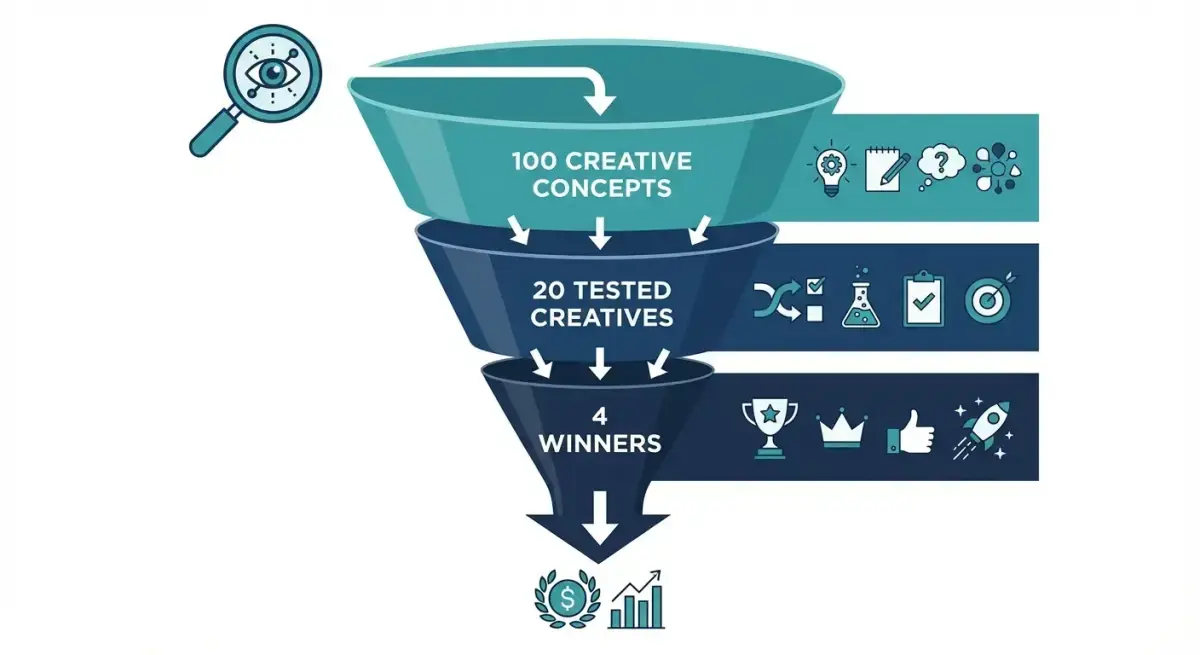 The intelligence-driven testing funnel: start with proven concepts, not random guesses.
Setting Up Your Testing Infrastructure
Before launching tests, your Ads Manager structure needs to support clean measurement.
Campaign Structure for Creative Testing
Use one of two approaches:
CBO Testing Campaign: Create a Campaign Budget Optimization campaign with one ad set and multiple ads. Facebook distributes budget toward the best performers. Pros: simple setup, automatic budget allocation. Cons: Facebook may prematurely pick a winner before sufficient data accumulates.
DCT (Dynamic Creative Testing): Upload multiple headlines, images, videos, and descriptions. Facebook tests combinations automatically. Pros: tests more variations with less setup. Cons: harder to isolate specific creative concepts.
Recommendation for serious testing: Dedicated ad sets per creative concept with manual budget allocation ($10-20/day per creative minimum). This gives you the cleanest data at the cost of more setup time.
Key Testing Parameters
- Budget per creative: Minimum $50-100 total spend before making decisions
- Duration: 48-72 hours minimum
- Audience: Use your proven, broad targeting. Don't test creatives on untested audiences simultaneously
- Optimization event: Use your standard conversion event. Don't switch to link clicks or impressions for testing
- Placements: Automatic placements for maximum delivery, but check placement breakdowns when analyzing results
Naming Conventions
Every creative in testing should follow a clear naming convention that includes:
- Test batch number (e.g., W10 for week 10)
- Tier (T1/T2/T3)
- Concept identifier (e.g., "ugc-unboxing" or "benefit-comparison")
- Variant number if testing multiple executions of the same concept
Example: W10-T1-ugc-unboxing-v2
This makes analysis dramatically easier when you're reviewing dozens of tests across weeks.
Using Adligator to Pre-Validate Creative Concepts
The intelligence-gathering phase is where Adligator transforms your testing framework from guessing to informed decision-making.
Finding Proven Creative Concepts
The most valuable Adligator workflow for creative testing:
- Search by keyword or competitor page ID in your niche
- Filter by days active: 14+ days — this immediately surfaces ads that are likely profitable
- Sort by longevity to see the longest-running ads first
- Analyze the top 10-15 results for patterns
What you're looking for isn't specific ads to copy — it's patterns that reveal what the market responds to:
- Which formats dominate among long-runners? (Video vs static vs carousel)
- What messaging angles appear repeatedly? (Price, quality, urgency, social proof)
- What hook structures work? (Question, statement, statistic, testimonial)
- Which CTA buttons are most common? (Shop Now vs Learn More vs Sign Up)
Cross-Competitor Pattern Analysis
The signal gets stronger when you see the same pattern across multiple competitors. If three different brands in your niche all have long-running UGC testimonial videos with a "before and after" hook, that's a near-validated concept.
Build a simple tracking sheet:
| Pattern | # of competitors using it | Avg days active | Confidence |
|---|---|---|---|
| UGC testimonial + before/after | 4 | 28 days | High |
| Static comparison chart | 2 | 14 days | Medium |
| Founder story video | 1 | 21 days | Medium |
Patterns with high confidence become Tier 1 test candidates.
Ready to find proven creative concepts? Start validating creative concepts with Adligator — free account, no credit card required
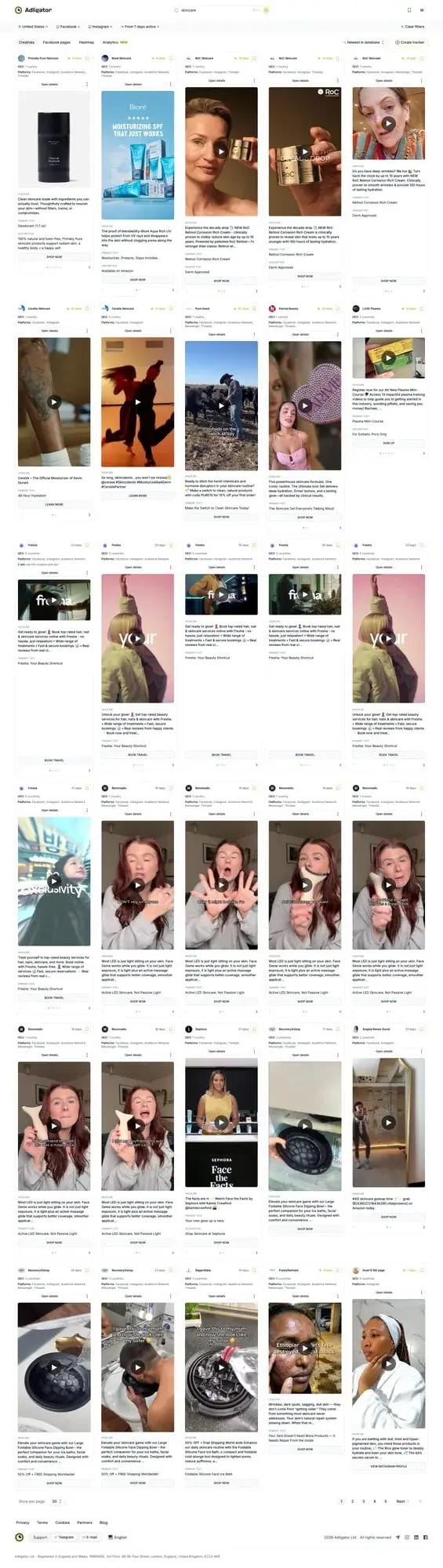 Filtering by days active in Adligator reveals competitor creatives that are likely profitable — your strongest test candidates.
Tracker-Based Continuous Intelligence
Don't limit intelligence gathering to weekly sessions. Set up Adligator trackers for your top 5-7 competitors. When a competitor launches a new creative that survives past 14 days, it automatically appears in your tracker — giving you a continuous stream of pre-validated concepts.
This shifts creative testing from a reactive process ("we need new creatives") to a proactive pipeline ("here are 5 validated concepts ready for next week's test batch").
Reading Test Results: The Decision Matrix
After 48-72 hours of testing, you need a systematic way to categorize results and decide next steps.
The Four Quadrants
Plot each creative on two axes: CTR (engagement signal) and CPA/ROAS (efficiency signal).
Quadrant 1: High CTR + Good CPA → SCALE This is your winner. Move it to a scaling campaign with increased budget. Monitor for creative fatigue over the next 2-4 weeks.
Quadrant 2: High CTR + Bad CPA → ITERATE People are clicking but not converting. The creative catches attention but the landing page or offer isn't connecting. Test with a different landing page, offer adjustment, or audience.
Quadrant 3: Low CTR + Good CPA → NICHE WINNER Low engagement but those who do engage convert well. This creative may work for a specific audience segment. Try it with more targeted audiences or placements.
Quadrant 4: Low CTR + Bad CPA → KILL Neither engagement nor conversion. Stop spend immediately. Analyze why: was the concept wrong, or just the execution?
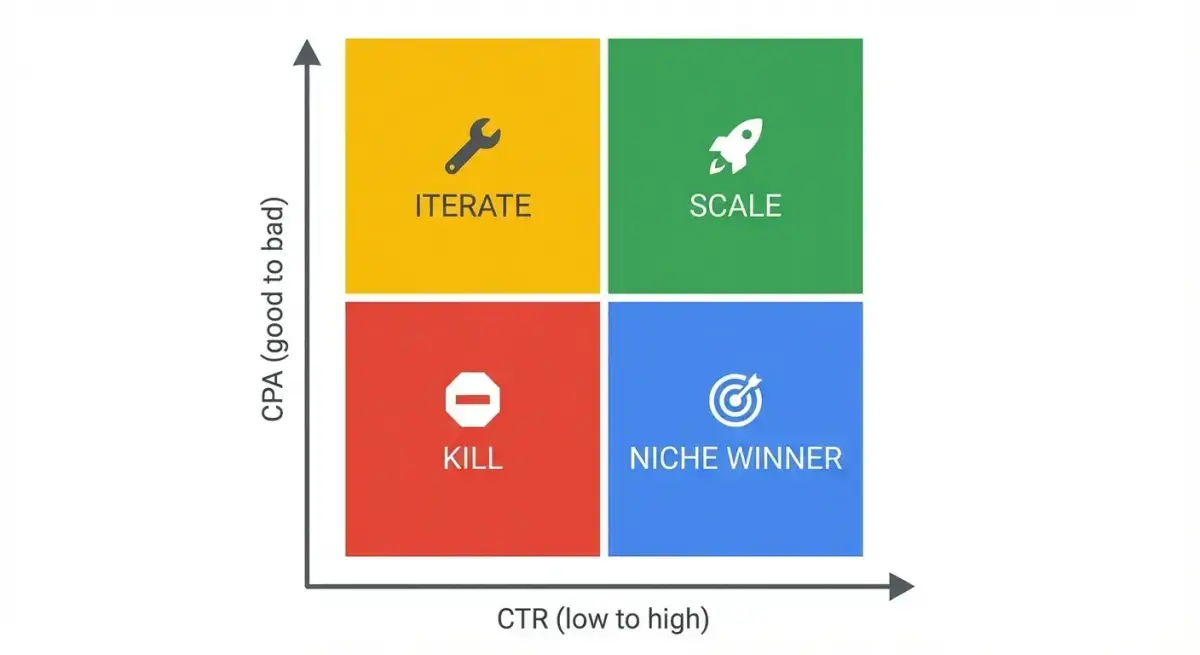 Use this decision matrix to quickly categorize test results and decide next steps.
Benchmarks for Decision-Making
Define your thresholds before launching tests, not after:
- CTR threshold: Your account's average CTR × 0.8 = minimum acceptable. Below this, the creative isn't competitive
- CPA threshold: Your target CPA × 1.3 = maximum acceptable during testing (testing costs more than scaled campaigns)
- Minimum impressions: 1,000-2,000 impressions before making decisions
- Minimum conversions: At least 5-10 conversion events for statistical confidence
The Iteration Protocol
For Quadrant 2 and 3 creatives (partial winners), follow a structured iteration:
- Identify the working element — what specifically is good about this creative?
- Hypothesize the weakness — what's holding it back?
- Create 2-3 targeted variations — change only the suspected weakness
- Re-test with the same budget and audience
Limit iterations to two rounds. If a concept doesn't produce a clear winner after the original test plus two iterations, move on. The opportunity cost of over-iterating on a mediocre concept is worse than testing a fresh one.
Weekly Testing Cadence
A sustainable testing rhythm matters more than any individual test. Here's the weekly cadence that works for teams spending $10K-100K/month:
Monday: Intelligence & Planning
- Review Adligator trackers for new competitor patterns
- Categorize findings into Tier 1/2/3 concepts
- Create creative briefs for production team
Tuesday-Wednesday: Production
- Design and produce test creatives from briefs
- Quality check: does the execution match the brief's intent?
Thursday: Launch
- Upload new test batch to Ads Manager
- Set budgets per creative
- Double-check tracking and naming conventions
Friday: Analysis of Last Week's Batch
- Apply the decision matrix to previous week's tests
- Scale winners, iterate partials, kill losers
- Document learnings in your testing log
Ongoing: Monitor Active Tests
- Check for anomalies daily (creative disapproved, unusual spend patterns)
- Don't make decisions before the 48-72 hour window
The Testing Log
Keep a running log of every test with:
- Concept description and tier
- Source inspiration (competitor reference if Tier 1)
- Results (CTR, CPA, ROAS, spend)
- Decision (scale/iterate/kill)
- Learning (what this test taught you)
After 8-12 weeks, this log becomes your most valuable creative strategy asset. Patterns emerge about what your specific audience responds to, independent of competitor data.
Scaling the Testing Process
As your budget grows, scale the number of tests proportionally — not the budget per test. If you're spending $20K/month and testing 15 creatives, moving to $40K/month should mean testing 25-30 creatives, not spending twice as much per test.
The reason: creative testing follows a power law. Most of your ROAS comes from the top 2-3 creatives in any given month. Finding those winners requires volume. More tests at the same confidence threshold beats fewer tests with higher spend.
When scaling past 20 tests per week, consider splitting by creative type: one batch for static, one for video, one for carousel. This keeps production organized and makes pattern recognition in your testing log much cleaner.
FAQ
How many creatives should I test per week?
For most accounts spending $5K-50K/month, 10-20 new creatives per week is the sweet spot. This gives enough statistical signal to identify winners while keeping production manageable.
How long should I run a creative test before deciding?
Minimum 48-72 hours with at least $50-100 spend per creative. If a creative hasn't shown signal by then with sufficient impressions, it's unlikely to become a winner at scale.
Does using competitor intelligence count as copying?
No. Competitive intelligence means understanding what messaging angles, formats, and hooks resonate with your shared audience. You adapt proven concepts with your own brand, product, and creative execution — never copy directly.
Conclusion
The difference between teams with 10% creative win rates and teams with 25%+ win rates isn't talent — it's information. An ad creative testing framework built on competitor intelligence starts every test cycle with an unfair advantage: concepts that are already proven to work in the market.
Use the tiered approach (50% competitor-validated, 30% market-informed, 20% experimental), apply the decision matrix consistently, and maintain a weekly cadence. Over 8-12 weeks, your testing log will reveal your audience's specific preferences, compounding the advantage.
The hardest part isn't the framework itself — it's building the intelligence pipeline that feeds it. Tools like Adligator eliminate the bottleneck by giving you filtered, structured access to competitor creatives sorted by what matters most: proof of profitability through days active.
Ready to improve your creative win rate? Start validating creative concepts with Adligator — free account, no credit card required
Related Reading
- How to A/B Test Facebook Ad Creatives: A Beginner Guide to Statistical Confidence and Faster Winners
- How to Use Ad Spy Data to Scale Facebook Campaigns: From Testing to Six-Figure Spend
- How to Build a Creative Brief from Ad Spy Data: A Reusable Template for Media Buying Teams
- How to Write High-Converting Facebook Ad Copy Using Competitor Spy Data: A Copywriting Framework for Media Buyers
