How to Build a Facebook Ad Creative Testing Framework Using Competitor Spy Data
Most creative testing on Facebook is structured like this: someone on the team has an idea, they produce a creative, they launch it, and they hope for the best. When it doesn't work, they try another idea. This cycle burns budget and produces inconsistent results because there's no underlying system.
A facebook ad creative testing framework built on competitor spy data flips this approach. Instead of starting from ideas, you start from evidence — patterns extracted from ads that are already winning in your market. Then you structure those patterns into a test matrix that systematically isolates what works and what doesn't.
This guide covers the complete five-step framework: from mining competitor ads for patterns to feeding results back into your next research cycle.
Why Most Creative Testing Fails (And How Spy Data Fixes It)
Creative testing fails for three predictable reasons:
1. Random hypothesis generation. Without competitive intelligence, creative hypotheses come from brainstorms, trend articles, or gut instinct. These sources produce occasional hits but mostly noise. Spy data replaces randomness with market-validated starting points — you test patterns that are already proven to survive Meta's auction.
2. Unstructured testing. Testing one creative at a time against a "control" tells you almost nothing about why something works. Was it the hook? The format? The offer angle? Without a structured matrix that isolates variables, you learn slowly and scale slowly.
3. No feedback loop. Most teams test, find a winner, scale it, and then start the entire cycle from scratch when it fatigues. A proper framework creates a continuous loop: spy data feeds test hypotheses → test results refine your understanding of the market → refined understanding improves your next spy data mining session.
The spy data advantage: When you analyze 30–50 proven competitor ads (filtered by longevity), you don't just get creative ideas. You get statistical patterns: "65% of winning ads in my space use UGC format with a question hook." That's not inspiration — that's a testable hypothesis with pre-existing market validation.
The Creative Testing Framework: From Spy Data to Winning Ads
The framework has five steps that form a continuous cycle:
- Mine competitor ads for patterns
- Classify creatives by hook type, format, and angle
- Build a test matrix from classified patterns
- Structure testing campaigns in Ads Manager
- Analyze results and feed back into spy research
Each step feeds the next. Let's break them down.
Step 1: Mine Competitor Ads for Patterns
The quality of your testing framework depends entirely on the quality of your pattern mining.
Who to analyze:
- 5–7 direct competitors (same product/service category)
- 3–5 adjacent competitors (different product, same audience)
- 2–3 aspirational competitors (larger players, potentially different vertical)
What to filter for:
- Minimum 14 days active. This eliminates tests and failures, showing only ads that Meta's algorithm is delivering profitably.
- Your target GEOs. Creative patterns vary by market. A hook that works in the US may not resonate in Germany.
- Relevant formats. If you're focused on video testing, filter for video ads. If you want to explore carousel, filter specifically for that.
What to capture per ad: Create a spreadsheet or database with these columns:
- Competitor name
- Ad format (video/carousel/static/UGC)
- Hook type (first 3 seconds for video, headline for static)
- Primary messaging angle (pain-point/benefit/social-proof/comparison)
- CTA button type
- Offer type (discount/free trial/free shipping/none)
- Visual style (UGC/lifestyle/product-focused/data-driven)
- Days active (longevity signal)
- Estimated engagement level (low/medium/high)
Minimum sample size: Aim for 30–50 ads minimum. Below 20, you'll see false patterns. Above 50 adds marginal value unless you're analyzing multiple verticals.
Want to mine patterns faster? Start extracting winning creative patterns with Adligator — try free
Step 2: Classify Creatives by Hook Type, Format, and Angle
Raw data becomes useful when you classify it into testable categories.
Hook type classification: After analyzing your sample, you'll find hooks cluster into 5–7 types:
| Hook Type | Example | When It Works |
|---|---|---|
| Question | "Still paying $50/month for X?" | Pain-point awareness |
| Result-first | "How we saved $10K in 30 days" | Proof-oriented audiences |
| Pattern interrupt | Sudden zoom, unexpected visual | Scroll-stopping in crowded feeds |
| Controversy | "Stop using X — here's why" | Opinionated audiences |
| Curiosity gap | "The #1 mistake every media buyer makes" | Information-seeking audiences |
| Social proof | "Join 50,000 marketers who..." | Trust-building |
| Demonstration | Product in action, first 2 seconds | Product-focused audiences |
Format classification:
- Video (short-form <30s, mid-form 30–60s, long-form 60s+)
- Carousel (product showcase, benefit sequence, comparison)
- Static image (product hero, lifestyle, data/stat, testimonial quote)
- UGC (creator talking, product review, unboxing, tutorial)
Angle classification:
- Pain-point led: "Tired of X? Here's how to fix it"
- Benefit-led: "Get X result with Y"
- Comparison-led: "X vs Y — which is better?"
- Social proof-led: "10,000 businesses trust us"
- Urgency-led: "Limited time offer" / "Prices increase Friday"
The classification output: After classifying your 30–50 ads, you'll see clear distributions. For example:
- 45% video (80% UGC, 20% studio)
- 30% carousel
- 25% static
- Top hook types: Question (35%), Result-first (25%), Demo (20%)
- Top angles: Pain-point (40%), Benefit (30%), Social proof (20%)
These distributions become the inputs for your test matrix.
Step 3: Build Your Test Matrix from Spy Insights
The test matrix is where spy data transforms into actionable creative briefs.
The 3-variable matrix: Select your top patterns from each classification:
| Question Hook | Result-First Hook | Demo Hook | |
|---|---|---|---|
| UGC Video | Creative A1 | Creative A2 | Creative A3 |
| Carousel | Creative B1 | Creative B2 | Creative B3 |
| Static Image | Creative C1 | Creative C2 | Creative C3 |
This gives you 9 test creatives that systematically cover the top patterns. Each creative differs on exactly two variables (hook + format), making it possible to isolate what drives performance.
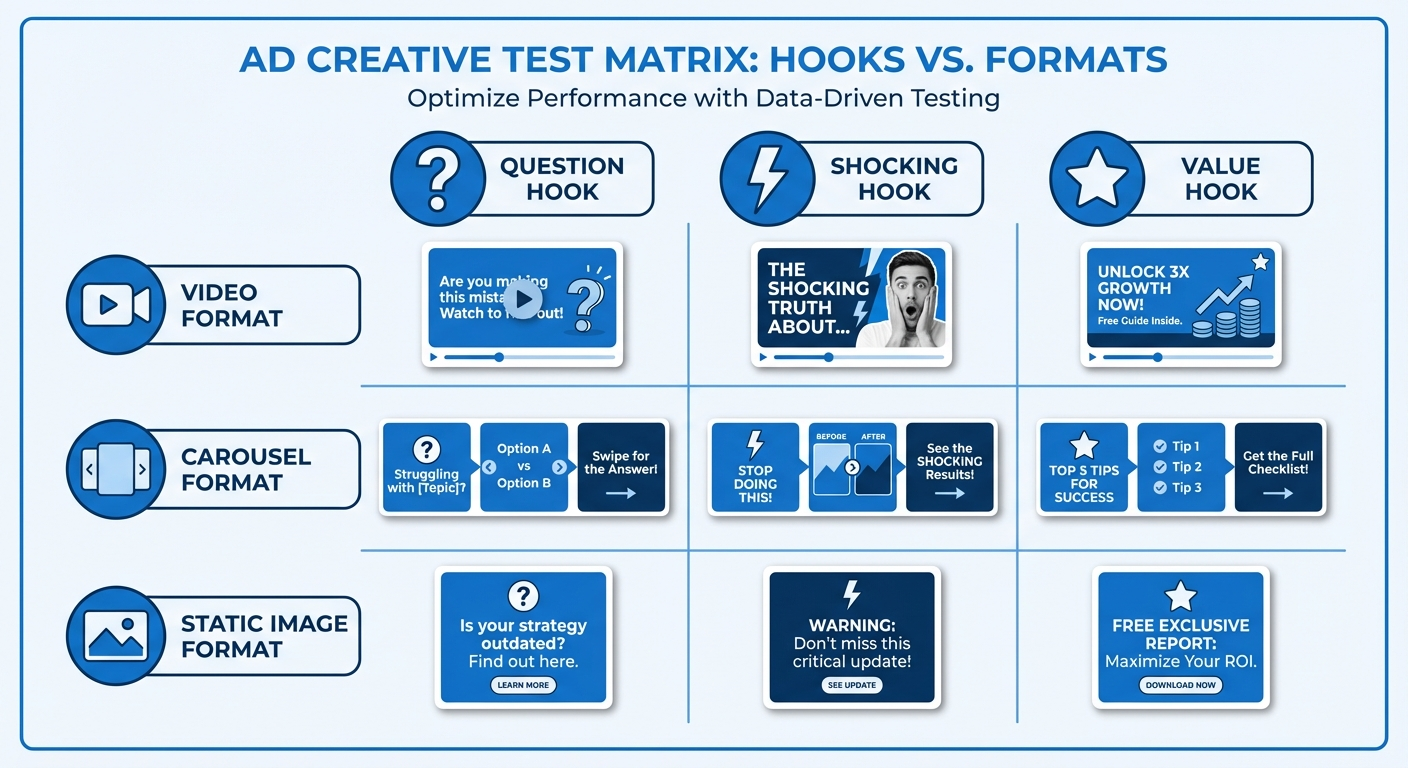 A structured test matrix ensures you test systematically, not randomly
Adding the angle variable: For a more comprehensive test, add messaging angle as a third dimension. Pick the top 2 angles and create 2 versions of each matrix cell:
- A1-pain: UGC Video + Question Hook + Pain-point angle
- A1-benefit: UGC Video + Question Hook + Benefit angle
This doubles your test to 18 creatives — still manageable with adequate budget.
Production priorities: Don't try to produce all 18 creatives at equal quality. Prioritize:
- The cells that match the dominant competitor pattern (highest spy data frequency)
- Cells that represent your strongest production capability
- Cells that test the biggest format/hook shift from your current approach
Brief format for each creative:
- Hook (first 3s for video, headline for static): Specific hook text/concept
- Format: Video/Carousel/Static
- Angle: Pain-point/Benefit/etc.
- Body: Key message points — 2-3 bullets
- CTA: Button type + destination
- Production notes: [UGC creator, product shots needed, etc.]
Step 4: Structure Your Testing Campaign in Ads Manager
How you set up testing campaigns determines whether you get clean data or noise.
Recommended structure:
Campaign level:
- Objective: Conversions (optimize for your actual KPI, not link clicks)
- Budget: Campaign Budget Optimization (CBO) for even distribution
- Total daily budget: $10–$20 per creative × number of creatives
Ad set level (two approaches):
Approach A: Single ad set (simpler)
- One ad set containing all test creatives
- Broad targeting (1% lookalike or broad interest)
- Let Meta's algorithm distribute budget to winners
- Pro: Simple setup, Meta optimizes quickly
- Con: Budget may concentrate on 2–3 ads, leaving others undertested
Approach B: One ad set per creative (more control)
- Each creative gets its own ad set with equal budget
- Same targeting across all ad sets
- Pro: Every creative gets equal budget and exposure
- Con: More complex, slower optimization
For most teams, Approach A is recommended with one adjustment: after 48 hours, check if any creative has received less than 20% of its fair share of impressions. If so, duplicate it into its own ad set.
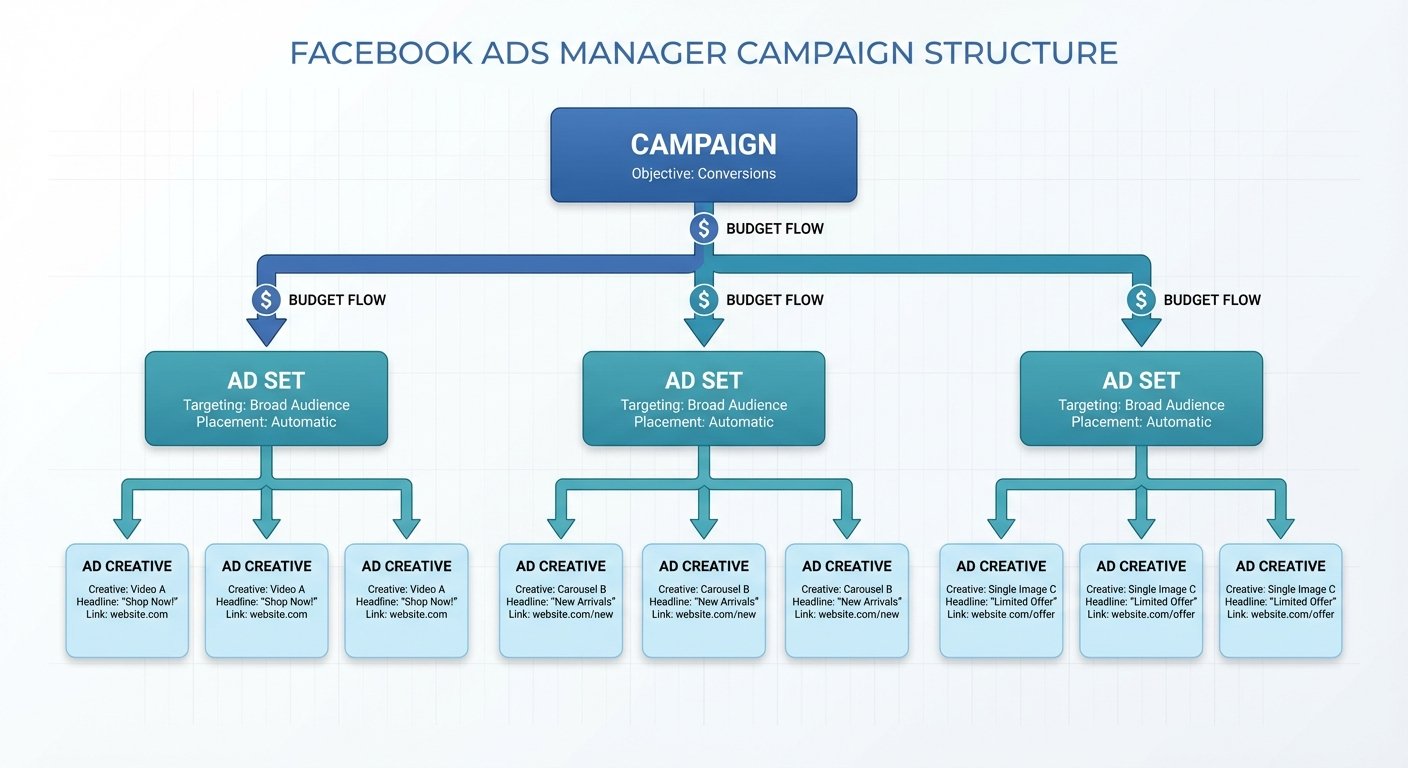 Proper campaign structure isolates creative variables for clean test results
Targeting for testing: Use the broadest viable targeting. The goal is to test creative, not audience. If you layer tight interest targeting on top, you're testing creative × audience — too many variables.
Duration: Run tests for 72 hours minimum. At $15/day per creative over 72 hours, each creative gets ~$45 in spend — enough for initial signal in most verticals. For higher-CPA products (SaaS, finance), extend to 5–7 days.
What NOT to do:
- Don't test creative and audience simultaneously
- Don't change budgets during the 72-hour test window
- Don't use engagement objectives (they optimize for likes, not conversions)
- Don't test more than 15 creatives per campaign (data gets too thin)
Step 5: Analyze Results and Feed Back into Spy Research
After the test window, categorize results and extract learnings.
Decision criteria (72-hour mark):
| Metric | Scale | Iterate | Kill |
|---|---|---|---|
| CPA | ≤ Target | Target to 1.5× Target | > 1.5× Target |
| CTR | > Vertical avg | Near vertical avg | < 50% of avg |
| Conversion rate | > 1% | 0.5–1% | < 0.5% |
| Spend delivery | Smooth | Inconsistent | Stalled |
Pattern extraction from results: The most valuable part of testing isn't finding winners — it's understanding WHY something won.
Look across your matrix results:
- Did one hook type consistently outperform? → That hook type should dominate your next test batch
- Did one format beat others across hooks? → Double down on that format
- Did one angle work with some formats but not others? → Interaction effect — test more combinations
Feeding back into spy research: Your test results should change how you mine spy data:
- If question hooks won, filter spy tools specifically for question-style ads and analyze the specific questions competitors ask
- If UGC beat studio across the board, research the specific UGC styles competitors use (talking head, product demo, testimonial, tutorial)
- If carousels underperformed, check whether competitors are also pulling back on carousel (confirming a market trend) or doubling down (indicating your creative execution needs work)
The continuous cycle: Week 1: Mine 30+ competitor ads → Build test matrix → Launch Week 2: Analyze Week 1 results → Refine spy research filters → Mine new patterns → Build updated matrix → Launch Week 3+: Repeat with compounding knowledge
Each cycle gets faster and more targeted as your understanding of market patterns deepens.
Building a test results database: After 4–8 test cycles, your results database becomes a powerful asset. You'll have data on:
- Which hook types consistently perform in your vertical (and which never work)
- Which formats your specific audience responds to (format preferences vary by audience segment)
- Which messaging angles drive clicks versus conversions (these are often different)
- Seasonal patterns in creative performance (Q4 messaging works differently than Q1)
- Creative fatigue timelines (how long before a winning pattern stops working)
This database effectively becomes your own proprietary creative intelligence — more valuable than any single competitor analysis because it's validated against your specific audience, product, and funnel.
When to break the framework: Structured testing is powerful, but don't let it become a cage. Reserve 10–15% of your testing budget for "wild card" creatives that break your established patterns. Occasionally, a completely unconventional approach outperforms everything in your matrix — and you won't discover these without space for experimentation.
The framework should also evolve. After running it for 3–6 months, review the overall system: Are your classification categories still relevant? Has your market shifted to new patterns? Are there new formats (e.g., Reels-specific creative) that need their own testing track?
Tools You Need for This Workflow
Essential:
- Ad spy tool (for pattern mining) — Adligator, AdSpy, or similar
- Facebook Ads Manager (for campaign execution)
- Spreadsheet or database (for pattern classification and test matrix)
Recommended:
- Creative production tool (Canva, CapCut, or similar for rapid asset creation)
- Project management tool (for tracking test cycles and results)
- Analytics dashboard (for cross-test comparison over time)
How Adligator Accelerates Creative Testing Research
The bottleneck in this framework is usually Step 1 — pattern mining. Without proper filters, you'll spend hours scrolling through irrelevant ads.
Adligator streamlines mining with filters that map directly to classification categories:
- Format filter: Isolate video, carousel, or static ads instantly. No scrolling through mixed results.
- Days active filter: Show only ads running 14+ days (proven performers). This is the single most valuable filter for testing research.
- Button type filter: Filter by CTA type (Shop Now, Learn More, Sign Up) to see which CTAs dominate in your space.
- GEO filter: Limit results to your target markets for locally relevant patterns.
- Language filter: See ads in your target language to analyze copy patterns.
- Keyword search: Find ads mentioning specific product categories, pain points, or competitor names.
The 30-minute mining session:
- Set format filter to "Video" + days active 14+ + your GEOs (5 min)
- Scan top 20 results, classify hook types and angles (10 min)
- Switch format filter to "Carousel," repeat scan (5 min)
- Switch to "Static Image," repeat (5 min)
- Log patterns in your classification spreadsheet (5 min)
That's your entire weekly mining session. The output: a ranked list of patterns ready to feed into your test matrix.
FAQ
How many competitor ads should I analyze before building a test?
Aim for 30–50 proven ads (active 14+ days) from at least 8–10 competitors. This gives you enough data to identify real patterns versus one-off creative choices. Fewer than 20 ads leads to false pattern recognition.
What is the minimum budget for a structured creative test?
Allocate $10–$20 per day per creative variant for 72 hours minimum. For a 9-creative test matrix, that's $90–$180/day ($270–$540 for a full test cycle). Below this, you won't generate enough data for reliable decisions.
How often should I refresh spy data for new hypotheses?
Weekly for active campaigns. Creative trends shift fast — patterns that work in January may fatigue by March. A weekly 30-minute spy session keeps your hypothesis pipeline fresh and prevents creative stagnation.
Conclusion
A facebook ad creative testing framework built on spy data replaces guesswork with evidence. Instead of testing random ideas, you test market-validated patterns. Instead of learning slowly from isolated tests, you build a systematic understanding of what your market rewards.
The five-step cycle — mine, classify, build matrix, structure campaigns, analyze and feedback — compounds over time. Each iteration refines your pattern recognition, improves your creative hit rate, and shortens the path from test to scaled winner.
Stop testing blind. Start testing with intelligence.
Ready to build your spy-data-powered testing framework? Start extracting winning creative patterns with Adligator — try free
Related Reading
- How to Use Ad Spy Data to Scale Facebook Campaigns: From Testing to Six-Figure Spend
- Facebook Ad Creative Testing Framework: How to Validate Winners Faster Using Competitor Intelligence
- How to Estimate Competitor Facebook Ad Spend Using Spy Tools and Ad Library Data
- Facebook Ad Performance Benchmarks by Vertical in 2026: CPM, CTR, and Creative Lifespan Data for Media Buyers
