Facebook Ad Creative Trends 2026: What Spy Tools Reveal About Winning Formats, Hooks, and CTAs
The Facebook ad creative landscape in 2026 looks nothing like it did two years ago. AI-generated content, the UGC explosion, short-form vertical video — these aren't predictions anymore. They're patterns visible right now across millions of active Meta ads.
The problem with most "trends" articles? They're based on opinion, not data. What follows is different. These six facebook ad creative trends 2026 are backed by what spy tools actually reveal about which formats, hooks, and CTAs are running the longest — and running the longest means they're making money.
Whether you're an in-house media buyer or running creative strategy at an agency, this guide shows you what's winning, why it works, and how to implement each trend in your own campaigns.
Why Creative Is the #1 Lever in Meta Ads 2026
Meta's algorithm has gotten remarkably good at finding the right audience. Advantage+ targeting, broad audiences, and machine learning optimization mean that for most advertisers, targeting is increasingly commoditized. The variable that still separates winners from losers is creative.
Here's why creative matters more than ever:
- Algorithm dependence on creative signals. Meta's delivery system uses early engagement signals (thumb-stop rate, watch time, click-through) to decide which ads to serve more. Better creative = better signals = more delivery at lower costs.
- Auction saturation. More advertisers competing for the same audiences means CPMs rise. The only way to maintain efficiency is creative that earns higher engagement per impression.
- Testing velocity. Top advertisers now test 20–50 new creatives per week. The creative testing framework has become the core operational advantage.
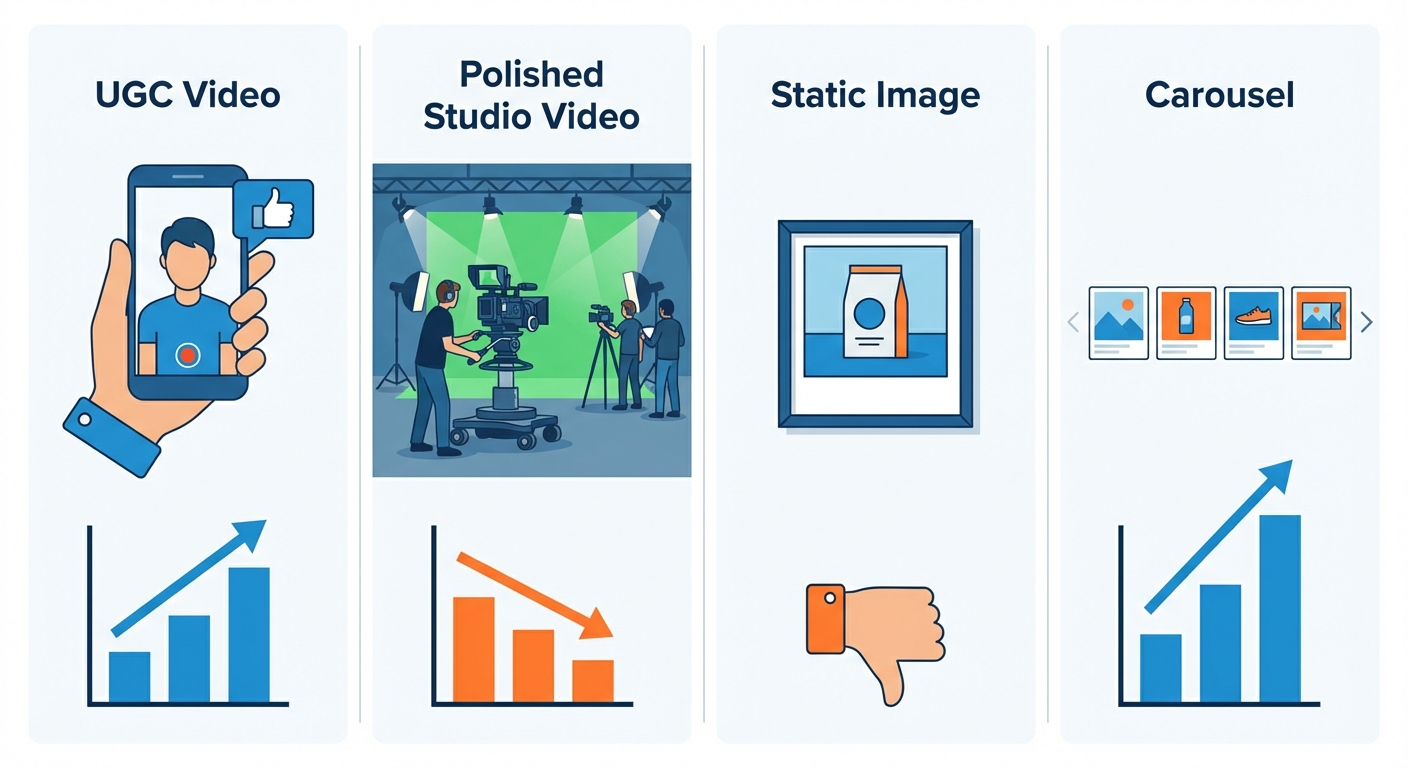 How different ad formats compare in performance across Meta placements in 2026
The shift is clear: creative strategy is no longer a design team's problem. It's the primary performance lever for every media buyer running Meta campaigns.
Trend 1: UGC-Style Video Dominates
UGC-style video isn't new, but in 2026 it has become the default creative format for high-performing Facebook advertisers. When you filter spy tool databases for ads with the longest active lifespans, UGC-style content dominates across nearly every vertical.
What "UGC-style" actually means in 2026:
- Shot on a phone (or made to look like it)
- Single person talking to camera or demonstrating a product
- Minimal editing — jump cuts, text overlays, but no motion graphics
- Native to the platform — looks like organic content, not an ad
Why it works:
- Lower thumb-stop resistance. Users scroll past polished ads because they're trained to recognize ads. UGC blends into the feed.
- Higher perceived authenticity. Even when it's produced by a brand (and most is), the format carries an implicit trust signal.
- Cheaper to produce at scale. A single creator can film 10 variations in a day, enabling rapid testing.
Vertical differences:
- E-commerce/DTC: Unboxing, product demos, "honest review" format
- SaaS/B2B: Screen recording with voiceover, founder talking to camera
- Gaming: Gameplay recordings with reaction overlays
- Finance/insurance: Testimonial-style, "here's what happened when I…"
Implementation tip: Don't hire expensive production studios. Build a roster of 5–10 micro-creators who can produce 3–5 videos per week at $100–$300 per video. Test aggressively and scale what works.
Trend 2: Short-Form Vertical (15–30s) Outperforms
The data is unambiguous: short-form vertical video between 15 and 30 seconds has the highest survival rate in spy tool databases. These ads stay active the longest, which means they're delivering profitable results for advertisers.
Why 15–30 seconds?
- Under 15 seconds: Not enough time to communicate value proposition and CTA
- 15–30 seconds: Sweet spot for hook + value + CTA structure
- Over 30 seconds: Drop-off rates spike; only works for considered purchases
The format breakdown:
- 9:16 vertical (Reels/Stories placement) — highest distribution
- 1:1 square (feed placement) — still strong for carousel-style video
- 16:9 horizontal — declining rapidly except for YouTube cross-posts
What spy tools reveal about video length: When you filter for video ads active for 30+ days (the strongest longevity signal), the vast majority fall in the 15–25 second range. Ads over 60 seconds represent less than 10% of long-running creatives in most verticals.
Implementation tip: Structure every video ad around this template:
- 0–3 seconds: Hook (pattern interrupt, bold claim, or visual surprise)
- 3–15 seconds: Value delivery (demo, benefit, social proof)
- 15–25 seconds: CTA + urgency driver
- 25–30 seconds: Reinforcement or brand moment
Trend 3: Authenticity Beats Polish
This trend is related to UGC but broader. Even non-UGC formats are shifting toward a more authentic, less produced aesthetic. The "authenticity premium" applies to:
- Ad copy: Conversational, first-person, specific rather than generic marketing language
- Visuals: Real environments over studio setups. Real lighting over perfect lighting.
- CTAs: Direct and practical ("See pricing" works better than "Unlock your potential")
- Social proof: Real customer quotes with attribution over anonymous testimonials
What this looks like in practice:
The old approach: "Discover our revolutionary solution that transforms how you manage your business."
The 2026 approach: "We switched to product 3 months ago. Here's what changed."
Why spy tools confirm this: Filter for ads with "Learn More" vs "Shop Now" buttons and compare longevity. Ads with direct, specific CTAs consistently outperform vague aspirational ones. The trend extends to every element of the creative.
Want to see what's actually working in your vertical? Spot winning creative trends first — try Adligator free
Trend 4: Hook-First Creative Structure
The first 3 seconds of a video ad determine everything. This has always been true, but in 2026 the "hook-first" approach has become systematized across top advertisers.
The hook taxonomy (what spy tools reveal works best):
- Pattern interrupt hooks: Start with something visually unexpected. A zoom, a color flash, text that fills the screen.
- Question hooks: "Did you know…?" / "What if I told you…?" — engagement bait that works because it creates an information gap.
- Result hooks: Show the end result first. Before/after. The number. The outcome. Then explain how.
- Controversy hooks: Take a contrarian position. "Stop doing X" / "Why X is dead" — polarizing but effective for stopping the scroll.
- Curiosity hooks: Incomplete information. "This one change…" / "The secret that…" — creates anticipation.
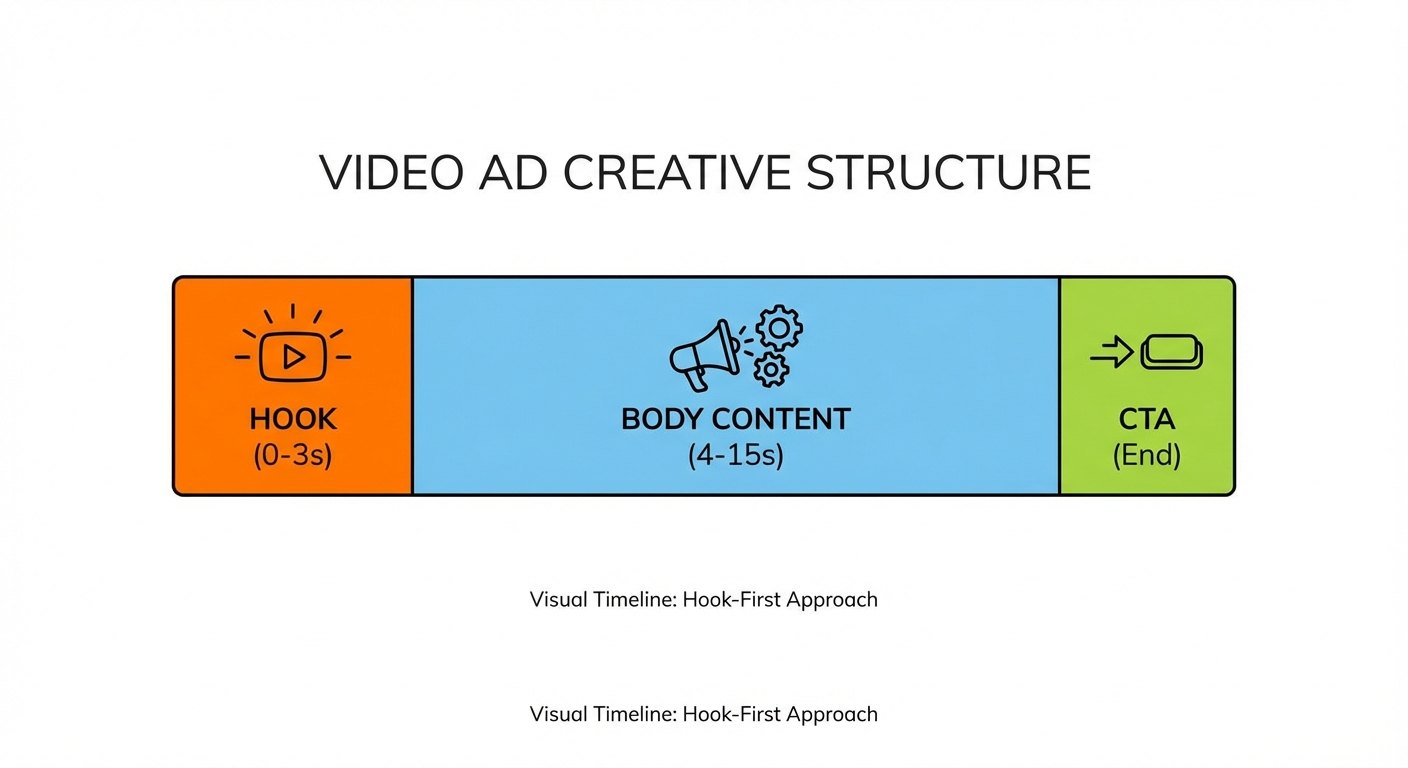 The hook-first creative structure that dominates high-performing Facebook video ads
How top advertisers test hooks: The winning strategy is to create one core video body and test 5–10 different hooks against it. This isolates the hook variable and lets you find winners faster. Spy tools confirm this pattern — you'll often see the same advertiser running 8–12 variations of what is clearly the same ad with different opening frames.
Implementation tip: Build a "hook library" of 20–30 proven hook templates. For each new creative, match the appropriate hook type to the audience segment and product stage. Test at least 3 hook variants per creative concept.
Trend 5: Carousel Comeback for E-commerce
After years of video dominance, carousels are making a measurable comeback in e-commerce advertising. Spy tool data shows a significant increase in carousel ads with 30+ day longevity, particularly in:
- Multi-product catalogs
- Feature comparison layouts
- Step-by-step tutorials
- Before/after sequences
- Social proof compilations
Why carousels are resurgent:
- Swipe engagement. Each card swipe is an engagement signal that tells Meta the ad is working. More engagement signals = more delivery.
- Information density. Carousels can communicate 4–10 product benefits in a single ad unit, versus one message in a static or video.
- Lower production cost. No video production needed — just strong visuals and copy per card.
- Dynamic product ads. Meta's DPA format leverages carousel automatically, and catalog ads are increasingly sophisticated.
The winning carousel structure (from spy tool analysis):
- Card 1: Hook image or hero product with bold claim
- Cards 2–4: Individual benefits, features, or products
- Card 5: Social proof (review screenshot, star rating, user quote)
- Final card: Strong CTA with urgency element
Implementation tip: Test carousel vs. video for the same product message. In many e-commerce verticals, carousels outperform video for mid-funnel audiences who already have some awareness.
Trend 6: AI-Generated Creative on the Rise
AI-generated ad creative is no longer experimental — it's a meaningful share of new ads appearing in spy tool databases. The pattern is clear: advertisers are using AI for rapid variation testing.
Where AI creative appears most:
- Product imagery variations (background swaps, color changes, lifestyle contexts)
- Ad copy generation (headline variants, description testing)
- Video script variations
- Thumbnail and static image testing at scale
What spy tools reveal: A growing number of advertisers show 50–100+ creative variants launched simultaneously — far more than manual production allows. These burst-test patterns are a clear signal of AI-assisted creative workflows.
The disclosure question: Meta's advertising policies now require disclosure when AI is used to create certain types of content. In practice, enforcement varies, and most AI-generated ad creatives don't carry visible disclosure labels. This is an evolving compliance area to watch.
What this means for media buyers:
- AI lowers the marginal cost of creative testing to near-zero
- Volume testing becomes the default strategy (50+ variants per concept)
- Human creative direction still matters — AI needs strong briefs and hook frameworks
- The competitive advantage shifts from creative production to creative strategy and analysis
How to integrate AI creative into your workflow:
- Start with a human-created "hero" concept — the core message, visual direction, and hook structure
- Use AI to generate 20–50 variations: different backgrounds, color treatments, copy angles, and headline tests
- Launch all variations simultaneously in a testing campaign with small budgets ($5–$10/day per variant)
- Let Meta's algorithm identify winners over 48–72 hours
- Scale the top 3–5 performers with real budget
- Repeat weekly
Common AI creative pitfalls to avoid:
- Generating variations without a strong base concept (garbage in, garbage out)
- Over-relying on AI for emotional or story-driven creative (AI is better at variation than origination)
- Ignoring platform-specific requirements (aspect ratios, safe zones, text density)
- Skipping human review before launch — AI occasionally produces off-brand or policy-violating content
How to Spot Trends with Spy Tools
Reading about trends is one thing. Detecting them yourself — before they become mainstream knowledge — is the real competitive advantage.
A systematic trend detection workflow:
Step 1: Set your baseline filters
- Select your vertical (e.g., e-commerce, SaaS, gaming)
- Filter by GEO (your target markets)
- Set date range to last 30 days (recent creatives only)
Step 2: Filter by format Run separate searches for each ad format — video, image, carousel, etc. Note the relative volume of each. Compare to 90 days ago. Growing formats = emerging trends.
Step 3: Sort by longevity Filter for ads active 14+ days. These are proven performers. Analyze what they have in common:
- Format type
- Hook structure
- CTA button type
- Visual style
- Copy tone
Step 4: Track creative velocity Identify competitors who are dramatically increasing their creative output. High velocity often signals a new strategy or funnel test — worth analyzing.
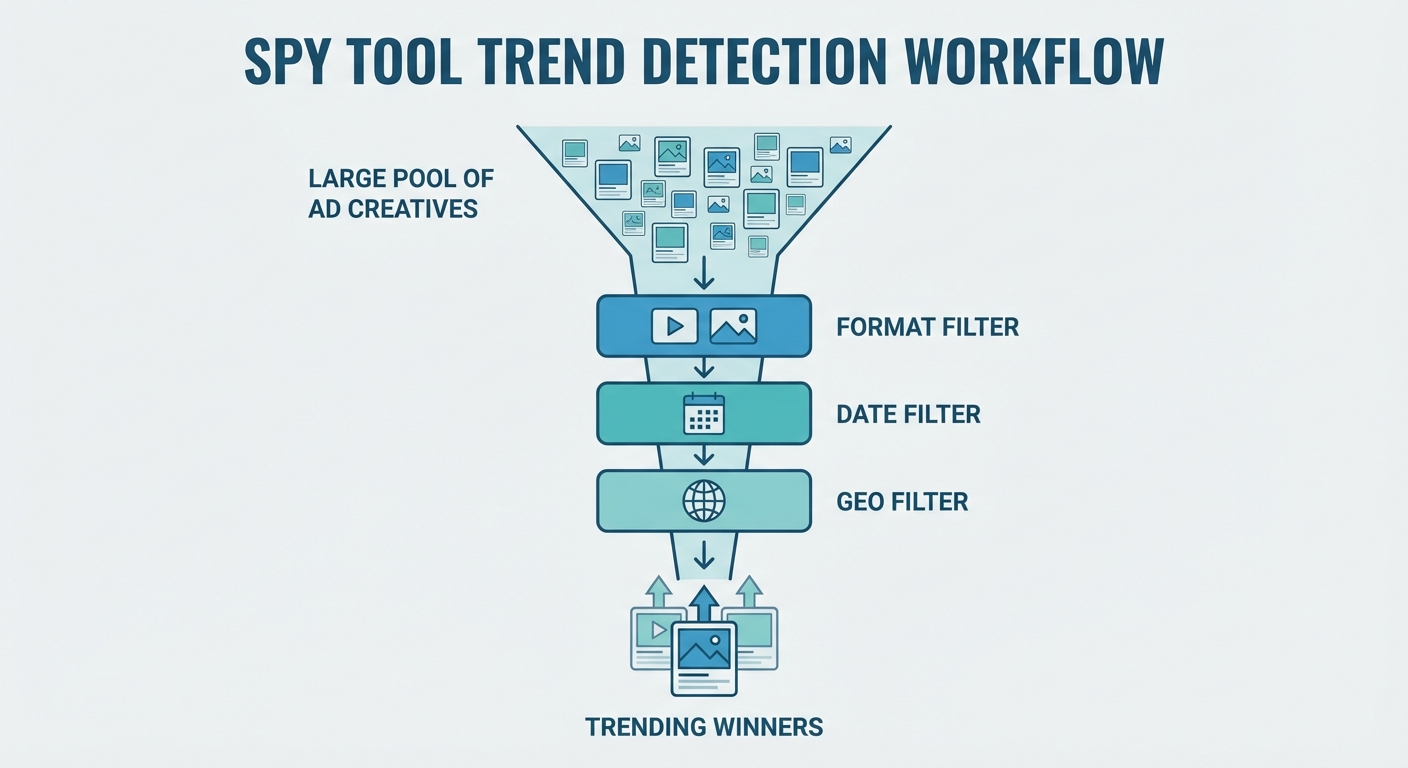 A systematic workflow for detecting creative trends using spy tool filters
Step 5: Build a trend log Document patterns you spot weekly. After 4–8 weeks, you'll see which patterns accelerate (real trends) versus which were noise.
Adligator makes this workflow practical by letting you filter by display format (video, carousel, image, etc.), creation date, days active, GEO, and platform. Instead of manually scrolling through the Ad Library, you can systematically slice the data to surface patterns. The "days active" filter is particularly valuable — it's the closest proxy to ad performance available in any spy tool.
Ready to detect trends before your competitors? Spot winning creative trends first — try Adligator free
How to Apply Trends to Your Campaigns
Knowing what's trending is only valuable if you act on it. Here's a practical implementation framework:
Week 1: Audit your current creative mix
- What percentage of your active creatives are video vs. static vs. carousel?
- How many use UGC-style format?
- What's your average video length?
- Do your hooks follow a pattern-interrupt structure?
Week 2: Produce trend-aligned test creatives
- Create 5–10 UGC-style videos (15–25 seconds, vertical)
- Test 3–5 hook variants per concept
- Build 2–3 carousel variations for your top products
- Use AI tools for copy and visual variation generation
Week 3: Launch and measure
- Run trend-aligned creatives against your current best performers
- Track CPA, ROAS, and creative longevity (how long before performance decays)
- Document what works for your specific audience and vertical
Week 4: Scale and iterate
- Kill underperformers fast (48–72 hours)
- Scale winners with budget increases
- Produce new variations of winning concepts
- Repeat the spy tool trend scan for new patterns
Vertical-specific notes:
- E-commerce: Prioritize short-form UGC product demos + carousels. Test unboxing hooks and "honest review" formats. Carousel DPAs are particularly strong for retargeting.
- SaaS/B2B: Focus on screen recording UGC + founder-talking formats. "Here's how we solved X" narratives outperform feature lists. Keep videos under 20 seconds for cold traffic.
- Gaming: Lean heavily into gameplay recording + reaction hook formats. "Watch what happens when…" hooks drive the highest thumb-stop rates. Include in-game footage within the first 2 seconds.
- Finance/Insurance: Testimonial UGC + authenticity-first copy approach. Compliance requires careful copy review, but the authentic format still wins over polished explainer videos.
- Health & Wellness: Before/after result hooks dominate but require careful compliance with Meta's ad policies. UGC testimonials with specific (verified) outcomes perform best.
Budget allocation for trend testing: Allocate 15–20% of your total creative testing budget to trend-aligned experiments each month. This gives you enough signal to validate or reject each trend for your specific audience without risking your core performance campaigns. As trends prove out, shift budget from proven underperformers to scaled trend winners.
FAQ
What Facebook ad formats work best in 2026?
Short-form vertical video (15–30 seconds) and UGC-style content consistently outperform polished studio creatives across most verticals. Carousels are making a strong comeback in e-commerce, while AI-generated creatives are gaining traction for testing at scale.
Is UGC still effective for Facebook ads?
Yes — UGC-style video remains the dominant creative format in 2026. The key distinction is that it's UGC-style (authentic, low-production feel) rather than actual user-generated content. Brands and agencies produce content designed to look organic because it outperforms polished ads in most feed environments.
How long should Facebook video ads be?
Spy tool data shows 15–30 second vertical videos have the highest longevity (meaning they stay active longest, a strong signal of profitability). Hook within the first 3 seconds is critical — ads that don't grab attention immediately get killed by both the algorithm and the advertiser.
How to stay ahead of ad creative trends?
Use ad spy tools to filter by format, recency, and your specific vertical. Track which new creatives have the longest active lifespans — longevity is the best proxy for performance. Review competitor creative output weekly rather than reading trend prediction articles quarterly.
What tools track ad creative trends?
Adligator, AdSpy, and PowerAdSpy all let you filter Meta ads by format, date, and geography. Adligator specifically shows ad longevity and lets you filter by display format (video, carousel, static, etc.), making trend detection more systematic.
Conclusion
The facebook ad creative trends 2026 are clear: UGC-style video dominates, short-form vertical is the winning format, authenticity beats production value, hooks determine everything, carousels are back for e-commerce, and AI is transforming creative testing volume.
But knowing the trends isn't the advantage — detecting them early and acting first is. The media buyers who consistently outperform are the ones who use spy tools to see what's working right now, not what pundits predict will work next quarter.
Build a weekly trend detection habit. Test aggressively. Kill losers fast. Scale winners hard. That cycle — powered by real data from millions of active ads — is the meta ad creative trends playbook that actually drives results.
Ready to see what's trending on Meta right now? Spot winning creative trends first — try Adligator free
Related Reading
- Facebook Ad Format Analysis: What Spy Tools Reveal About Carousel vs Video vs Static Performance in 2026
- Facebook Video Ad Spy: How to Analyze Competitor Video Creatives and Extract Winning Hooks
- DTC Brand Facebook Ad Research: How to Spy on Competitors and Build a Winning Creative Launch Strategy
- Seasonal Facebook Ad Research: How to Use Spy Tools to Prepare Winning Campaigns Before Q4 and Peak Seasons
