
Facebook Ad Spy for Crypto and Fintech: How to Research Competitor Campaigns in Regulated Verticals
Running ads in crypto and fintech on Facebook is not like running ads for e-commerce or SaaS. Every creative goes through additional compliance review. Entire campaigns get rejected for minor wording choices. And the advertisers who do get approved guard their winning angles closely.
That makes competitive intelligence in regulated verticals both harder and more valuable. If you can see what compliant creatives your competitors are running — how long they have been active, which geos they target, what copy angles survive Meta's review — you have a real edge.
This guide breaks down how to use crypto facebook ads spy techniques to research competitor campaigns in regulated verticals on Facebook. You will learn what Meta currently allows, how to find competitor ads efficiently, and how to extract patterns that inform your own compliant creative strategy.
The State of Crypto and Fintech Advertising on Facebook in 2026
Meta's relationship with crypto and fintech advertising has been a rollercoaster. After the blanket ban in 2018, the platform gradually reopened to licensed operators. By 2026, the landscape has settled into a regulated-but-accessible model.
What has changed:
- Meta now accepts ads from licensed crypto exchanges, wallets, and fintech platforms in most Tier 1 markets
- Pre-approval is required through Meta's cryptocurrency advertising eligibility application
- Fintech products (neobanks, payment apps, trading platforms) face lighter restrictions but still require compliance with financial services ad policies
- DeFi, ICOs, and unregistered token offerings remain largely banned from paid promotion
What this means for competitive research:
The advertisers who are running compliant campaigns have invested significant effort to get approved. Their creatives represent tested, policy-safe approaches. Studying these campaigns gives you a blueprint for what passes review and what resonates with audiences — without burning your own ad spend on trial and error.
Market size makes this worthwhile. Global crypto advertising spend on social platforms is estimated to exceed $1.2 billion annually, with fintech adding another $3+ billion. The competition for compliant ad placements is intensifying, and the winners are those who understand both the policy landscape and the creative patterns that convert.
Compliance Challenges: What Meta Allows and Blocks
Before you start researching competitor campaigns, you need to understand the compliance framework. This determines what you will find in spy tools and what angles are worth replicating.
Meta's current crypto ad policy (2026):
- Allowed with pre-approval: Licensed crypto exchanges, custody services, blockchain-based payment platforms, NFT marketplaces with clear terms of service
- Allowed with standard review: Fintech apps, neobanks, investment platforms with regulatory licenses, tax software for crypto
- Restricted: Leveraged trading products, yield farming promotions, any claims about guaranteed returns
- Banned: ICOs, unregistered securities, privacy coins promotion, P2P lending without licensing
Common rejection triggers:
- Income claims — Any suggestion of guaranteed or specific returns gets flagged immediately
- Urgency language — "Last chance to buy" or "price about to explode" triggers rejection
- Misleading simplicity — "Earn passive income with one click" does not pass review
- Missing disclaimers — Many jurisdictions require risk warnings in financial ads
- Unapproved tokens — Mentioning specific unlicensed tokens or DeFi protocols
What survives review:
The creatives that make it through tend to share characteristics: educational framing, platform feature highlights rather than return promises, social proof from verified users, and clear regulatory credentials. Understanding these patterns is exactly why competitor research matters.
Regional Compliance Variations
Compliance is not uniform across geos. A creative that runs in the US may get rejected in the EU due to MiCA regulations. Key differences:
- US: SEC and FinCEN compliance references expected. State-level licensing matters.
- EU: MiCA framework requires specific disclosures. Stricter on speculative language.
- UK: FCA-regulated entities only. Crypto ads must include clear risk warnings.
- APAC: Varies dramatically — Singapore is permissive, India is restrictive.
This is why geo-specific research matters. When you spy on competitor ads, filtering by country shows you which creatives are approved for which markets.
How to Find Competitor Crypto Ads Using Spy Tools
There are two main approaches to finding competitor crypto and fintech ads on Facebook: Meta's free Ad Library and dedicated ad spy platforms. Each has distinct strengths and limitations.
Meta Ad Library (Free, Limited)
Meta Ad Library lets you search for active ads by advertiser name or keyword. For crypto research:
- Search by competitor brand name to see their active creatives
- Browse the "Financial Products and Services" category
- See ad spend ranges for political/issue ads (not all crypto ads)
Limitations for regulated verticals:
- No filtering by ad longevity (you cannot tell if an ad has run for 1 day or 60 days)
- No keyword search across ad copy text
- No geo-specific filtering beyond country of the page
- No creative format filtering
- No historical data — once an ad stops running, it disappears
- Cannot monitor multiple competitors simultaneously
Dedicated Ad Spy Tools
Tools like Adligator solve these limitations by crawling and indexing ad creatives across the Meta ecosystem. For regulated vertical research, the critical capabilities are:
Keyword search: Search for terms like "crypto exchange," "trading platform," "neobank," or specific competitor names directly in ad copy. This is how you find campaigns you did not know existed.
Days-active filter: This is the most important filter for regulated verticals. If a crypto ad has been running for 30+ days, it has passed compliance review and is likely profitable. Short-lived ads may have been rejected or were just tests.
Geo targeting: Filter ads by the countries where they are shown. This reveals which markets competitors prioritize and which compliant creatives work in specific regulatory environments.
Platform filter: See whether competitors run on Facebook, Instagram, Messenger, Audience Network, or Threads. Crypto ads often perform differently across placements.
CTA button filter: Filter by button types like "Sign Up," "Learn More," or "Download" to understand the conversion funnel competitors use.
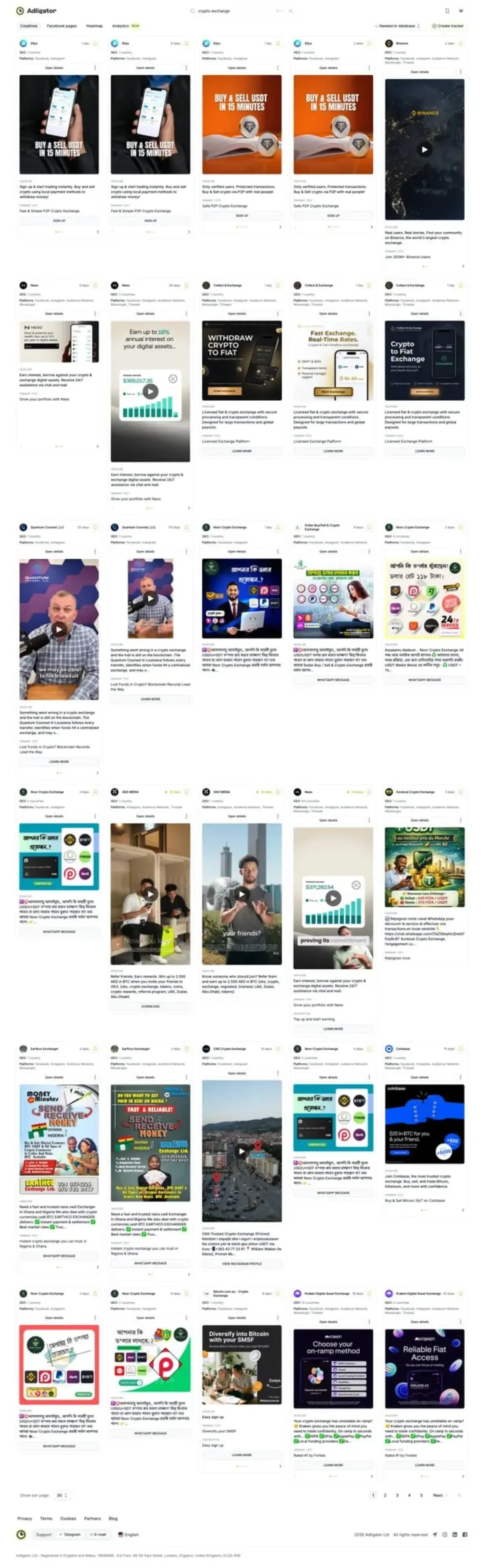 Searching for crypto-related ads in Adligator reveals active campaigns with longevity and geo data.
Building Your Competitor List
Start with direct competitors, then expand:
- Direct competitors — Other crypto exchanges, fintech apps, or financial platforms targeting the same audience
- Indirect competitors — Traditional finance brands entering crypto, payment apps adding crypto features
- Adjacent players — Crypto education platforms, tax tools, wallet providers — they often test creative angles you have not considered
- Regional players — Competitors in specific geos that may use localized approaches
For each competitor, grab their Facebook page ID (visible in their page URL or "About" section) and save it. You can use page ID filtering to monitor specific advertisers over time.
Analyzing Creative Patterns in Regulated Verticals
Once you have a dataset of competitor crypto and fintech ads, the real value comes from pattern analysis. Here is what to look for:
Copy Angles That Pass Compliance
Group competitor ads by their primary messaging angle:
- Education-first: "Learn how crypto works" — positions the platform as a teacher, not a seller
- Feature-focused: "Trade 200+ tokens with instant settlement" — highlights platform capabilities without return promises
- Security/trust: "Bank-grade security, insured assets" — addresses the fear factor in crypto
- Community/social proof: "Join 5M+ traders" — leverages user counts as credibility signals
- Regulatory credibility: "Licensed in 40+ jurisdictions" — uses compliance as a competitive advantage
Track which angles appear most frequently among long-running ads. High frequency plus long duration equals a proven pattern.
Creative Format Distribution
Regulated vertical ads tend to favor specific formats:
| Format | Usage Pattern | Why It Works |
|---|---|---|
| Video (15-30s) | Most common for crypto exchanges | Explains complex products visually, builds trust through production quality |
| Carousel | Popular for fintech apps | Shows multiple features or use cases in one ad, good for app screenshots |
| Static image | Common for brand awareness | Simple messaging, easy to iterate, fast to produce |
| DPA (Dynamic) | Rare in crypto, growing in fintech | Personalized product recommendations for trading platforms |
 Fintech advertisers rely heavily on video and carousel formats to explain complex products.
Landing Page Patterns
The ad creative is only half the story. Pay attention to destination URLs:
- Direct to app store — Common for fintech apps trying to drive installs
- Educational landing page — Used by crypto platforms to warm up cold traffic before signup
- Comparison page — "Why Brand vs competitors" — effective for bottom-funnel prospects
- Webinar/demo signup — Used by B2B fintech to generate qualified leads
Use domain and URL filters in your spy tool to categorize landing page strategies across competitors.
Common Ad Angles and Funnels in Crypto/Fintech
Understanding the typical funnel structures in regulated verticals helps you identify where competitors invest most of their budget and where opportunities exist.
Top-of-Funnel (Awareness)
- Content marketing amplification: Sharing blog posts, market reports, or educational content as ads
- Brand videos: 30-60 second brand introduction pieces emphasizing trust and scale
- Thought leadership: CEO or founder speaking about market trends (particularly effective in crypto)
Mid-Funnel (Consideration)
- Feature comparison ads: Side-by-side comparisons with generic alternatives (avoid naming competitors directly — compliance risk)
- User testimonials: Real users describing their experience (must comply with testimonial advertising rules)
- Platform walkthroughs: Screen recordings showing the product in action
Bottom-of-Funnel (Conversion)
- Sign-up incentives: "Get $10 in BTC when you create an account" — must include terms and conditions
- Limited-time promotions: Fee waivers, reduced spreads — must avoid urgency manipulation
- Retargeting creatives: Simpler messaging for users who already visited the site
Ready to research competitor crypto and fintech ads? Start monitoring regulated vertical campaigns free with Adligator
Red Flags in Competitor Research
While analyzing competitor ads, watch for patterns that indicate policy violations or risky approaches:
- Ads that appear and disappear quickly (likely rejected)
- Income or return claims, even implied ones
- Fake urgency ("Only 100 spots left")
- Unverified celebrity endorsements
- Missing regulatory disclosures
Do not replicate these patterns. Just because a competitor runs an ad briefly does not mean it is compliant or successful.
Using Adligator to Monitor Regulated Vertical Campaigns
Here is a practical workflow for ongoing crypto and fintech ad monitoring using Adligator:
Step 1: Set Up Keyword Tracking
Create searches for your key terms:
- Brand-specific: competitor names, product names
- Vertical-specific: "crypto exchange," "bitcoin trading," "neobank," "digital wallet"
- Angle-specific: "earn crypto," "trade bitcoin," "financial freedom" (to catch compliance-edge creatives)
Step 2: Apply Regulated Vertical Filters
Configure your filters to surface the most valuable data:
- Days active: 10+ — Focus on creatives that have survived compliance review and proven profitable
- Geo: Your target markets — Start with your primary geos (US, UK, EU countries)
- Platform: Facebook + Instagram — These are the primary placements for financial ads
- Format: Video + Carousel — The dominant formats in regulated verticals
- Last seen active: 7 days — Ensure you are looking at currently running campaigns
Step 3: Build a Competitive Intelligence Database
For each noteworthy ad, capture:
- Advertiser name and page ID
- Copy angle category (education, feature, trust, social proof, regulatory)
- Creative format and approximate length for video
- CTA type and destination URL pattern
- Geos where the ad runs
- Days active (longevity signal)
- Any compliance patterns (disclaimers, risk warnings, licensing mentions)
Step 4: Set Up Ongoing Monitoring
Use Adligator's tracker feature to save your key searches. Pro accounts get 7 live trackers, Team accounts get 14. Allocate them across:
- 2-3 trackers for direct competitors (by page ID)
- 2-3 trackers for vertical keywords
- 1-2 trackers for new entrants (broader keyword searches)
Review weekly. Look for new entrants, creative refreshes, and ads that crossed the 30-day mark (strong winner signal).
 A systematic workflow for monitoring regulated vertical campaigns over time.
Step 5: Extract Actionable Insights
Turn your monitoring into creative briefs:
- Winning angles: Which copy themes appear in the longest-running ads?
- Format preferences: What ratio of video to static are top competitors using?
- Geo expansion signals: Are competitors entering new markets you have not tested?
- Compliance templates: What disclaimer language and structures get approved consistently?
- Seasonal patterns: Do campaign volumes shift around market events (halvings, regulation announcements)?
Practical Example: Monitoring a Crypto Exchange Competitor
Suppose you want to monitor Competitor X, a licensed crypto exchange:
- Find their Facebook page ID from their Facebook page
- In Adligator, search by their page ID using the FB page filter
- Set days-active filter to 7+ to see only surviving creatives
- Note their top geos, formats, and copy angles
- Save this as a tracker for weekly review
- Compare their creative refresh rate — how often do they launch new ads?
Over time, this builds a picture of their strategy: which markets they prioritize, what creative fatigue looks like for them, and when they test new angles.
FAQ
Can you run crypto ads on Facebook in 2026?
Yes, but with restrictions. Meta requires pre-approval through their cryptocurrency advertising eligibility process. Advertisers must hold valid licenses and comply with local regulations. Not all crypto products are eligible — ICOs and unregistered tokens remain banned.
What is the best ad spy tool for regulated verticals?
For crypto and fintech specifically, you need a tool that supports keyword-based search, days-active filtering, and geo targeting. Adligator covers the full Meta ecosystem with these filters, making it effective for monitoring regulated vertical campaigns across 234 countries.
How do I find competitor fintech ads on Facebook?
Start by identifying competitor Facebook page IDs, then use an ad spy tool to track their active creatives. Filter by geo, language, and ad format to narrow results. Look for patterns in copy angles, CTA types, and creative formats that survive Meta's compliance review.
How long do crypto ads typically run on Facebook?
Compliant crypto ads from established exchanges often run for 30-60 days before creative refresh. Newer or riskier advertisers see shorter lifespans, often under 7 days. Longevity is a strong signal of both compliance and performance.
Is it legal to spy on competitor Facebook ads?
Yes. Ad spy tools index publicly available advertising data. Meta's Ad Library itself is designed for transparency. Using this data for competitive research is standard practice in digital marketing. You should never replicate copyrighted creative assets, but studying strategies and patterns is entirely legitimate.
Conclusion
Competitive intelligence in crypto and fintech advertising is not optional — it is a strategic necessity. The combination of strict compliance requirements and high-value audiences means that understanding what works (and what gets rejected) saves both time and money.
The key takeaway: focus on longevity signals. In regulated verticals, an ad that has been running for 30+ days is worth more study than a hundred one-day campaigns. It means the creative passed compliance, the audience responded, and the economics work.
Manual research through Meta Ad Library gives you a starting point, but it lacks the filtering, historical data, and scale needed for systematic crypto facebook ads spy operations. Dedicated tools close that gap.
Ready to start monitoring crypto and fintech competitor campaigns? Start monitoring regulated vertical campaigns free with Adligator
Related Reading
- How to Spy on Competitor Facebook Ads by Industry: Vertical-Specific Research Strategies
- DTC Brand Facebook Ad Research: How to Spy on Competitors and Build a Winning Creative Launch Strategy
- Facebook Ad Spy for SaaS and B2B: How to Research Competitor Campaigns Beyond Ecommerce
- Facebook Ads by Country: How to Research Competitor Creatives by GEO
