Facebook Ads Budget Allocation Framework: CBO vs ABO and How to Split-Test Budgets Like a Pro
Budget allocation is where most Facebook advertisers either waste money or leave performance on the table. Spend too little per ad set and you never exit the learning phase. Spread too thin across too many audiences and no single test gets enough data to reach statistical significance. Go all-in on one ad set and you miss opportunities in untested segments.
The core decision every media buyer faces: should you let Meta's algorithm distribute your budget (Campaign Budget Optimization, or CBO), or should you control spend at the ad set level (Ad Set Budget Optimization, or ABO)?
This guide gives you a practical facebook ads budget allocation framework for 2026. You will learn exactly when CBO outperforms ABO, when ABO is the smarter choice, and how to split-test budgets systematically so every dollar drives measurable learning or profit.
CBO vs ABO: How Each Approach Works
Before choosing a strategy, you need to understand the mechanics of each.
Campaign Budget Optimization (CBO)
With CBO, you set one daily or lifetime budget at the campaign level. Meta's algorithm dynamically distributes that budget across your ad sets based on real-time performance signals.
How it works:
- You set a $500/day campaign budget with 5 ad sets
- Meta might spend $200 on the top-performing ad set, $150 on the second, and divide the remaining $150 among the other three
- Distribution shifts continuously throughout the day based on conversion probability
Pros:
- Meta's algorithm processes millions of signals per second — it often finds optimal distribution faster than manual monitoring
- Less daily management overhead
- Automatically shifts spend away from underperforming audiences
- Better for scaling because Meta can quickly increase spend on winning segments
Cons:
- Can starve new or smaller audiences before they have enough data to prove themselves
- Less predictable spend per ad set — makes reporting by audience segment harder
- May over-concentrate on one ad set if it shows early promise (even if that early signal is noise)
Ad Set Budget Optimization (ABO)
With ABO, you set individual budgets for each ad set. Every ad set gets exactly the budget you assign, regardless of relative performance.
How it works:
- You create 5 ad sets, each with $100/day
- Each ad set spends its full $100 regardless of which performs best
- You manually analyze results and reallocate budget based on your own analysis
Pros:
- Guaranteed data for every audience you test — no starvation
- Predictable spend makes ROI calculation per segment straightforward
- Full control over which segments get budget
- Better for early-stage testing when you do not yet know which audiences work
Cons:
- Requires more manual monitoring and budget adjustments
- You may overspend on losing ad sets while you wait for enough data
- Scaling requires manual intervention (increasing budgets, creating new ad sets)
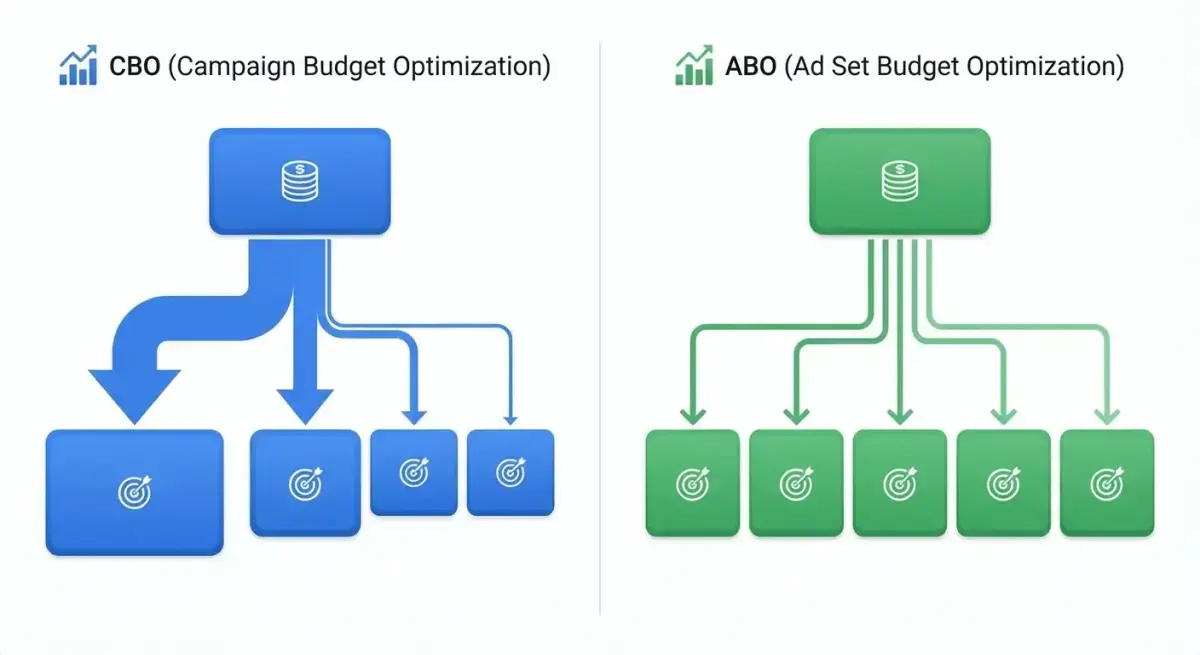 CBO lets Meta distribute budget across ad sets automatically, while ABO gives you fixed control over each ad set's spend
When to Use CBO vs ABO: The Decision Framework
The right choice depends on your campaign phase, audience maturity, and testing goals.
Use ABO When:
- Testing new audiences — You need equal data across all segments. CBO might kill a promising audience before it has 50 conversions.
- Testing new creatives — When you want to see how different creatives perform in the same audience with guaranteed equal exposure.
- Small total budgets — Below $200/day total, CBO does not have enough budget to distribute meaningfully across multiple ad sets.
- Running A/B tests — Any controlled experiment needs equal budget allocation to produce valid results.
- Niche or small audiences — If audience sizes vary dramatically (10K vs 2M), CBO will ignore the smaller audience. ABO ensures it gets tested.
Use CBO When:
- Scaling proven winners — You have already identified your best audiences and creatives. Let Meta optimize distribution for maximum conversions.
- Large budgets ($500+/day) — CBO excels when it has enough budget to distribute across multiple opportunities.
- Multiple overlapping audiences — CBO handles audience overlap better because it optimizes across the campaign rather than double-serving the same users.
- Mature campaigns — When your Pixel has strong historical data and Meta's algorithm has clear optimization signals.
- Reducing management overhead — If you manage many campaigns, CBO reduces the need for daily budget adjustments.
The Hybrid Approach (What Top Media Buyers Actually Do)
Most experienced buyers use both:
- ABO testing campaigns — Small budgets, isolated variables, equal spend per ad set. Goal: find winners.
- CBO scaling campaigns — Proven audiences + creatives, larger budgets, Meta distributes. Goal: maximize conversions.
This separation keeps your testing clean and your scaling efficient. Never test and scale in the same campaign.
The Budget Split-Testing Framework
Split-testing budgets requires the same rigor as testing creatives or audiences. Here is a systematic framework.
Step 1: Define Your Test Hypothesis
Before spending anything, write down what you are testing and what result would change your behavior.
Examples:
- "CBO with 3 proven audiences will produce 15% lower CPA than ABO with the same audiences at the same total budget"
- "Increasing ad set budget from $50 to $100/day will reduce CPA by exiting the learning phase faster"
- "A 70/20/10 budget split (proven/testing/experimental) will outperform equal distribution over 14 days"
Step 2: Structure the Test
Rules for valid budget tests:
| Rule | Why |
|---|---|
| Same total budget | Ensures differences come from allocation, not spend level |
| Same audiences | Isolates the budget variable |
| Same creatives | Prevents creative performance from skewing results |
| Same optimization event | Comparing Purchase-optimized vs Lead-optimized campaigns tells you nothing about budget allocation |
| Minimum 3x target CPA per ad set | Ensures enough conversions for learning |
| 5-7 day minimum runtime | Accounts for day-of-week variance |
Step 3: Monitor Without Intervening
The hardest part: do not touch the test for at least 5 days.
Track daily:
- Cost per result (CPA, ROAS, or your primary KPI)
- Spend distribution (for CBO — is it concentrating too early?)
- Frequency (are you saturating the audience?)
- Learning phase status (has each ad set exited learning?)
Do NOT adjust:
- Do not increase or decrease budgets mid-test
- Do not pause ad sets that look bad on day 1-2
- Do not add new creatives to the test campaign
Step 4: Analyze and Decide
After 5-7 days with sufficient data:
- Compare CPA across variants — Is the difference statistically significant? Use a significance calculator if the difference is less than 20%.
- Check consistency — Did one variant win every day, or did results fluctuate? Consistent winners are more reliable.
- Evaluate by segment — Even if total CPA is similar, one approach may have found a profitable segment the other missed.
Decision rules:
- CPA difference > 20% and consistent → adopt the winner
- CPA difference 10-20% → extend the test 3-5 more days
- CPA difference < 10% → choose the approach with lower management overhead (usually CBO)
 A systematic framework for split-testing budgets: structure, monitor, decide, scale
Budget Allocation Formulas That Actually Work
Stop guessing at numbers. Use these frameworks to set initial budgets based on your goals.
The 70/20/10 Rule
Allocate your total Facebook budget:
- 70% → Proven campaigns (audiences and creatives with 3+ weeks of profitable data)
- 20% → Testing campaigns (new audiences OR new creatives, one variable at a time)
- 10% → Experimental campaigns (new angles, new funnels, new formats you have never tried)
This ratio ensures you keep profit flowing while continuously finding new winners.
Minimum Budget Per Ad Set
Calculate the minimum daily budget needed for each ad set:
Minimum daily budget = Target CPA × 3
If your target CPA is $25, each ad set needs at least $75/day to generate enough data for Meta's algorithm to optimize. Below this, the ad set stays in the learning phase indefinitely.
For purchase-optimized campaigns, Meta officially recommends 50 conversions per week per ad set. Work backward:
Recommended daily budget = (50 × Target CPA) / 7
At $25 CPA: (50 × $25) / 7 = $178/day per ad set. This is the ideal — not always realistic, but anything below the 3x minimum is wasteful.
Scaling Budget: The 20% Rule
When scaling a winning ad set or campaign:
- Increase budget by no more than 20% every 48-72 hours
- Larger jumps reset the learning phase and often spike CPA temporarily
- If CPA increases by more than 30% after a budget increase, revert to the previous level and wait 3 days before trying again
Pro tip: Before scaling, check what competitors in your niche are running. Ads that have been active for 30+ days almost certainly have profitable budget allocation behind them — study their creative approach and audience signals. See which competitor ads have been running longest → Try Adligator free
Common Budget Allocation Mistakes
Mistake 1: Starting With CBO Before You Have Winners
CBO is an optimization tool, not a testing tool. If you launch a CBO campaign with 5 untested audiences, Meta will concentrate budget on whichever shows the earliest signal — which may not be the best long-term performer. Test with ABO first, then scale winners with CBO.
Mistake 2: Setting Ad Set Budgets Too Low
A $10/day budget on a Purchase-optimized ad set with a $30 CPA means you might get one conversion every three days. That is nowhere near enough data for Meta to optimize. Either increase the budget or switch to a higher-funnel optimization event (like Add to Cart or Landing Page View).
Mistake 3: Changing Budgets Too Frequently
Every significant budget change resets the learning phase. If you adjust budgets daily based on yesterday's results, your ad sets never stabilize. Set a budget, wait 5-7 days, then make data-driven adjustments.
Mistake 4: Ignoring Audience Size Relative to Budget
A $500/day budget targeting a 50K audience will saturate quickly and spike frequency. A $50/day budget targeting a 10M audience will never reach enough people to generate meaningful data. Match budget to audience size:
Rule of thumb: Aim for a daily reach of 1-5% of your target audience. Check this in Ads Manager under "Estimated Daily Results."
Mistake 5: Not Accounting for Creative Fatigue
Budget allocation cannot fix creative fatigue. If your best-performing ad set's CPA is rising while frequency climbs above 3, the issue is not budget — it is stale creative. Monitor frequency alongside CPA for every budget decision.
Mistake 6: Equal Budget Across Unequal Opportunities
Giving every ad set the same budget assumes every audience has equal potential. In practice, some audiences are 5x more valuable than others. After an initial equal-budget testing phase, reallocate based on actual performance data. The 70/20/10 rule helps — your best performers deserve the lion's share.
Mistake 7: Optimizing Budget Without Optimizing Creative
Budget is one lever. Creative quality is a bigger one. A mediocre creative with a perfect budget structure will always lose to a great creative with decent budget allocation. Before blaming your budget strategy, audit your creative performance:
- Is your click-through rate above 1%? Below that, your creative is not engaging.
- Is your hook rate (3-second video views / impressions) above 25%? Below that, you are losing attention immediately.
- Are you testing at least 3-5 creative variants per ad set? Single-creative ad sets limit Meta's optimization ability.
Budget Allocation by Campaign Objective
Different campaign objectives require different budget approaches.
Conversion Campaigns (Purchase, Lead)
- Use higher minimum budgets (3-5x target CPA per ad set)
- CBO works well once you have 2+ ad sets with proven conversion history
- Allocate 60-70% of total budget here for campaigns with validated creatives
- Monitor ROAS at the ad set level, not just campaign level
Traffic and Engagement Campaigns
- Lower minimums are acceptable ($20-50/day per ad set)
- ABO is often better because CPA variance is lower and you want equal reach testing
- Use these campaigns to build retargeting audiences for conversion campaigns
- Budget here should be 15-20% of your total Facebook spend
Retargeting Campaigns
- Smaller audiences require smaller budgets — match budget to audience size
- Daily budget should produce a frequency of 1-3 per week (not per day)
- Usually 10-15% of total budget
- ABO is better here because audience sizes are fixed and you want precise control
Lookalike Campaigns
- Budget should reflect the quality of your source audience
- Start with ABO to test 1%, 2%, and 3-5% lookalikes with equal budget
- Graduate top performers to CBO for scaling
- Allocate 20-30% of your testing budget to lookalike exploration
Using Competitive Intelligence to Inform Budget Decisions
Your budget allocation does not exist in a vacuum. Understanding what competitors spend — and which of their ads sustain budget long-term — gives you context for your own decisions.
What ad longevity reveals about budget:
- An ad running 7+ days has likely passed initial testing
- An ad running 14+ days is probably profitable enough to keep funded
- An ad running 30+ days almost certainly has significant budget behind it and a validated creative-audience match
You cannot see competitor budgets directly. But you can see their ads' run duration, which is the next best signal.
With Adligator, you can filter competitor ads by "days active" to find these long-runners. Study their creative approach, messaging, and landing page strategy — then apply those patterns to your own budget-backed tests.
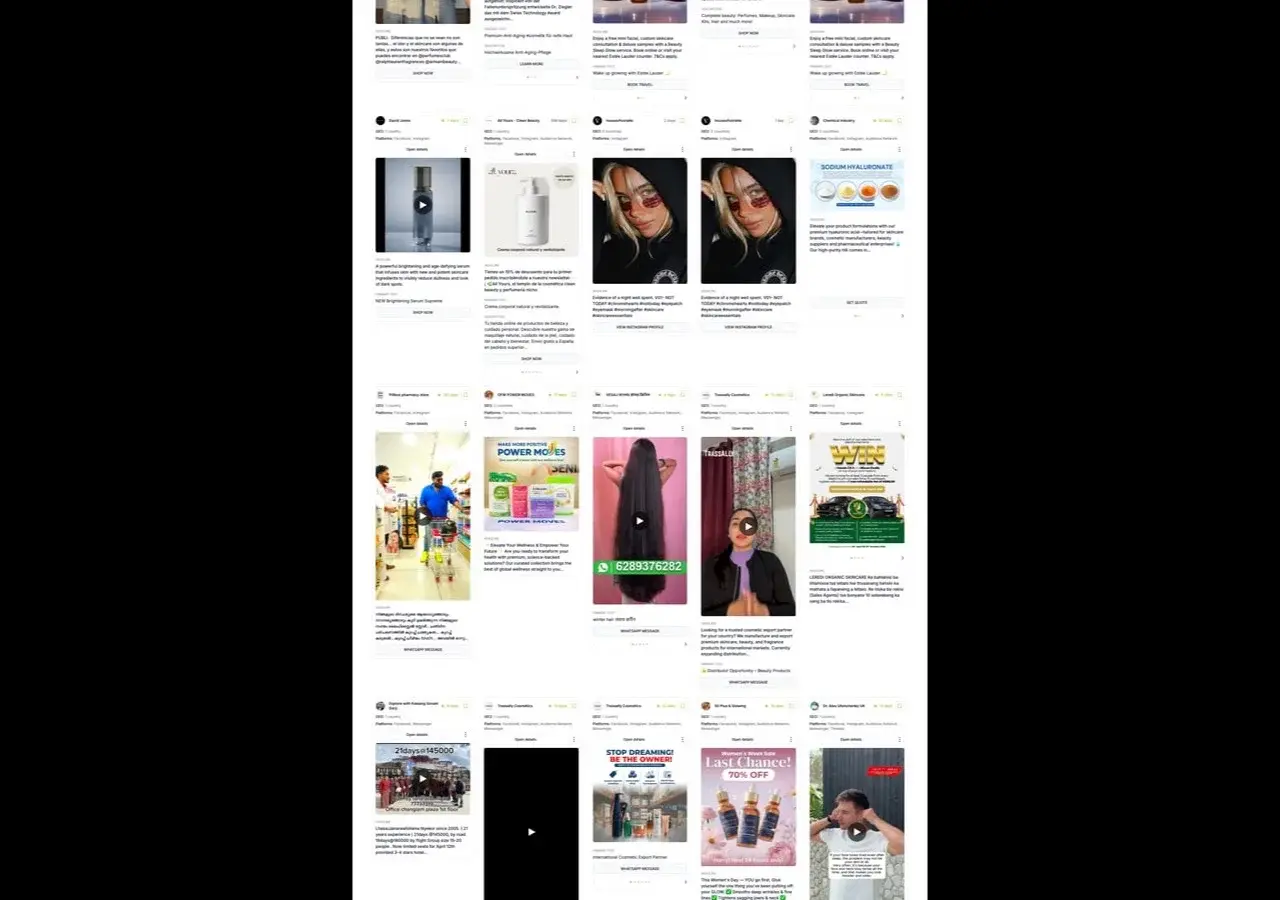 Ads running 30+ days in Adligator signal profitable budget allocation — use longevity as a proxy for spend efficiency
FAQ
Should I always use CBO for Facebook Ads?
No. CBO works best when you have proven audiences and creatives and want Meta to distribute budget toward top performers. For testing new audiences or creatives with small budgets, ABO gives you more control over spend distribution and prevents Meta from prematurely concentrating budget on one ad set.
What is the minimum budget for split-testing Facebook Ads?
A practical minimum is 3x your target CPA per ad set, running for at least 3-5 days. If your target CPA is $30, budget at least $90 per ad set in the test. Below this threshold, you will not generate enough conversions for statistically meaningful results.
Can I use CBO and ABO in the same account?
Yes. Many advanced media buyers run both simultaneously — CBO for scaling proven winners and ABO for testing new variables. The key is separating testing campaigns (ABO) from scaling campaigns (CBO) so each serves its purpose.
How long should I run a budget split test?
Run tests for at least 5-7 days to account for day-of-week variations in performance. End tests after 14 days maximum — if you do not have clear results by then, the difference between variants is likely too small to matter.
Conclusion
Effective facebook ads budget allocation comes down to three principles: test with ABO to find winners, scale with CBO to maximize them, and follow a structured framework to split-test budget strategies with the same rigor you apply to creatives.
Use the 70/20/10 rule to balance profit and exploration. Set minimum budgets at 3x your target CPA per ad set. Scale in 20% increments. And never test and scale in the same campaign.
The most overlooked budget insight: study what competitors sustain. Long-running ads are a proxy for profitable budget allocation. If a competitor keeps an ad live for 30+ days, their budget structure and creative approach are worth studying.
Ready to see which ads in your niche have been running longest? Try Adligator free
Research competitor ad spend signals with Adligator
Related Reading
- How to Allocate Your Facebook Ads Budget for Testing: A Practical Framework for Solo Media Buyers
- How to Run Facebook Ads for SaaS Products: Campaign Structure, Targeting, and Creative Strategy for B2B Marketers
- How Many Ad Creatives Do You Need for Facebook Ads? A Data-Driven Framework by Budget Level (2026)
- How to A/B Test Facebook Ad Creatives: A Beginner Guide to Statistical Confidence and Faster Winners
