Facebook Ads Budget Optimization: CBO vs ABO Strategy Guide for Media Buyers
The fastest way to waste ad budget on Facebook is to pick the wrong budget structure for your campaign objective. Campaign Budget Optimization (CBO) and Ad Set Budget Optimization (ABO) are not interchangeable — each serves a specific purpose in the media buying lifecycle.
Yet most guides treat this like a religious debate: "CBO is always better" or "ABO gives more control." The truth is situational. Your budget structure should change based on whether you are testing, scaling, or maintaining. This facebook ads budget optimization guide gives you a practical decision framework, not opinions.
You will learn exactly when CBO outperforms ABO (and vice versa), how to structure budgets at each campaign stage, and how to use competitive intelligence to validate your budget allocation. No fluff, no theory — just the framework experienced media buyers actually use in 2026.
Understanding CBO and ABO: How Each Actually Works
Before choosing between them, you need to understand what happens under the hood.
Campaign Budget Optimization (CBO)
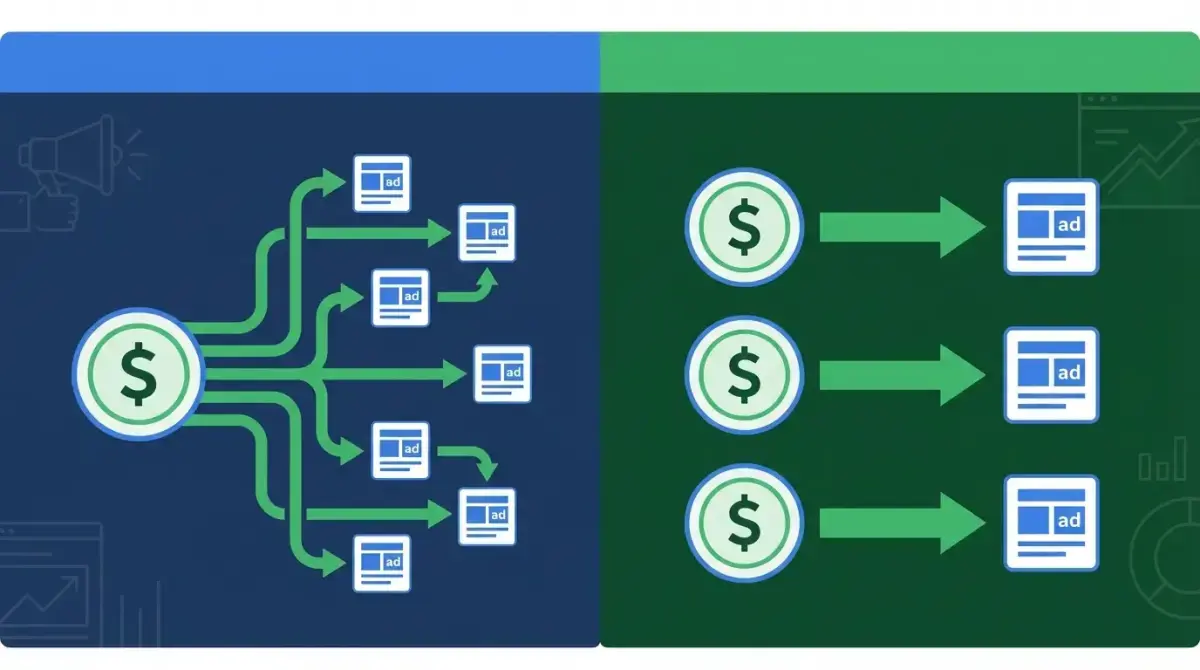
With CBO, you set one budget at the campaign level. Meta's algorithm distributes that budget across ad sets in real time based on performance. The algorithm continuously reallocates — shifting more spend to ad sets delivering better results and pulling back from underperformers.
Key mechanics:
- Budget is shared across all ad sets within a campaign
- Algorithm reallocates every few minutes (not daily)
- You can set minimum and maximum spend limits per ad set
- Requires sufficient data volume to optimize effectively (at least 50 conversions/week recommended)
- Works best with 3+ ad sets so the algorithm has options to distribute
Ad Set Budget Optimization (ABO)
With ABO, you set individual budgets at the ad set level. Each ad set gets its fixed allocation and spends independently. You control exactly how much goes where.
Key mechanics:
- Each ad set has its own independent budget
- Spend is consistent and predictable per audience
- You manually decide reallocation based on results
- Better for controlled testing with equal spend distribution
- No algorithmic redistribution between ad sets
The fundamental tradeoff is simple: CBO trades control for efficiency. ABO trades efficiency for control. Neither is inherently superior.
CBO vs ABO: When to Use Each
This is the decision framework that matters. Stop asking "which is better" and start asking "which fits my current objective."
Use ABO When:
1. Testing new audiences. When you launch a new audience — whether it is a new interest stack, lookalike, or broad targeting — you want equal budget distribution. ABO ensures every audience gets the same spend so your comparison is fair. CBO would starve the slower-starting audiences before they have enough data.
2. Testing new creatives. Same logic. If you are split-testing 3–5 new creatives across identical audiences, ABO gives each creative equal opportunity. CBO might dump 80% of budget into the first creative that gets an early win, even if another would outperform over time.
3. Small budgets ($50–$200/day). With limited budget, CBO has less room to optimize effectively. ABO lets you control exactly where every dollar goes.
4. When you need predictable spend. Client told you to spend exactly $100/day on retargeting? ABO. CBO might decide to shift that budget to prospecting if it performs better — not what the client wants.
5. During the learning phase. New campaigns need stable conditions to exit the learning phase. ABO provides that stability.
Use CBO When:
1. Scaling proven campaigns. Once you have 3+ ad sets with proven performance, CBO can distribute budget more efficiently than you can manually. The algorithm processes thousands of signals per user — you cannot replicate that speed.
2. Large budgets ($500+/day). The algorithm needs data volume to work. At scale, CBO finds efficiency gains that are invisible to manual management.
3. Multiple ad sets with similar audiences. If your audiences overlap (and they often do), CBO avoids the self-competition problem. It identifies which users convert best and routes spend accordingly, rather than bidding against yourself.
4. Broad targeting strategies. Running Advantage+ or broad targeting with no interest constraints? CBO excels here because the algorithm needs freedom to explore the full audience pool.
5. Maintaining established campaigns. Campaigns in the "scale and maintain" phase benefit from CBO's continuous micro-optimization. Set it, monitor it, and intervene only on anomalies.
 Use this decision framework to choose between CBO and ABO for each campaign.
The Hybrid Approach: How Top Media Buyers Structure Accounts
The best media buyers do not commit to one strategy. They run both simultaneously in a structured account architecture:
Testing Tier (ABO)
- Purpose: Validate new audiences, creatives, and offers
- Budget: 20–30% of total ad spend
- Structure: ABO with equal budgets per ad set
- Cadence: Launch new tests weekly, kill losers after 3–5 days
- Graduation criteria: CPA below target for 3+ consecutive days with 10+ conversions
Scaling Tier (CBO)
- Purpose: Maximize volume from proven combinations
- Budget: 60–70% of total ad spend
- Structure: CBO with 3–8 ad sets per campaign
- Min/max spend limits: Set minimums at 50% of ideal per-ad-set spend, maximums at 200%
- Monitoring: Daily check for ad set spend distribution anomalies
Retargeting Tier (ABO or CBO)
- Purpose: Convert warm audiences
- Budget: 10–20% of total ad spend
- Structure: ABO if you need precise spend control by audience segment, CBO if retargeting pools are large enough
- Key metric: Frequency (keep below 5–6 to avoid creative fatigue)
This tiered structure gives you the best of both worlds: controlled testing with ABO, efficient scaling with CBO, and dedicated retargeting that does not compete with prospecting budgets.
Budget Scaling Strategies That Actually Work
Facebook ads budget optimization is not just about CBO vs ABO — it is about how you increase spend without destroying performance. Here are the proven approaches:
Gradual Scaling (The Safe Path)
Increase daily budget by 20–30% every 2–3 days. This gives the algorithm time to adjust without resetting the learning phase. For a $100/day campaign:
- Day 1: $100
- Day 3: $125
- Day 5: $155
- Day 7: $195
- Day 10: $245
At this pace, you double your budget roughly every 10 days while maintaining stability.
Horizontal Scaling (The Smart Path)
Instead of increasing budget on one campaign, duplicate successful ad sets into new campaigns:
- Take your best-performing ad set
- Duplicate it into a new CBO campaign
- Give the new campaign its own fresh budget
- Run both simultaneously
This avoids the learning phase reset entirely. You are creating new campaigns, not modifying existing ones. The downside: more campaigns to manage.
Audience Expansion Scaling
When your current audiences hit frequency caps:
- Create broader lookalikes (expand from 1% to 3–5%)
- Test interest expansion (add related interests)
- Try Advantage+ broad targeting with no interest constraints
- Expand to new geos if your product supports it
Audience expansion is the only sustainable scaling strategy. Budget increases without audience growth just raise your CPM.
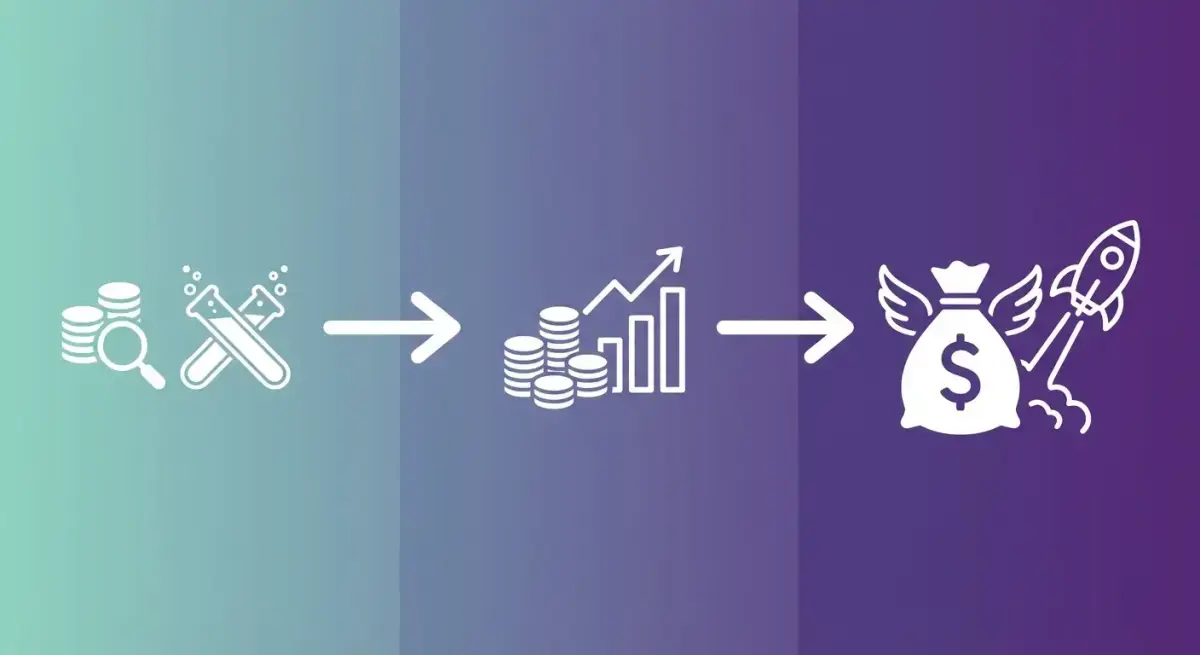 Budget scaling follows three phases — rushing through any stage leads to wasted spend.
What to Do When Scaling Breaks Performance
It will happen. You scale, CPA spikes, ROAS tanks. Here is the playbook:
- If CPA spiked within 24 hours of a budget increase: Revert the budget. Wait 48 hours. Try a smaller increase.
- If CPM is rising but CTR is stable: Audience saturation or increased competition. Expand audiences, do not just throw more budget.
- If CTR is declining across all creatives: Creative fatigue. Pause scaling, refresh creatives first. Check what competitors are running for inspiration.
- If conversion rate dropped but traffic quality looks fine: Landing page issue or offer fatigue. Test a new angle before increasing ad spend.
Using Competitive Intelligence to Inform Budget Decisions
Here is the blind spot in most campaign budget optimization strategies: you are making decisions based only on your own data. But your budget performance depends heavily on what competitors are doing in the same auction.
When a competitor launches an aggressive campaign targeting your audience, your CPMs rise. When they pull back, your efficiency improves. Without competitive context, you are optimizing in a vacuum.
What Competitor Signals Tell You About Budget Allocation
- Competitor ad longevity (7+ days active): Ads running for weeks are almost certainly profitable. They signal where budget is flowing in your niche — and which creative angles are working.
- Competitor creative volume: An advertiser launching 20+ new creatives in a week is likely in heavy testing mode. Their increased auction participation may explain your CPM spikes.
- Competitor format shifts: If competitors pivot from static images to video, it signals where the algorithm is rewarding engagement. Adjust your creative budget allocation accordingly.
- Seasonal patterns: Tracking competitor activity over months reveals when they increase spend (Q4, major sales events) and when they pull back.
How Adligator Makes This Actionable
Manually monitoring competitors through the Meta Ad Library is possible but impractical for budget decisions. You cannot filter by days active, cannot see format breakdowns, and cannot track changes over time.
Adligator gives you the competitive intelligence layer that informs smarter budget allocation:
- Filter by days active to identify ads that have been running 14+ days — strong signal of profitable spend
- Track specific competitors by Facebook page ID to monitor their creative velocity
- Analyze format distribution to see where competitors allocate creative budgets (video vs. image vs. carousel)
- Set up live trackers to get notified when competitors launch new campaigns in your niche
Want to see what your competitors are spending on? Try Adligator Free — See What Competitors Spend On
The practical application: before making a major budget increase, check Adligator for competitive activity. If three competitors just launched aggressive campaigns targeting similar keywords, your CPM will rise regardless of your optimization. Wait for the auction to cool, or shift budget to less competitive placements.
Common Budget Optimization Mistakes
Mistake 1: Scaling Too Fast
The number one budget killer. Jumping from $100/day to $500/day overnight almost always triggers a learning phase reset and performance collapse. Patience scales better than aggression.
Mistake 2: Using CBO with Only 2 Ad Sets
CBO needs options. With only 2 ad sets, the algorithm is essentially making a binary choice. At 3+ ad sets, it can distribute meaningfully. At 5+, it truly shines.
Mistake 3: No Min/Max Spend Limits on CBO
Without limits, CBO can dump 90% of budget into one ad set. Set minimum spend at 10–15% of campaign budget per ad set and maximum at 40–50%. This constrains the algorithm while still giving it room to optimize.
Mistake 4: Ignoring the Learning Phase
Every significant budget change (50%+) can reset the learning phase. During learning, performance is volatile and CPA is typically 20–30% higher. If you are constantly changing budgets, you are constantly in learning mode.
Mistake 5: Same Budget Strategy for All Objectives
A brand awareness campaign and a conversion campaign need completely different budget approaches. Awareness works fine with CBO and broad distribution. Conversions need more controlled allocation, especially during testing.
Mistake 6: Not Separating Testing and Scaling Budgets
If your test campaigns compete for budget with your scaling campaigns, you will always underfund testing. Separate them structurally — different campaigns, different budgets, different KPIs.
Budget Allocation Checklist for Media Buyers
Use this checklist when setting up or revising your facebook ad budget strategy:
- Campaign objective clearly defined (awareness, leads, purchases)
- Budget structure matched to objective (ABO for testing, CBO for scaling)
- Min/max spend limits set on all CBO campaigns
- Testing budget is 20–30% of total spend
- Scaling budget increases are capped at 20–30% per change
- Retargeting has dedicated budget (not competing with prospecting)
- Competitive landscape checked before major budget increases
- Learning phase completion confirmed before next budget change
- Creative refresh scheduled before frequency hits 4+
- Attribution window consistent across all reporting
FAQ
Should I use CBO or ABO for Facebook Ads in 2026?
Use ABO when testing new audiences or creatives with controlled budgets. Switch to CBO when scaling proven campaigns with 3+ ad sets. Most successful media buyers use both simultaneously — ABO for testing, CBO for scaling winners.
How much should I increase my Facebook Ads budget when scaling?
Increase budgets by 20–30% every 2–3 days to avoid resetting the learning phase. Sudden jumps of 50%+ often trigger performance drops as the algorithm readjusts. For CBO campaigns, you can be slightly more aggressive since the algorithm redistributes automatically.
What is the minimum budget for Facebook Ads CBO to work effectively?
Meta recommends a minimum daily budget of at least $1 per ad set for CBO to have enough data to optimize. In practice, aim for at least 50 conversions per week at the campaign level — so your minimum CBO budget is roughly 50× your target CPA divided by 7 days.
Conclusion
Facebook ads budget optimization comes down to matching your budget structure to your campaign stage. Use ABO for controlled testing with predictable spend distribution. Switch to CBO when scaling proven campaigns that need algorithmic efficiency. Run both simultaneously in a tiered account structure.
Scale gradually — 20–30% increases every few days. Use horizontal scaling and audience expansion to grow sustainably. Add competitive intelligence to your workflow so you are not blindsided by market shifts that spike your CPMs.
The media buyers who consistently hit targets are not the ones with the biggest budgets. They are the ones who allocate systematically, test rigorously, and scale only what is proven.
Ready to see how competitors allocate their ad budgets? Try Adligator Free — See What Competitors Spend On
Spy on Competitor Ad Budgets with Adligator
Related Reading
- How to Allocate Your Facebook Ads Budget for Testing: A Practical Framework for Solo Media Buyers
- Top 10 Facebook Ads Mistakes That Waste Budget: An Audit Checklist for Media Buyers (2026)
- Facebook Carousel Ads Optimization: Card Sequencing, Storytelling, and Conversion Strategies for Media Buyers
- How to Analyze Facebook Ad Creatives by GEO and Vertical: A Data-Driven Approach for Media Buyers
