How to Allocate Your Facebook Ads Budget for Testing: A Practical Framework for Solo Media Buyers
Most solo media buyers waste 40-60% of their testing budget. Not because they pick bad creatives or wrong audiences, but because they have no structure for how they spend. They throw $20 at five different ad sets, pull the plug after one day, and conclude that "Facebook ads do not work."
The real problem is not budget size — it is budget allocation. A $1,000 monthly facebook ads budget for testing can outperform a $5,000 budget if it is structured properly. You need clear rules for how much goes to testing versus scaling, when to kill a test, and how to sequence your experiments so each one builds on the last.
This guide gives you a practical budget allocation framework designed for solo media buyers and small teams. No agency-scale budgets required. Just disciplined structure that turns limited resources into consistent learnings.
Why Most Testing Budgets Fail
Before diving into the framework, let us understand why unstructured testing burns money.
Testing too many variables at once. If you change the creative, audience, placement, and copy simultaneously, you cannot attribute results to any single variable. When something works (or fails), you do not know why.
Insufficient budget per test. Spending $5/day on an ad set gives Facebook almost nothing to work with. The algorithm needs data to optimize, and $5 buys roughly 250-500 impressions — not enough for any meaningful signal. Your results become random noise, not actionable data.
No kill criteria defined before launch. Without predetermined thresholds for when to stop a test, you either kill winners too early (impatience) or let losers run too long (hope). Both waste money.
No connection between tests. Each test should answer a specific question that informs the next test. Random testing without a hypothesis is just gambling with extra steps.
Ignoring what already works in the market. Starting creative tests from scratch when competitors have already validated concepts in your niche is inefficient. Competitive research before testing reduces the number of failed experiments.
The Budget Split Framework: 70-20-10
The foundation of effective ad testing budget allocation is separating your total budget into three buckets with clear purposes.
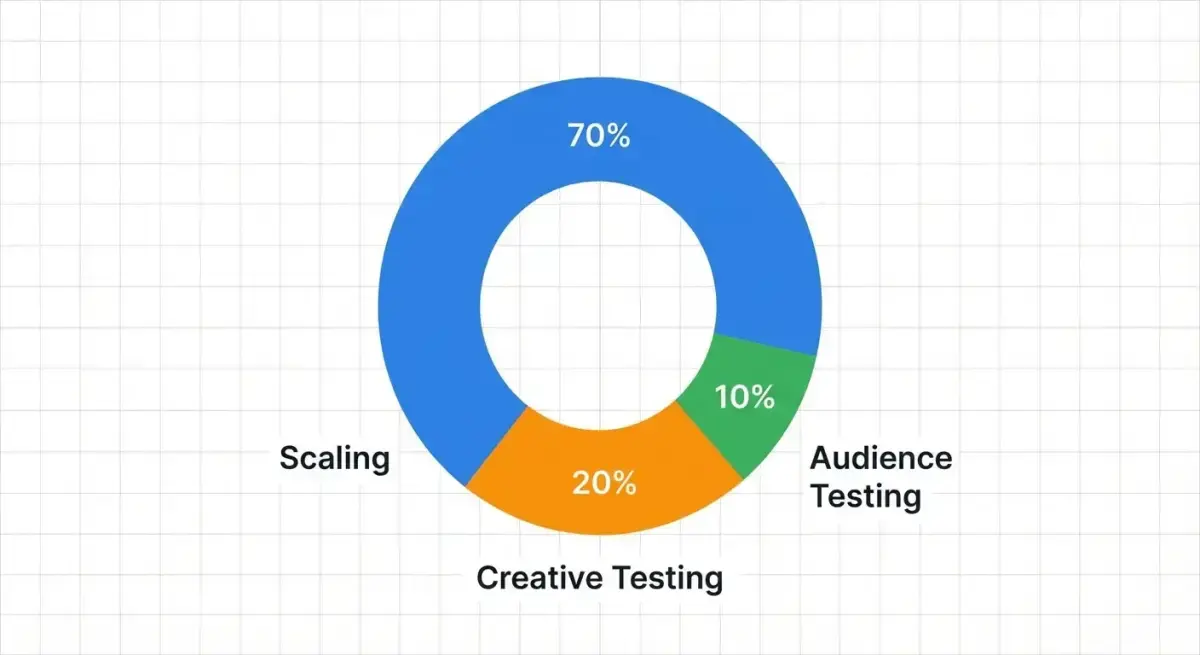 The 70-20-10 budget framework gives structure to your testing while protecting proven campaign performance
70% — Scaling (proven campaigns)
This is your money-making bucket. It funds ad sets and creatives that have already proven profitable. The goal is consistent, predictable returns.
- Only campaigns with 3+ days of profitable data enter this bucket
- Scaling means increasing budget by 20-30% every 2-3 days (not doubling overnight)
- If a scaled campaign drops below target ROAS for 3 consecutive days, move it back to testing
20% — Creative testing
This is your innovation bucket. It funds new ad creatives tested against your best-performing audience.
- Test 3-5 new creatives per week
- Each creative gets $20-30/day minimum for 3-5 days
- Hold the audience constant — use your best proven audience so creative is the only variable
- Winners move to the 70% scaling bucket
10% — Audience/offer testing
This is your exploration bucket. It funds tests of new audiences, lookalikes, interests, and offers.
- Test one new audience variable at a time
- Use your best-performing creative so audience is the only variable
- Smaller budget is fine here because you are looking for directional signals, not definitive answers
Adjusting the split for beginners
If you have no proven campaigns yet (just starting out), flip the ratio:
- 0% Scaling (nothing proven yet)
- 70% Creative testing (find what works)
- 30% Audience testing (find who responds)
As you find winners, gradually shift toward the 70-20-10 model. Most solo buyers reach this equilibrium within 4-8 weeks of disciplined testing.
How to Size Individual Tests
The biggest mistake in facebook ads test budget allocation is spending too little per test to get meaningful data. Here is how to calculate the right test budget.
Minimum viable test budget
Your minimum test budget per ad set depends on your target CPA (cost per acquisition):
Formula: Minimum test budget = Target CPA × 3
If your target CPA is $30, you need to spend at least $90 per ad set before deciding it is a winner or loser. This gives the algorithm enough data to attempt optimization and gives you enough conversions (or lack thereof) to make a decision.
Daily budget per ad set: Divide total test budget by 3-5 days. For a $90 test: $18-30/day per ad set.
Budget by campaign objective
| Objective | Minimum Daily Budget/Ad Set | Test Duration |
|---|---|---|
| Conversions (Purchase) | $30-50 | 5-7 days |
| Conversions (Lead) | $20-30 | 3-5 days |
| Traffic | $10-20 | 3-5 days |
| Engagement | $5-10 | 3-5 days |
Why conversions need more budget: Facebook's algorithm needs approximately 50 conversions per week per ad set to fully exit the learning phase. For a $30 CPA product, that is $1,500/week — unrealistic for most solo buyers. The practical compromise is accepting that your ad sets will remain in "Limited Learning" and making decisions based on directional trends rather than statistical perfection.
Monthly budget examples
| Monthly Budget | Scaling (70%) | Creative Test (20%) | Audience Test (10%) | Tests/Month |
|---|---|---|---|---|
| $500 | $350 | $100 | $50 | 3-4 creative, 1-2 audience |
| $1,000 | $700 | $200 | $100 | 5-7 creative, 2-3 audience |
| $2,500 | $1,750 | $500 | $250 | 10-15 creative, 4-5 audience |
| $5,000 | $3,500 | $1,000 | $500 | 20+ creative, 8-10 audience |
What to Test First (Priority Sequence)
Not all tests are equal. The order in which you test variables dramatically affects how quickly you find winners.
Priority 1: Creative (highest impact)
Creative is responsible for 50-70% of your ad performance. Always test creative first.
Start with:
- Hook variations. The first 3 seconds of video or the headline of an image ad. Test 3-4 different hooks with the same body content.
- Format variations. Static image vs short video vs carousel. Often one format dramatically outperforms others in your niche.
- Angle variations. Pain point vs aspiration vs social proof vs urgency. Each angle attracts different segments of your audience.
Priority 2: Audience (after you have a winning creative)
Once you have a creative that converts, test it against different audiences:
- Broad targeting (age + gender only)
- Interest-based targeting (3-5 relevant interests)
- Lookalike audiences (1%, 3%, 5% of purchasers or leads)
- Stacked interests vs individual interests
Priority 3: Offer/landing page (after you have creative + audience)
With winning creative and audience locked, test:
- Different price points or discount levels
- Different landing page layouts
- Different lead magnets or free offers
- Payment plan vs full price
Priority 4: Placements and delivery
Test last because they have the smallest impact:
- Feed vs Stories vs Reels
- Facebook vs Instagram
- Manual placements vs Advantage+
Pre-Test Research: Reduce Waste Before You Spend
The most cost-effective way to improve your testing hit rate is researching what already works before you create a single ad.
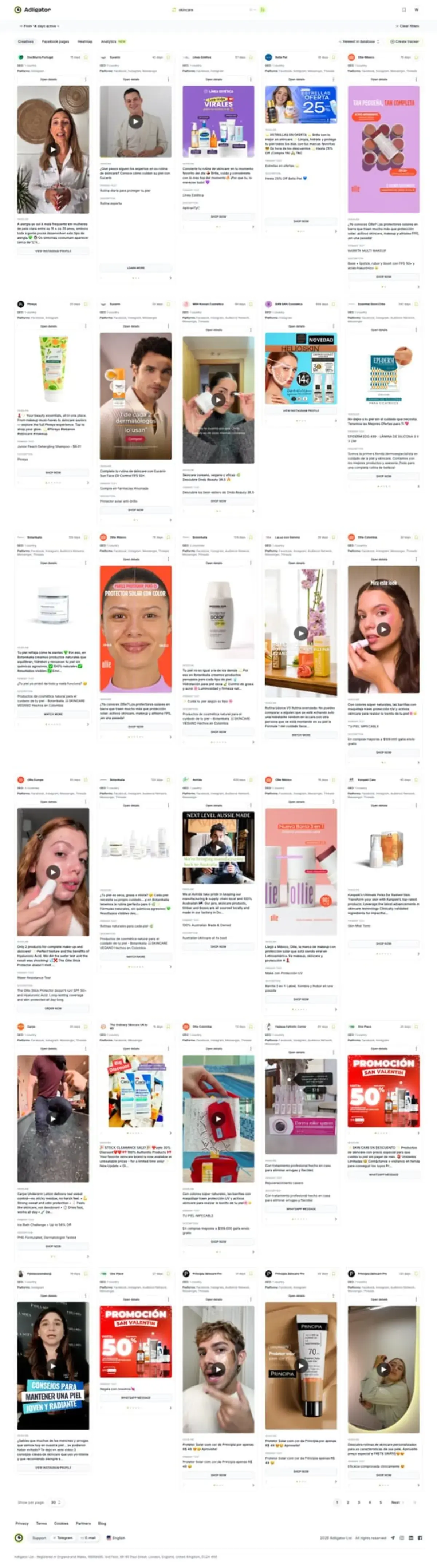 Research what creatives already work in your niche before spending test budget on unproven concepts
Manually browsing Meta Ad Library gives you a raw list of competitor ads, but you cannot tell which ones are performing well. You see everything — winners and losers alike — with no way to filter by longevity or format.
With Adligator, you can filter competitor ads by days active to find creatives that have been running for 10, 20, or 30+ days. Longevity is one of the strongest signals of profitability — no one runs unprofitable ads for weeks. You can also filter by ad format, platform, and creative type to find exactly the kind of ads that work in your vertical.
This pre-test research does not mean copying competitors. It means understanding which creative angles, formats, and hooks resonate with your target audience before you invest test budget. If you see that carousel ads dominate your niche while video ads are rare, that is a signal about format preference. If testimonial-style creatives run the longest, social proof is likely a strong angle.
Research winning creatives before you spend — try Adligator free
When to Kill, Iterate, or Scale a Test
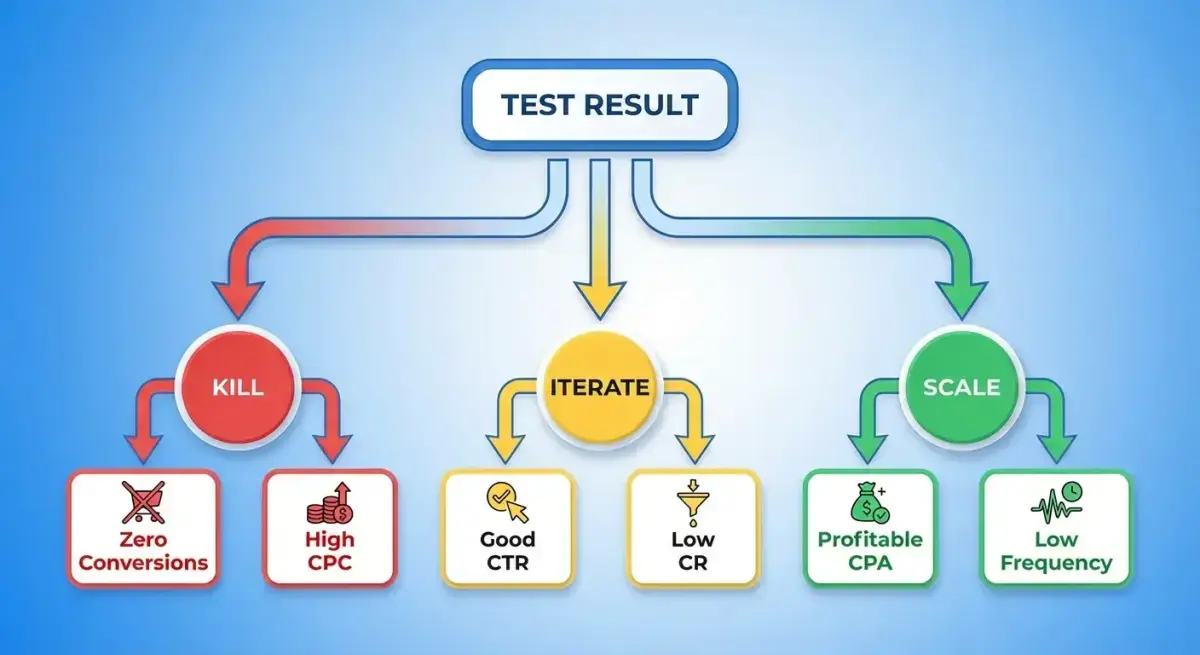 Use clear performance thresholds to make testing decisions — never rely on gut feelings alone
Kill the test when:
- Spent 3x your target CPA with zero conversions
- CPC is 2x+ above your niche benchmark after 1,000+ impressions
- CTR is below 0.5% after 2,000+ impressions (creative is not resonating)
- Relevance score is 3 or below (audience mismatch)
Iterate when:
- CTR is decent (1%+) but conversion rate is low — the creative attracts attention but the landing page or offer does not convert
- CPA is within 20-50% of target — close but needs refinement
- Good engagement (saves, shares, comments) but few clicks — the content is interesting but CTA is weak
Scale when:
- CPA is at or below target for 3+ consecutive days
- ROAS exceeds your minimum threshold consistently
- Frequency is below 3 (room to grow reach)
- Creative quality ranking is "Above Average" or "Average"
The scaling protocol:
- Increase budget by 20-30% (never more than double)
- Wait 24-48 hours for the learning phase to stabilize
- If performance holds, increase again
- If CPA rises above target for 2+ days, reduce budget back and test new creatives
Tracking and Documenting Your Tests
Solo media buyers who track their tests outperform those who do not by a wide margin. Create a simple test log:
| Test # | Date | Variable Tested | Hypothesis | Budget | Duration | Result | Next Action |
|---|---|---|---|---|---|---|---|
| 1 | Mar 1 | 3 hook variations | "Pain point hook will outperform aspiration" | $90 | 3 days | Pain hook won (CPA $24 vs $38) | Scale pain hook, test body variations |
| 2 | Mar 5 | 3 audience segments | "Lookalike 1% will beat interest targeting" | $120 | 4 days | Interest targeting won | Scale interest, test narrower interests |
This log becomes your institutional memory. After 20-30 tests, you will have a clear picture of what works in your niche — which angles, formats, audiences, and offers drive results. That knowledge is worth far more than any single test result.
What to track for each test
Beyond the basic log, capture these metrics for every test:
- Impressions and reach — Was the audience large enough for meaningful data?
- CPM — How much did you pay for exposure? Higher CPMs suggest competitive audiences.
- CTR — Did the creative capture attention? Below 1% usually means creative needs work.
- CPC — What was the cost of each click? Compare against your niche benchmarks.
- Landing page conversion rate — Are clicks turning into conversions? If CTR is strong but CR is weak, the problem is post-click.
- CPA — The ultimate metric. How much did each conversion cost?
- ROAS — For ecommerce, what was the return on ad spend?
- Frequency — How many times did each person see the ad? High frequency on a short test suggests audience is too small.
Using spreadsheets vs ads manager
Ads Manager shows you current performance. Spreadsheets show you patterns over time. Both are essential.
Export your test results weekly into a spreadsheet. After 4-6 weeks, you can identify patterns that Ads Manager alone will not reveal: which creative angles consistently outperform, which audiences have the lowest CPAs, what time of month performs best, and whether video or static drives better results in your specific niche.
Some solo media buyers use tools like Google Sheets with simple formulas. Others use dedicated ad tracking platforms. The tool matters less than the habit — consistent tracking beats sophisticated tools used inconsistently.
Common Budget Allocation Mistakes
Even with a framework, solo media buyers frequently fall into these traps.
Spreading budget across too many campaigns. Running 10 campaigns at $5/day each gives you nothing. Better to run 2 campaigns at $25/day and get real data from both. Consolidation beats diversification at small budgets.
Testing audiences before creative. If your creative does not work, no audience will save it. Always validate creative first — it has the highest impact on performance and is the cheapest variable to test.
Scaling too aggressively. Doubling a winning ad set's budget overnight often triggers a new learning phase and destroys performance. Increase by 20-30% every 2-3 days. Patience during scaling preserves what testing built.
Not refreshing creative on schedule. Even your best-performing creative will fatigue. Plan creative refresh cycles: every 2-3 weeks for aggressive verticals, every 4-6 weeks for stable niches. Have new creative ready before you need it.
Ignoring the testing-to-scaling transition. Some buyers get stuck in perpetual testing mode, always looking for the next winner without scaling what already works. If a test hits your CPA target for 3+ days, move it to the scaling bucket and let it earn.
Running tests on weekends or holidays. Consumer behavior changes on weekends and during holidays. Unless your product is weekend-specific, run tests Monday through Friday for more consistent data. Weekends can distort results and lead to incorrect kill/scale decisions.
The Weekly Testing Rhythm
For solo media buyers, establishing a weekly testing cadence creates consistency and prevents ad-hoc decisions.
Monday: Review last week's test results. Kill losers, identify winners for scaling. Plan this week's tests.
Tuesday-Wednesday: Launch new creative tests. Monday data is often unreliable (weekend carryover effects), so mid-week launches produce cleaner data.
Thursday-Friday: Monitor active tests. Make preliminary kill/continue decisions based on 48-72 hours of data.
Weekend: Let scaling campaigns run. Avoid launching new tests on weekends unless your product specifically targets weekend behavior.
This rhythm ensures you make one clear decision per test per week, avoiding the impulse to micro-manage daily fluctuations. Most performance variance in the first 24-48 hours is noise, not signal.
FAQ
How much should I spend testing Facebook ads?
A reasonable testing budget is $20-50 per day per ad set, running for 3-5 days before making decisions. For most solo media buyers, $500-1,500 per month dedicated to testing is a practical starting point. The key is having enough budget for statistical significance, not just gut feelings.
What percentage of budget should go to testing vs scaling?
The standard split is 70-80% for scaling proven campaigns and 20-30% for testing new creatives, audiences, and offers. If you are just starting with no proven campaigns, flip this ratio — spend 70-80% on testing until you find winners.
How many ad variations should I test at once?
Test 3-5 creative variations per ad set. More than that spreads budget too thin and delays learning. Use Facebook's dynamic creative feature or separate ad sets — each approach has trade-offs depending on your budget level.
When should I kill a Facebook ad test?
Kill a test after it has spent 2-3x your target CPA without a conversion, or after 3-5 days with no improvement trend. If CPC is 2x or more above your niche benchmark after 1,000+ impressions, the creative likely needs reworking.
Conclusion
Effective facebook ads budget for testing is not about spending more — it is about spending with structure. The 70-20-10 framework gives you clear guardrails: protect your proven campaigns, systematically test new creatives, and explore new audiences without risking your entire budget.
Start with the priority sequence: creative first, then audience, then offer, then placements. Define your kill criteria before launching any test. Document every result. And do your homework before testing — researching what already works in your niche eliminates many failed experiments before they start.
Ready to see what creatives are winning in your niche? Research competitor ads with Adligator
Related Reading
- How Many Ad Creatives Do You Need for Facebook Ads? A Data-Driven Framework by Budget Level (2026)
- Facebook Ad Account Structure and Naming Conventions: A Scaling Framework for Media Buyers
- Top 10 Facebook Ads Mistakes That Waste Budget: An Audit Checklist for Media Buyers (2026)
- How to Write High-Converting Facebook Ad Copy Using Competitor Spy Data: A Copywriting Framework for Media Buyers
