
Facebook Ads by Country: How to Research Competitor Creatives by GEO
If you're only researching competitor Facebook ads in your own country, you're seeing a fraction of the competitive landscape. The most profitable media buyers and affiliate marketers systematically research ads across multiple countries — finding winning angles before they arrive in their market, discovering cheaper GEOs to test, and identifying creative patterns that work globally.
Facebook ads by country competitor research isn't a nice-to-have. It's a strategic advantage that separates buyers who react from buyers who anticipate. This guide walks you through exactly how to do it — from the free tools available to the systematic workflows that make multi-GEO research scalable.
Whether you're an affiliate looking for the next untapped market or an agency managing campaigns across regions, you'll leave with a practical framework for turning GEO-based ad intelligence into better ROAS.
Why GEO-Based Competitor Research Gives You an Unfair Advantage
Most media buyers research competitors in their target country. That's the obvious move. But obvious moves produce average results.
Here's what GEO-based research reveals that single-country research can't:
Early warning on winning creatives. Advertisers often test new creatives in smaller markets before scaling to Tier-1 countries. A creative that's been running for 30 days in Brazil or Poland might hit the US market next week. If you spot it first, you can adapt the angle before your competitors see it.
Cheaper testing markets. CPMs in Tier-2 and Tier-3 countries are significantly lower than in the US, UK, or Australia. If a creative concept works in the Philippines or Colombia at a $2 CPM, there's a strong signal it'll work in the US at a $15 CPM — and you just validated the concept for a fraction of the cost.
Cross-cultural creative patterns. Some creative structures work universally. UGC testimonials, before/after transformations, and problem-agitation-solution sequences perform across cultures. By studying ads in multiple GEOs, you identify these universal patterns faster.
Market expansion intelligence. If you're considering entering a new market, knowing which competitors are already running there — and what creatives they're using — tells you about competitive density, audience sophistication, and creative expectations.
Localization insights. Comparing the same advertiser's creatives across countries reveals how they localize messaging. Do they translate directly? Adapt angles? Use completely different creatives? These insights inform your own localization strategy.
How to Filter Facebook Ads by Country in Meta Ad Library
The Meta Ad Library is the free, official tool for viewing active Facebook and Instagram ads. Here's how to use its country filter:
Step-by-step process:
- Go to facebook.com/ads/library
- Select "All ads" from the ad category dropdown
- Choose your target country from the country dropdown
- Search for a competitor's page name or keyword
- Browse the results — all ads shown are targeting that specific country
What Meta Ad Library does well:
- Free and comprehensive — shows every active ad
- Official data directly from Meta
- Lets you search by advertiser name, keyword, or topic
- Shows ad creative, copy, CTA, and platform placement
- Provides a "started running" date for each ad
What it doesn't do:
- No multi-country comparison. You can only filter by one country at a time. Comparing a competitor's ads across 10 countries means 10 separate searches.
- No run duration filter. You can't sort or filter by how long an ad has been running — the single most useful signal for identifying winners.
- No engagement data. No likes, shares, comments, or any performance indicator.
- No historical data. Once an ad stops running, it disappears. You can't research what worked last quarter.
- No cross-GEO pattern detection. There's no way to see which ads run in multiple countries simultaneously.
For single-country, single-competitor checks, Meta Ad Library works fine. For systematic multi-GEO research, it's a manual bottleneck.
Limitations of Free GEO Research (And When You Need More)
The manual approach to multi-GEO competitor research looks like this:
- Open Meta Ad Library
- Select Country A → search competitor → screenshot interesting ads
- Switch to Country B → repeat
- Switch to Country C → repeat
- Try to mentally compare patterns across your screenshots
- Repeat weekly to track changes
This breaks down at scale. Here's where it becomes unworkable:
Time cost. Researching 5 competitors across 10 countries means 50 individual searches. At 5 minutes per search, that's over 4 hours — just for one research session. And you need to do this regularly to catch new creatives.
Pattern blindness. When you're switching between browser tabs and screenshot folders, you miss the patterns that matter: which creative is running in 15 countries vs. 2, which advertiser just expanded into your market, which creative format dominates in a specific GEO.
No winner identification. Without run duration or engagement filters, you're looking at a mix of tests, failures, and winners with no way to tell them apart. You're investing analysis time in ads that might be performing terribly.
No tracking over time. You can't set up alerts or monitors. If a competitor launches a new campaign in a GEO you're watching, you'll only find out if you manually check again.
If you're running campaigns in a single GEO with 2–3 competitors, the manual approach is manageable. Once you're working across multiple markets or tracking more than a handful of competitors, you need a tool built for this.
Using Ad Spy Tools to Research Competitors by Country at Scale
Ad spy tools index Facebook ads at scale and provide the filtering capabilities that Meta Ad Library lacks. For GEO-based research, the key features to evaluate are:
Country/GEO filter. The ability to filter ads by one or multiple target countries. The best tools let you combine GEO filters with other criteria (keyword, run duration, format).
GEO count indicator. Showing how many countries a single ad targets. An ad running in 25 countries is a very different signal than one running in 1 country.
Run duration filter. Filtering by how long an ad has been active. Combined with GEO data, this identifies globally successful creatives.
Advertiser/page tracking. Monitoring specific competitor pages across all GEOs simultaneously, rather than checking country by country.
Historical data. Seeing ads that are no longer active to understand what worked in the past.
Tool comparison for GEO research:
| Feature | Meta Ad Library | AdSpy | PowerAdSpy | Adligator |
|---|---|---|---|---|
| Country filter | Single country | Multi-country | Multi-country | Multi-country (234) |
| GEO count per ad | No | Limited | Limited | Yes |
| Run duration filter | No | Yes | Yes | Yes (Days active) |
| Max GEOs indexed | All (one at a time) | 80+ | 100+ | 234 |
| Live tracking/alerts | No | Limited | No | Yes (Trackers) |
| Free tier | Unlimited | No | Limited | 5 searches/day |
Research competitor ads across 50+ countries — try Adligator free
How Adligator Simplifies Multi-GEO Competitor Analysis
Adligator's GEO capabilities are specifically designed for cross-country ad research. Here's what makes it effective for this workflow:
GEO Filter with Count Selector
The GEO filter lets you select one or multiple target countries. But the key differentiator is the GEO count selector — you can filter to show only ads targeting a minimum number of countries. Setting this to 5+ immediately surfaces globally-scaled creatives and eliminates local-only ads.
Per-Card GEO Information
Every creative card shows the GEO count and which platforms the ad runs on. You can see at a glance whether an ad targets 1 country or 20 — without clicking into the details.
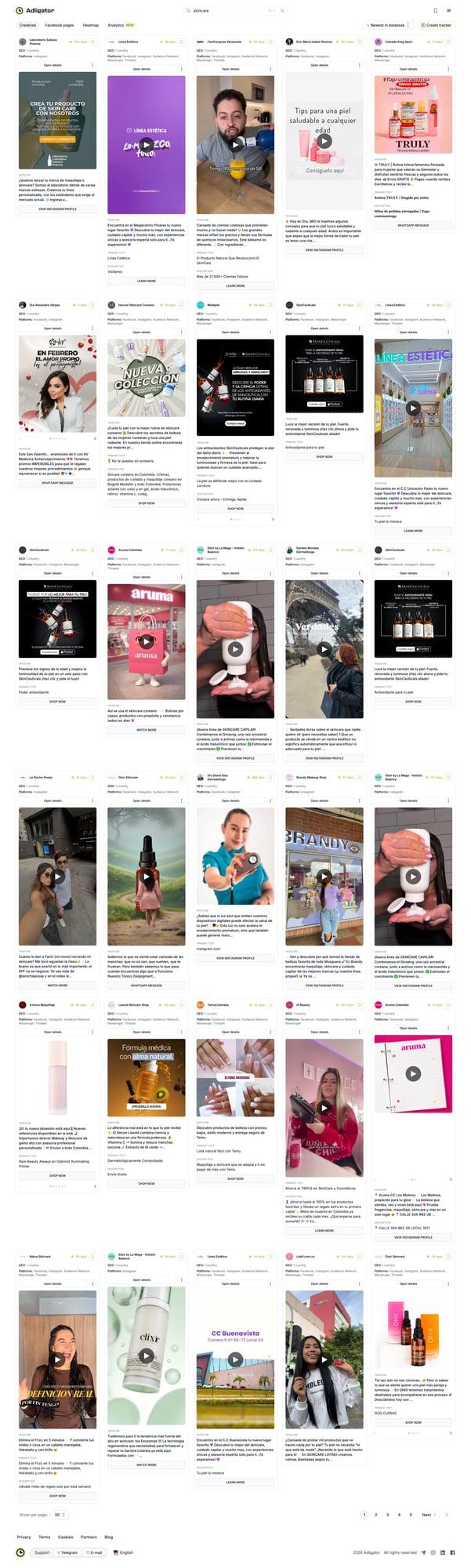 Adligator's GEO filter lets you research competitor ads across 234 countries in a single search.
Combined Filtering
The real power comes from combining filters:
- Keyword + GEO + Days Active — Find long-running ads in specific countries for your niche
- Facebook Page ID + GEO — See where a specific competitor is running ads globally
- GEO count (5+) + Days Active (30+) — Surface proven global winners regardless of niche
- GEO + Platform (Instagram only) — Research Instagram-specific creative strategies by country
Live Trackers for GEO Monitoring
Save any filtered search as a tracker. Adligator will continuously monitor for new creatives matching your criteria. Set up trackers for:
- Your top competitor's page ID + specific GEOs you're watching
- Your niche keyword + new GEOs you're considering expanding into
- High GEO count + long run duration for global creative inspiration
Case Study: Finding Untapped Angles in Tier-2 GEOs
Here's a practical example of how GEO-based research creates opportunity.
The scenario
An e-commerce media buyer selling skincare products in the US market. CPMs are high ($18–25), competition is fierce, and creative fatigue sets in within 7–10 days.
The GEO research approach
- Identify competitors — Find 5 skincare brands running Facebook ads in the US with Adligator
- Check their GEO spread — Filter each competitor's page by different countries
- Discover the pattern — Two competitors are running the same skincare creatives in Colombia, Brazil, and Mexico with 60+ days active
- Analyze the creative differences — The LatAm versions use stronger before/after visuals, more emotional copy, and WhatsApp CTAs instead of website links
- Extract the insight — The before/after visual approach has been validated at scale (long run duration in 3+ countries) but hasn't appeared in the US market yet
- Adapt and test — Create a US-market version of the before/after approach with English copy and website CTA
The result
The adapted creative becomes a winner because the concept was pre-validated across multiple markets. The media buyer didn't guess — they used GEO data to find a proven angle and adapted it.
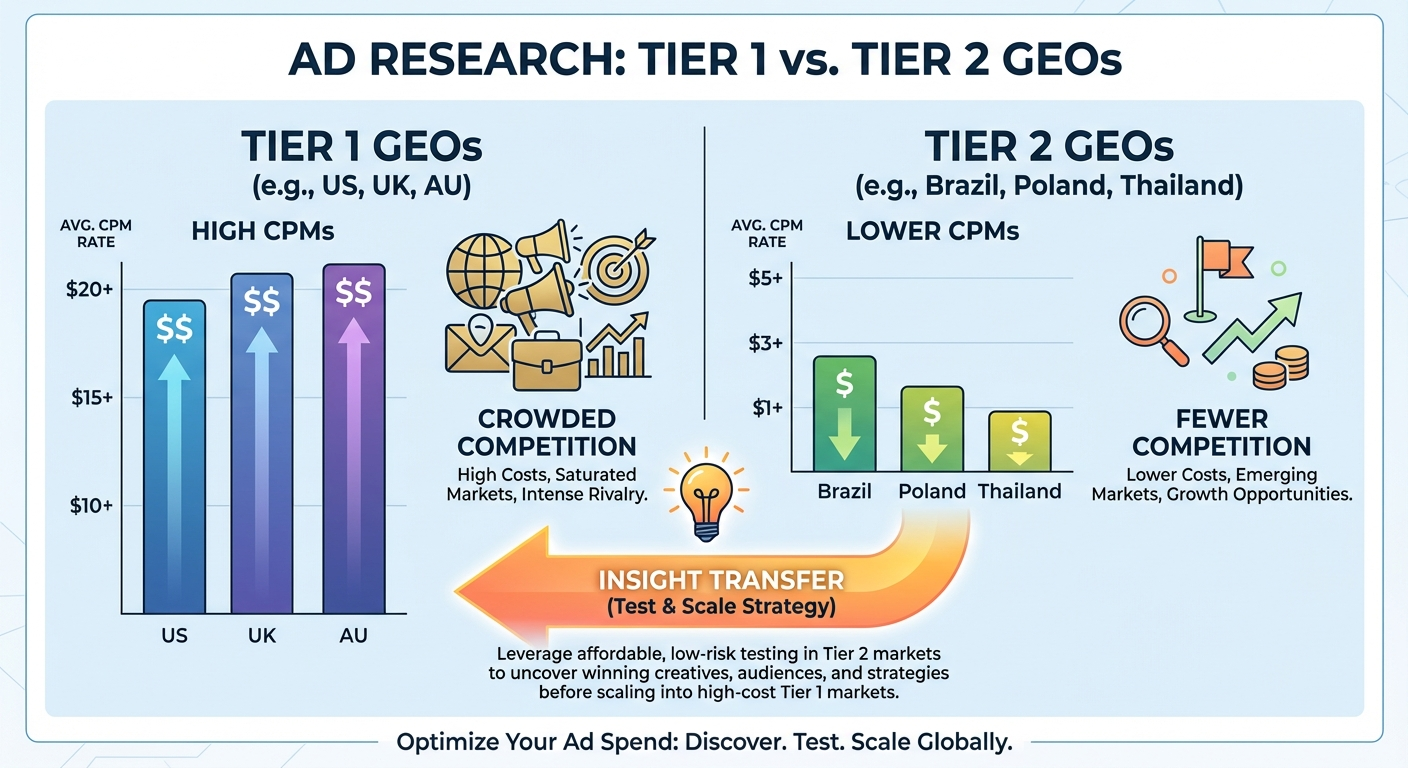 Tier-2 GEOs often reveal winning creative angles at a fraction of Tier-1 CPMs.
Why this works
- Tier-2 GEOs have lower competition. Fewer advertisers means winning creatives run longer and are easier to spot.
- Creative concepts travel. A visual hook that works in Brazil often works in the US with localization.
- You see creative evolution. By watching how brands adapt creatives across markets, you learn what's essential (the hook structure) vs. what's contextual (the language, CTA type).
Building a GEO-Based Competitor Monitoring Workflow
A one-time research session is useful. A systematic monitoring workflow compounds over time. Here's how to build one:
Weekly GEO Research Routine (60 minutes)
Minutes 1–15: Check your trackers. Review any new creatives surfaced by your Adligator trackers. Focus on ads that appeared in new GEOs or crossed the 14-day active threshold.
Minutes 15–35: Competitor page scans. For each of your top 3–5 competitors, check their Facebook page ID filtered by your target GEOs. Note any new creatives, format changes, or messaging shifts.
Minutes 35–50: Cross-GEO pattern analysis. Search your primary keyword filtered by different country groups:
- Tier-1 (US, UK, CA, AU) — what's the current creative standard?
- Tier-2 (BR, MX, PL, TH) — what angles are emerging?
- New GEOs you're considering — what's the competitive density?
Minutes 50–60: Document and brief. Update your competitive intelligence document with:
- New winning creatives spotted (with source GEO)
- Format trends shifting across markets
- Angles to test in your own campaigns
- GEOs to explore for expansion
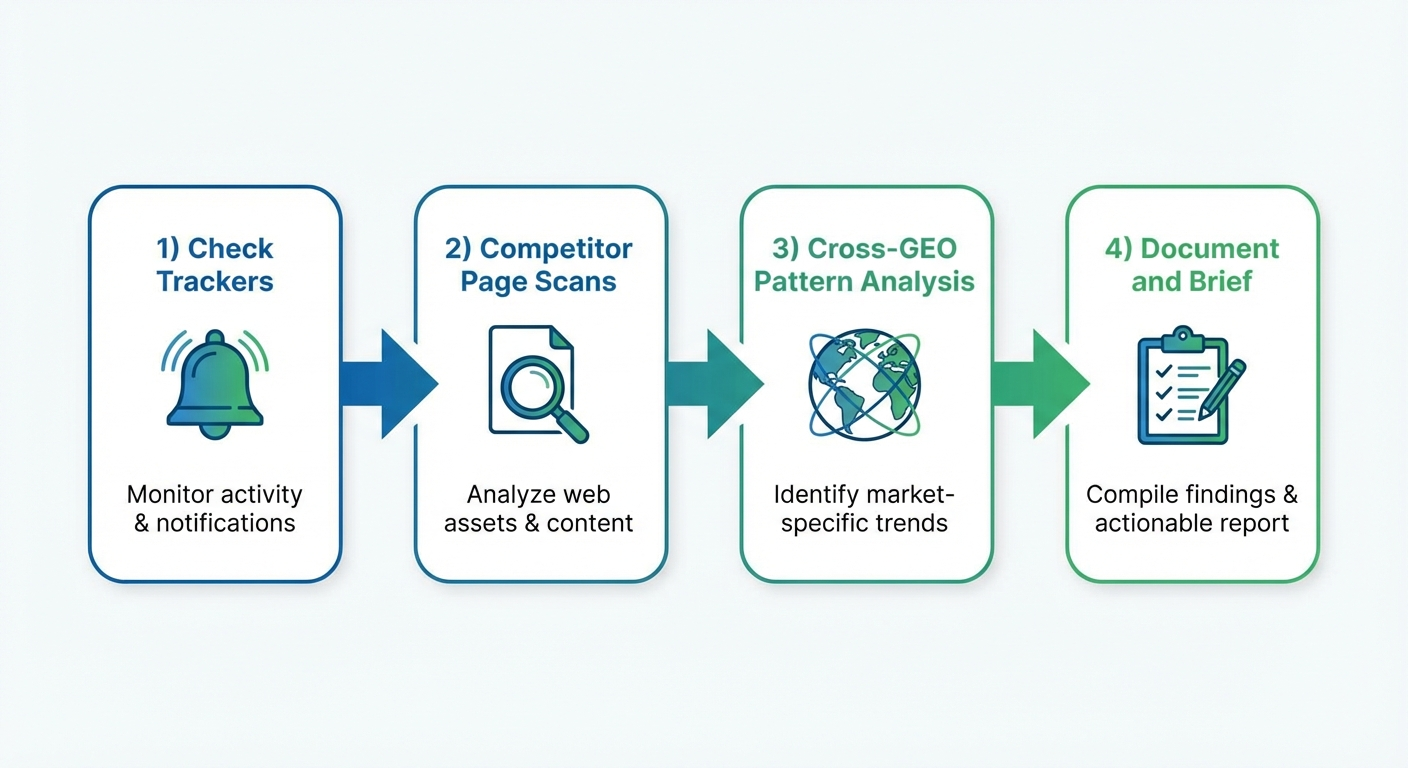 A systematic GEO research workflow surfaces winning angles before they saturate your market.
Monthly GEO Audit
Once a month, do a deeper analysis:
- GEO expansion review — Which new countries are your competitors entering? Are they testing or scaling?
- Creative lifecycle tracking — Which creatives from last month's research are still running? Which died? This validates your winner identification.
- Localization pattern review — How do the strongest creatives differ by region? What stays the same?
- Own campaign performance vs. intelligence — Did the angles you adapted from GEO research actually perform? Close the feedback loop.
Tracking Template
Keep a simple spreadsheet with these columns:
| Date | Competitor | GEO | Creative Type | Days Active | GEO Count | Key Angle | Action Taken |
|---|---|---|---|---|---|---|---|
| 2/14 | Brand X | BR | UGC video | 45 | 8 | Before/after | Adapted for US |
| 2/14 | Brand Y | PL | Static | 28 | 3 | Price anchor | Added to brief |
This creates a historical record that makes your GEO research cumulative rather than episodic.
Common Mistakes in GEO Research
Avoid these pitfalls that reduce the value of your multi-country analysis:
- Researching too many GEOs without focus. Start with 5–10 strategically chosen countries rather than trying to cover everything. Prioritize GEOs where your competitors are active or where CPMs are favorable for your product.
- Ignoring localization context. A creative performing well in Japan may rely on cultural references that don't translate. Always assess whether the concept transfers or just the surface-level execution.
- Only looking at Tier-1 markets. The US, UK, and Australia are obvious — but that's where everyone looks. Tier-2 markets like Poland, Thailand, Colombia, and the Philippines often surface winning angles earlier because competition is lower and creative cycles are longer.
- Not cross-referencing with your own data. GEO research should connect to your campaign performance. If you adapted an angle from a Brazilian competitor and it flopped in the US, document why. Maybe the audience sophistication was different, or the offer didn't translate.
- Treating GEO research as a one-time activity. Markets evolve. A GEO that was untapped last quarter may be saturated now. Regular monitoring beats sporadic deep dives.
FAQ
Can I see Facebook ads from any country?
Yes. The Meta Ad Library lets you filter by country, but only one at a time. Ad spy tools like Adligator index ads across 234 countries simultaneously, letting you compare creatives across GEOs in a single search. This makes multi-country research practical rather than theoretical.
How do I research competitor ads across multiple GEOs?
Start by identifying your top 3–5 competitors. Use a tool with multi-GEO filtering to search each competitor's Facebook page ID across different countries. Document which creatives appear in which markets, their run duration, and any localization differences. Establish a weekly routine to catch new patterns as they emerge.
What are the best tools for multi-country Facebook ad research?
Adligator, AdSpy, and PowerAdSpy all support GEO filtering. Adligator covers 234 countries with a GEO count filter that shows how many countries each ad targets — making it fastest for identifying cross-border creative patterns. All three offer paid plans; Adligator also has a free tier with 5 searches per day for initial exploration.
Conclusion
Facebook ads by country competitor research is the most underused competitive advantage in media buying. While most buyers focus exclusively on their own market, systematic GEO-based research reveals winning angles before they arrive, validates creative concepts at lower CPMs, and exposes expansion opportunities with real data.
The workflow is straightforward: identify competitors, research their ads across multiple GEOs, spot patterns in what works globally, and adapt proven angles for your market. The only barrier is the tooling — doing this manually through Meta Ad Library is impractical at scale.
Start with your top 3 competitors and 5 target GEOs. Spend one hour this week mapping what they're running where. You'll likely find at least one creative angle you haven't tested — and it's already been validated in another market.
Ready to research competitor ads across countries? Try Adligator free
See what your competitors are running in other markets
Related Reading
- How to Analyze Facebook Ad Creatives by GEO and Vertical: A Data-Driven Approach for Media Buyers
- How to Research Competitor Ads in iGaming and Gambling: Facebook Ad Spy Strategies for Affiliates
- How to Spy on Competitor Facebook Ads by Industry: Vertical-Specific Research Strategies
- DTC Brand Facebook Ad Research: How to Spy on Competitors and Build a Winning Creative Launch Strategy
