How to Combine Facebook Ads and Email Marketing to Maximize Ecommerce Customer Lifetime Value in 2026
Most ecommerce brands treat Facebook Ads and email marketing as separate channels. Ads bring in new customers. Email handles the post-purchase drip. The two teams barely talk. This siloed approach leaves massive revenue on the table.
The reality: facebook ads email marketing ecommerce work exponentially better together. Your ad spend acquires customers at a known CPA. Your email sequences turn one-time buyers into repeat customers. The combination can 2-3x your effective ROAS when measured over 90 days instead of 7.
This guide provides a complete framework for combining paid acquisition and email retention to maximize customer lifetime value.
Why First-Purchase ROAS Is Misleading Without LTV Context
If your Facebook Ads show a 2x ROAS on first purchase, most media buyers would call that marginal. But what if 40% of those customers buy again within 60 days — driven by your email sequences? Suddenly your 90-day ROAS is 3.5-4x.
The LTV math:
- First purchase: $50 AOV, CPA $25 → 2x ROAS
- 40% repeat rate, $55 average second purchase → $22 additional revenue per customer
- Email-driven reactivation: $8 additional revenue per customer
- 90-day LTV: $80 per customer, CPA $25 → 3.2x ROAS
This changes everything about how you bid, which audiences you target, and how much you're willing to spend on acquisition.
How to calculate your actual LTV
- Export your customer data (last 12 months)
- Calculate: Total Revenue / Unique Customers = Average LTV
- Segment by acquisition source (Facebook Ads vs organic vs other)
- Compare 30-day, 60-day, and 90-day LTV windows
Tools: Shopify Reports, Klaviyo Customer Analytics, Triple Whale, or a simple spreadsheet with order data.
The Facebook-to-Email Handoff: Capturing Emails from Paid Traffic
The critical moment is the transition from anonymous ad clicker to known email subscriber. Every visitor you don't capture an email from is a missed retention opportunity.
Pre-purchase email capture
Not every visitor buys on the first visit. Capture emails before they leave:
- Exit-intent popup: "Get 10% off your first order" → email capture → remarketing via email AND Facebook
- Content upgrades: Free guide, lookbook, or quiz results in exchange for email
- Facebook Lead Ads: Capture emails directly in-platform, then nurture via email
- Messenger opt-in: Use Messenger as an alternative to email for Facebook-native users
Post-purchase email capture
For customers who purchase without subscribing to marketing emails:
- Order confirmation opt-in: Add a checkbox on the thank-you page
- Transactional-to-marketing: Use order confirmation emails to encourage marketing opt-in
- SMS + email: Capture phone number at checkout for SMS, email via post-purchase follow-up
 How Facebook Ads and email marketing create a unified customer journey
Key metric: Email capture rate
Track what percentage of Facebook-acquired visitors provide their email:
- Pre-purchase popup: 3-8% capture rate (of all visitors)
- At checkout: 80-95% (of purchasers)
- Marketing opt-in rate: 40-60% (of email captures)
Post-Purchase Email Sequences That Drive Repeat Purchases
The post-purchase window is your highest-leverage retention opportunity. Here's the sequence:
Day 0-1: Welcome & Confirmation
- Order confirmation with tracking info
- Welcome to the brand (if first purchase)
- Set expectations: "Here's what happens next"
Day 3-5: Value & Education
- How to use/get the most from the product
- Care instructions, tips, recipes (depending on product)
- No hard sell — build relationship
Day 7-10: Review Request
- Ask for a product review
- Include a photo/video submission option
- Social proof loop: reviews feed your ads AND your landing pages
Day 14-21: Cross-Sell
- Recommend complementary products
- "Customers who bought X also love Y"
- Personalized based on purchase history
Day 30: Replenishment / Re-engagement
- For consumables: "Time to restock?"
- For non-consumables: "New arrivals you'll love"
- Include a small incentive if needed (5-10% off second purchase)
Day 45-60: Win-Back
- "We miss you" with a stronger incentive
- Highlight what's new since their purchase
- Last chance before reducing email frequency
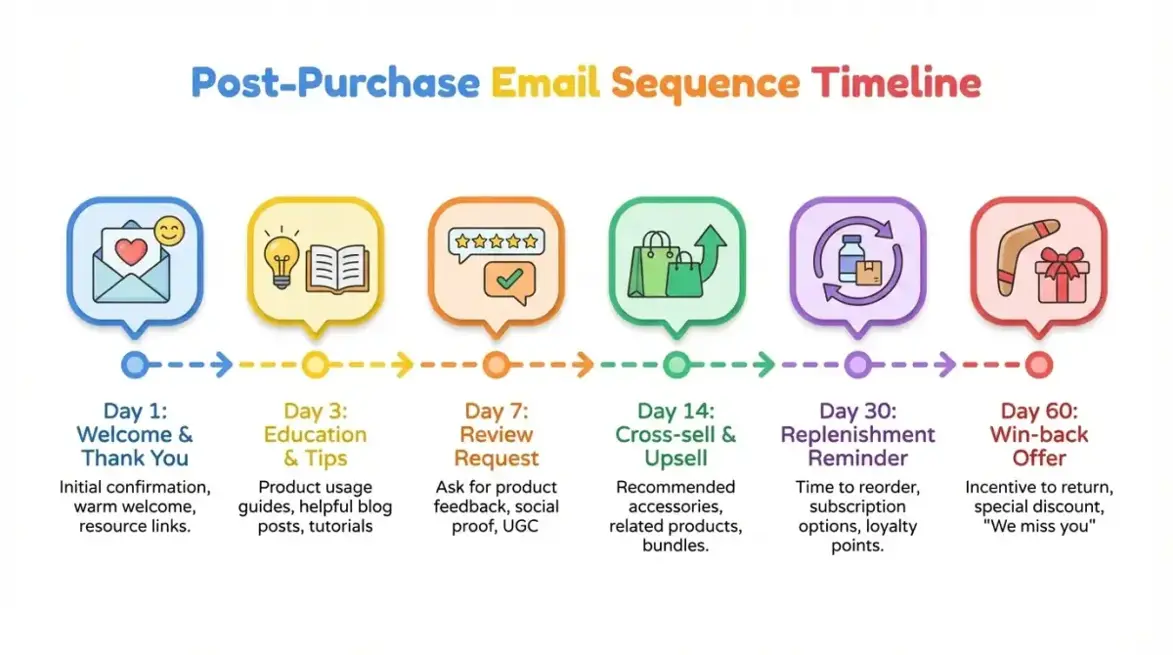 Optimized post-purchase email sequence for maximizing repeat purchases
Want to see what acquisition strategies your competitors use? Try Adligator for free — analyze competitor ad creatives, landing pages, and campaign durations.
Using Facebook Custom Audiences + Email Segments Together
This is where the magic happens. Your email data supercharges your Facebook targeting.
Audience synergies
| Email Segment | Facebook Action | Why |
|---|---|---|
| Active subscribers (opened in 30d) | Exclude from cold prospecting | They already know you |
| Purchased 2+ times | Create Lookalike | Find more high-LTV customers |
| Cart abandoners (email non-responders) | Retarget on Facebook | Different channel, same message |
| High-AOV customers | Create 1% Lookalike | Quality over quantity |
| Churned (90+ days no purchase) | Win-back ads on Facebook | Email didn't work, try ads |
| Email non-openers | Retarget on Facebook | Reach them where they're active |
How to set it up
- Export segments from your ESP (Klaviyo, Mailchimp, etc.) weekly or set up auto-sync
- Create Custom Audiences in Facebook Ads Manager from each segment
- Build Lookalike audiences from your best segments (high-LTV, repeat purchasers)
- Set up exclusions — don't spend ad dollars on people your emails already reach
Suppression lists: stop wasting ad spend
One of the biggest ROI improvements: exclude email-engaged customers from prospecting campaigns. If someone opened your email yesterday, you don't need to pay $2 to show them a Facebook ad.
Implementation:
- Export "opened email in last 7 days" segment daily
- Upload as exclusion Custom Audience
- Apply to all prospecting (cold) campaigns
This alone can reduce wasted ad spend by 10-15%.
Lookalike Audiences from High-LTV Email Cohorts
Not all customers are equal. Your email data tells you who's most valuable.
Best seed audiences for Lookalikes
- Top 10% by LTV — customers with highest total spend
- 3+ purchases — proven repeat buyers
- High email engagement + purchase — active, loyal, responsive
- Highest AOV purchasers — quality signal for the algorithm
Lookalike configuration
- Start with 1% Lookalike for maximum quality
- Test 1-3% for scale
- Avoid 5%+ unless you have massive data (100k+ seed)
- Refresh seed audiences monthly (LTV cohorts change)
The feedback loop
This creates a powerful flywheel:
- Facebook Ads acquire customers →
- Email sequences nurture and convert to repeat buyers →
- High-LTV cohort grows →
- Better Lookalike audiences →
- Facebook acquires better customers → repeat
Tracking LTV Attribution Across Paid and Email Touchpoints
The attribution challenge
Customer journey: Click Facebook ad → purchase → receive emails → click email → purchase again. Who gets credit for the second purchase? Facebook? Email? Both?
Recommended approach
- First-touch attribution for acquisition: Facebook Ads gets credit for acquiring the customer
- Last-touch attribution for retention: Email gets credit for driving repeat purchases
- Blended LTV metric: Total revenue from Facebook-acquired cohort / Total ad spend for that cohort
Tools for cross-channel LTV tracking
- Triple Whale / Northbeam: Cross-channel attribution with LTV modeling
- Klaviyo: Customer analytics with acquisition source tracking
- Google Analytics 4: Multi-touch attribution with cohort analysis
- Spreadsheet: Export Shopify orders, tag by acquisition source, calculate cohort LTV
90-Day LTV Maximization Playbook
Here's the complete playbook, combining Facebook Ads and email:
Days 1-7: Acquisition & Onboarding
- Facebook: Run prospecting campaigns with best-performing creatives
- Email: Welcome sequence (confirmation → education → value)
- Key metric: Email capture rate, first-purchase CPA
Days 8-14: Engagement & Review
- Facebook: Retarget non-converters from Day 1-7 clicks
- Email: Review request → social proof collection
- Key metric: Review submission rate, retargeting CPA
Days 15-30: Cross-Sell & Expand
- Facebook: DPA retargeting with complementary products
- Email: Cross-sell sequence with personalized recommendations
- Key metric: Second purchase rate, cross-sell revenue
Days 31-60: Retention & Loyalty
- Facebook: Exclude active email openers from prospecting; target churning customers
- Email: Loyalty program invitation, exclusive offers, replenishment reminders
- Key metric: 60-day repeat purchase rate
Days 61-90: Win-Back & Optimization
- Facebook: Win-back campaigns for 60+ day inactive customers
- Email: Final win-back sequence with escalating incentives
- Key metric: Win-back conversion rate, 90-day cohort LTV
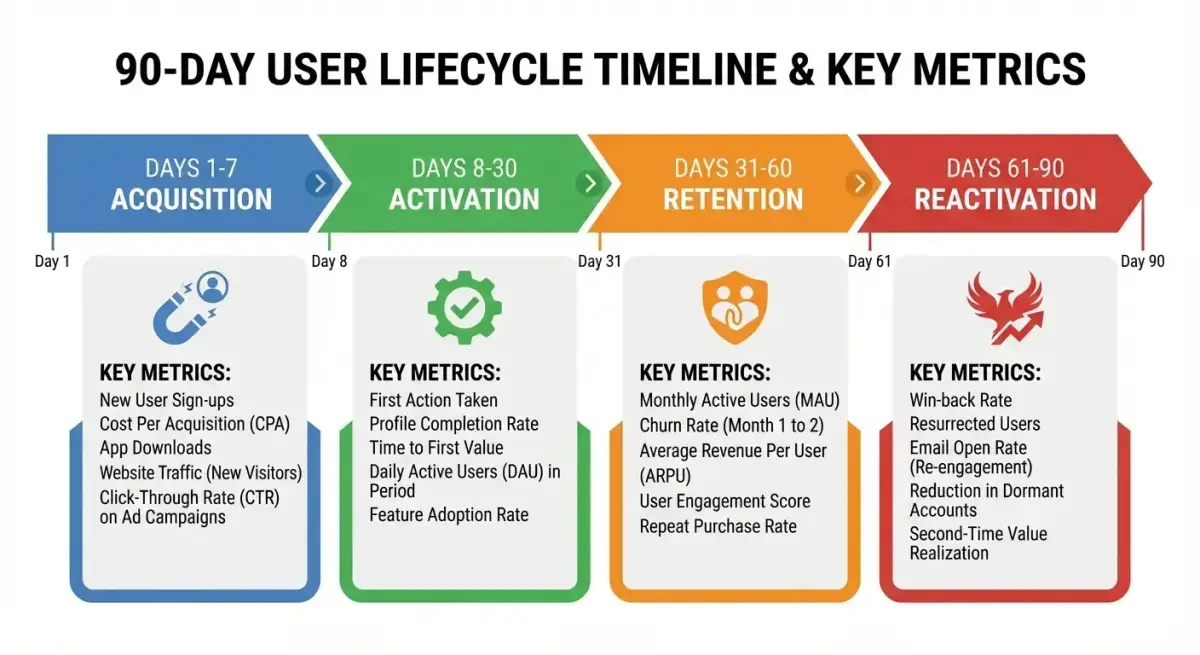 The 90-day LTV maximization playbook: key milestones and actions
Tools and Stack Recommendations
Email Service Providers (ESP)
| Tool | Best For | Facebook Integration |
|---|---|---|
| Klaviyo | Ecommerce (Shopify, WooCommerce) | Native Custom Audience sync |
| Mailchimp | Small businesses | Manual CSV export |
| Drip | DTC brands | API + Zapier |
| Omnisend | Multi-channel (email + SMS) | Native sync |
Attribution & Analytics
- Triple Whale: Best for DTC brands, combines paid + email + organic
- Northbeam: Enterprise-grade multi-touch attribution
- Lifetimely: Shopify-native LTV and cohort analysis
Automation
- Zapier: Connect ESP ↔ Facebook Ads Manager for audience syncing
- Hightouch / Census: Reverse ETL for syncing customer data to ad platforms
- Make (Integromat): Complex automation workflows
Common Mistakes That Kill Ecommerce LTV
Mistake 1: Optimizing Facebook Ads for First-Purchase ROAS Only
When you optimize solely for immediate ROAS, you bias toward low-AOV impulse purchases and discount-driven customers. These buyers rarely come back. Instead, optimize for customer quality: use high-LTV Lookalikes, bid on value rather than volume, and give the algorithm 30-60 days of conversion data instead of 7.
Mistake 2: Generic Post-Purchase Emails
"Thanks for your order!" followed by silence for 30 days is a missed opportunity. Every day without contact is a day your customer forgets about you. Build a sequence that delivers value at every touchpoint, not just promotional blasts.
Mistake 3: Not Syncing Email Data to Facebook
Your ESP has gold-mine data: who opens emails, who clicks, who buys repeatedly. If you're not feeding this data back to Facebook as Custom Audiences and Lookalikes, you're leaving significant optimization potential on the table.
Mistake 4: Treating All Customers the Same
A customer who bought once with a 50% discount coupon has different LTV potential than someone who bought at full price and left a 5-star review. Segment your audiences in both email AND Facebook based on customer quality signals.
Mistake 5: No Win-Back Strategy
Most brands give up on customers after 2-3 emails. But win-back campaigns (both email and Facebook ads) can recover 5-15% of churned customers. The key is escalating incentives: start with "we miss you" (no discount), move to 10% off, then 20% off as a final attempt.
Mistake 6: Ignoring Subscription Models
If your product is consumable (supplements, coffee, skincare), subscription reduces churn dramatically. Promote subscription options in your post-purchase email sequence and create Facebook ads specifically for subscription sign-ups from existing customers.
Advanced Strategies: Lifecycle-Based Facebook Campaigns
Acquisition Phase (0 purchases)
- Prospecting campaigns: Broad targeting + Lookalikes from best customers
- Lead gen campaigns: Email capture via lead magnets or quizzes
- Retargeting: Site visitors who didn't purchase within 7 days
Activation Phase (1 purchase)
- Cross-sell DPA: Show complementary products to recent buyers
- Exclude from prospecting: Stop paying for ads to people who already bought
- Testimonial ads: Show reviews to recent buyers (reinforces purchase decision)
Retention Phase (2+ purchases)
- Loyalty ads: Exclusive offers for repeat customers
- New product launch ads: Your repeat customers are the best early adopters
- Referral program ads: "Give $10, Get $10" targeted to loyal customers
Reactivation Phase (60+ days inactive)
- Win-back ads: "We miss you" messaging with incentive
- New arrival ads: Show what's changed since they last purchased
- Different formats: If they ignored image ads, try video testimonials
Budget allocation by lifecycle stage
| Stage | % of Total Budget | Primary Channel |
|---|---|---|
| Acquisition | 60-70% | Facebook Ads (prospecting) |
| Activation | 10-15% | Email + Facebook DPA |
| Retention | 10-15% | Email (primary) + Facebook |
| Reactivation | 5-10% | Facebook Ads + Email win-back |
Building Your LTV Dashboard
Track these metrics weekly to measure the health of your combined strategy:
Acquisition Metrics
- CPA (Cost Per Acquisition) — from Facebook Ads
- Email Capture Rate — % of visitors who provide email
- New Customer ROAS — first-purchase only
Retention Metrics
- 30/60/90-day Repeat Purchase Rate — % who buy again
- Email Open Rate — post-purchase sequences
- Email Click Rate — engagement signal
LTV Metrics
- 30-day Cohort LTV — early indicator
- 90-day Cohort LTV — primary KPI
- LTV:CAC Ratio — should be 3:1 or higher
- Payback Period — how many days until customer pays back their acquisition cost
Channel Efficiency
- Facebook ROAS (90-day) — blended, including email-driven repeat purchases
- Email Revenue per Subscriber — monthly
- Suppression Savings — estimated ad spend saved by excluding email-engaged users
Analyzing Competitor Strategies with Adligator
Understanding how competitors acquire and retain customers gives you a competitive edge. Adligator helps you:
- Find competitor acquisition creatives — what messaging drives their initial conversions
- Analyze ad longevity — ads running 14+ days are likely profitable, indicating strong LTV
- Spot retargeting patterns — cross-sell and win-back creatives reveal their email-to-ads strategy
- Filter by CTA type — "Shop Now" vs "Learn More" shows where competitors focus in the funnel
Look for competitors with many long-running creatives across different formats — this signals a mature acquisition + retention system worth studying.
FAQ
What's the average ecommerce customer lifetime value?
It varies widely by niche: fashion averages 3-4x first-purchase AOV over 12 months, beauty/supplements 4-6x due to replenishment cycles, and electronics 1.5-2x. Your LTV depends on repeat purchase rate, AOV, and retention period.
How soon should I start email marketing after acquiring a customer through Facebook Ads?
Immediately. Send a welcome email within 1 hour of purchase, a shipping confirmation, and begin your post-purchase sequence within 3-5 days. The first 30 days after purchase are the highest-engagement window.
Can I use Facebook Custom Audiences with my email list?
Yes. Upload your email list as a Custom Audience in Facebook Ads Manager. Facebook matches emails to user profiles (typically 50-70% match rate). Use this for retargeting, exclusions, and creating Lookalike audiences from your best customers.
Conclusion
The biggest ecommerce LTV wins come from treating facebook ads email marketing ecommerce as one system, not two. Your ads acquire customers. Your emails retain them. Your data connects both channels into a flywheel that compounds over time.
Start with the basics: capture emails from every Facebook-acquired visitor, build a post-purchase email sequence, and sync your email segments to Facebook Custom Audiences. Then optimize: create Lookalikes from high-LTV cohorts, suppress email-engaged customers from prospecting, and track 90-day cohort LTV instead of first-purchase ROAS.
The media buyers who win in 2026 aren't just running better ads — they're building better systems. Ads + email + data = compounding returns. When you measure success over 90 days instead of 7, you unlock the ability to outbid competitors on acquisition — because you know your customers are worth more over time. That's the ultimate competitive advantage in performance marketing: not a better ad, but a better customer lifecycle system that turns every acquired customer into a profitable long-term relationship.
Ready to analyze how competitors acquire and retain customers? Try Adligator for free — research competitor ad strategies, creative longevity, and funnel tactics in any niche.
Related Reading
- Post-Purchase Facebook Ads: How to Build Retention Campaigns That Maximize Customer Lifetime Value
- How to Use Ad Spy Tools for eCommerce: Find Winning Products and Scale Facebook Campaigns Faster
- How to A/B Test Facebook Ad Creatives: A Beginner Guide to Statistical Confidence and Faster Winners
- Facebook Ad Account Structure and Naming Conventions: A Scaling Framework for Media Buyers
