How to Run Facebook Ads for SaaS Products: Campaign Structure, Targeting, and Creative Strategy for B2B Marketers
Most SaaS marketers treat Facebook Ads as a B2C channel and ignore it entirely for B2B. That is a mistake. Facebook has over 3 billion monthly active users — including your ICP's decision-makers, who scroll their feeds every evening after work.
The challenge is not whether B2B buyers are on Facebook. They are. The challenge is reaching them efficiently with the right message, offer, and funnel. Facebook ads for SaaS require a fundamentally different approach than e-commerce or DTC advertising: longer sales cycles, higher consideration, and the need to educate before converting.
This guide covers the complete SaaS Facebook Ads playbook for 2026: campaign structure by funnel stage, B2B targeting strategies that actually work, creative frameworks that drive qualified leads, and the metrics that matter for SaaS-specific optimization.
Why Facebook Ads Work for SaaS (When Done Right)
Before diving into tactics, let's address the skepticism. Here is why Facebook deserves a place in your SaaS marketing mix.
The CPM Advantage
Facebook's average CPM ($8-15) is 3-5x lower than LinkedIn's ($30-60). For SaaS companies with broad ICPs (small business owners, marketers, developers), Facebook often delivers qualified leads at a fraction of LinkedIn's cost.
The Reach Advantage
LinkedIn has 1 billion members. Facebook has 3+ billion monthly active users. Your ICP is on both — but Facebook offers more inventory and more placements (Feed, Reels, Stories, Messenger) to reach them.
The Creative Advantage
Facebook supports rich creative formats (video, carousel, instant forms) that let you demonstrate your product in ways LinkedIn's limited ad formats cannot match. A 30-second product demo video ad on Facebook generates more engagement than a static image on LinkedIn.
When Facebook Works Best for SaaS
- SMB and mid-market SaaS (ACV under $10K) — shorter sales cycles work well with Facebook's intent signals
- PLG (product-led growth) — free trial or freemium offers convert well from Facebook traffic
- Horizontal SaaS — tools used across industries (project management, CRM, marketing tools) have broad targeting potential
- Content-led growth — webinars, ebooks, and templates as lead magnets pair perfectly with Facebook's lead generation tools
When LinkedIn Is the Better Choice
- Enterprise SaaS (ACV $50K+) with very narrow ICPs (VP-level at Fortune 500)
- Highly regulated industries where job title precision matters
- ABM strategies targeting specific named accounts
Most SaaS companies should run both — Facebook for volume and efficiency, LinkedIn for precision targeting of enterprise accounts.
Campaign Structure for SaaS
SaaS requires a full-funnel approach on Facebook. You cannot run a single campaign asking cold audiences to start a free trial and expect results.
TOFU Campaign: Awareness + Content Offer (40% of budget)
Objective: Traffic or Lead Generation Audience: Broad targeting, interest-based, lookalikes
Offer types:
- Educational blog posts
- Webinar registrations
- Ebook/whitepaper downloads
- Free tools or templates
Why this matters: Cold B2B audiences need education before they consider your product. Content offers build awareness and generate a retargeting pool of engaged prospects.
MOFU Campaign: Consideration + Product (30% of budget)
Objective: Conversions (Lead or CompleteRegistration) Audience: Retargeting (TOFU engagers, website visitors, content consumers)
Offer types:
- Free trial signup
- Product demo video
- Case study downloads
- Comparison guides (your product vs competitors)
Why this matters: People who consumed your TOFU content have some awareness. Now show them the product and its specific benefits.
BOFU Campaign: Conversion + Decision (20% of budget)
Objective: Conversions (Purchase or SubmitApplication) Audience: Retargeting (trial users, pricing page visitors, demo requesters)
Offer types:
- Limited-time pricing offer
- Personalized demo request
- Customer success stories
- Free upgrade or extended trial
Why this matters: These prospects know your product. They need a reason to commit now.
Testing Campaign (10% of budget)
Objective: Various (depends on what you are testing) Audience: Mirrors TOFU audiences Purpose: Test new creatives, audiences, and offers before adding to the main funnel
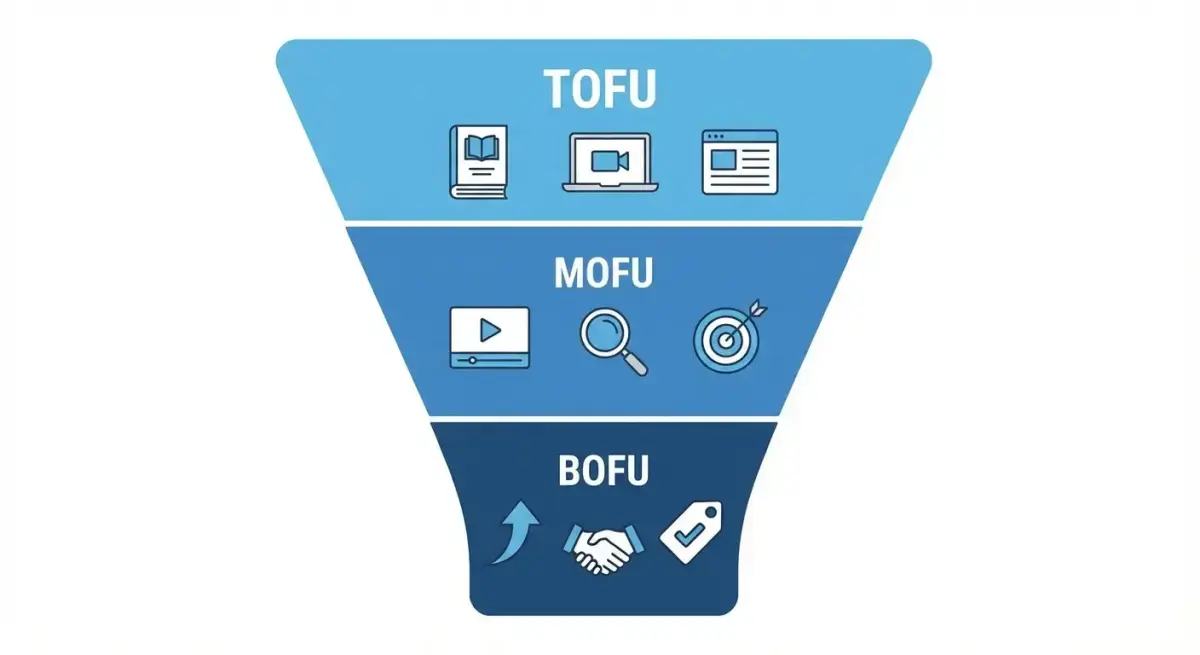 Recommended SaaS Facebook Ads campaign structure: separate campaigns by funnel stage
Targeting Strategies for B2B SaaS
Facebook's targeting for B2B is less precise than LinkedIn's, but it is more than sufficient when used correctly.
Interest-Based Targeting
Layer interests to approximate your ICP:
For marketing SaaS:
- Interests: Digital marketing, Marketing automation, HubSpot, Salesforce, Google Analytics
- Behaviors: Small business owners, Technology early adopters
For developer tools:
- Interests: Software development, GitHub, Stack Overflow, Python, JavaScript
- Behaviors: Technology early adopters
For project management SaaS:
- Interests: Project management, Asana, Trello, Monday.com, Agile methodology
- Behaviors: Small business owners, Business decision makers
Job Title Targeting
Facebook does allow job title targeting through "Detailed Targeting":
- Search for titles like "Marketing Manager," "CTO," "Product Manager"
- Less reliable than LinkedIn (self-reported, less standardized)
- Best combined with interest targeting as a layered approach
Lookalike Audiences
Your most powerful B2B targeting tool on Facebook:
- Customer list lookalike (1-3%) — upload your customer email list, create a lookalike
- High-value customer lookalike — weight by ACV or LTV for quality over volume
- Trial-to-paid converters — create a lookalike from users who converted from free trial to paid
- Website visitor lookalike — broader but still effective for TOFU
Exclusion Strategy
Critical for SaaS efficiency:
- Exclude existing customers from all campaigns
- Exclude free trial users from TOFU and MOFU campaigns
- Exclude competitors' employees (if identifiable)
- Exclude irrelevant job functions (students, interns for enterprise SaaS)
Creative Strategy for SaaS
SaaS creative on Facebook must educate, demonstrate, and build credibility — often in 15 seconds or less.
The Four SaaS Creative Types
1. Product Demo / Screen Recording Show the actual product solving a specific problem. Capture a 15-30 second screen recording of a key workflow with voiceover explaining the benefit.
- Most consistently high-performing SaaS ad format
- Cursor movement and real UI builds credibility
- Focus on one feature per video, not the whole product
2. Pain Point Creative Lead with the frustration your ICP experiences, then show how your product eliminates it.
- "Still managing task in spreadsheets?"
- Show the messy before, then the clean after in your product
- Works best for problem-aware audiences (TOFU/MOFU)
3. Social Proof Creative Lead with customer results, logos, or testimonials.
- "$X company increased metric by Y% with product"
- Logo bars of recognizable customers
- Video testimonials from ICP-matching customers
- Works best for solution-aware audiences (MOFU/BOFU)
4. Educational Content Creative Promote a lead magnet (ebook, webinar, template) that addresses an ICP pain point.
- "Free guide: How to solve pain point"
- Show a preview of the content
- Works best for cold audiences (TOFU)
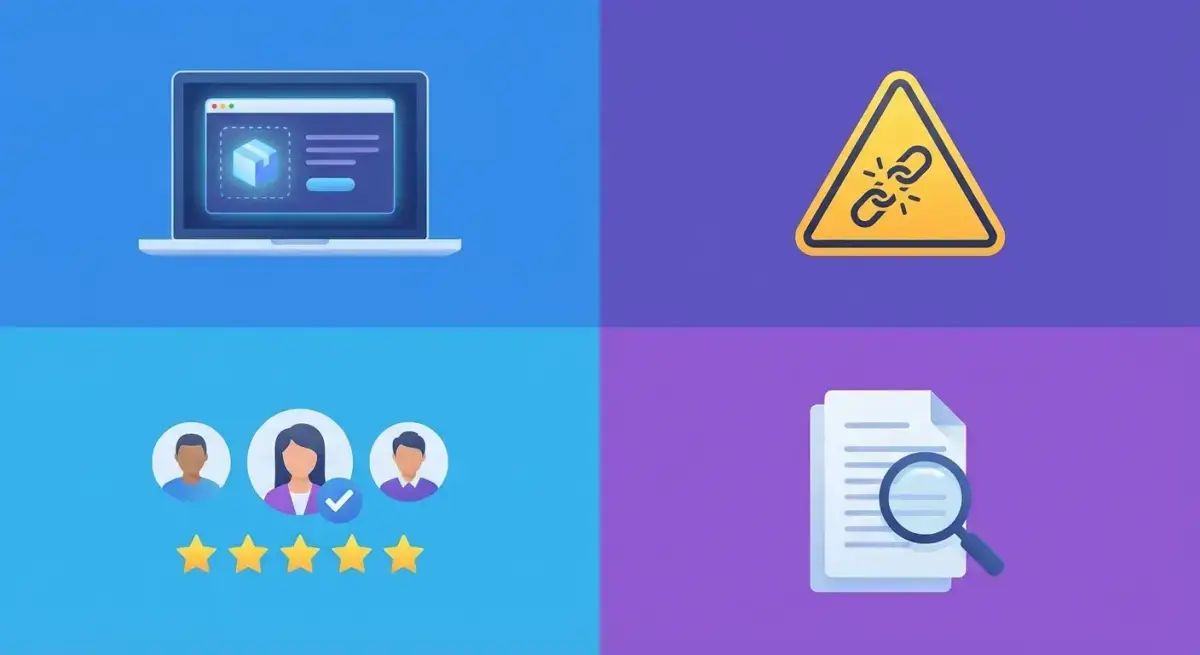 Four creative types that consistently convert for SaaS Facebook Ads
Creative Best Practices for SaaS
- Show the product, not stock photos. Real UI screenshots and screen recordings outperform generic imagery every time.
- One feature per ad. Do not try to explain your entire product in one creative. Focus on one specific workflow or benefit.
- Include social proof. Customer logos, user counts ("Trusted by 10,000+ teams"), or specific metrics build credibility.
- Design for mobile. 95%+ of impressions are mobile. Use vertical video, large text, and ensure your product UI is legible on a phone screen.
- Test video vs static. Video typically wins for SaaS, but test — some ICPs respond better to carousel ads showing step-by-step workflows.
Want to see what SaaS competitors are running? Research competitor ad creatives to find proven approaches for your vertical. See what SaaS competitors are running on Facebook right now → Try Adligator free
Lead Generation: Instant Forms vs Landing Pages
SaaS marketers face a critical choice: use Facebook's native Lead Ads (instant forms) or drive traffic to your own landing page.
When to Use Lead Ads (Instant Forms)
Best for:
- Content offers (ebook, webinar, template)
- Newsletter signups
- Early-stage TOFU campaigns where volume matters
Advantages:
- 2-5x higher conversion rate than landing pages (pre-filled fields, no page load)
- Lower cost per lead
- Works well on mobile (no redirect)
Disadvantages:
- Lower lead quality (easy to submit = less intent)
- Limited form customization
- Cannot pixel the form for retargeting
Quality improvement tips:
- Add a review screen before submission (reduces accidental submits)
- Use conditional questions to qualify leads
- Add a custom question specific to your ICP (forces deliberate engagement)
When to Use Landing Pages
Best for:
- Free trial signups
- Demo requests
- MOFU/BOFU offers where quality matters more than volume
Advantages:
- Higher intent (user took more steps)
- Full analytics and retargeting capability
- Better user experience for complex offers
Disadvantages:
- Higher cost per lead (page load drop-off)
- Requires landing page optimization
- Mobile experience must be excellent
The Hybrid Approach
Many successful SaaS companies run both:
- Lead Ads for TOFU content offers → build email list → nurture via email
- Landing pages for MOFU/BOFU trial and demo offers → higher quality, lower volume
Metrics and Optimization for SaaS
SaaS metrics on Facebook differ significantly from e-commerce. Focus on these.
Primary Metrics
| Metric | Description | SaaS Benchmark |
|---|---|---|
| CPL (Content) | Cost per content download | $5-25 |
| CPL (MQL) | Cost per marketing qualified lead | $20-80 |
| Cost per Trial | Cost per free trial signup | $50-200 |
| Cost per Demo | Cost per demo request | $75-250 |
| Trial-to-Paid % | Free trial conversion rate | 5-15% |
| CAC (blended) | Customer acquisition cost | Varies by ACV |
Optimization Strategy
- Optimize for the deepest event you have volume for. If you get 50+ trial signups per week, optimize for trial. If not, optimize for lead or landing page view and nurture downstream.
- Use offline conversions. Import your CRM data (SQLs, closed-won deals) back into Meta Events Manager to train the algorithm on what a good lead looks like.
- Monitor lead quality, not just volume. A $15 CPL with 2% SQL rate is worse than a $40 CPL with 15% SQL rate. Connect your CRM to track downstream quality.
- Set up value-based optimization. If you have enough data, send deal values back to Meta and optimize for ROAS instead of volume. This shifts the algorithm toward higher-value leads.
Competitive Intelligence for SaaS Ads
Understanding what competitor SaaS companies run on Facebook gives you a strategic advantage.
What to Research
- Ad formats — Are competitors using video demos, static images, or carousels?
- Offers — What lead magnets and CTAs do they promote?
- Messaging — What pain points and benefits do they emphasize?
- Landing pages — What does their conversion experience look like?
- Longevity — Which ads have been running longest (indicating profitability)?
With Adligator, you can search for competitor SaaS brands by name or keywords related to your vertical, filter by ad format and duration, and study their creative strategies systematically.
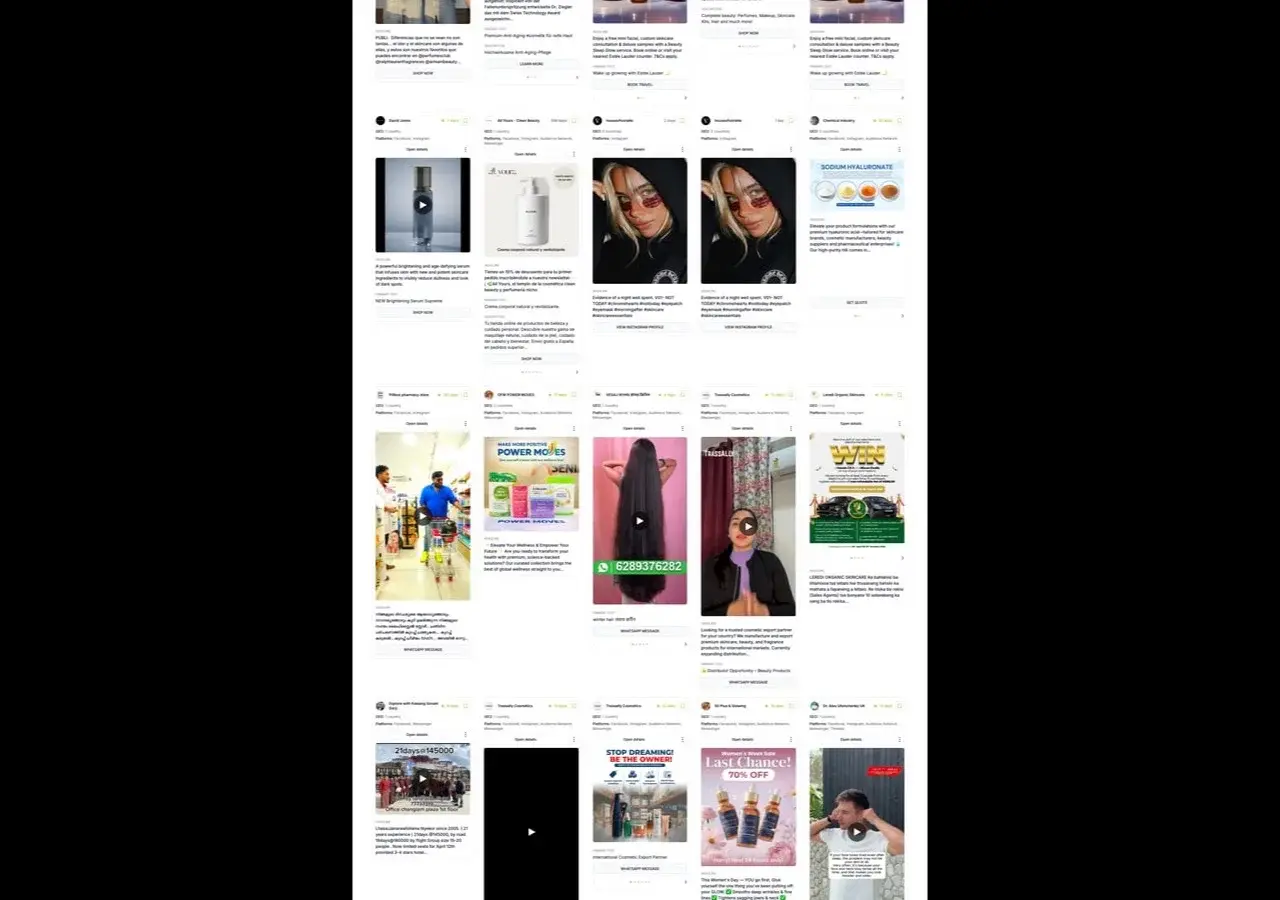 Use Adligator to research what SaaS competitors are running on Facebook
Retargeting Sequences for SaaS
Retargeting is where SaaS Facebook Ads become truly powerful. Your retargeting sequences should mirror the buyer journey.
Sequence 1: Content Consumer → Trial Offer (7-14 days)
Audience: People who downloaded ebook/attended webinar but have not visited your product page Creative: Product demo video showing how the content's concepts apply in your tool CTA: "See it in action — start your free trial"
Sequence 2: Product Page Visitor → Social Proof (3-7 days)
Audience: People who visited your pricing or product page but did not start a trial Creative: Customer testimonial video, case study results, or logo bar with "Join X companies using product" CTA: "Start your 14-day free trial"
Sequence 3: Trial User → Activation Nudge (During trial)
Audience: People who signed up for a trial but have not completed key activation steps Creative: Quick tutorial showing the "aha moment" feature CTA: "Complete your setup in 2 minutes"
Sequence 4: Trial User → Upgrade Offer (Final 3 days)
Audience: Active trial users approaching trial end Creative: Urgency-focused ("Your trial ends in 3 days"), special offer (20% off first year), or feature comparison (free vs paid) CTA: "Upgrade now and save"
Sequence 5: Lost Trial → Win-Back (30-60 days)
Audience: People whose trial expired without converting Creative: New feature announcement, improved pricing, or competitor comparison CTA: "Come back and try new feature"
Retargeting Budget Allocation
| Sequence | % of Retargeting Budget | Expected CPL |
|---|---|---|
| Content → Trial | 30% | $30-60 |
| Page Visitor → Trial | 25% | $25-50 |
| Trial → Activation | 20% | $5-15 |
| Trial → Upgrade | 15% | $15-40 |
| Win-Back | 10% | $40-80 |
Advanced: CRM-Synced Audiences
For SaaS companies with CRM data, sync your pipeline stages to Facebook Custom Audiences:
- Export SQLs → create custom audience → exclude from TOFU campaigns (reduce waste)
- Export churned customers → retarget with win-back campaigns and new features
- Export expansion candidates → upsell campaigns for higher-tier plans
- Offline conversion import → send closed-won deal data back to Meta for value-based optimization
This feedback loop trains Meta's algorithm to find more leads that look like your actual paying customers, not just people who click ads.
Common SaaS Facebook Ads Mistakes
Mistake 1: Going Straight for Trial Signups With Cold Traffic
Cold audiences do not sign up for trials. They need education first. Always run TOFU content before asking for a trial commitment.
Mistake 2: Using LinkedIn-Style Creative on Facebook
Formal, corporate creative underperforms on Facebook. The platform rewards native, engaging content — not white-on-blue banner ads. Adapt your creative to Facebook's casual environment.
Mistake 3: Ignoring the Nurture Sequence
Generating leads on Facebook is step one. Without email nurture sequences, retargeting campaigns, and sales follow-up, those leads die. Build the full funnel before scaling ad spend.
Mistake 4: Optimizing for CPL Instead of CAC
A low CPL is meaningless if those leads never convert to paying customers. Track the full funnel from ad click to revenue and optimize for the metric that matters: customer acquisition cost.
Mistake 5: Not Testing Lead Ads vs Landing Pages
Many SaaS marketers assume landing pages are superior. Test both — Lead Ads often surprise with strong results for content offers, freeing up landing page traffic for higher-intent offers.
Mistake 6: Spending Too Much on BOFU Without TOFU Foundation
BOFU retargeting only works when you have a meaningful TOFU pool to retarget. If your retargeting audience is under 1,000 people, your BOFU campaign will not have enough volume to optimize. Build your TOFU audience first, then layer on retargeting.
Mistake 7: Not Connecting CRM Data to Facebook
Without CRM feedback, you are optimizing for clicks and form fills — not for revenue. Import your deal stage data back into Meta Events Manager so the algorithm can learn what a good lead looks like. This single step can transform your campaign performance.
Scaling SaaS Facebook Ads
Once your funnel is working, scaling requires a systematic approach.
Phase 1: Validate (Weeks 1-4)
- Test 3-5 audience and creative combinations
- Budget: $50-100/day per ad set
- Goal: find 2-3 profitable combinations with acceptable CAC
Phase 2: Optimize (Weeks 5-8)
- Double down on winning combinations
- Add lookalike audiences based on your best leads
- Introduce retargeting sequences
- Budget: $200-500/day total
Phase 3: Scale (Weeks 9+)
- Increase budgets by 20% every 3-4 days on winners
- Expand to new geographic markets
- Test new creative angles and offers
- Add Advantage+ Sales campaigns for broad prospecting
- Budget: $500+/day total
Scaling Signals to Watch
- If CPL rises 30%+ after budget increase → too aggressive, pull back
- If lead quality drops while volume increases → tighten targeting or add qualifying questions
- If frequency exceeds 3.0 per week → audience is saturated, expand targeting
- If trial-to-paid rate drops → traffic quality issue, review audience composition
FAQ
Do Facebook Ads work for B2B SaaS?
Yes. While Facebook is primarily a B2C platform, B2B decision-makers are active users. The key is targeting by job title, industry interest, and company size — not trying to reach businesses directly. SaaS companies routinely achieve $20-80 cost per qualified lead on Facebook, competitive with LinkedIn Ads at often lower CPMs.
What is a good cost per lead for SaaS Facebook Ads?
For B2B SaaS, expect $20-80 per marketing qualified lead and $50-200 per free trial signup depending on your ICP and pricing tier. Enterprise SaaS with high ACV can justify higher CPLs. The key metric is cost per qualified opportunity, not raw lead cost.
Should SaaS companies use Lead Ads or landing page conversions?
Both have their place. Lead Ads (instant forms) generate higher volume at lower cost but often lower quality. Landing page conversions produce fewer leads but higher intent. Test both — many SaaS companies find a middle ground using Lead Ads for content offers and landing pages for free trial signups.
What Facebook Ad creative works best for SaaS?
Product demos and screen recordings consistently outperform stock photos for SaaS. Show the actual product in use, highlight a specific pain point being solved, and include social proof (customer logos, metrics, testimonials). Video ads typically outperform static images for SaaS, especially 15-30 second product walkthroughs.
Conclusion
Facebook ads for SaaS work when you respect the platform's strengths and adapt your approach. Build a full-funnel campaign structure (TOFU → MOFU → BOFU), use interest and lookalike targeting to approximate your ICP, and create product-focused creative that demonstrates real value.
The biggest opportunity for SaaS on Facebook is the CPM advantage over LinkedIn — you can reach the same B2B buyers at a fraction of the cost. The key is combining this cost efficiency with proper lead qualification and nurture sequences.
Ready to see what your SaaS competitors are running on Facebook? Try Adligator free
Research competitor SaaS ads with Adligator
Related Reading
- Click-to-Message Ads on Facebook and Instagram: WhatsApp, Messenger, and DM Campaign Strategy
- Facebook Ads Campaign Anatomy: Breaking Down 5 Winning Campaign Structures Across Different Verticals
- Facebook Ads Budget Allocation Framework: CBO vs ABO and How to Split-Test Budgets Like a Pro
- Facebook Ads for Local Businesses: Targeting, Creative Strategy, and Campaign Setup Guide
