Facebook Ads Frequency Benchmarks by Vertical: When Creative Fatigue Hits and What to Do (2026)
Every Facebook Ads guide cites the same frequency rule: "keep it under 3." That number has been copied across blogs for a decade, and it is wrong for most of the people reading it. A DTC apparel brand running broad prospecting at a weekly frequency of 3.2 is usually fine. A B2B SaaS account at the same frequency is barely warming up. A lead gen campaign at 3.2 in a narrow geo is already burning cash.
This guide drops the universal number and gives you facebook ads frequency benchmarks vertical 2026 numbers — the actual thresholds where creative fatigue starts showing up in ecommerce, SaaS, local services, lead gen, and affiliate. It is written for media buyers and agency teams who need to set real rules per account, not repeat generic advice in a QBR deck.
You will walk away with: the frequency range where performance typically cracks in your vertical, how prospecting and retargeting differ, how to monitor frequency without babysitting the dashboard, and how to use competitor ad longevity as a real-world frequency proxy.
Why Frequency Matters More Than Most Metrics
Frequency is the only metric that predicts decay. CTR tells you what happened yesterday. ROAS tells you what the algorithm already figured out. Frequency tells you what is about to happen to both.
When a user sees the same creative too many times, three things happen in sequence: CTR drops, CPM rises because the auction sees you bidding harder for the same impressions, and CPA climbs until the campaign stops being profitable. If you are waiting for ROAS to drop before you act, you are already two weeks late — by then the creative is dead, the audience is annoyed, and you have a rebuild on your hands.
The practical value of frequency is that it is predictive. If you know the threshold where your vertical typically cracks, you can pre-schedule creative refreshes, pre-load testing slots in ad sets, and stop playing reactive catch-up.
There is also a user-experience piece that does not show up in the dashboard. Every extra exposure above the healthy zone erodes brand trust, especially in categories where the audience is small and the same buyer is being hit across multiple platforms. Frequency is not just a performance knob — it is a brand hygiene metric. The buyers who treat it that way get longer runway on their hero creatives because they stop before the damage is visible in the numbers.
The Problem With Universal Frequency Rules
The "keep frequency under 3" rule comes from Facebook brand-lift research circa 2017. It was never designed for direct response, it was never segmented by vertical, and the ad environment has changed materially since then. Users see more ads per session, Reels inventory changed the pacing, and Advantage+ auctions pool audiences differently than the old manual setups.
Three reasons universal rules fail in 2026:
- Audience size distorts everything. A 500k audience with $200/day spend hits frequency 3 in three days. A 30M audience with the same spend takes three weeks. Same "rule," wildly different decay curves.
- Intent varies by vertical. A cold SaaS prospect needs 4-7 touches before they even understand the product. A DTC impulse buy needs one good creative and a 20% off code.
- Creative format shifts the curve. A 6-second UGC hook fatigues slower than a 30-second explainer. The "frequency number" without format context is meaningless.
This is why blanket benchmarks waste your time. You need the number for your vertical, your funnel stage, and your creative format.
Frequency Benchmarks by Vertical (Ecommerce, SaaS, Local, Lead Gen, Affiliate)
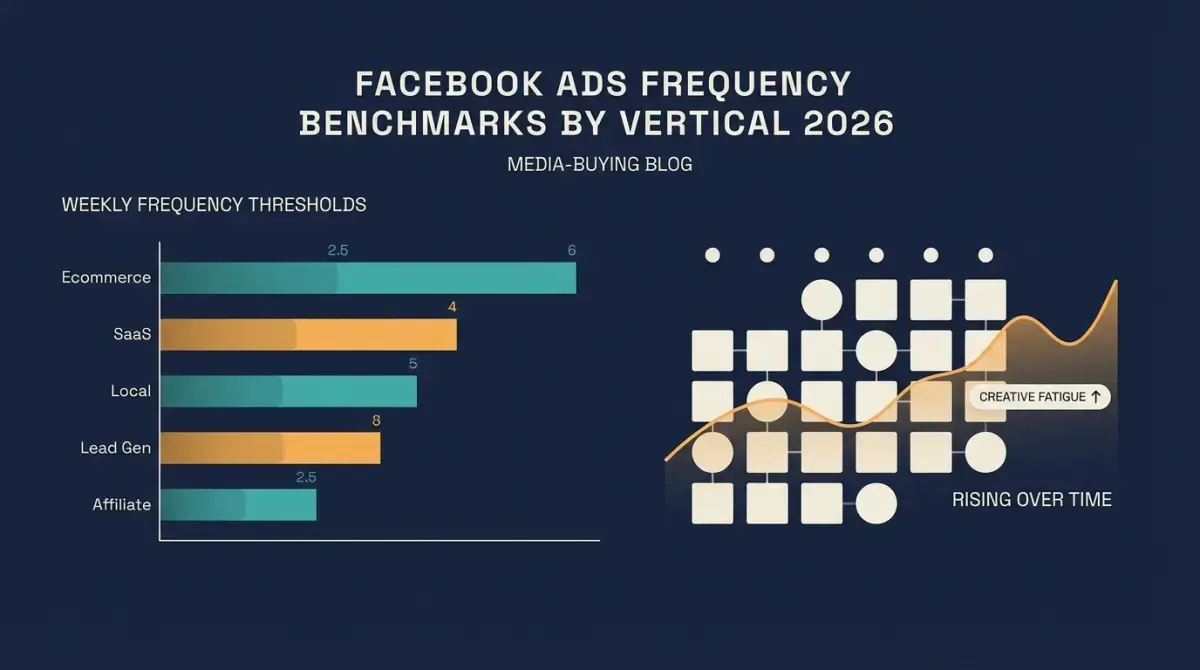
The numbers below are weekly frequency thresholds where practitioners typically see the first meaningful fatigue signals (CTR drop 15-25%, CPM rise 10-20%, CPA drift upward) on cold prospecting campaigns. Treat them as the upper end of the healthy zone — hit them, start rotating.
 Weekly frequency thresholds where creative fatigue signals typically appear, broken out by vertical.
Ecommerce / DTC — weekly frequency 2.5 to 3.5 (prospecting). Impulse verticals like apparel, beauty and accessories fatigue fast because purchase decisions are quick and audiences are often narrower than people think. Hero creatives in apparel routinely start decaying by weekly frequency 3.0 on cold, faster in narrow geos. Higher-consideration categories like furniture and premium electronics can stretch to 4.0 because buyers revisit creatives before deciding.
SaaS — weekly frequency 3.5 to 5.0 (prospecting). B2B and consumer SaaS tolerate higher frequency because the buyer needs repeated exposure to grasp the product. Pain-point hook videos and case study carousels often get better by the third exposure. Fatigue usually shows up as a soft CPL creep rather than a cliff. Retargeting audiences here can comfortably push 8-10 weekly.
Local service — weekly frequency 4.0 to 6.0 (prospecting). Local is the outlier because audiences are small by default (city-level), intent is high, and creatives are often low-polish. You can run the same before/after video for a roofer at weekly frequency 5 for months as long as the offer stays relevant. Fatigue in local is more seasonal than creative-driven.
Lead generation — weekly frequency 2.0 to 3.0 (prospecting). Lead gen is the fastest to fatigue because the promise is usually a gated asset or form, and repeated exposure just trains users to scroll past. By weekly frequency 3, expect CPL to climb 20-30% in most insurance, finance, education and home services accounts. Retargeting lead gen can push 5-6 weekly before the second form-fill opportunity is wasted.
Affiliate — weekly frequency 2.0 to 2.8 (prospecting). Affiliate campaigns fatigue fastest because the creative is usually built for a single hook, the audience is broad but skeptical, and the angle does not survive repeated exposure. Top affiliate buyers rotate creative when weekly frequency crosses 2.5 regardless of ROAS — by the time ROAS drops, the angle is already burned and the competition has copied it.
These are not rules, they are starting thresholds. The operational version is: pick the number for your vertical, use it as a trigger for a creative rotation review, and adjust from observed performance in your account.
Prospecting vs Retargeting: Different Frequency Thresholds
Treating prospecting and retargeting with the same frequency ceiling is one of the most common mistakes in mid-level accounts. They behave completely differently.
 Prospecting and retargeting fatigue curves are different animals — plan creative rotation accordingly.
Prospecting is about discovery. The user has no existing relationship, the creative has to earn the click, and repeated exposure to the same hook accelerates blindness. Prospecting frequency should stay at the vertical benchmarks above.
Retargeting is about reminding. The user already knows you, the creative is closing a loop, and repeated exposure often helps rather than hurts — up to a point. Across most verticals, retargeting tolerates weekly frequency of:
- Ecommerce cart abandoners: 6-10
- SaaS free-trial nurture: 5-8
- Lead gen content nurture: 4-6
- Local service reminder: 6-10
- Affiliate retargeting: 4-6
Retargeting fatigue shows up as a plateau in conversion rate — the remaining audience stops converting — rather than a CTR cliff. When that plateau hits, it is usually a signal to expand the retargeting window (7 → 14 → 30 days) or change the offer, not necessarily to rotate the creative.
Soft CTA: See how long competitor ads survive at scale — Adligator shows days active as a frequency proxy
The Frequency-Performance Relationship: What Actually Happens
The short version: frequency is a leading indicator, ROAS is a lagging one. Here is the typical decay sequence on a cold prospecting creative:
- Week 1 — Healthy zone. Frequency 1.0-2.0. CTR is at or above account baseline. CPM is stable. ROAS is strong.
- Week 2 — First signal. Frequency 2.5-3.5. CTR starts sliding 10-15%. CPM creeps up 5-10%. ROAS still looks fine because conversions lag.
- Week 3 — The break. Frequency hits the vertical threshold. CPM is now 15-25% above week 1. CTR is down 20-30%. ROAS starts sliding noticeably.
- Week 4 — Cliff. Frequency overshoots by 20-40%. CTR is halved. CPM is 30% over baseline. ROAS collapses. Most buyers finally notice.
The mistake is waiting for stage 4. Stage 2 is when you should be queuing the next creative batch. Stage 3 is when you rotate. If you hit stage 4, you are not rotating — you are rebuilding.
A second pattern worth naming: account-level frequency, not just ad-level. If a user is in multiple overlapping audiences (cold prospecting + lookalike + interest), they can see several of your ads in one session even when each individual creative has a healthy frequency. Always check the Account attribution setting → Frequency per person view in Ads Manager, not just the ad-level number.
How to Monitor Frequency in Real-Time
You cannot manage what you are not checking. A reliable monitoring setup:
- Dashboard column setup. Add Frequency, 7-day Frequency, Impressions, CTR (Link), CPM, CPA and Spend as fixed columns. Save as a preset called "Fatigue Watch."
- Breakdowns that matter. Break down by Time → Day for the last 14 days. You want to see frequency per day, not the cumulative number that gets watered down by early days.
- Cadence. Check top-spending ad sets daily. Check long-tail ad sets twice a week. Never rely on weekly check-ins — in fast verticals like affiliate you can lose a week of profit.
- Threshold alerts. Set up automated rules (see next section) so you are not squinting at a dashboard.
- Creative-level view. Always monitor at the ad level, not the ad set. A healthy ad set average can hide one creative running at 6.0 and dragging the rest down.
One extra habit that separates senior buyers: track frequency velocity, not just the number. A creative going from 1.5 to 2.5 in three days on stable spend is a more urgent signal than a creative sitting at 3.2 for two weeks. Velocity means the audience is saturating fast and your next creative needs to be ready yesterday.
Automated Rules for Frequency Management
Manual babysitting does not scale past three accounts. Set automated rules in Ads Manager to remove judgment calls from the day-to-day.
Starter rule set for prospecting campaigns:
- Pause trigger. If ad frequency in last 7 days > vertical threshold AND CTR decline > 20% vs 14-day average → pause ad. Notification only, not auto-pause, for the first two weeks so you can learn your account's quirks.
- Budget down trigger. If ad set frequency > vertical threshold AND CPA > 120% of 14-day average → reduce budget 20%.
- Rotation trigger. If any ad in top-spending ad set hits frequency > 1.2x vertical threshold → email notification to creative team to ship replacement.
- Retargeting-specific rule. If retargeting ad set frequency > 8 AND conversion rate declining → swap creative for a different offer hook.
Rules should be conservative, not aggressive. Auto-pausing creatives based on frequency alone will shut down winners that happen to spike on a good day. Use rules to flag and prioritize, then make the call yourself for the first 4-6 weeks in any new account.
A few additional rules worth layering once the basics are stable:
- Creative refresh prep. Once any ad set's top creative hits 80% of the vertical frequency threshold, trigger a Slack message to the creative team so the replacement brief is already moving before rotation day.
- Audience expansion prompt. If frequency climbs on stable spend and a well-defined audience, it is often a signal that the audience is too narrow, not that the creative is tired. Flag for targeting review before ripping the creative.
- Seasonality guardrail. During peak periods (Black Friday, Q4 retail, end-of-quarter SaaS pushes) frequency will spike faster than baseline. Relax thresholds by 15-20% temporarily or you will kill winners chasing a shadow.
Using Competitor Ad Longevity as a Frequency Proxy
Here is the lever most media buyers miss. Frequency benchmarks are internally focused — what is happening in your account. But the most direct evidence for how long a creative can survive in your vertical is sitting in plain sight: how long competitors run their own creatives.
If every top advertiser in your niche rotates hero creatives every 14-21 days, that is the true ceiling for your vertical — no blog post can beat it. If a category leader has been running the same video for 60 days at scale, you have permission to stretch your rotation cadence because the audience clearly tolerates it.
 Adligator surfaces competitor ad longevity, which maps closely to effective fatigue thresholds in your vertical.
This is exactly what Adligator surfaces. Instead of guessing, you filter by your vertical, sort active Facebook ads by days active, and read the distribution:
- The median days active in your niche is a realistic baseline for how long your creatives should survive.
- The top 10% longest-running ads tell you what a truly evergreen format looks like in your category (steal the structural patterns, not the copy).
- Sudden drops in days active across the top 20 advertisers are a signal that audience fatigue is rising across the whole niche — time to push new angles faster.
Concrete workflow: pick your top 5-10 direct competitors, filter their ads to "active" on Facebook, sort by days active, and note the median. That number is your vertical's real tolerance ceiling. Recheck monthly. When the median starts dropping, your own rotation cadence needs to tighten too — the whole niche is fatiguing faster, not just you.
FAQ
What is a good frequency for Facebook ads in 2026?
There is no single good number — it depends on your vertical and funnel stage. For cold prospecting, ecommerce tolerates 2.5-3.5 per week, SaaS 3.5-5, and lead gen around 2-3 before CPL climbs. Retargeting audiences can handle 6-10+ weekly because intent is already there.
At what frequency does Facebook ad fatigue start?
Creative fatigue typically starts showing up when weekly frequency crosses 3-4 in broad prospecting for most verticals. You'll see CTR drop 15-25% and CPM rise before ROAS collapses. By a weekly frequency of 5-6, most cold creatives are cooked unless the offer is very strong.
Is frequency cap still a thing on Meta in 2026?
Campaign-level frequency caps exist for reach and brand awareness objectives, but for conversion campaigns you manage frequency through creative rotation, budget pacing, and audience size — not caps. The system optimizes for outcomes, so controlling the inputs is how pros manage exposure.
How often should I refresh Facebook ad creatives?
Ecommerce: every 2-3 weeks on top spenders. SaaS and lead gen: every 3-6 weeks. Local service: every 4-8 weeks. Affiliate: whenever ROAS drops 15% from the rolling 7-day average. Rotate sooner if frequency in your vertical is climbing above the benchmarks in this article.
Conclusion
Stop using the universal "keep frequency under 3" rule. The real facebook ads frequency benchmarks vertical 2026 numbers live in a range: ecommerce 2.5-3.5, SaaS 3.5-5, local 4-6, lead gen 2-3, affiliate 2-2.8 on cold prospecting, with retargeting comfortably running 2-3x higher. Match the number to your vertical, watch frequency velocity at the ad level, set automated flagging rules so nothing slips, and — the piece most teams miss — use competitor ad longevity to calibrate what is actually possible in your niche.
The teams winning on Meta in 2026 are not the ones with the strictest rules. They are the ones whose rules match their reality. Set yours accordingly.
Ready to apply this workflow? See how long competitor ads survive at scale — Adligator shows days active as a frequency proxy
Monitor competitor creative rotation speed to inform your own frequency management
Related Reading
- Facebook Ad Creative Lifespan: How Long Do Ads Last Before Fatigue? Data-Backed Guide (2026)
- Facebook Ad Performance Benchmarks by Vertical in 2026: CPM, CTR, and Creative Lifespan Data for Media Buyers
- How to A/B Test Facebook Ad Creatives: A Beginner Guide to Statistical Confidence and Faster Winners
- How to Analyze Facebook Ad Creatives by GEO and Vertical: A Data-Driven Approach for Media Buyers
