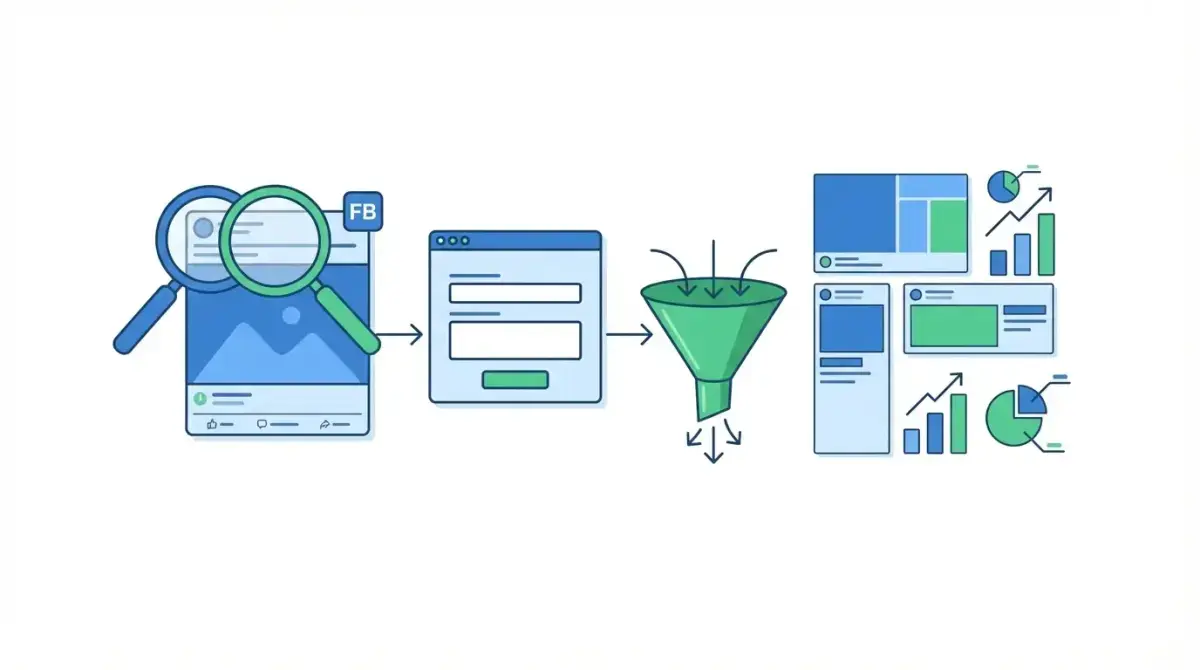
Facebook Lead Gen Ads Spy: How to Research Competitor Lead Generation Campaigns and Build Higher-Converting Funnels
Lead generation is one of the most competitive categories in Facebook advertising. Every B2B SaaS, real estate agency, insurance company, and service business fights for the same leads — and the cost per lead keeps climbing.
The fastest way to reduce your CPL isn't to test random creatives until something works. It's to study what's already working for competitors, reverse-engineer their approach, and build a better version of their funnel. Facebook lead gen ads spy isn't optional — it's the foundation of any serious lead generation strategy in 2026.
This guide covers exactly how to research competitor lead gen campaigns, what to analyze in their funnels, and how to turn competitive insights into higher-converting lead generation ads.
Why Lead Gen Campaigns Deserve Dedicated Competitive Research
Not all Facebook ad campaigns are equal. Lead gen has unique characteristics that make competitive research especially valuable.
Lead Gen Is a System, Not a Single Ad
E-commerce campaigns live and die by the creative. Lead gen campaigns involve a multi-step system: the ad creative → the offer → the form (Instant Form or landing page) → the follow-up sequence. Each step compounds on the others.
This means competitive research for lead gen goes deeper than just looking at creatives. You need to understand the entire funnel: what's the hook, what's the offer, what information do they collect on the form, and how do they follow up?
High CPL Makes Every Optimization Count
In competitive B2B verticals, a single lead can cost $50-200+. When you're spending $10K/month on lead gen, a 20% improvement in conversion rate saves $2K/month. That's $24K/year from a single optimization insight you got from competitor research.
Lead Gen Ads Leave More Signals
Because lead gen campaigns have more moving parts, they leave more intelligence signals for you to analyze:
- CTA button choice reveals funnel type (Sign Up = form, Learn More = landing page, Get Quote = configurator)
- Ad copy structure reveals the offer and the qualifying criteria
- Creative format shows which approach resonates (case study, demo preview, data point, testimonial)
- Landing page design (when accessible) shows form length, social proof strategy, and objection handling
Anatomy of a Facebook Lead Gen Funnel
To effectively spy on competitor lead gen campaigns, you need to understand what you're looking at. Here are the standard funnel architectures:
Architecture 1: Instant Form Funnel
Flow: Ad → Facebook Instant Form → Thank You Screen → CRM/Email Sequence
This is the simplest lead gen funnel. The user never leaves Facebook. Instant Forms reduce friction dramatically but typically produce lower-quality leads because there's no qualification step.
What to look for in competitor ads using this architecture:
- CTA button is usually "Sign Up" or "Learn More"
- Ad copy often mentions what the user will receive ("Get your free guide", "Book a call")
- The creative frequently shows the offer itself (ebook cover, webinar preview)
Architecture 2: Landing Page Funnel
Flow: Ad → Landing Page → Form Submission → Confirmation → Email Sequence
Higher friction but higher-quality leads. The landing page allows for more persuasion, social proof, and qualification before the form.
What to look for:
- CTA button is usually "Learn More" or "Apply Now"
- Destination URL is visible in the ad (reveals the landing page you can visit)
- Ad copy focuses on the value proposition, not just the lead magnet
Architecture 3: Multi-Step Funnel
Flow: Ad → Quiz/Calculator/Assessment → Results Page → Lead Capture → Follow-up
The most sophisticated approach. Interactive elements qualify the lead before capturing their information. Common in insurance, finance, and SaaS.
What to look for:
- CTA is often "Get Quote" or "Get Started"
- Ad copy mentions personalization ("Find out which plan fits you", "Get your custom quote")
- These ads frequently run the longest because the funnel is highly optimized
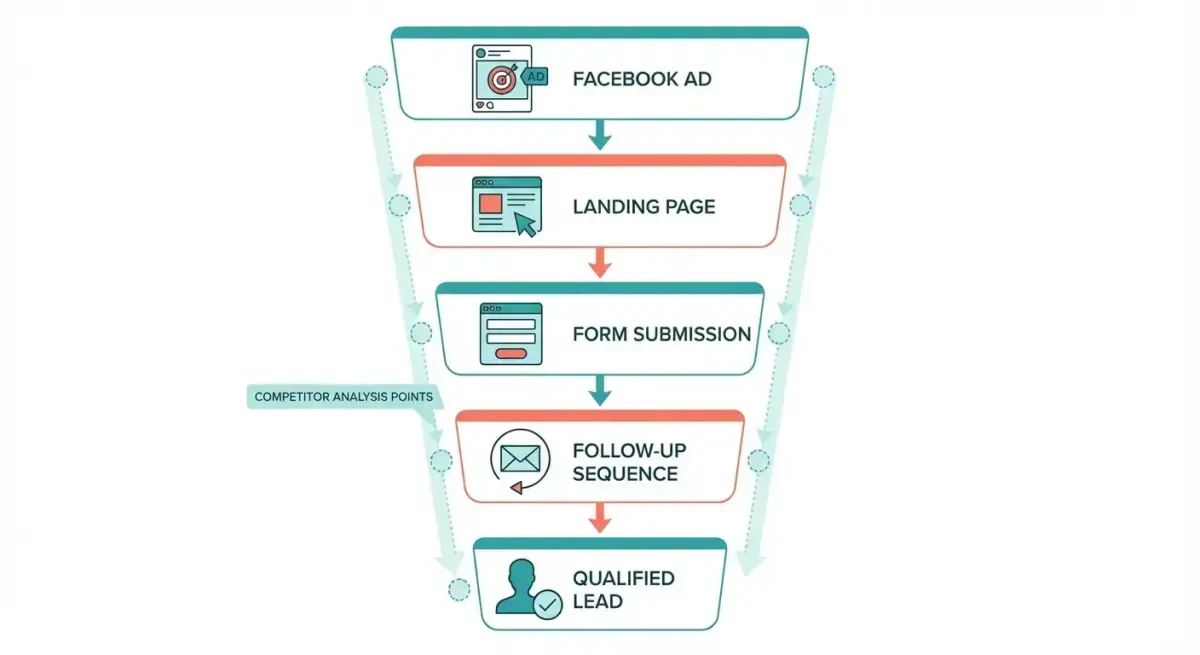 The complete lead gen funnel — and the points where competitive intelligence reveals the most value.
How to Find Competitor Lead Gen Ads with Adligator
The challenge with researching lead gen ads specifically is that they look similar to other ad types in general search results. Adligator's filter system solves this by letting you isolate lead gen ads precisely.
Step 1: Use the Button Type Filter
This is the key differentiator for lead gen research. Filter by CTA button types that indicate lead generation:
- Sign Up — the clearest lead gen signal
- Learn More — often used for landing page funnels
- Apply Now — common in finance, education, SaaS
- Get Quote — insurance, services, custom pricing
- Book Now — appointment-based businesses
In Adligator, open the Properties filters section and select the relevant button types. This immediately eliminates e-commerce (Shop Now), content (Watch Video), and other non-lead-gen ads.
Step 2: Combine with Keyword and GEO Filters
Narrow further by:
- Keywords related to your industry ("insurance quote", "free demo", "CRM software")
- GEO targeting your specific markets
- Platform — lead gen often performs differently on Facebook vs Instagram
Step 3: Sort by Days Active
This is where competitive intelligence becomes actionable. Sort by days active to surface the longest-running lead gen ads. An ad running 14+ days is generating leads at an acceptable cost. An ad running 30+ days is a proven machine.
These long-runners are your highest-priority research targets. They represent validated funnels that are worth reverse-engineering.
Ready to find competitor lead gen ads? Start researching competitor lead gen ads with Adligator — free account, no credit card
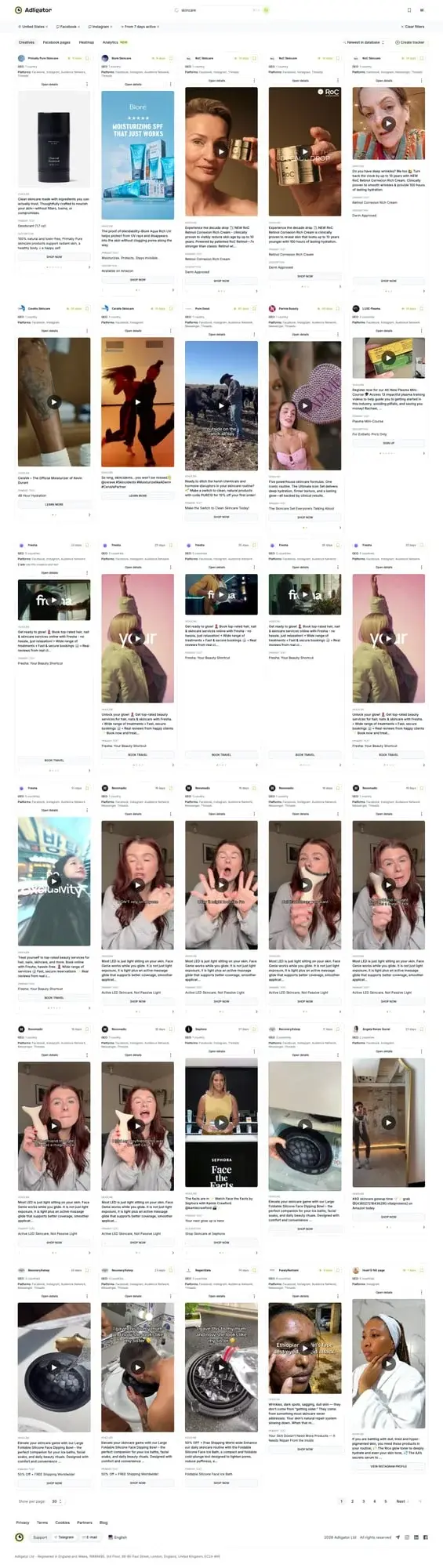 Adligator's button type filter lets you isolate lead gen ads from the entire competitive landscape.
Step 4: Analyze the Full Funnel
For each promising competitor ad, go deeper:
- Read the full ad copy — what's the offer? What's the hook? What qualifies the lead?
- Check the CTA and destination URL — Instant Form or landing page?
- Visit the landing page (if available) — what social proof do they use? How long is the form? What fields do they collect?
- Note the creative format — is it a case study, demo, data point, testimonial, or something else?
- Track over time — does the competitor iterate on this ad? New versions with similar angles suggest they're optimizing a working funnel.
What to Analyze in Competitor Lead Gen Ads
The Offer
The offer is the core of any lead gen campaign. What does the competitor promise in exchange for contact information?
Common lead gen offers, ranked by typical conversion rate:
- Free tool or calculator (highest conversion) — interactive, immediate value
- Free consultation or demo — high intent, strong qualification
- Ebook, whitepaper, or guide — lower intent but easier to convert
- Webinar registration — time-specific, creates urgency
- Newsletter signup (lowest conversion) — minimal commitment
Track which offers your competitors use and which ones run the longest. Long-running offers are generating quality leads at scale.
The Hook (First 3 Seconds / First Line)
How does the competitor grab attention? Lead gen hooks typically fall into categories:
- Pain point: "Tired of paying $X per lead?"
- Data point: "78% of marketers say lead quality is their biggest challenge"
- Social proof: "Join 10,000+ marketers who..."
- Direct offer: "Get your free thing in 2 minutes"
- Question: "Do you know how much your competitors spend on lead gen?"
Copy Length and Structure
Lead gen ads tend to use longer copy than e-commerce ads because they need to:
- Explain the offer
- Build credibility
- Qualify the lead (so unqualified leads don't waste form submissions)
- Handle objections ("No credit card required", "Cancel anytime")
Note whether competitors use short-form (2-3 sentences), medium-form (paragraph + bullets), or long-form (multiple paragraphs) copy. The format that runs longest is likely the most effective for your shared audience.
Creative Format Patterns
Lead gen creatives differ by industry:
- B2B SaaS: Product demo GIFs, UI screenshots, customer testimonials, data visualizations
- Real estate: Property photos, virtual tour previews, market data graphics
- Education: Student success stories, curriculum previews, instructor introductions
- Financial services: Calculator previews, comparison charts, trust badges
- Services: Before/after results, team photos, process infographics
Identify which format dominates among long-running competitors in your vertical.
Optimizing Your Funnel Based on Competitive Insights
Once you've gathered intelligence, here's how to apply it systematically.
The Priority Optimization Stack
Optimize in this order (highest impact first):
- Offer — If competitor research reveals a clearly better offer type (e.g., free tool vs. ebook), test it first. The offer drives the most variance in CPL.
- Hook/Headline — Test the top 2-3 hook structures you found in competitor research. The hook determines whether someone reads your ad.
- Creative format — If competitors are winning with video and you're running static, test video. Format affects reach and engagement.
- Copy structure — Match the copy length and style that works in your vertical. If long-form dominates, don't fight the market.
- CTA button — Test the CTA buttons used by successful competitors. Sometimes switching from "Learn More" to "Sign Up" improves conversion.
- Form length — If competitors use short forms (name + email only), and you're asking for 8 fields, test a shorter form.
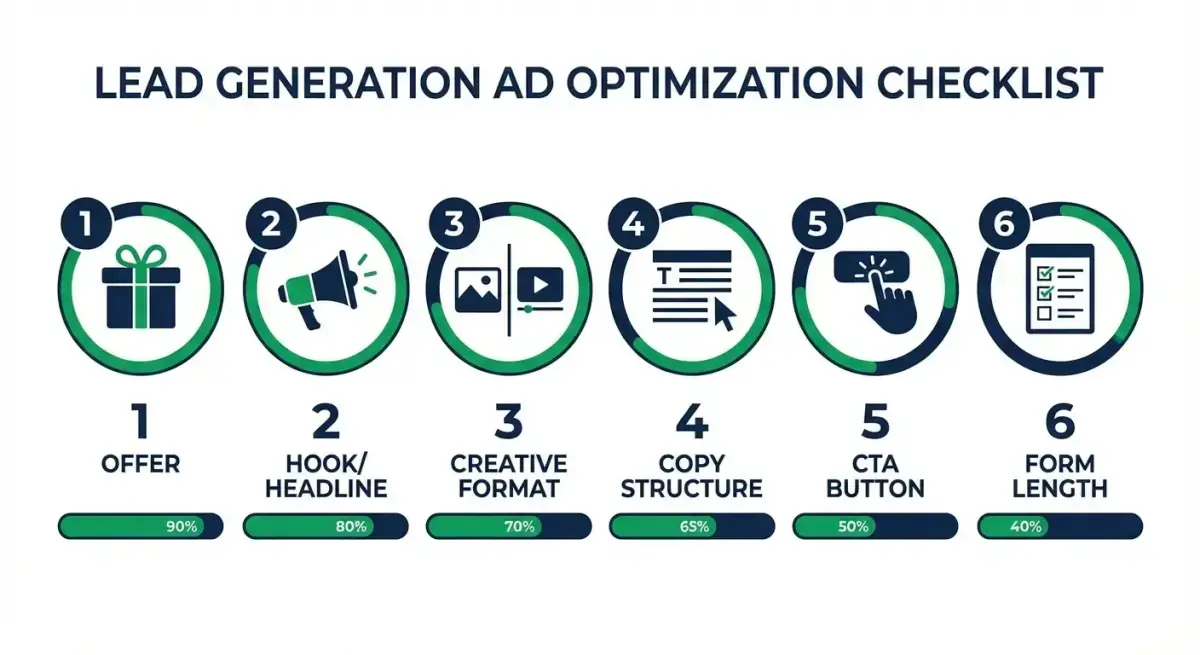 Use this checklist to systematically optimize every element of your lead gen funnel.
Building Your Test Roadmap
Create a 4-week optimization plan based on competitive insights:
Week 1: Launch new offer test (inspired by competitor's most successful offer type) Week 2: Test top 3 hook structures from competitor research Week 3: Test the dominant creative format in your vertical Week 4: Optimize form and landing page based on competitor patterns
After each week, measure CPL, lead quality, and conversion rate. Keep winners, iterate on partial wins, kill losers.
Common Lead Gen Optimization Mistakes
Optimizing for volume over quality. A lower CPL doesn't help if the leads don't convert to sales. When researching competitors, pay attention to their qualification language — "For companies with 50+ employees" or "If you spend $5K+/month on ads." These qualifiers intentionally reduce lead volume to increase quality. If successful competitors use qualifying copy, you probably should too.
Ignoring the follow-up sequence. The ad and form are just the beginning. What happens after form submission determines whether leads become revenue. While you can't directly spy on competitor email sequences, you can submit your own information to their forms and study the follow-up. This reveals timing, messaging, and the sales process — intelligence that directly improves your own post-capture strategy.
Testing too many things simultaneously. Lead gen funnels have many variables, and it's tempting to change the offer, creative, and form at the same time. This makes it impossible to attribute results. Use the competitive intelligence to prioritize one variable at a time, starting with the highest-impact element (usually the offer).
Ongoing Monitoring
Set up Adligator trackers for your top 5 competitor lead gen campaigns. Monitor for:
- New offers (a competitor testing a new lead magnet signals market evolution)
- Format shifts (the market moving from static to video means audience preferences are changing)
- Seasonal patterns (some verticals have strong lead gen seasons)
- New competitors entering the space (tracked via keyword searches, not just page monitoring)
Industry-Specific Lead Gen Patterns
Different verticals have distinct lead gen patterns that emerge from systematic competitive research:
SaaS/B2B Tech: Demo-focused funnels dominate. The most successful competitors run video demos or interactive product tours. Long-running ads almost always feature customer logos, specific ROI numbers, or integration lists. Form length is typically 4-6 fields including company size and role.
Real Estate: Market report lead magnets outperform property-specific ads for top-of-funnel. The strongest competitors run geographic-targeted campaigns with hyper-local data. Instant Forms with minimal fields (name, email, phone) have the highest conversion rates in this vertical.
Education/Courses: Social proof is the primary driver. Long-running competitor ads consistently feature student testimonials with specific outcomes ("I got a $120K job after 6 months"). Free workshop or masterclass offers outperform downloadable content. Video creatives dominate.
Financial Services: Compliance requirements shape the creative landscape. Calculator and quiz funnels consistently outperform direct lead capture because they provide value before asking for information. Trust signals (licenses, certifications, years in business) are present in every successful long-running ad.
FAQ
Can I see the actual lead gen forms competitors use on Facebook?
Not directly from ad spy tools. You can see the ad creative, copy, and CTA button. To see the actual form, click through the ad as a user. Some competitors use Instant Forms (visible in-app), while others redirect to landing pages you can analyze.
Which CTA buttons indicate a lead generation campaign?
Sign Up, Learn More, Apply Now, Get Quote, and Book Now are the most common CTA buttons for lead gen campaigns. In Adligator, use the button type filter to isolate these specific buttons.
How do I know if a competitor's lead gen ad is actually working?
Days active is the strongest signal. A lead gen ad running for 14+ days is almost certainly generating leads at an acceptable CPL. Ads that disappear within 3-5 days are likely underperforming.
Conclusion
Facebook lead gen ads spy is the single highest-ROI activity for any lead generation team. When CPLs are $50-200+, even a small improvement from competitive intelligence pays for itself within days.
The framework is straightforward: use Adligator's button type filter to isolate lead gen ads, sort by days active to find proven campaigns, analyze the complete funnel (offer → hook → creative → form), and apply those insights in a structured optimization roadmap.
The teams winning at lead gen in 2026 aren't the ones with the biggest budgets — they're the ones who systematically study what works for everyone else and build better versions.
Ready to reduce your CPL? Start researching competitor lead gen ads with Adligator — free account, no credit card
Related Reading
- Seasonal Facebook Ad Research: How to Use Spy Tools to Prepare Winning Campaigns Before Q4 and Peak Seasons
- How to Estimate Competitor Facebook Ad Spend Using Spy Tools and Ad Library Data
- Facebook Ad Creative Testing Framework: How to Validate Winners Faster Using Competitor Intelligence
- Facebook Video Ad Spy: How to Analyze Competitor Video Creatives and Extract Winning Hooks
