
Google Ads vs Facebook Ads: Choosing the Right Platform for Your Business
Every performance marketer faces this decision: where to put the next dollar — Google Ads or Facebook Ads? The answer isn't one or the other. It's understanding what each platform does best and building a strategy that leverages both.
Google Ads captures existing demand. When someone searches "best running shoes under $150," they're ready to buy. Facebook Ads creates demand. When someone scrolls past a compelling video of running shoes, they didn't know they wanted them — until now.
This fundamental difference shapes everything: targeting, creative, cost structure, and optimization. In this comparison, we'll break down Google Ads vs Facebook Ads across every dimension that matters to media buyers in 2026 — so you can allocate your budget where it drives the highest return.
Intent-Based vs Interest-Based: The Core Difference
This is the most important concept to understand before comparing any other metric.
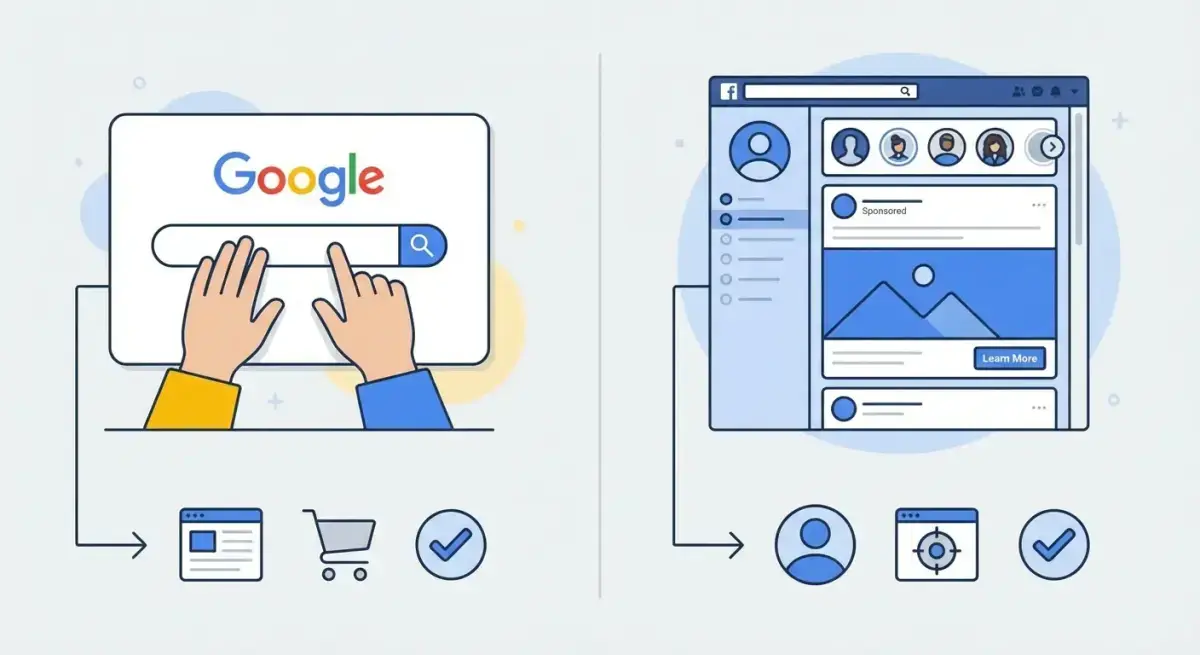 The fundamental difference: capturing demand vs creating demand
Google Ads: Capturing existing demand
Google Ads shows your ad to people who are actively searching for what you sell. The user has already identified a need and is looking for a solution. This means:
- Higher intent = higher conversion rates. Someone searching "buy iPhone 16 case" is much closer to purchasing than someone scrolling Instagram.
- You're competing for existing demand. If 10,000 people search your keyword per month, that's your ceiling. You can't create more searches.
- Performance is keyword-dependent. The right keywords at the right bids determine your success.
- Less creative-dependent. A well-written text ad can outperform a mediocre video, because the user already wants what you're selling.
Facebook Ads: Creating new demand
Facebook Ads shows your ad to people based on demographics, interests, and behaviors — not what they're searching for. The user isn't looking for your product; you're interrupting their scroll with something compelling. This means:
- Larger addressable market. You can reach millions of people who don't know they need your product yet.
- Creative is king. Your ad needs to stop the scroll, create desire, and drive action — all in 3 seconds.
- Lower CPM, but lower initial intent. You reach more people for less, but conversion rates on first touch are lower.
- Better for new products and brands. If nobody is searching for your product yet, Facebook can create awareness from scratch.
Practical implication
If your product solves a known problem (plumber near me, best CRM software, buy running shoes), Google captures that demand efficiently. If your product is new, visually compelling, or impulse-driven (innovative gadget, fashion brand, subscription box), Facebook creates demand that wouldn't exist otherwise.
Most businesses benefit from both — Google for bottom-funnel conversion, Facebook for top-funnel awareness and mid-funnel consideration.
Audience Targeting Comparison
Google Ads targeting
- Keyword targeting: the core of Search Ads. You bid on specific search queries.
- Audience targeting: in-market audiences, custom intent audiences, remarketing lists (RLSA)
- Demographic targeting: age, gender, household income, parental status
- Geographic targeting: country, region, city, radius — extremely precise
- Device targeting: desktop, mobile, tablet with bid adjustments
- Placement targeting: for Display and YouTube — choose specific websites and channels
Facebook Ads targeting
- Interest-based targeting: thousands of interest categories from user behavior
- Behavioral targeting: purchase behavior, device usage, travel patterns
- Custom Audiences: website visitors (pixel), customer lists (email/phone), app users, engagement audiences
- Lookalike Audiences: find users similar to your best customers (1-10% of a country)
- Advantage+ Audiences: AI-driven targeting with minimal constraints
- Detailed exclusions: exclude by interests, behaviors, or custom audiences
Who wins?
Google wins for intent-based precision — you reach people exactly when they need you. Facebook wins for audience discovery — you find people who match your ideal customer profile but haven't started searching yet.
For retargeting, both platforms work well, but Facebook's visual formats and frequency of use (33+ minutes/day) give it an edge for brand recall. Google's RLSA (Remarketing Lists for Search Ads) is powerful for capturing retargeted users when they search again.
Ad Formats and Creative Requirements
Google Ads formats
- Search Ads: text-based ads shown above search results. Headlines (30 chars x3), descriptions (90 chars x2), extensions.
- Shopping Ads: product images with price, pulled from Merchant Center feed. Ideal for e-commerce.
- Performance Max: AI-driven cross-channel campaigns (Search, Display, YouTube, Gmail, Maps, Discover).
- YouTube Ads: skippable, non-skippable, bumper, and Shorts ads. Video-focused.
- Display Ads: banners across millions of websites in Google Display Network.
- Demand Gen: visually rich ads across YouTube, Discover, and Gmail.
Facebook Ads formats
- Single Image/Video: the workhorse format across all placements.
- Carousel: up to 10 cards, each with its own link. Great for e-commerce catalogs.
- Collection + Instant Experience: immersive mobile-first shopping experiences.
- Dynamic Product Ads (DPA): automatically show products from your catalog to interested users.
- Advantage+ Shopping: fully automated e-commerce campaigns.
- Lead Ads: collect leads without leaving Facebook.
- Reels Ads: vertical video in the Reels feed.
Creative requirements
Google Search: copywriting skills. Write compelling headlines and descriptions that match search intent. No visuals needed (for text ads).
Google Shopping: product data quality. Great product titles, clean images, competitive pricing. The algorithm does the rest.
Facebook: visual creative skills. You need scroll-stopping images or videos with strong hooks. Creative quality is the #1 lever for performance. Expect to produce 5-15 new creatives per month for active campaigns.
This is a major operational difference. Google Search campaigns can run with minimal creative work (text ads update quarterly). Facebook campaigns need constant creative refreshment (every 2-3 weeks) due to ad fatigue.
Automation and AI features
Both platforms are investing heavily in AI-driven campaign types:
Google Performance Max:
- Automatically distributes ads across all Google surfaces (Search, Display, YouTube, Gmail, Maps, Discover)
- Uses your assets (text, images, videos) to generate ad combinations
- Requires minimal targeting — the algorithm finds your customers
- Best for e-commerce with product feeds; results for lead-gen are more variable
- Caveat: limited transparency into which placements drive results
Facebook Advantage+ Shopping:
- Automatically manages targeting, placements, budgets, and creative combinations
- Requires minimal setup — upload creatives, set budget and target ROAS
- Works best for e-commerce with established pixel data (50+ conversions/week)
- Meta recommends combining all audiences into one campaign for maximum signal
- Delivers strong results once the algorithm has enough data
Google vs Facebook AI: key differences: Google's AI excels at matching intent to ads (search query → relevant ad). Facebook's AI excels at predicting behavior (user profile → likely to convert). Google gives you more manual control through keyword strategy. Facebook increasingly moves toward fully automated targeting, relying on creative quality as the primary lever.
For media buyers who prefer control, Google offers more knobs to turn. For those who prefer "set the inputs and let the machine optimize," Facebook's approach is more hands-off.
Cost Benchmarks: CPC, CPM, CPA by Vertical
Costs vary dramatically by vertical, geography, and competition. Here are indicative benchmarks for 2026:
E-commerce
- Google Shopping: CPC $0.30-1.50, ROAS 4-8x
- Google Search: CPC $0.50-3.00, ROAS 3-6x
- Facebook Ads: CPM $8-15, CPC $0.50-1.50, ROAS 3-5x
Google Shopping tends to deliver the highest ROAS for e-commerce because users are actively searching for products. Facebook excels at product discovery and works especially well for visually appealing or impulse-buy products.
SaaS / B2B
- Google Search: CPC $3-15, CPL $30-150
- Facebook Ads: CPM $10-25, CPL $20-80
Google is typically more cost-effective for high-intent B2B keywords ("CRM software for small business"). Facebook works for broader awareness and retargeting, but converting cold traffic is expensive.
Local Services
- Google Search: CPC $2-10, CPL $15-60
- Google Local Services Ads: pay-per-lead model, $15-75 per lead
- Facebook Ads: CPM $5-15, CPL $10-40
Google dominates local services because people search for providers when they need them ("dentist near me"). Facebook is useful for brand building and seasonal promotions.
Finance / Insurance
- Google Search: CPC $5-50+, CPL $30-200
- Facebook Ads: CPM $15-35, CPL $15-80
Google CPC for finance keywords can be extremely high ($50+ for insurance terms). Facebook often delivers cheaper leads, but conversion quality may be lower due to lower intent.
Health / Wellness
- Google Search: CPC $1-8, ROAS 3-6x
- Facebook Ads: CPM $8-18, ROAS 2-5x
Both platforms work well. Google captures people searching for specific products/solutions. Facebook excels with UGC-style content showing transformations and testimonials.
Conversion Tracking and Attribution
Google Ads
- Google Tag + Enhanced Conversions: server-side enhanced measurement
- Google Analytics 4 integration: cross-channel attribution
- Offline Conversion Import: upload CRM data for lead quality optimization
- Data-driven attribution: AI model that distributes credit across touchpoints
- Conversion lag reporting: shows when conversions actually happen after click
Facebook Ads
- Meta Pixel + Conversions API: browser + server-side tracking
- Attribution Settings: 1/7/28-day click, 1-day view windows
- Aggregated Event Measurement: iOS ATT compliance with 8-event limit
- Offline Conversions API: upload offline sales data
- Self-attributing: tends to over-report vs third-party measurement
The attribution challenge
Neither platform gives you the full truth. Google tends to over-attribute search (last-click bias). Facebook tends to over-attribute social (view-through bias). For honest measurement:
- Use third-party attribution tools (TripleWhale, Hyros, Northbeam)
- Track blended ROAS (total revenue / total ad spend) as the north star
- Run incrementality tests: pause one channel for 2 weeks and measure impact on total revenue
- Use UTM parameters + GA4 for baseline cross-channel visibility
Best Verticals for Each Platform
Google Ads excels in:
- Service businesses: plumbers, lawyers, dentists — high-intent local search
- B2B/SaaS: complex products with research-heavy buying cycles
- High-ticket e-commerce: products people research before buying ($200+)
- Regulated industries: finance, healthcare — where trust and intent matter
- Travel: hotels, flights — comparison shopping behavior
Facebook Ads excels in:
- DTC brands: fashion, beauty, supplements — visually-driven discovery
- Low-ticket e-commerce: impulse-buy products under $50
- App installs: mobile games, lifestyle apps
- Events and entertainment: concerts, festivals, launches
- Subscription services: meal kits, boxes, SaaS trials
- New product categories: things people don't know they want
Tip: Before launching Facebook campaigns, research what competitors are doing. Try Adligator free — filter ads by CTA button, format, and longevity to find proven creative approaches in your vertical.
Using Both Platforms Together
The most effective advertisers don't choose one — they build a full-funnel strategy using both.
The full-funnel framework
Top of Funnel (Awareness): Facebook Ads
- Broad interest targeting or Lookalike audiences
- Video content, UGC, educational content
- Goal: introduce your brand and product to new audiences
- KPI: CPM, reach, video view rate
Middle of Funnel (Consideration): Facebook Retargeting + Google Search
- Facebook: retarget website visitors and video viewers with product-specific ads
- Google: capture users who search for your brand or product category after seeing Facebook ads
- KPI: CTR, CPC, engagement rate
Bottom of Funnel (Conversion): Google Search + Google Shopping + Facebook Retargeting
- Google: bid on high-intent keywords and branded terms
- Facebook: retarget cart abandoners with urgency messaging
- KPI: ROAS, CPA, conversion rate
Cross-platform synergies
- Facebook drives Google searches. Users see your ad on Facebook → search for your brand on Google → convert. This "Facebook-to-Google" pipeline is well-documented. Track branded search volume as a leading indicator of Facebook campaign effectiveness.
- Google data improves Facebook targeting. Use your top-converting search terms to inform Facebook interest targeting and ad copy.
- Unified remarketing. Show consistent messaging across both platforms. A user who viewed a product on your site should see it on Facebook Feed AND Google Display.
Budget Allocation Framework
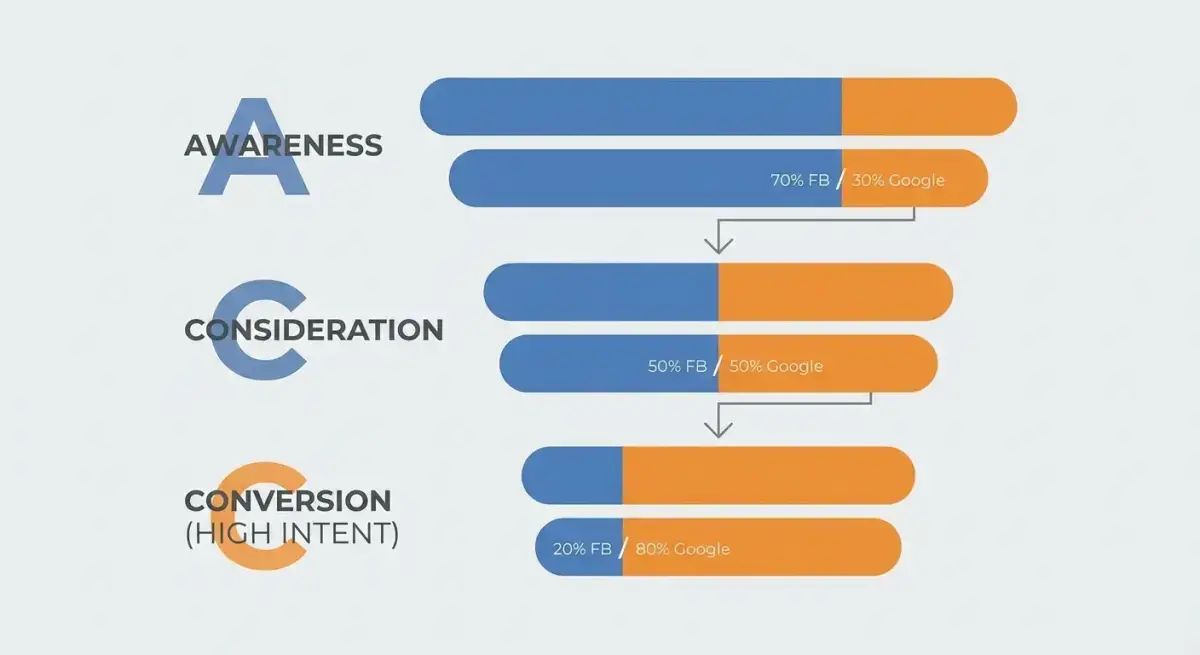 How to split your budget between Google and Facebook by funnel stage
Starting point recommendations
New business, limited budget ($1,000-3,000/month):
- Google Search: 70% (capture existing demand first)
- Facebook: 30% (test creative and audience fit)
Established business, growth mode ($3,000-15,000/month):
- Google: 50-60% (Search + Shopping)
- Facebook: 40-50% (Prospecting + Retargeting)
Scaling business ($15,000+/month):
- Allocate based on blended ROAS data
- Typical split: Google 45-55% | Facebook 45-55%
- Add YouTube and TikTok for diversification
When to shift budget
- Shift to Google if: branded search volume is growing, Google ROAS is consistently higher, you're in a high-intent vertical
- Shift to Facebook if: you need to build awareness, your product is visually compelling, Google CPC is prohibitively expensive in your vertical
- Balance both if: your blended ROAS improves when both run simultaneously (synergy effect)
Seasonal budget adjustments
Both platforms experience seasonal CPM increases during major shopping periods (Black Friday, Christmas, back-to-school). Google CPCs for commercial keywords can increase 50-200% during Q4 peak. Facebook CPMs typically rise 30-80% during the same period.
Planning tips:
- Before peak season: stockpile winning creatives on Facebook, build remarketing audiences, increase prospecting budgets
- During peak season: shift more budget to Google Shopping (highest intent converts fastest when competition is high)
- After peak season: CPMs drop sharply in January — ideal time to scale Facebook prospecting at low costs
- Budget buffer: reserve 15-20% of Q4 budget as flex budget to allocate in real-time based on performance
Attribution across platforms
When running both Google and Facebook, attribution becomes tricky. Both platforms claim credit for the same conversions. A typical user journey might look like:
- Sees Facebook ad → doesn't click
- Searches on Google → clicks your ad → browses but doesn't buy
- Sees Facebook retargeting ad → clicks → purchases
In this scenario, both Google (click attribution) and Facebook (click attribution) would claim the conversion. Your real cost is the sum of both platforms, not each individually.
Solutions:
- Track blended metrics: total ad spend / total revenue = blended ROAS. This is the most honest metric.
- Use incrementality testing: turn off one channel for 2 weeks in a test region and measure the impact on total revenue.
- Implement server-side tracking: Google Enhanced Conversions + Facebook CAPI to ensure both platforms receive accurate data.
- GA4 as neutral ground: use Google Analytics 4 with data-driven attribution as a third-party view (acknowledging it has its own biases).
Common Mistakes When Switching Platforms
Moving from Google to Facebook
- Expecting immediate ROAS. Google converts intent; Facebook builds it. Your first month on Facebook will likely have lower ROAS — that's normal. Give it 4-6 weeks.
- Using Google creative on Facebook. Text-heavy, feature-focused ads that work on Google Search fail on Facebook. Facebook needs visual storytelling.
- Not investing in creative production. Google needs 5 text ad variations. Facebook needs 10-20 image/video creatives per month. Budget for creative production before allocating ad spend.
- Measuring too early. Facebook's learning phase requires 50 conversions per ad set per week. Don't judge performance after 3 days — give it at least 7-14 days with sufficient budget.
Moving from Facebook to Google
- Bidding on broad keywords. Facebook's algorithm finds your audience automatically. Google requires precise keyword strategy — start narrow.
- Ignoring negative keywords. On Google, you pay for every click. Without negative keywords, you'll waste budget on irrelevant searches.
- Skipping Shopping Ads for e-commerce. If you sell products, Google Shopping should be your first campaign — not Search.
How to Test a New Platform Without Wasting Budget
The structured test framework
Week 1-2: Research and setup
- Study competitors on the new platform (for Facebook: use Adligator to analyze competitor ads)
- Set up tracking (Pixel + CAPI for Facebook, Google Tag + Enhanced Conversions for Google)
- Prepare creatives adapted for the platform
Week 3-4: Small-scale test
- Budget: $30-50/day
- 3-5 ad variations
- 2-3 audience segments
- Goal: find one winning creative + audience combination
Week 5-6: Validation
- Scale winning combination by 2x
- Add new creatives based on learnings
- Compare CPA against your baseline on the existing platform
Week 7+: Decision
- If CPA is within 20% of your existing platform → scale further
- If CPA is 50%+ higher → either iterate or reallocate budget back
- Track blended ROAS throughout — the new platform may lift overall performance even if its standalone ROAS is lower
What "success" looks like
Don't judge the new platform in isolation. The real question is: does total revenue increase when you add this channel? If adding $2,000/month to Facebook increases total revenue by $8,000 (even if Facebook alone shows 2x ROAS vs Google's 4x), the investment is justified.
FAQ
Which is cheaper — Google Ads or Facebook Ads?
Facebook Ads typically has lower CPMs ($5-15) compared to Google Search ($15-50+ depending on vertical). However, Google often delivers higher-intent traffic. Cost-effectiveness depends on your conversion rate and customer lifetime value, not just click costs.
Can I run Google Ads and Facebook Ads at the same time?
Absolutely — and most successful advertisers do. Use Google for capturing existing demand (search intent) and Facebook for creating new demand (interest-based targeting). They complement each other in a full-funnel strategy.
Which platform is better for e-commerce?
Both work well for e-commerce, but serve different purposes. Google Shopping captures high-intent buyers actively searching for products. Facebook excels at product discovery and retargeting. Most e-commerce businesses should use both.
Conclusion
The Google Ads vs Facebook Ads debate isn't about choosing a winner — it's about understanding how each platform fits your business. Google captures intent; Facebook creates it. Google excels at the bottom of the funnel; Facebook dominates the top.
The best strategy for most businesses: start with the platform that matches your immediate need (Google for high-intent, Facebook for discovery), prove it works, then add the second platform to build a full-funnel system. Track blended ROAS as your north star metric, and allocate budget based on incremental contribution, not platform-level ROAS.
Remember: your competitors are likely using both. Understanding what they're doing — especially on Meta, where creative strategy drives results — gives you a significant edge. Don't guess what works — research it. Analyze long-running competitor ads (ads active for 30+ days are almost certainly profitable), study their hooks, offers, and landing pages, then create something better.
The best media buyers in 2026 don't pick sides in the Google vs Facebook debate. They master both platforms, build systems that leverage the strengths of each, and continuously optimize based on data — not assumptions.
Ready to see what competitors are running on Facebook and Instagram? Try Adligator free — analyze long-running ads in your niche to find proven creative approaches before you invest a dollar.
Related Reading
- TikTok Ads vs Facebook Ads: Platform Comparison for Performance Marketers
- Facebook Ads for Local Businesses: Targeting, Creative Strategy, and Campaign Setup Guide
- How to A/B Test Facebook Ad Creatives: A Beginner Guide to Statistical Confidence and Faster Winners
- How to Use Ad Spy Tools for Affiliate Marketing: Find Winning Facebook Offers Before Your Competition
