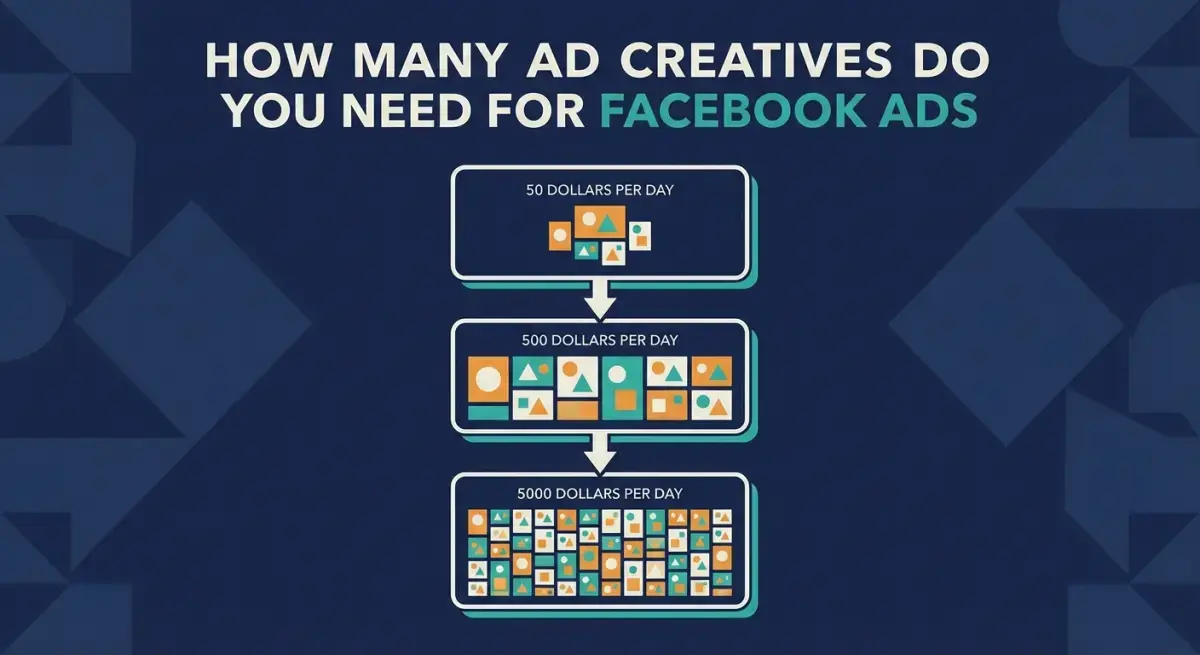
How Many Ad Creatives Do You Need for Facebook Ads? A Data-Driven Framework by Budget Level (2026)
"It depends" is the most unhelpful answer in media buying. Ask on Twitter how many Facebook ad creatives you need and you will get ten different replies in ten minutes, all confident, all vague, none tied to your actual spend level. This guide takes the opposite approach: concrete numbers, tied to daily budget, with the math shown.
If you are running Facebook Ads in 2026 and you need to plan creative production — either in-house, with a freelancer, or with a production agency — this article answers how many creatives facebook ads 2026 campaigns actually require at different spend levels, how that splits across ad sets, and how to stop both under-testing and burning cash on wasted production. It is written for media buyers and agency leads who have to defend creative budgets to a client or a CFO.
You will walk away with: a volume framework at $50, $500 and $5,000/day, the learning phase math behind ads-per-ad-set decisions, a weekly production cadence that scales, the minimum viable creative mix by format, and a way to calibrate your plan against what competitors are actually doing in your niche.
Why Creative Volume Is the New Targeting
Meta's ad system in 2026 is not the targeting-driven machine it was in 2019. Advantage+ campaigns, broad targeting as a default, consolidated audience pools, and signal loss from iOS tracking have collapsed most targeting advantages. What used to be "find the right audience" is now "give the algorithm enough creative variation to find buyers inside a broad audience it already decided on."
That shift turned creative from a craft decision into a volume decision. The account with 3 creatives is competing against an account with 30, and the one with 30 is learning faster — more signal, more variations to test, more chances to hit an outlier winner. The volume itself is the unfair advantage.
This does not mean "just make more bad ads." It means you have to size production intentionally. Under-produce and you cannot feed the learning phase or replace fatigued winners. Over-produce and you waste cash on creatives that never get fair tests. Both failures are common, and both come from the same root cause: no framework for volume.
A useful reframe: creative volume is the modern equivalent of having a well-segmented audience in 2018. The buyers who got rich in the targeting era were the ones who built tight custom audiences while their competitors used interests. The buyers getting rich in the creative era are the ones shipping 10x the ads while their competitors ship five a month. The lever moved — the game did not.
The Math: How Meta Distributes Budget Across Ads
To understand how many creatives you need, you first have to understand how Meta allocates spend within an ad set. The system is an auction, but inside an ad set it behaves like a reinforcement learner. It starts by giving each eligible ad some exposure, measures early performance signals (CTR, conversions, time-on-ad), and then skews budget toward the creatives showing the strongest signal.
Two important consequences:
- Ads below a signal threshold get throttled fast. If an ad underperforms for the first few hundred impressions, Meta effectively stops distributing it. Running 10 ads in an ad set does not mean each gets 10% of budget. Usually 1-2 ads capture 70-80% of spend, 2-3 get scraps, and the rest get near-zero.
- The learning phase needs conversion volume per creative. Meta's documentation talks about the 50-conversions-per-week-per-ad-set rule. In practice, you also need enough conversions per active creative for the algorithm to judge it. A single creative capturing 50 conversions a week is fine. Ten creatives splitting 50 conversions is a blurry signal and nothing exits learning.
This is why more ads is not always better. Past a point, you are adding creatives that will never get enough statistical weight to matter — you are paying for production that produces no decision.
Creative Volume Framework by Budget Level ($50-$500-$5000/day)
Here is the working framework. It assumes a conversion campaign with roughly standard CPAs for your vertical, a single primary objective, and a realistic fatigue curve.
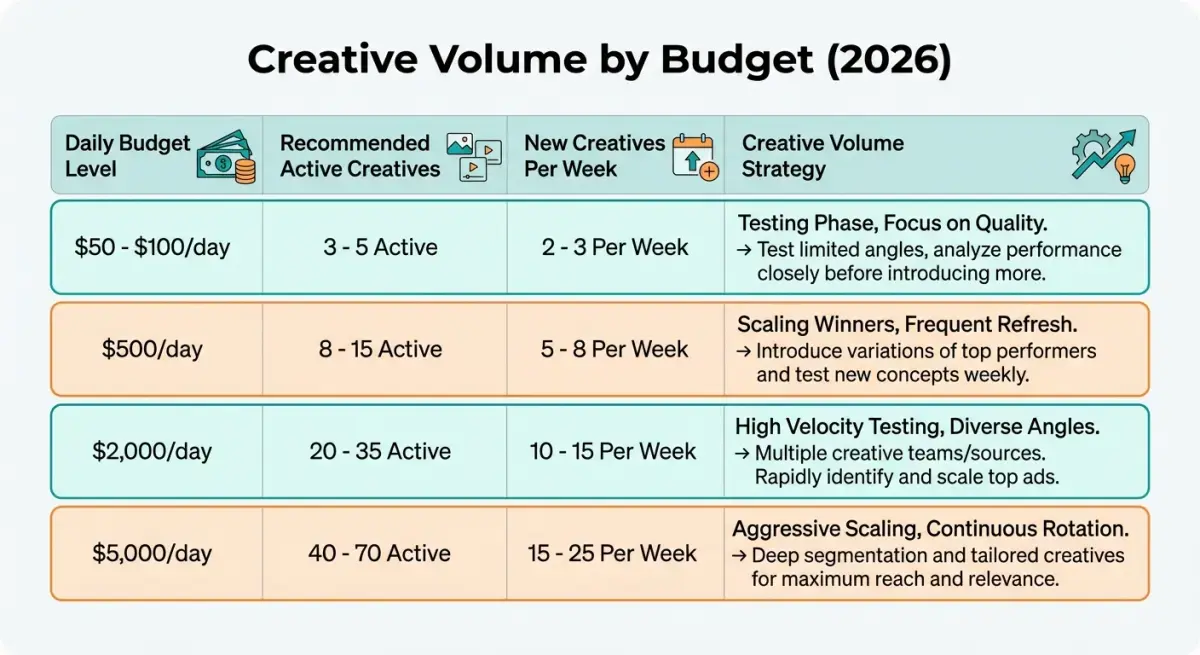 Creative volume scales with daily budget — here are the working targets for 2026.
$50-$100/day — Small / local / new accounts. Active creatives at any time: 3-5. New creatives per week: 2-3. Total ad sets: 1-2. At this spend level you cannot feed more than a couple of ads into the learning phase at once, so production volume should focus on quality over quantity. Refresh cycle: every 2-3 weeks.
$200-$500/day — Growing DTC, mid-size lead gen, SMB SaaS. Active creatives: 8-15. New creatives per week: 5-8. Total ad sets: 2-4. This is the sweet spot where most accounts fail — they keep running $500/day on 3 creatives because that is what the agency used at $100/day, and then they wonder why performance plateaus. Refresh cycle: every 2-3 weeks on prospecting.
$1,000-$2,000/day — Scaling DTC and mid-market. Active creatives: 20-35. New creatives per week: 10-15. Total ad sets: 3-5. At this level you are running multiple creative concepts simultaneously, not just variations. Each concept should have 3-5 execution variants, and each variant needs a clear testing slot. Refresh cycle: every 1-2 weeks on top-spending creatives.
$5,000/day — Scaled DTC, enterprise, large affiliate. Active creatives: 40-70. New creatives per week: 15-25. Total ad sets: 4-8. Multiple concepts per ad set, plus a separate "always-on" testing ad set with 5-10 fresh creatives rotating through. Refresh cycle: rolling — something new entering the mix every 2-3 days.
$10,000+/day — Enterprise scale. Active creatives: 80-150+. New creatives per week: 30-50. This is the level where in-house creative teams or dedicated agencies are not optional — freelance production cannot sustain it. Expect 60-70% of production to lose, which is the expected cost of finding outlier winners.
These numbers are active and tested, not "rendered and uploaded." A creative sitting in a paused ad set is not part of the count. If you are producing 10 creatives a week but only running 4 of them, your real volume is 4.
How Many Ads Per Ad Set: The Learning Phase Math
Inside an ad set, the question is different: not "how much production total" but "how do I split it so each creative can actually learn?"
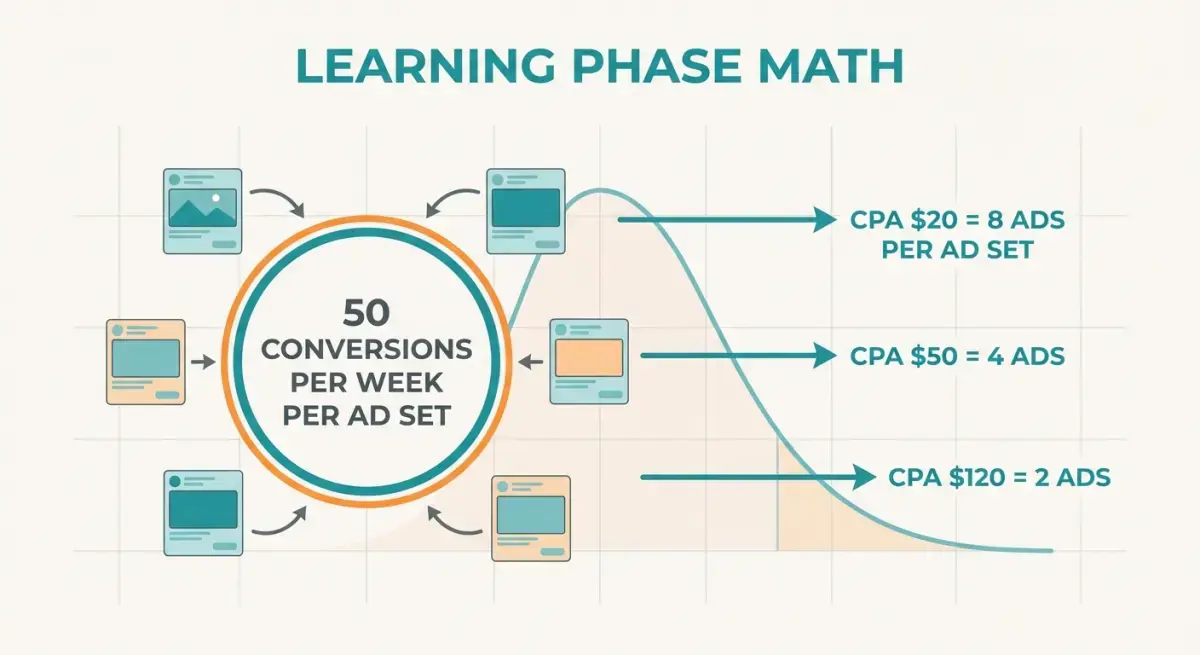 The 50-conversions-per-creative rule drives minimum ads per ad set.
The anchor number is 50. Meta's learning phase needs roughly 50 conversions per week per ad set to stabilize. At the creative level, you want at least 15-20 conversions per creative per week for reliable ranking. Do the math backwards from your CPA:
- CPA $20, $500/day ad set budget → ~175 conversions/week in the ad set → can realistically support 6-8 ads with enough signal per creative.
- CPA $50, $500/day ad set budget → ~70 conversions/week → support 3-4 ads per ad set without starving any of them.
- CPA $120, $500/day ad set budget → ~29 conversions/week → support only 1-2 ads per ad set; anything more is noise.
- CPA $20, $100/day ad set budget → ~35 conversions/week → support 2-3 ads per ad set.
- CPA $50, $2,000/day ad set budget → ~280 conversions/week → support 10-12 ads per ad set comfortably.
If your math says you can only support 2 creatives per ad set, stop running 10. You are paying for 8 creatives that will never get judged fairly. Instead, run 2-3 per ad set and rotate in new ones as the losers get paused.
The default rule for most mid-market accounts: 3-5 active ads per ad set. Anything less starves testing, anything more splits budget too thin unless CPA is very low or budget is very high.
Soft CTA: See how many creatives your competitors run — use Adligator to count their active ads
Creative Types You Need: The Minimum Viable Mix
Volume matters, but variety matters too. A stack of 30 creatives that are all static product images with different captions is not 30 creatives — it is one creative tested 30 times. The minimum viable creative mix for any account running more than $500/day:
- UGC-style video (3 variants). Different hooks, same product, short form (6-15 seconds). Highest ROI format for DTC in 2026 by a wide margin.
- Static product photography (3 variants). Clean background, lifestyle, and feature callout versions. Cheap and reliable, always produce them.
- Carousel (2 variants). One product-focused, one story-driven. Still underused by most mid-market advertisers.
- Text-forward / meme style (2 variants). Low production cost, great at cutting through feed fatigue, useful for pattern interrupts.
- Demo / explainer (2 variants). Essential for SaaS and tools, optional for simple DTC.
- Testimonial / review compilation (2 variants). Critical for retargeting, strong for prospecting in high-consideration categories.
That is 14 creatives for a baseline mix. Add more variants inside each category as budget scales. Running $5k/day without at least 3 formats in rotation is leaving money on the table.
Weekly Creative Production Cadence by Account Size
Production cadence is where most creative plans fall apart. The volume numbers above assume you can ship consistently, week after week. The cadence breakdown:
- Under $200/day: 2-3 creatives per week, mostly in-house or freelance.
- $200-$500/day: 5-8 creatives per week, usually requires a dedicated freelancer or small in-house team.
- $500-$2,000/day: 10-15 creatives per week, needs a production workflow with briefs, shots, edits and approvals running in parallel.
- $2,000-$5,000/day: 15-25 creatives per week, requires either an in-house team of 2-3 or a dedicated creative-as-a-service partner.
- $5,000+/day: 25-50+ creatives per week, typically full in-house team plus external production.
The cadence that kills accounts is burst production. A team ships 30 creatives in week one, runs them for a month, then nothing for three weeks while the next batch is in production. Performance collapses in week three as fatigue hits and nothing is ready to rotate in. Smooth cadence beats burst every time, even at lower total volume.
Two production habits that protect smooth cadence:
- Run a briefs-in-production-in-review pipeline. At any given moment you should have next week's creatives briefed, this week's in production, and last week's already running. That three-stage pipeline is what keeps weeks from going empty.
- Maintain an emergency pool. Keep 5-10 quick-turnaround creative templates — hooks, captions, static overlays — that can be produced in 24 hours if a top performer dies unexpectedly. You will use them more often than you expect.
When You Have Too Many Creatives (Yes, It Happens)
Over-production is real and expensive. Signs your volume is too high for your spend:
- Most creatives get less than 500 impressions before fatiguing or being paused. The algorithm never gave them a fair read.
- Your per-creative conversion count is below 5-10 per week on most ads. You are judging winners on noise.
- You have creatives that have been "active" for 4+ weeks with less than $50 total spend. Meta never chose to give them impressions. They should be paused.
- Your production cost per week exceeds 10-15% of your ad spend. Above that ratio, creative production is eating the margin it is supposed to protect.
The fix is not fewer creatives, it is tighter ad sets. Consolidate. Run 3-5 creatives in 2-3 ad sets instead of 15 creatives in 8 ad sets. Let the winners accumulate spend, then replace the losers aggressively. A good discipline: every Monday, review the last 7 days and pause any creative that spent less than 3% of ad set budget. That single rule pulls most over-produced accounts back into a healthy testing shape within a month, and frees up budget for the creatives that actually have a chance to win.
How to Source Creative at the Volume You Need
The four common sourcing models and when each works:
- In-house team. Best for $2,000+/day accounts or brands. Fast turnaround, deep brand knowledge, expensive to maintain.
- Dedicated freelancers. Best for $500-$2,000/day. Cheaper than agencies, but cadence suffers if the freelancer gets sick or overbooked. Always have a backup.
- Creative-as-a-service agencies. Best for $1,000-$5,000/day without in-house ambitions. Pay monthly, get a steady pipeline, trade some brand nuance for cadence reliability.
- UGC marketplaces / creator briefs. Best for DTC brands producing UGC-style video. Scales linearly with spend — more briefs equals more videos — and works well alongside any of the other models.
Most mid-market accounts run a hybrid: in-house for static and brand-safe assets, UGC creators for video volume, and a freelancer or small agency for editing and assembly. That model hits $10k/day without a 10-person creative team.
Using Competitor Analysis to Calibrate Your Volume
The volume framework above is the starting point. The calibration point is what your direct competitors are actually running. Their active ad counts are public — you just have to look.
 Adligator lets you count exactly how many active creatives each competitor is running.
Here is the practical workflow:
- List your top 10 direct competitors in the vertical, at roughly your spend level.
- Open Adligator and filter their active Facebook ads. You will get a straight count per brand.
- Calculate the median. That median is what a competitive baseline looks like in your niche. If your volume is 30% below the median, you are under-investing. If you are 30% above, make sure you are seeing ROI on it.
- Check creative type distribution. How many are video vs static vs carousel? Match or deliberately differ from the distribution.
- Recheck monthly. If the median climbs, the whole niche is scaling creative production — likely in response to fatiguing audiences. Plan to increase your cadence too.
This transforms creative volume planning from gut-feel to benchmark-driven. Instead of defending "we should produce 15 ads a week" with an opinion, you defend it with "our top 10 competitors run a median of 42 active creatives — we're at 22, we are under-investing."
FAQ
How many Facebook ads should I run per ad set in 2026?
For most conversion campaigns, run 3-5 active ads per ad set so each can gather enough data within the learning phase while still letting the algorithm pick a winner. Fewer than 3 starves testing; more than 6 usually splits budget too thin unless your daily spend is high.
How many new creatives should I produce each week?
Tie weekly production to daily spend: about 2-3 new creatives per week at $50-100/day, 5-10 at $500/day, 15-25 at $2,000-5,000/day, and 30+ at $10k+/day. These match realistic test cycles and fatigue rates for most MOFU-to-BOFU accounts.
Is it better to have more ads per ad set or more ad sets?
In 2026, consolidation wins. Meta's Advantage+ and the current optimizer prefer fewer ad sets with more creatives inside each, because pooled conversion signal trains faster. Run 3-5 creatives per ad set in 2-4 ad sets rather than 15 ad sets with one ad each.
How many creatives do top Facebook advertisers run?
Leading DTC advertisers typically have 30-80 active Facebook creatives at any given time, split across prospecting and retargeting. Enterprise and large affiliates often push past 150. Small local businesses can win with 5-10. You can verify this yourself by checking competitor active ad counts in an ad intelligence tool.
Conclusion
The answer to how many creatives facebook ads 2026 campaigns need is not a single number — it is a framework tied to your budget. Roughly: 3-5 active and 2-3 per week at $50-100/day, 8-15 active and 5-8 per week at $500/day, 40-70 active and 15-25 per week at $5,000/day. Within that, keep 3-5 ads per ad set unless the CPA-budget math says otherwise, maintain a diverse format mix, ship on a smooth cadence instead of bursts, and calibrate your numbers against what your actual competitors are running.
Pick the tier that matches your spend, compare it against your competitors' live ad counts, and adjust production until the math works. Creative volume is the unfair advantage in 2026 — the only question is whether you plan it or leave it to chance.
Ready to apply this framework? See how many creatives your competitors run — use Adligator to count their active ads
Research competitor creative volume to benchmark your own production
Related Reading
- How to Allocate Your Facebook Ads Budget for Testing: A Practical Framework for Solo Media Buyers
- How to A/B Test Facebook Ad Creatives: A Beginner Guide to Statistical Confidence and Faster Winners
- How to Analyze Facebook Ad Creatives by GEO and Vertical: A Data-Driven Approach for Media Buyers
- Facebook Ad Account Structure and Naming Conventions: A Scaling Framework for Media Buyers
