How to Localize Facebook Ad Creatives for Different GEOs: A Media Buyer's Playbook
You found a winning creative. It's scaling well in your home market. Now the obvious question: can you take it to Germany? Brazil? Southeast Asia?
Most media buyers try the simplest approach first — translate the copy, keep everything else the same, launch. And most of the time, it underperforms. Not because the product doesn't fit the market, but because Facebook ad localization requires more than swapping words between languages.
This guide walks through the complete workflow for adapting ad creatives for different GEOs: what to localize, how to research what actually works in each market, and how to build a repeatable system that doesn't require starting from zero every time you enter a new country.
If you're running multi-market Facebook ads or planning to expand beyond your current GEOs, this is the playbook that will save you weeks of expensive testing.
Why Localization Beats Translation for Ad Creatives
Translation handles language. Localization handles everything else — and "everything else" is usually what determines whether an ad converts.
The gap between translation and localization:
- Cultural context: A thumbs-up emoji means approval in the US but is offensive in parts of the Middle East. Color associations differ dramatically — white means purity in Western markets but mourning in some Asian cultures
- Buying behavior: German consumers expect detailed product specifications and strong data privacy messaging. Brazilian audiences respond better to social proof and community-driven copy. Japanese users value subtle, polished visuals over bold Western-style ads
- Trust signals: "As seen on TechCrunch" means nothing in Indonesia. "10 million downloads" works everywhere, but "Rated #1 by Stiftung Warentest" only works in Germany
- Regulatory differences: Health claims, financial disclaimers, and privacy statements vary by jurisdiction. What's legal in the US might violate EU advertising regulations
- Platform behavior: Ad formats perform differently across markets. Stories dominate in some GEOs while feed ads still win in others. Video consumption rates vary significantly
The real cost of skipping localization:
When you launch translated-but-not-localized ads, you typically see:
- 30-60% higher CPA compared to properly localized creatives
- Lower relevance scores because the ad feels "foreign" to the audience
- Faster creative fatigue because the audience doesn't engage deeply
- Wasted learning phase budget as Facebook's algorithm struggles to find the right audience for a mismatched creative
The media buyers who consistently scale across GEOs treat localization as a research-driven process, not a translation task. And the first step in that process is understanding what to localize.
The 5 Elements to Localize: Copy, Visuals, CTA, Social Proof, Format
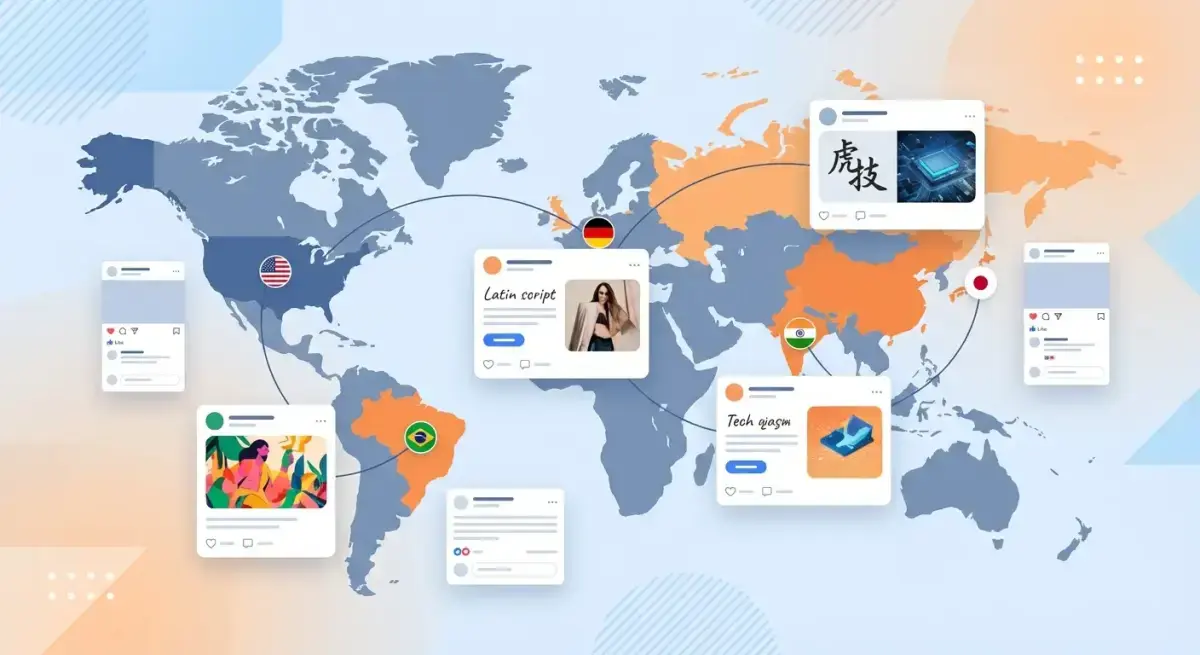
 The 5 elements to localize when adapting ad creatives for new markets
Every ad creative has five layers that need localization attention. Skipping any one of them creates friction that hurts conversion rates.
1. Copy (Beyond Translation)
Ad copy localization means rewriting, not translating. The value proposition might stay the same, but the way you express it changes.
Practical differences:
- Formality levels: German and Japanese audiences expect formal language (Sie/です・ます form). Spanish-speaking markets vary — Spain is more formal than Latin America
- Copy length: Northern European markets prefer concise, direct copy. MENA and South Asian markets often respond to longer, more detailed text
- Pain points: The same product solves different problems in different markets. A VPN sells "streaming access" in the US but "privacy and security" in Europe
- Urgency language: "Limited time offer" works in the US. In Japan, scarcity messaging needs to be more subtle. In Brazil, urgency works but with a warmer tone
2. Visuals
Visual localization goes beyond changing text overlays on images.
- People in the ad: Match the ethnic diversity of the target market. This is the single biggest visual localization win — audiences respond to people who look like them
- Environment and setting: Urban skyline for Tokyo, beach for Thailand, countryside for parts of Europe. The background signals "this is for you"
- Color palette: Red means luck in China, danger in the West. Green is money in the US, nature in Europe, sacred in Islamic cultures
- Product presentation: Some markets respond to lifestyle imagery (product in context), others prefer clean product shots with specifications
3. CTA Button and Landing Page
The CTA button is often overlooked in localization, but it matters significantly.
- CTA text: "Get Started" might translate literally but lose its punch. "Buy Now" is too aggressive in some cultures. "Learn More" outperforms in high-research markets like Germany
- Landing page continuity: If the ad is localized but the landing page is in English, you'll see massive drop-off. The entire funnel must match
- Payment methods: Mentioning local payment methods (Boleto in Brazil, iDEAL in Netherlands, LINE Pay in Thailand) in the ad increases trust
4. Social Proof
Social proof is the element most affected by localization.
- Local reviews and testimonials: A quote from a Brazilian customer means nothing to a German audience
- Local metrics: "Popular in Brazil" matters to Brazilians. Global download numbers work universally but feel less personal
- Media mentions: Replace US publications with local equivalents
- User numbers: "500,000 users in Germany" is more powerful than "10 million users worldwide" when targeting Germany
5. Ad Format
Different markets have different format preferences, influenced by device types, connectivity, and platform usage patterns.
- Video length: Short-form (under 15s) dominates in markets with high mobile data costs. Longer formats work where WiFi is common
- Carousel vs single image: E-commerce carousels perform differently across markets — some audiences swipe, others don't
- Stories vs feed: Stories ads have higher engagement in markets where Instagram Stories are the primary content consumption mode
How to Research Competitor Creatives by GEO Using Spy Tools
You can guess what works in a new market — or you can look at what's already working. Spy tools with GEO filtering turn localization from guesswork into data-driven adaptation.
Step 1: Define your target market
Before touching any tool, clarify:
- Which country or countries are you entering?
- What language(s) do they speak?
- What's your product category?
- Who are the top 3-5 competitors or similar products already advertising there?
Step 2: Filter by GEO and language
In a spy tool like Adligator, apply the GEO filter for your target country and the language filter for the primary language. This immediately shows you what ads are actually running in that market.
Step 3: Sort by longevity
Filter for ads running 7+ days. In performance marketing, longevity is the closest proxy to profitability. If a creative has been running for 14+ days, it's almost certainly profitable — no media buyer keeps unprofitable ads running that long.
Step 4: Analyze patterns
Look at 20-30 long-running ads in your category and market. Document:
- What visual style dominates? (Clean product shots? UGC? Lifestyle?)
- What copy angles are used? (Price-focused? Feature-focused? Problem-solution?)
- What CTA buttons are most common?
- What ad formats appear most? (Video, image, carousel?)
- What social proof elements are included?
Step 5: Build a localization brief
Compile your findings into a brief for your creative team:
- "In Germany, the top 5 competitors in our category use clean product imagery, formal copy with technical specifications, and 'Jetzt testen' (Try now) as the primary CTA"
- "In Brazil, UGC-style video dominates, copy is casual and benefit-focused, and social proof mentions user counts"
This brief is worth more than any localization agency's generic advice because it's based on what's actually working in your market right now.
Ready to research? Start researching competitor creatives by GEO — try Adligator free
Building a Localization Workflow: From Research to Launch
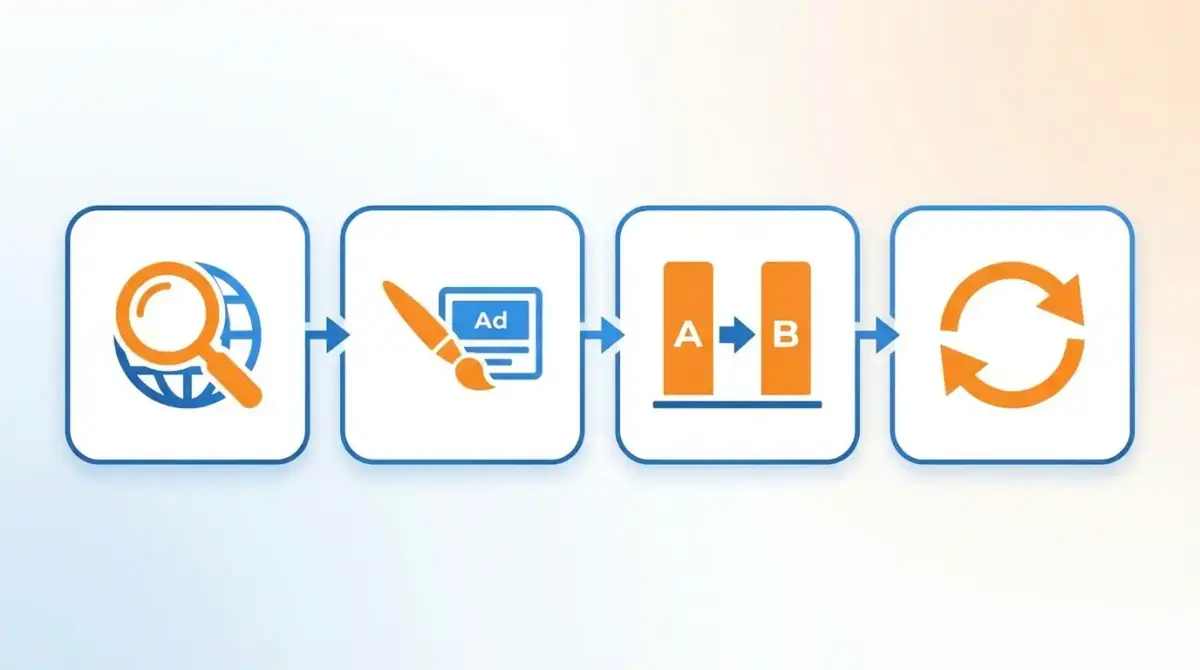 GEO-based creative research workflow: from market selection to localization brief
A repeatable localization workflow prevents you from reinventing the process every time you enter a new market. Here's the framework that works for media buyers running 5+ GEOs.
Phase 1: Market Intelligence (Day 1-2)
- Research competitor creatives in the target GEO (process above)
- Identify the top 3 creative patterns (visual style, copy angle, format)
- Note any localization elements you hadn't considered (local payment methods, local celebrities, cultural references)
- Document regulatory requirements specific to the market
Phase 2: Creative Adaptation (Day 3-5)
- Select your top 3-5 performing creatives from your home market
- For each creative, create a localization brief covering all 5 elements
- Produce localized versions — don't translate, rewrite
- Get native speaker review (not just translation accuracy — cultural appropriateness)
- Prepare localized landing pages to match
Phase 3: Structured Testing (Day 6-10)
- Launch localized creatives alongside a direct translation (your control)
- Budget split: 70% localized, 30% translated control
- Run for at least 5-7 days before judging results
- Track CPA, CTR, and relevance score separately for each variant
Phase 4: Iteration (Ongoing)
- Kill underperformers after 7 days
- Scale winners with budget increases (20-30% every 2-3 days)
- Create new variants based on what's working
- Re-check competitor landscape every 2 weeks — markets evolve
Managing the workflow at scale:
When you're running this across multiple GEOs simultaneously, the research phase is where most time gets burned. This is where spy tools pay for themselves — instead of manually researching each market for hours, you can pull GEO-filtered competitive data in minutes.
Keep a shared document or spreadsheet with columns: GEO, Creative Pattern Summary, Top Performing Format, Key Cultural Notes, Regulatory Notes. Update it after each research cycle. Over time, this becomes your institutional knowledge for each market.
Common Localization Mistakes That Kill ROAS
After analyzing hundreds of multi-GEO campaigns, these are the mistakes that cost media buyers the most money.
Mistake 1: Literal translation without cultural adaptation
The classic error. "Get 50% off" translated literally might work, but the context around it matters. In Japan, a straightforward discount feels cheap — framing it as "exclusive member pricing" converts better. In Germany, the discount needs to reference the original price clearly (legally required in some cases).
Mistake 2: Using the same visuals everywhere
A beach scene works for Australian audiences but feels disconnected for Scandinavian users in winter. A family dinner scene needs to show the right family structure, food, and setting for each culture. Stock photography that looks "generically international" is the worst of both worlds — it resonates with nobody.
Mistake 3: Ignoring local competition
You might be a market leader at home, but a newcomer in the target GEO. Your ads need to acknowledge the competitive landscape. If the dominant player in Germany uses a specific claim, you either need to beat it or differentiate. Running your US-style "we're #1" messaging in a market where nobody knows you erodes trust.
Mistake 4: One landing page for all GEOs
If your ad is beautifully localized but the landing page is in English (or a different language), expect 60-80% bounce rates. The entire funnel — ad, landing page, checkout — must be consistent. This includes currency, payment methods, and shipping information.
Mistake 5: Launching too many GEOs at once
The temptation to go "global" with 15 GEOs simultaneously usually results in mediocre localization for all of them. Start with 2-3 high-potential markets, perfect your localization process, then expand. Quality localization for 3 markets beats thin localization for 15.
Mistake 6: Not tracking per-GEO creative performance
Aggregate numbers hide per-market problems. A creative might have a 2.0 ROAS overall but 4.0 in Brazil and 0.5 in Germany. If you're not breaking down performance by GEO, you can't iterate effectively. Set up separate reporting for each market from day one.
Mistake 7: Assuming what works in one GEO transfers to similar markets
Spain ≠ Mexico ≠ Argentina. UK ≠ Australia ≠ Canada. These markets share a language but have different cultures, price sensitivities, and competitive landscapes. Use each market's data to guide localization, not assumptions from "similar" markets.
Scaling Multi-GEO Creative Research with Adligator
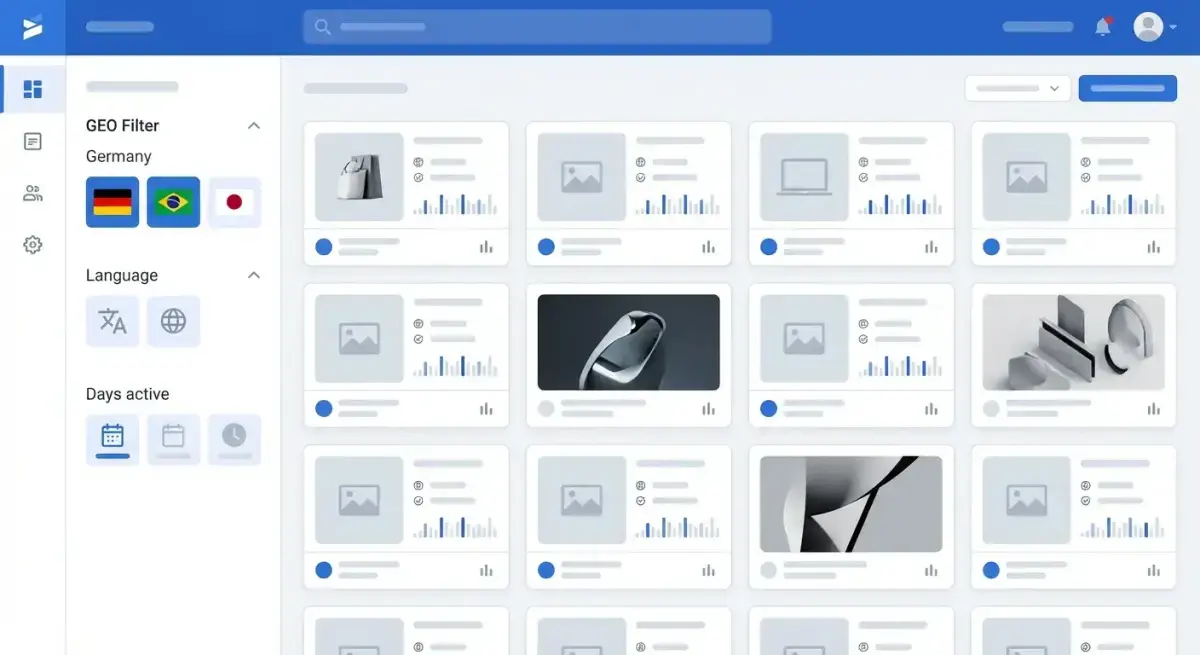 Using GEO and language filters to research what works in a target market
The biggest bottleneck in multi-GEO localization isn't the creative production — it's the research. Understanding what works in each market before you spend money testing is what separates profitable GEO expansion from expensive trial-and-error.
How Adligator accelerates GEO research:
- GEO filter: Select one or multiple countries to see only ads running in those markets. This instantly narrows your view from millions of ads to the ones that actually matter for your target market
- Language filter: Combine with GEO to see ads in specific languages — essential for multilingual markets like Switzerland (German, French, Italian) or India (English, Hindi)
- Longevity filter (Days Active): Sort by how long ads have been running. Ads active for 7+ days in a specific GEO are proven performers in that market
- CTA button filter: See what call-to-action approaches dominate in each market. "Shop Now" vs "Learn More" vs "Sign Up" ratios tell you about the market's buying behavior
- Tracker alerts: Set up trackers for your top competitors in each GEO. Get notified when they launch new creatives — so you can analyze their localization approach in real time
Building a GEO research cadence:
For each active GEO, schedule a 20-minute research session every two weeks:
- Check tracker alerts for competitor updates
- Search for your category keywords filtered by GEO
- Filter for ads active 7+ days — these are the current winners
- Compare against your current creatives — are you following market patterns or diverging?
- Update your GEO brief document with new findings
This cadence keeps your localization data fresh without becoming a time sink. With Adligator's filters, a 20-minute session covers what used to take 2-3 hours of manual Ad Library browsing.
Pro tip: When entering a completely new GEO, do one deep research session (60-90 minutes) analyzing 50+ long-running ads in your category. Document every pattern you see. This initial investment creates the foundation for all future creative decisions in that market.
FAQ
What's the difference between ad translation and ad localization?
Translation converts text from one language to another. Localization adapts the entire creative — copy tone, visuals, CTAs, social proof, and even ad format — to match the cultural context and buying behavior of the target market. Localized ads consistently outperform translated ones because they feel native to the audience rather than imported.
How do I find what ad creatives work in a specific country?
Use a spy tool with GEO filtering like Adligator. Filter by your target country, sort by ad longevity (7+ days active = likely profitable), and analyze the creative patterns: what visuals, CTAs, and copy angles dominate in that market. This gives you a data-driven localization brief instead of guesswork.
How many GEOs should I localize for at once?
Start with 2-3 markets that share similar characteristics (language, purchasing power, or vertical maturity). Master the localization workflow for those before expanding. Spreading too thin across 10+ GEOs simultaneously leads to poor creative quality and wasted budget. Once your process is proven, add 1-2 new GEOs per month.
Conclusion
Facebook ad localization is the difference between scaling internationally and burning budget internationally. The media buyers who win in multi-market campaigns don't just translate — they research, adapt, and iterate based on what's actually working in each GEO.
The framework is straightforward: research competitor creatives by GEO, identify the 5 localization elements that need adaptation, build a localization brief for your creative team, test structured variants, and iterate based on per-market data. The research phase is where spy tools save the most time and prevent the most expensive mistakes.
Whether you're entering your second market or your twentieth, the same process applies. Start with data, adapt with intention, measure by GEO.
Ready to see what's working in your target market? Start researching competitor creatives by GEO — try Adligator free
Related Reading
- AI-Generated Ad Creatives on Facebook in 2026: How to Identify, Analyze, and Outperform Them Using Spy Tools
- How to Analyze Facebook Ad Creatives by GEO and Vertical: A Data-Driven Approach for Media Buyers
- Facebook Ad Format Analysis: What Spy Tools Reveal About Carousel vs Video vs Static Performance in 2026
- How to Build a Facebook Ad Swipe File That Actually Improves Your ROAS
