
How to Localize Facebook Ad Creatives for New GEOs: A Spy Data-Driven Playbook for Media Buyers
Expanding to a new GEO is one of the fastest ways to scale Facebook ad campaigns — and one of the most common ways to waste budget. The typical approach is painfully simple: translate your winning creatives, launch, and hope for the best.
It rarely works. What converts in the US often falls flat in Brazil. Creatives that crush in Germany may confuse audiences in Southeast Asia. The problem isn't the translation — it's the entire creative approach.
Spy tools change this equation. Instead of blind testing in unfamiliar markets, you can see exactly what's working in your target GEO before spending a dollar. This playbook shows you how to use spy data for facebook ad localization that actually converts.
Why Translation Isn't Localization
The distinction matters more than most media buyers realize. Translation changes words. Localization changes the creative strategy.
Here's what differs between GEOs:
- Visual preferences. Some markets respond better to lifestyle imagery, others to product-focused shots, others to text-heavy designs. Southeast Asian markets often favor busy, information-dense creatives. Nordic markets prefer minimalism.
- Color psychology. Red means luck in China, danger in Western markets. White symbolizes purity in the West, mourning in parts of Asia. These associations directly impact ad performance.
- CTA button preferences. "Shop Now" dominates in the US. "Learn More" performs better in markets where direct selling feels aggressive. "WhatsApp Message" is critical in Latin America and parts of Africa.
- Social proof formats. US audiences respond to star ratings and review counts. Markets in Southeast Asia value influencer endorsements. European audiences prioritize certifications and official approvals.
- Price presentation. Whether to lead with price, hide it, use installment messaging, or emphasize discounts varies dramatically by market.
- Trust signals. Free shipping matters everywhere, but money-back guarantees carry different weight by culture. Local payment methods (PIX in Brazil, GCash in Philippines) shown in ads can dramatically boost conversion.
A simple translation misses all of these dimensions. That's why the first step isn't writing copy — it's research.
The Spy Data-Driven Localization Workflow
Here's the complete framework for entering a new GEO with confidence:
 The complete GEO expansion workflow powered by spy data
Step 1: Research Your Target GEO
Before creating anything, spend 2-3 hours studying what already works in your target market. In Adligator:
- Set the GEO filter to your target country (e.g., BR for Brazil, TH for Thailand).
- Search your product category keywords in the local language AND in English (many international advertisers run English ads in non-English markets).
- Filter by "Days Active" > 10 to focus on proven performers.
- Note the dominant patterns:
- What ad format wins? (image, video, carousel)
- What CTA buttons do top advertisers use?
- What's the visual style? (clean, busy, UGC, professional)
- What messaging angle dominates? (price, quality, urgency, social proof)
- How long are the ad copy texts?
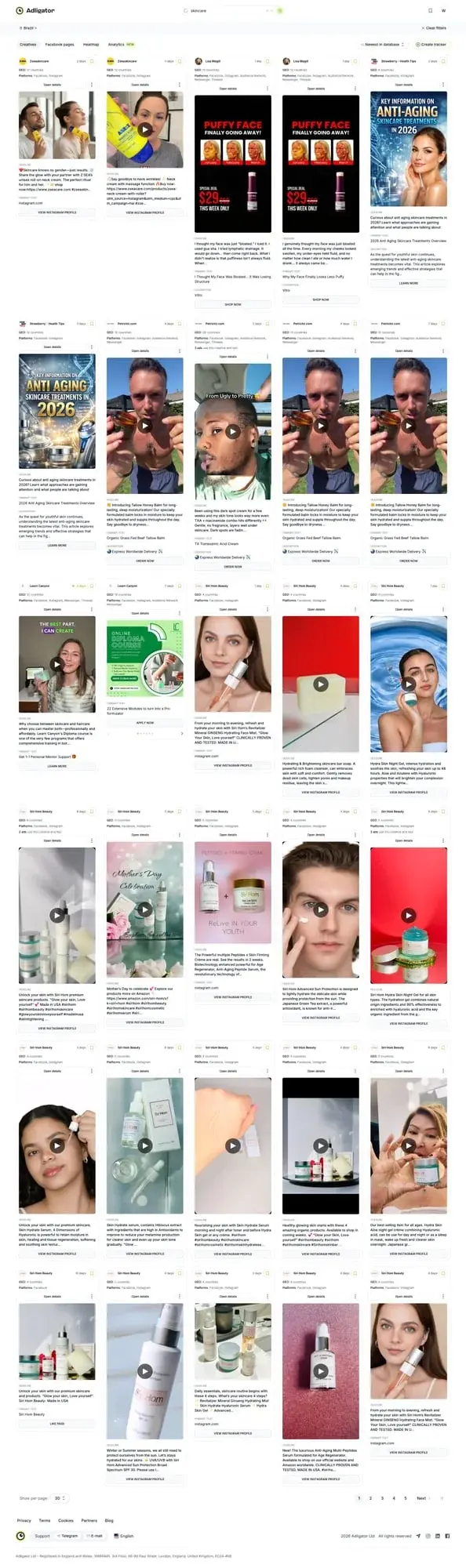 Adligator's GEO filter lets you research ad creative patterns in any of 234 countries
Step 2: Analyze the Top 5 Performers
From your research, identify the 5 longest-running creatives in your category for that GEO. For each, document:
- Visual approach: What does the image/video show? How is the product presented?
- Headline structure: Question? Benefit statement? Social proof?
- Body copy: Long or short? Emotional or logical? Features or benefits?
- CTA: Which button type? Where does it lead?
- Landing page: Does the LP match the ad language/style?
These 5 creatives represent proven market-fit. They're your blueprint.
Step 3: Identify What to Adapt vs. Create Fresh
Not everything needs to change. Typically:
Keep from your existing campaigns:
- Core offer/value proposition
- Brand guidelines and visual identity
- Product photography (if applicable)
- Proven funnel structure
Adapt for the new GEO:
- Ad copy (rewrite, don't translate)
- CTA button type
- Price presentation format
- Trust signals and social proof
- Visual composition style
Create fresh:
- GEO-specific testimonials or social proof
- Culturally relevant imagery
- Local payment/delivery messaging
- Seasonal/cultural references
Research any GEO in minutes — Try Adligator Free with GEO filters covering 234 countries.
Step 4: Build Your Localized Creative Set
Based on your research, create 5-8 creative variants per GEO:
- 2-3 variants closely modeled on the top-performing patterns you found through spy research
- 2-3 variants adapting your best-performing creatives from other GEOs with proper localization
- 1-2 variants testing unique angles not yet present in the market (your competitive edge)
For each variant, ensure:
- Copy is written by a native speaker or reviewed by one
- Visual style matches local preferences identified in research
- CTA button type aligns with GEO norms
- Landing page is localized (not just translated)
Step 5: Launch, Measure, and Iterate
Launch with a structured test:
- Budget allocation: Equal budget across variants for the first 3-5 days
- Primary metric: CPA (not CPM or CTR — they vary too much by GEO to be useful benchmarks)
- Kill criteria: Pause variants exceeding 2x target CPA after spending 3x CPA
- Scale criteria: Increase budget on variants hitting target CPA for 3+ consecutive days
- Iteration: After initial test, use spy tools to check if competitors have launched new approaches you should test
What Changes Between GEOs (And What Doesn't)
Based on analyzing thousands of creatives across multiple markets, here are the most common localization patterns:
 Creative approaches vary dramatically by GEO — even for the same product category
US / Canada / UK / Australia (Tier 1 English)
- Clean, professional visuals
- Benefit-driven headlines
- Star ratings and review social proof
- "Shop Now" and "Learn More" CTAs dominate
- Concise copy (under 200 words)
- Video performs well, especially UGC-style
Western Europe (DE, FR, IT, ES)
- Quality-focused messaging over price
- Compliance and certification badges matter
- Longer, more detailed copy accepted
- Privacy-conscious audience — avoid aggressive retargeting language
- Local language is essential (English-only underperforms significantly)
- Sustainability messaging gaining traction
Latin America (BR, MX, CO, AR)
- Price and installment messaging front and center
- WhatsApp CTA button is critical (WhatsApp is the primary commerce channel)
- Warm, vibrant visual style
- Influencer and testimonial-heavy approaches
- Portuguese (BR) and Spanish (LATAM) are distinct — don't use Spain's Spanish for Mexico
- Urgency and scarcity messaging performs strongly
Southeast Asia (TH, VN, PH, ID, MY)
- Information-dense creatives (more text, more details)
- Price comparison and discount emphasis
- Mobile-first design critical (90%+ mobile traffic)
- Short video content dominates
- Local payment method visibility (GCash, GrabPay, etc.)
- COD (Cash on Delivery) messaging is a strong trust signal
Middle East & North Africa (SA, AE, EG)
- Arabic right-to-left layout considerations
- Premium/luxury positioning performs well in Gulf states
- Family-oriented imagery resonates
- Ramadan seasonality creates massive CPM swings
- Gold and green color tones perform well
- Gender-specific targeting and creative sets often necessary
Eastern Europe (PL, RO, UA, CZ)
- Value-for-money messaging dominates
- Direct, no-nonsense copy preferred
- Product demonstration and comparison content performs well
- Local currency pricing essential
- Skepticism toward hype — provide concrete proof points
- Courier and delivery details in ads boost conversion
GEO Expansion Mistakes to Avoid
Mistake 1: Launching Without Research
Every dollar spent without competitive intelligence is a gamble. Even 2 hours of spy research can save thousands in wasted ad spend by eliminating creative approaches that don't fit the market.
Mistake 2: Using Google Translate
Machine translation has improved dramatically, but ad copy needs cultural fluency, not linguistic accuracy. "Buy Now and Save" might need to become "Grab This Deal Before It's Gone" in markets that respond to urgency differently. Invest in native copywriters for your top GEOs.
Mistake 3: One Creative Set for "Europe"
Germany and Spain are as different as the US and Japan when it comes to ad creative preferences. Treat each GEO individually or at minimum group by cultural similarity (DACH, Nordics, Southern Europe, etc.).
Mistake 4: Ignoring Local Competition
Your biggest competition in a new GEO isn't usually international brands — it's local players who already understand the market. Spy tools let you study what local competitors do differently.
Mistake 5: Scaling Too Fast
Finding one winning creative in a new GEO isn't a signal to 10x budget overnight. Scale gradually (20-30% daily increases) while monitoring for audience saturation. Different GEOs have different ceiling sizes.
Mistake 6: Neglecting Landing Page Localization
A localized ad leading to an English-only landing page kills conversion. If you can't localize the full funnel, at minimum localize the landing page headline, CTA, pricing, and trust signals.
FAQ
Should I translate my existing ads or create new ones for each GEO?
Translation alone rarely works. Spy data shows that top performers in different GEOs often use completely different creative approaches — different visual styles, CTA types, and messaging angles. Create GEO-native creatives informed by local competitive intelligence, using your existing brand assets as a starting point.
How many GEOs should I expand to at once?
Start with 1-2 new GEOs at a time. Use spy tools to research each market thoroughly before launch. Expanding to too many GEOs simultaneously spreads budget thin and makes it hard to diagnose what's working. Once you have a profitable system in one GEO, replicate the research-and-launch process for the next.
What's the minimum budget for testing a new GEO?
Plan for at least 3-5x your target CPA per creative variant per GEO. If your target CPA is $20 and you're testing 5 creatives, budget $300-500 minimum for the initial test phase. Spy data helps reduce the number of variants you need to test by eliminating approaches that don't match market patterns.
Conclusion
Facebook ad localization in 2026 is a data problem, not a translation problem. The media buyers who consistently win in new GEOs are the ones who research before they launch, adapt rather than translate, and use competitive intelligence to skip the expensive trial-and-error phase.
Spy tools give you a window into what works in any market before you spend your first dollar. The playbook is straightforward: research the GEO, study the winners, build localized creatives based on proven patterns, and iterate based on performance data.
The biggest risk isn't entering a new GEO — it's entering blind.
Ready to research your next GEO? Try Adligator Free — filter by any of 234 countries, 5 searches per day, no credit card required.
Related Reading
- AI-Generated Ad Creatives on Facebook in 2026: How to Identify, Analyze, and Outperform Them Using Spy Tools
- How to Analyze Facebook Ad Creatives by GEO and Vertical: A Data-Driven Approach for Media Buyers
- How to Estimate Competitor Facebook Ad Spend Using Spy Tools and Ad Library Data
- Facebook Video Ad Spy: How to Analyze Competitor Video Creatives and Extract Winning Hooks
