Marketing Just Got Harder.
Stop Guessing. Start Scaling.
For years, growth marketing benefited from relatively stable global conditions. Predictable supply chains, manageable energy prices, and stronger consumer confidence allowed brands to scale using historical performance as a reliable guide.
That environment is changing. Geopolitical conflicts and national disasters have been disrupting the global economy with increasing regularity over the past few decades. As of March 2026, escalating disruption across Iran and the Persian Gulf is creating ripple effects that extend far beyond the energy sector — touching supply chains, input costs, consumer confidence, and ultimately, how campaigns perform.
This article is for performance marketers, media buyers, and growth team leads navigating these shifts. Here's what the economic disruption means for your campaigns — and how teams grounding their decisions in real market evidence are adapting faster than those still relying on outdated assumptions.
What This Means for Marketers
Within days of escalating tensions affecting energy infrastructure and shipping routes in the Persian Gulf, commodity markets reacted sharply. Analysts observed significant volatility across several key inputs that affect global supply chains:
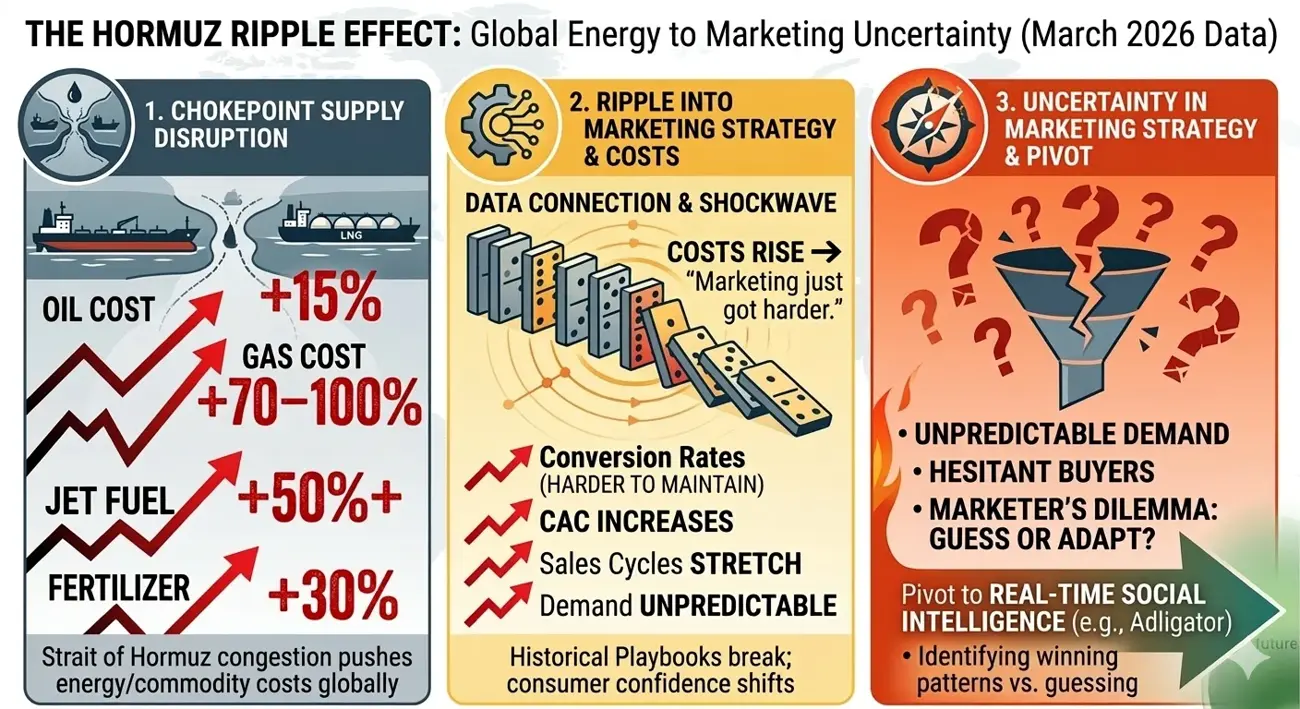
- Oil prices surged as much as 15% amid fears of disruptions to shipping through the Strait of Hormuz, one of the world's most critical oil transit routes. (Reuters; U.S. Energy Information Administration)
- European natural gas prices jumped sharply as traders reacted to the risk of supply disruptions across global energy markets. (Financial Times)
- Aviation fuel markets experienced rapid price increases, reflecting the close relationship between jet fuel supply and crude oil refining capacity. (S&P Global Commodity Insights)
- Fertilizer prices have remained elevated globally, rising nearly 30% during recent commodity shocks, increasing pressure on agricultural supply chains and food prices. (World Bank Commodity Markets Outlook)
These movements illustrate how geopolitical instability can rapidly cascade through energy markets and industrial supply chains, ultimately affecting production costs and consumer pricing worldwide. They flow into pricing, purchasing behaviour, advertising efficiency, and sales velocity.
Tools like Adligator exist precisely for this moment: to replace assumptions with evidence.
Why Economic Disruption Makes Marketing Harder
When costs rise across the supply chain, businesses respond in one of two ways: they raise prices, or they reduce spending. Both responses hurt marketing performance.
Higher prices make buyers more selective. When your prospect's costs go up, every purchase gets more scrutiny. The impulse buy disappears. The evaluation cycle lengthens. Your funnel slows down.
Lower budgets mean slower decisions. When businesses cut spending, marketing budgets are often first on the block. Prospects take longer to commit, require more touchpoints, and demand clearer ROI before signing.
Either way, the environment gets harder. And the teams that don't adapt their approach will burn through budget faster than ever.
The Reality for Growth Teams
Growth teams are facing three compounding problems right now:
- Demand is less predictable. The patterns you relied on last quarter may not hold this quarter. Economic volatility introduces noise into every metric you track.
- Testing is more expensive. With higher CPMs and lower conversion rates, every failed test costs more. You can't afford to run the same volume of experiments when each one burns more budget.
- Timing matters more than ever. In stable markets, you can afford to be a week late with an insight. In volatile markets, a week can be the difference between scaling a winner and doubling down on a loser.
The margin for error has shrunk. The cost of guessing wrong has gone up.
The Supply Chain Shock Behind the Economic Shift
The disruption extends far beyond oil and gas. The Strait of Hormuz is a chokepoint for a wide range of commodities that feed directly into global supply chains.
Fertilizers — critical for agriculture, now ~30% more expensive. Helium — essential for semiconductor manufacturing and healthcare. Aviation fuel — driving up travel and logistics costs by more than 50%. Chemical feedstocks — the building blocks for agriculture, healthcare, manufacturing, and tech.
This isn't a single-sector shock. It's a cascading disruption that touches agriculture, healthcare, manufacturing, technology, and consumer goods. Every one of these sectors has marketers trying to hit targets that were set before this disruption began.
Why These Changes Matter for Marketers
When businesses face higher input costs, they pass those costs to consumers. That's Economics 101. But the marketing implications are less obvious and more dangerous.
Weaker short-term demand. Consumers and businesses alike pull back when prices rise unexpectedly. Demand doesn't disappear — it shifts, delays, and becomes harder to capture.
Higher price sensitivity. Your audience is comparing options more carefully. Value propositions that worked three months ago may not resonate today.
More scrutiny on ROI. Every marketing dollar faces greater internal pressure. CMOs and growth leads need to justify spend with harder evidence.
Greater pressure to prove market fit. "We think this will work" isn't enough anymore. Teams need to demonstrate that their campaigns are aligned with where demand actually exists.
Want to see what's actually working in your market right now? Start analyzing real campaign data with Adligator
B2C and B2B Markets Under Pressure
The impact isn't uniform. Some categories will feel the squeeze more than others.
B2C Markets Likely to Become Harder to Scale
- Travel and Tourism — Jet fuel costs directly inflate ticket prices. Discretionary travel budgets shrink first.
- Consumer Electronics — Supply chain costs rise; consumers delay upgrades when prices climb.
- Luxury and Lifestyle Goods — First category to feel demand softening when economic confidence drops.
- Subscription Services — Consumers audit recurring expenses during economic uncertainty.
B2B Markets Likely to Face Stronger Resistance
- Manufacturing — Higher raw material costs create budget pressure across the entire value chain.
- Logistics and Transportation — Fuel surcharges cascade through every contract negotiation.
- Construction and Infrastructure — Material costs and financing costs both rise simultaneously.
The Key Shift for Performance Marketing
The fundamental shift is from assumption-led planning to signal-led execution.
In stable markets, you could plan campaigns based on last quarter's data, industry benchmarks, and reasonable assumptions about demand. Those signals are weaker now. In volatile markets, the gap between what was true and what is true widens every week.
The teams that win aren't the ones with better historical data. They're the ones with better current data. They've shifted from planning on old assumptions to launching on current market evidence.
This is where campaign intelligence becomes a strategic advantage — not a nice-to-have.
Stop Guessing. Start Scaling.
Instead of asking "what might work?", the question becomes:
- What offers are actively scaling right now?
- Which creative angles are appearing repeatedly across successful campaigns?
- Which markets show active, confirmed demand?
- Which competitors are increasing activity — and where?
These aren't hypothetical questions. They're answerable questions — if you have the right intelligence.
Adligator helps performance marketers analyze active campaigns across global markets. It replaces the guesswork with a real-time view of what's working, where it's working, and how the competitive landscape is shifting.
How Adligator Helps Growth Teams Adapt Faster
In volatile markets, speed and accuracy aren't luxuries. They're survival requirements. Here's what Adligator enables:
- Analyze campaigns across geographies — see what's running in markets you're targeting or considering.
- Spot proven creative angles — identify patterns in what's working before you spend budget testing from scratch.
- Confirm demand signals — verify whether demand in your category is strengthening or weakening based on real campaign activity.
- Identify categories that still support growth — not every market is contracting. Find the ones that aren't.
- Reduce the cost of guessing wrong — every campaign launched on evidence instead of assumption saves budget and accelerates results.
Why Data-Driven Scaling Wins in Volatile Markets
Teams that launch campaigns based on outdated playbooks burn budget. It's that simple. The market has shifted, and the playbook hasn't caught up.
Teams grounded in live market activity do four things better:
- Preserve efficiency — they allocate budget to what's proven, not what's hoped.
- Adapt messaging faster — they see shifts in creative trends as they happen, not weeks later.
- Prioritize stronger categories — they focus spend on markets with confirmed demand.
- Scale with confidence — they launch knowing the evidence supports the decision.
The difference between these two approaches compounds over time. In volatile markets, it compounds faster.
FAQ
How does economic disruption from the Hormuz crisis affect digital marketing performance?
The Hormuz crisis drives up costs across supply chains — oil, gas, aviation fuel, fertilizers — which forces businesses to raise prices or cut budgets. Both responses weaken marketing performance: higher prices make buyers more selective, and lower budgets slow purchase decisions. Conversion rates drop and historical benchmarks become unreliable.
What is signal-led marketing execution and why does it matter in volatile markets?
Signal-led execution means basing campaign decisions on current, real-time market evidence rather than historical assumptions. In volatile markets where demand shifts rapidly, teams that analyze what's actively scaling — which offers work, which creative angles appear repeatedly, which markets show live demand — outperform those relying on outdated playbooks.
Which industries are most affected by the 2026 economic disruption for marketers?
On the B2C side, travel/tourism, consumer electronics, luxury goods, and subscription services face the hardest scaling challenges. For B2B, manufacturing, logistics/transportation, and construction/infrastructure are seeing stronger buyer resistance. Campaign intelligence tools help identify where demand still exists.
Conclusion
Marketing is harder right now because the economy is less predictable. Old assumptions aren't enough. The teams that will scale through this disruption are the ones that identify real demand signals early, study what works across markets, and launch with evidence instead of hope.
This isn't about being reactive. It's about shifting to intelligence-led growth — using performance marketing economic disruption as a catalyst to build a smarter, more resilient approach to scaling.
The data is there. The signals are live. The question is whether you're reading them.
Ready to stop guessing and start scaling? Start analyzing real campaign data with Adligator
See how Adligator helps growth teams scale smarter
Sources:
- Reuters. Oil prices jump on Middle East supply concerns. https://www.reuters.com/markets/commodities/
- Financial Times. European gas prices surge amid supply disruption fears. https://www.ft.com/energy
- S&P Global Commodity Insights. Jet fuel and aviation markets react to oil volatility. https://www.spglobal.com/commodityinsights
- World Bank. Commodity Markets Outlook: Fertilizer price trends and agricultural supply risks. https://www.worldbank.org/en/research/commodity-markets
- U.S. Energy Information Administration. Strait of Hormuz oil transit chokepoint. https://www.eia.gov/todayinenergy/detail.php?id=65504
- International Energy Agency. Oil market risks and supply security analysis. https://www.iea.org/reports/oil-market-report-march-2026
Related Reading
- Programmatic Advertising Strategy: A Performance Marketer's Guide to DSPs and RTB
- How to Use AI-Powered Ad Intelligence to Predict Winning Facebook Creatives Before You Spend
- How to Build a Competitive Ad Intelligence Dashboard: Automated Reporting for Media Buying Teams
- Creative Testing Velocity: How Many Ad Variations You Need Per Week at Every Budget Level
