
Meta Ads CPM by Country in 2026: Complete Benchmark Data for GEO Expansion
If you are planning to expand your Facebook or Instagram advertising into new countries, the first number you need is CPM — cost per thousand impressions. It determines how far your budget stretches and whether a new market is financially viable before you spend a dollar on testing.
The problem is that reliable, current facebook ads CPM by country data is scattered across outdated blog posts, paywalled reports, and conflicting sources. Most benchmarks are from 2023 or 2024 and no longer reflect the reality of Meta's 2026 auction environment.
This guide consolidates current CPM benchmark data across 40+ countries organized by market tier, adds context on what drives the differences, and gives you a practical framework for making GEO expansion decisions. Whether you are an affiliate marketer testing emerging markets or an agency scaling established campaigns internationally, the data here will help you plan smarter budgets.
Why CPM Varies by Country (and Why It Matters)
CPM is not a fixed price set by Meta. It is an auction outcome determined by supply and demand dynamics in each market. Three primary factors drive the variation:
Advertiser competition. The more advertisers competing for the same audience in a country, the higher the auction price. The US, UK, and Australia have thousands of active advertisers per vertical, pushing CPMs to premium levels. In contrast, markets like Egypt or Vietnam have far fewer active advertisers, keeping costs low.
Purchasing power and GDP. Advertisers bid more aggressively in countries where consumers spend more. A conversion in the US might be worth $100 in revenue, justifying a $20 CPM. The same product sold in India at $10 cannot sustain that CPM — so bids stay lower.
Platform maturity. Markets where Facebook advertising has been established for years (North America, Western Europe, Australia) have more sophisticated advertisers, more competition, and higher costs. Emerging markets where adoption is still growing tend to have lower CPMs.
Why this matters for your budget: A $1,000/day budget buys roughly 50,000 impressions in the US ($20 CPM) versus 500,000 impressions in India ($2 CPM). That is a 10x reach difference. But reach alone does not equal results — you need to factor in conversion rates, average order values, and payment infrastructure.
Meta Ads CPM Benchmarks: Tier 1 Countries (US, UK, CA, AU, DE)
Tier 1 countries are the most expensive Meta advertising markets. They offer the highest consumer purchasing power and most mature digital ecosystems, but competition is fierce.
| Country | Facebook CPM (2026) | Instagram CPM (2026) | Notes |
|---|---|---|---|
| United States | $16.00 - $21.00 | $20.00 - $28.00 | Most expensive market globally |
| Canada | $11.00 - $14.50 | $14.00 - $18.00 | 30-40% lower than US |
| United Kingdom | $10.00 - $13.00 | $13.00 - $17.00 | Highest in Europe |
| Australia | $11.00 - $14.00 | $14.00 - $18.00 | Similar to Canada |
| Germany | $8.00 - $11.00 | $10.00 - $14.00 | Largest EU market by volume |
| France | $7.00 - $10.00 | $9.00 - $13.00 | Strong ecommerce market |
| Switzerland | $12.00 - $16.00 | $15.00 - $20.00 | High GDP drives premium pricing |
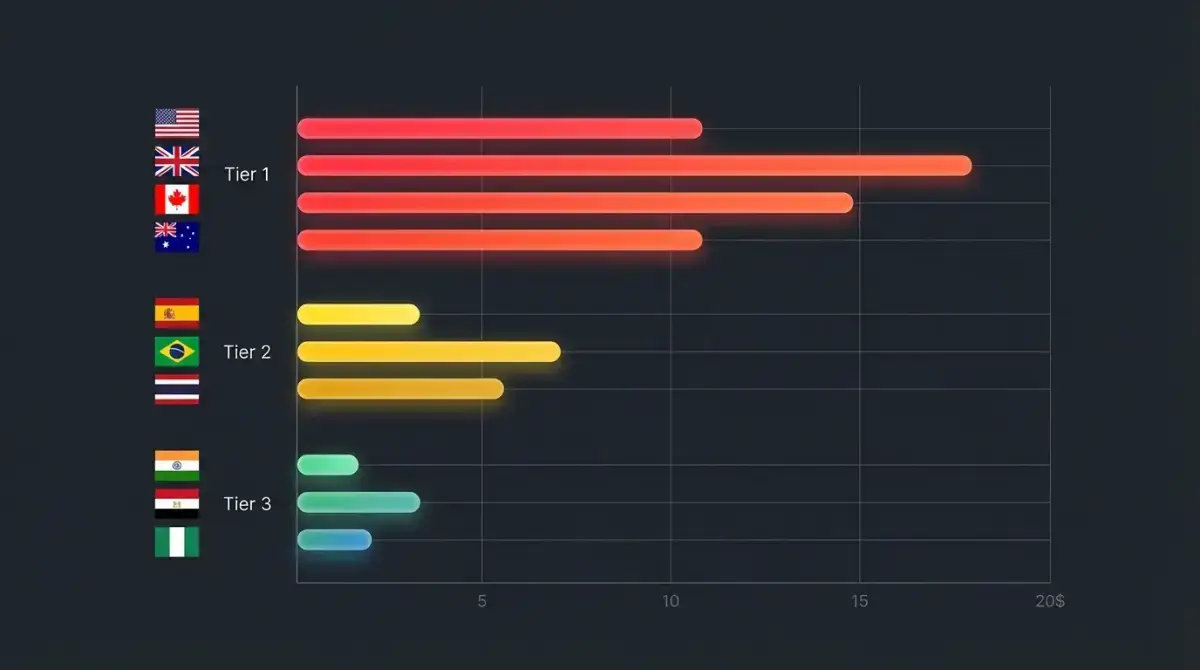 CPM varies dramatically across market tiers — from $16-21 in Tier 1 to under $3 in Tier 3
Key insight for Tier 1: These markets have the highest CPMs but also the highest conversion rates and average order values. A $20 CPM in the US can still deliver a 3-5x ROAS if your product-market fit is strong. The mistake is comparing Tier 1 CPMs to Tier 3 without adjusting for revenue potential.
Tier 2 CPM Data: Europe, LATAM, SE Asia
Tier 2 markets represent the sweet spot for many advertisers scaling internationally. CPMs are significantly lower than Tier 1, while purchasing power and digital infrastructure are strong enough to support healthy conversion rates.
Western and Southern Europe
| Country | Facebook CPM (2026) | Instagram CPM (2026) |
|---|---|---|
| Spain | $5.50 - $8.00 | $7.00 - $10.00 |
| Italy | $5.00 - $7.50 | $6.50 - $9.50 |
| Netherlands | $7.00 - $9.50 | $9.00 - $12.00 |
| Sweden | $7.50 - $10.00 | $9.50 - $12.50 |
| Portugal | $4.50 - $6.50 | $5.50 - $8.00 |
| Poland | $3.50 - $5.50 | $4.50 - $7.00 |
| Czech Republic | $3.50 - $5.00 | $4.50 - $6.50 |
| Romania | $2.50 - $4.00 | $3.50 - $5.50 |
Latin America
| Country | Facebook CPM (2026) | Instagram CPM (2026) |
|---|---|---|
| Brazil | $2.50 - $4.00 | $3.50 - $5.50 |
| Mexico | $2.00 - $3.50 | $3.00 - $5.00 |
| Argentina | $1.50 - $3.00 | $2.50 - $4.50 |
| Colombia | $1.80 - $3.00 | $2.50 - $4.00 |
| Chile | $3.00 - $4.50 | $4.00 - $6.00 |
Southeast Asia
| Country | Facebook CPM (2026) | Instagram CPM (2026) |
|---|---|---|
| Thailand | $2.50 - $4.00 | $3.50 - $5.50 |
| Indonesia | $1.50 - $3.00 | $2.50 - $4.00 |
| Malaysia | $2.50 - $4.00 | $3.50 - $5.50 |
| Philippines | $1.50 - $3.50 | $2.50 - $4.50 |
| Vietnam | $1.50 - $2.80 | $2.00 - $3.80 |
Tier 2 strategy note: LATAM and SE Asia are popular expansion targets for ecommerce and lead-gen advertisers. The CPMs are 60-80% lower than Tier 1, and platforms like Instagram have very high user engagement in these regions. The main challenge is payment infrastructure and logistics for ecommerce, not ad costs.
Eastern Europe: The overlooked opportunity
Eastern European markets (Poland, Czech Republic, Romania, Hungary) are increasingly attractive for advertisers. These countries combine several advantages:
- Moderate CPMs ($2.50-5.50) — significantly cheaper than Western Europe
- Growing ecommerce adoption — online shopping is expanding rapidly across the region
- EU membership — standardized payment and shipping infrastructure
- High smartphone penetration — mobile-first audiences responsive to social advertising
- English proficiency — particularly in Poland and Czech Republic, reducing localization costs
For advertisers already running in Western Europe, Eastern European expansion is often the lowest-risk next step. The cultural proximity, shared payment systems, and EU logistics networks make operational setup straightforward.
Tier 3 GEOs: Africa, South Asia, CIS
Tier 3 markets offer the lowest meta ads cost by country. They are popular with affiliate marketers, app install campaigns, and brand awareness plays where volume matters more than per-conversion value.
| Country | Facebook CPM (2026) | Instagram CPM (2026) |
|---|---|---|
| India | $1.00 - $1.80 | $1.50 - $2.80 |
| Pakistan | $0.80 - $1.50 | $1.20 - $2.20 |
| Bangladesh | $0.60 - $1.20 | $1.00 - $2.00 |
| Egypt | $1.50 - $2.50 | $2.00 - $3.50 |
| Nigeria | $1.00 - $2.00 | $1.50 - $3.00 |
| Kenya | $1.20 - $2.20 | $1.80 - $3.00 |
| South Africa | $2.50 - $4.00 | $3.50 - $5.50 |
| Ukraine | $1.50 - $3.00 | $2.00 - $4.00 |
| Kazakhstan | $1.50 - $2.80 | $2.00 - $3.80 |
| Turkey | $2.00 - $3.50 | $3.00 - $5.00 |
Tier 3 reality check: A $1 CPM looks attractive until you factor in conversion rates. If US traffic converts at 3% and Indian traffic converts at 0.3%, the effective cost per conversion may be similar. Always pair CPM data with estimated conversion rates and customer lifetime value for the target market.
CPM Trends: Year-over-Year Changes and Seasonality
Facebook CPM benchmarks in 2026 reflect several trends that media buyers should monitor:
Q4 premium remains significant. CPMs across all markets spike 30-60% during October through December due to holiday advertising competition. Tier 1 markets see the steepest increases — US CPM can exceed $30 during Black Friday and Cyber Monday.
Year-over-year increases. Global average CPM has increased roughly 8-12% year-over-year since 2024, driven by more advertisers entering the platform, reduced organic reach, and Meta's push toward higher-value ad placements (Reels, Stories).
Emerging market CPM inflation. Tier 3 markets that were previously very cheap are seeing faster CPM growth rates (15-25% YoY) as more international advertisers discover them. Markets like India, Brazil, and Nigeria are becoming more competitive each year.
Seasonal patterns by region:
- US/EU: Highest CPMs in Q4 (holiday), lowest in Q1 (January-February)
- LATAM: Spikes during local holidays (Carnival in Brazil, Buen Fin in Mexico)
- SE Asia: Relatively stable, with modest increases during Ramadan and year-end sales events
- Global: Election years drive CPM spikes in affected countries due to political ad spend
Planning tip: If you are testing a new GEO, launch in Q1 or Q2 when CPMs are lowest. This gives you the cheapest data for validating the market before Q4 competition drives costs up.
Regional CPM calendar
Understanding when CPMs spike in each region helps you time campaigns for maximum efficiency:
- January-February: Lowest CPMs globally. Best window for testing new GEOs, new creatives, and new audiences. Post-holiday budgets are reduced, competition drops sharply.
- March-April: CPMs begin recovering. Spring sales events (Easter, regional holidays) create minor spikes in specific markets.
- May-June: Stable, moderate CPMs. Good for scaling campaigns that proved profitable in Q1 testing.
- July-August: Summer slowdown in Northern Hemisphere markets. CPMs dip slightly in US/EU but remain stable in LATAM and SE Asia.
- September-October: CPMs start climbing as Q4 planning kicks in. Early Black Friday campaigns launch.
- November-December: Peak CPMs everywhere. US Facebook CPM regularly exceeds $30 during Black Friday week. Budget efficiency drops unless you have strong, proven creatives.
For media buyers running campaigns across multiple GEOs, staggering your testing calendar by region can optimize budget efficiency. Test LATAM markets in January, scale Tier 2 Europe in March, and reserve Tier 1 budget for proven campaigns in Q4.
CPM by Vertical and Objective
CPM does not only vary by geography — your industry and campaign objective also create significant cost differences within the same country.
CPM by industry (US baseline):
| Industry | Average CPM |
|---|---|
| Finance & Insurance | $28.00 - $35.00 |
| Legal | $22.00 - $30.00 |
| Technology & SaaS | $18.00 - $25.00 |
| Ecommerce (General) | $14.00 - $20.00 |
| Health & Wellness | $12.00 - $18.00 |
| Education | $10.00 - $15.00 |
| Entertainment | $8.00 - $12.00 |
| Food & Beverage | $6.00 - $10.00 |
CPM by campaign objective:
- Conversions/Sales: Highest CPM (Facebook optimizes for quality impressions)
- Traffic: Moderate CPM
- Engagement: Lower CPM
- Reach/Brand Awareness: Lowest CPM
When comparing advertising cost across countries, ensure you are comparing the same objective type. A conversion campaign in Poland will have a higher CPM than a reach campaign in Germany, even though Poland is a cheaper market overall.
How to Use CPM Data for Budget Planning and GEO Selection
Raw CPM numbers are a starting point, not a decision. Here is how to turn benchmark data into actionable budget plans.
Step 1: Calculate required impressions. Estimate your target number of conversions. Work backward: if your landing page converts at 2% and your CTR is 1%, you need 5,000,000 impressions to generate 1,000 conversions (5M × 1% CTR = 50,000 clicks × 2% CR = 1,000 conversions).
Step 2: Estimate budget per GEO. Multiply required impressions by the CPM for your target country. For the US at $20 CPM: 5,000,000 / 1,000 × $20 = $100,000. For Brazil at $3 CPM: 5,000,000 / 1,000 × $3 = $15,000.
Step 3: Adjust for conversion rate differences. If Brazilian traffic converts at 1% instead of 2%, you need 10M impressions instead of 5M, bringing the budget to $30,000. The CPM savings narrow when adjusted for lower conversion rates.
Step 4: Factor in average order value. A $50 AOV in the US versus $15 AOV in Brazil changes the ROAS math significantly. Calculate expected revenue per 1,000 conversions in each market to compare true profitability.
Step 5: Set test budgets. For a new GEO test, budget 2-3x your expected daily spend for 7-14 days. This gives Facebook enough data to optimize delivery while keeping risk manageable.
Budget planning example: US vs Brazil vs India
Let us walk through a concrete comparison. Assume you sell a $40 product and need 100 test conversions to validate a market.
United States:
- CPM: $20 | CTR: 1.5% | CR: 2.5%
- Impressions needed: 100 / (1.5% × 2.5%) = 266,667
- Budget: 266,667 / 1,000 × $20 = $5,333
- Expected revenue: 100 × $40 = $4,000
- Test ROAS: 0.75x (break-even requires optimization)
Brazil:
- CPM: $3.50 | CTR: 1.2% | CR: 1.5%
- Impressions needed: 100 / (1.2% × 1.5%) = 555,556
- Budget: 555,556 / 1,000 × $3.50 = $1,944
- Expected revenue: 100 × $25 (lower AOV) = $2,500
- Test ROAS: 1.29x (marginally profitable)
India:
- CPM: $1.50 | CTR: 0.8% | CR: 0.8%
- Impressions needed: 100 / (0.8% × 0.8%) = 1,562,500
- Budget: 1,562,500 / 1,000 × $1.50 = $2,344
- Expected revenue: 100 × $15 (lower AOV) = $1,500
- Test ROAS: 0.64x (not viable at current metrics)
This example illustrates why CPM alone is misleading. Brazil requires the smallest test budget and delivers the best initial ROAS despite having 6x the US CPM. India's ultra-low CPM is offset by lower engagement rates, conversion rates, and order values.
Factors That Influence CPM Beyond Geography
Even within the same country, your CPM can vary wildly based on factors you control.
Audience targeting specificity. Broad targeting (age 18-65, all interests) delivers lower CPM than narrow targeting (age 25-34, specific interests, lookalike audiences). The more specific your audience, the more advertisers compete for those same users.
Ad relevance and quality. Meta's ad auction rewards high-quality ads with lower CPMs. A high-relevance ad with strong engagement can pay 20-40% less CPM than a low-quality ad targeting the same audience.
Placement selection. Reels and Stories placements often have lower CPMs than Feed placements, though this varies by country and vertical. Automatic placements (Advantage+) typically optimize for the lowest effective CPM across all surfaces.
Bid strategy. Cost cap and bid cap strategies can limit CPM exposure but may restrict delivery. Lowest cost (the default) lets Facebook find the cheapest impressions but provides no CPM ceiling.
Creative format. Video ads often achieve lower CPMs than static images because they generate more engagement signals. Carousel ads fall in between. However, lower CPM does not always mean lower cost per conversion — test format impact on downstream metrics.
Day of week and time of day. CPMs fluctuate throughout the week. In most markets, Monday-Wednesday sees higher CPMs (advertisers launching weekly campaigns) while Saturday-Sunday can be 10-20% cheaper. Late night hours (11pm-6am local time) also tend to have lower CPMs, though conversion rates may also be lower.
Account history and spending patterns. Advertisers with consistent spending history and high-relevance accounts tend to receive more favorable auction dynamics. New ad accounts entering a competitive GEO may experience 10-15% higher CPMs during the initial learning phase.
Audience overlap with other advertisers. In niche verticals, a small number of advertisers may be competing for the same audience segment. Tools that reveal which competitors are active in your target GEO help you gauge how crowded the auction is for your specific audience — not just the market average.
How to Research Competitor Ad Activity by GEO
Before committing budget to a new country, you want to know what competitors are already running there. If no one in your vertical advertises in a target GEO, that is either an opportunity or a warning sign.
The manual approach is browsing Meta Ad Library filtered by country. This works for basic research but has significant limitations: you cannot filter by ad longevity, creative format, or see which ads persist over time. You get a raw list with no performance signals.
 Use Adligator's GEO filter to research competitor ad activity in your target country before committing budget
With Adligator, you can filter competitor ads by specific GEOs across 234 countries, then layer filters for days active, platform, language, and ad format. This shows you not just what competitors are running, but which creatives persist — a direct signal of what is working in that market.
For GEO expansion specifically, look for:
- Number of active advertisers in your vertical — indicates market maturity
- Ad longevity — ads running 10+ days suggest profitability
- Creative language — whether competitors localize or run English-only
- CTA types — Shop Now vs Learn More tells you about funnel sophistication
Research competitor ads in any GEO before you launch — try Adligator free
Making GEO Expansion Decisions: Framework and Checklist
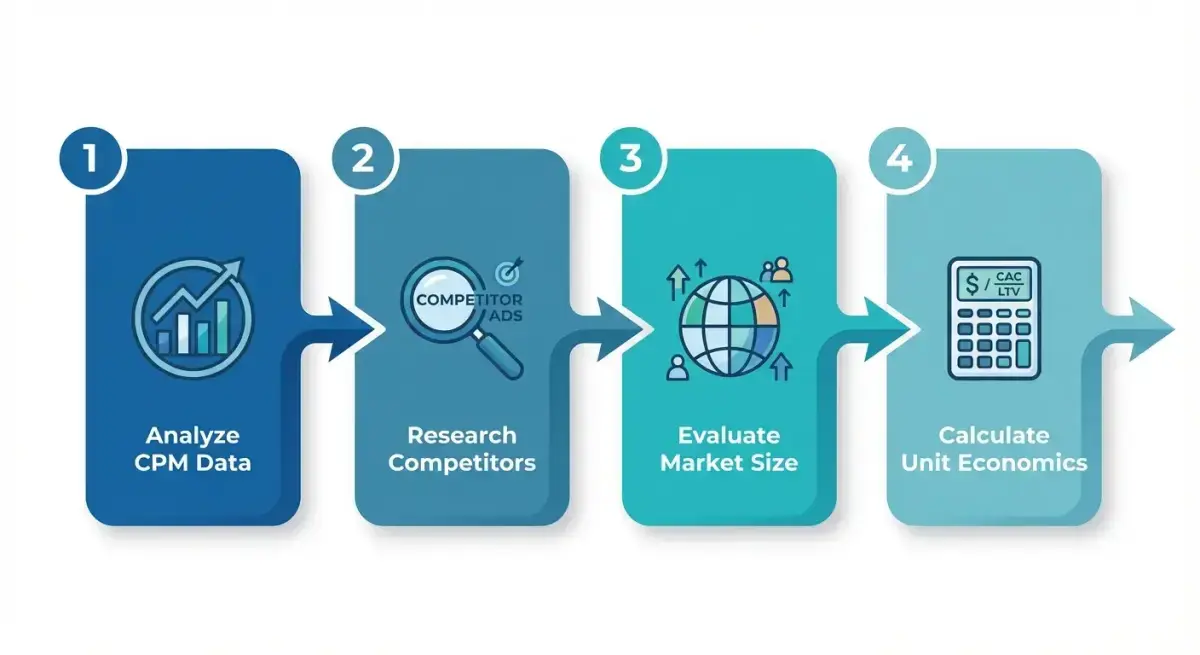 A structured framework helps media buyers evaluate new GEOs beyond just CPM numbers
Use this checklist before entering any new market:
Market viability:
- CPM is within acceptable range for your unit economics
- Estimated conversion rate justifies the required budget
- Average order value or lead value supports positive ROAS
- Payment infrastructure exists (credit cards, local payment methods)
- Logistics/delivery is feasible (for ecommerce)
Competitive landscape:
- Competitors are actively advertising in this GEO (validates demand)
- Competitor ad longevity suggests profitable campaigns exist
- Market is not oversaturated (some competitors, not hundreds)
- You have a differentiation angle for this market
Operational readiness:
- Landing page is localized (or English is widely used)
- Customer support can handle the language/timezone
- Legal/regulatory requirements are met
- Currency and pricing are adjusted for local purchasing power
Test plan:
- Test budget is set (2-3x daily spend × 7-14 days)
- Success criteria defined before launch (target CPA, ROAS threshold)
- Creative variations prepared (ideally localized)
- Measurement framework in place (attribution, pixel/CAPI verified)
The strongest GEO expansion decisions combine CPM data with competitor intelligence and operational readiness. Low CPM alone is not a reason to enter a market — profitable unit economics is.
Common GEO expansion mistakes
Chasing the cheapest CPM. The lowest CPM markets often have the lowest conversion rates and purchasing power. A $1 CPM in Bangladesh sounds attractive until your conversion rate is 0.1% and your average order value is $8. Always calculate cost per acquisition, not just cost per impression.
Skipping localization. Running English-only ads in non-English markets rarely works. Even if the CPM is low, your CTR and conversion rates will suffer dramatically without localized creative and landing pages. Budget for translation and cultural adaptation.
Ignoring payment infrastructure. Some Tier 3 markets have limited credit card penetration. If your checkout requires a Visa or Mastercard, you may lose 40-60% of potential conversions in markets where mobile payments or cash-on-delivery dominate.
Testing too many GEOs at once. Focus on 1-2 new markets at a time. Spreading a small budget across 5 new countries gives you statistically insignificant data in each. Better to get a clear signal from one market than noise from five.
Not accounting for currency fluctuations. If you price in USD but your customers pay in local currency, exchange rate shifts can erode margins. Monitor currency trends for your target markets and build a buffer into your unit economics calculations.
FAQ
Which country has the lowest Facebook CPM?
India consistently has the lowest Facebook CPM among major markets, typically ranging from $1.00-1.80. Other low-CPM countries include Bangladesh ($0.60-1.20), Pakistan ($0.80-1.50), and Egypt ($1.50-2.50). These markets offer cost-effective reach but may have lower conversion rates and purchasing power.
Why is US CPM so much higher than other countries?
The US has the highest advertiser competition, the most mature digital advertising market, and the highest consumer purchasing power. More brands competing for the same audience drives auction prices up. US CPM typically ranges from $16-21, roughly 10-15x higher than developing markets.
How does CPM differ between Facebook and Instagram?
Instagram CPM is generally 20-40% higher than Facebook CPM in the same country, driven by higher engagement rates and stronger visual ad formats. However, Instagram often delivers better engagement metrics, so the higher CPM may be justified by better downstream performance.
What affects CPM besides location?
Industry vertical, campaign objective, audience targeting specificity, ad relevance score, time of year (Q4 is most expensive), placement (Stories vs Feed vs Reels), and competition level all significantly impact CPM alongside geographic location.
Conclusion
Understanding facebook ads CPM by country is essential for any media buyer planning international expansion or optimizing budget allocation across markets. The data is clear: Tier 1 markets (US, UK, CA, AU) command $10-21 CPMs, Tier 2 markets offer 60-80% savings with solid conversion potential, and Tier 3 markets provide the cheapest reach with important caveats about conversion quality.
But CPM is just one variable. The smart approach is combining cost data with competitor intelligence, conversion rate estimates, and operational readiness. Research what is already working in your target GEO before committing budget — that context turns benchmark data into a competitive advantage.
Ready to research competitor ads in your target GEO? Try Adligator free and explore ads across 234 countries
Related Reading
- How to Localize Facebook Ad Creatives for New GEOs: A Spy Data-Driven Playbook for Media Buyers
- Facebook Ad Creative Lifespan: How Long Do Ads Last Before Fatigue? Data-Backed Guide (2026)
- How Many Ad Creatives Do You Need for Facebook Ads? A Data-Driven Framework by Budget Level (2026)
- How to A/B Test Facebook Ad Creatives: A Beginner Guide to Statistical Confidence and Faster Winners
