
Meta Advantage+ Shopping Campaigns vs Manual Setup: When to Use Each in 2026
Meta's Advantage+ Shopping campaigns (now officially called Advantage+ Sales Campaigns) promise to simplify advertising by letting AI handle targeting, placements, and budget distribution. For some advertisers, they deliver — lower CPAs, higher ROAS, less management time. For others, they burn budget with zero transparency.
The difference between success and failure with Advantage+ Shopping campaigns is not the feature itself — it is whether your account and business match the conditions where automation outperforms manual control.
This guide breaks down exactly how Advantage+ Shopping works, how it compares to manual campaign setup, and gives you a decision framework to choose the right approach based on your budget, catalog, audience maturity, and control needs.
How Advantage+ Shopping Campaigns Work
Advantage+ Shopping (ASC) is Meta's fully automated campaign type designed primarily for e-commerce advertisers. When you create an ASC campaign, you give up most manual controls in exchange for broader algorithmic optimization.
What You Control
- Budget: Daily or lifetime budget at the campaign level
- Country targeting: You choose which countries to target (but no detailed demographic or interest targeting)
- Creative assets: You provide up to 150 creative combinations (images, videos, copy variants)
- Existing customer definition: You upload a list or define existing customers so Meta can report new vs returning customer performance separately
- Existing customer budget cap: Optionally limit what percentage of budget goes to existing customers (default is uncapped)
What Meta Controls
- Audience targeting: Meta decides who sees your ads based on Pixel data, conversion history, and real-time signals — no interest targeting, no custom audience exclusions (beyond existing customer definition)
- Placements: All Meta placements are used (Facebook, Instagram, Messenger, Audience Network) — you cannot exclude any
- Budget distribution: Meta distributes across creative variants and audience segments automatically
- Ad format optimization: Meta may show different creative formats to different users
How It Differs From Manual Campaigns
| Feature | Advantage+ Shopping | Manual Campaign |
|---|---|---|
| Audience targeting | Algorithmic (broad) | Custom audiences, interests, lookalikes, exclusions |
| Placement control | All placements (no exclusions) | Full control over placement selection |
| Ad set structure | Single ad set (automatic) | Multiple ad sets with different audiences |
| Budget distribution | Automatic across all creatives | CBO or ABO at your discretion |
| Creative testing | Up to 150 variants auto-tested | Manual A/B testing structure |
| Audience exclusions | Only existing customer cap | Full exclusion capability |
| Reporting granularity | Campaign-level (limited) | Ad set-level (detailed) |
| Minimum Pixel data needed | High (50+ purchases/week ideal) | Works with less historical data |
 Key differences between Advantage+ Shopping and manual campaigns at a glance
The Decision Framework: When to Use Each
There is no universal "better" option. The right choice depends on your specific situation.
Use Advantage+ Shopping When:
1. You have strong Pixel data ASC relies heavily on your Pixel's conversion history to find new customers. If your Pixel has 100+ purchases per week, Meta has enough signal to optimize effectively. Below 50 purchases per week, ASC often underperforms.
2. You have a large product catalog ASC excels at dynamically matching products to users from large catalogs. If you sell 50+ SKUs, ASC can test product-user combinations at a scale impossible to manage manually.
3. Your budget is $100+/day ASC needs volume to learn. At $100+/day, the algorithm gets enough impressions and conversions to optimize. Below this, it may spend inefficiently during extended learning phases.
4. You are scaling a proven offer If you already know your product sells and you need to reach broader audiences, ASC's automated prospecting often finds pockets of demand that manual targeting misses.
5. You want to reduce management overhead ASC requires significantly less daily management — no audience creation, no ad set monitoring, no budget reallocation. For small teams managing many accounts, this time savings is substantial.
Use Manual Campaigns When:
1. You need strict audience control If you must exclude certain audiences (competitors' employees, existing subscribers, specific demographics), manual campaigns are your only option. ASC does not support detailed exclusions.
2. Your budget is under $50/day Small budgets need focused targeting to generate enough data for optimization. Manual campaigns with narrow, proven audiences will outperform ASC's broad approach at low spend levels.
3. You are testing new products or offers When you do not know if your product will sell, ABO manual campaigns with controlled audiences give you clearer test results than ASC's black-box approach.
4. You need detailed reporting by audience If you report performance by audience segment (lookalike vs interest vs retargeting), manual campaigns with separate ad sets give you the breakdown ASC cannot.
5. You sell in regulated industries Finance, healthcare, alcohol, and other regulated verticals often require targeting restrictions that ASC cannot accommodate.
6. You have limited conversion data New Pixels with fewer than 50 conversions per week do not give ASC enough signal. Build conversion volume with manual campaigns first, then graduate to ASC.
 Use this decision framework to choose the right campaign structure for your situation
The Hybrid Approach: Running Both Simultaneously
Most advanced e-commerce advertisers do not choose one or the other — they run both with clear roles.
Recommended Structure
Advantage+ Shopping campaign (60-70% of budget):
- Broad prospecting + catalog sales
- 20-50 creative variants loaded
- Existing customer budget capped at 20-30%
- Goal: scale winning products to new audiences
Manual retargeting campaign (15-20% of budget):
- Website visitors (7-day, 14-day, 30-day windows)
- Cart abandoners
- Email list custom audiences
- Specific creatives addressing objections
- Goal: convert warm audiences with tailored messaging
Manual testing campaign (10-20% of budget):
- ABO structure with equal budgets per ad set
- New creative tests, new audience tests, new product launches
- Goal: find winners to feed into the ASC campaign
Why This Works
ASC handles the heavy lifting of prospecting at scale. Manual campaigns handle the precision work that requires human judgment — retargeting specific segments with specific messages, and testing new variables in controlled conditions.
The key rule: graduates from manual testing go into ASC. When you find a winning creative or product in your manual test campaign, add it to your ASC creative pool and let the algorithm scale it.
Pro tip: Before loading creatives into your ASC campaign, research what your competitors are running. Long-running competitor ads signal proven creative approaches worth adapting. See what creatives top e-commerce advertisers run in their Advantage+ campaigns → Try Adligator free
Creative Strategy for Advantage+ Shopping
ASC's performance depends heavily on creative quality and variety. The algorithm needs options to test — the more diverse your creative pool, the better it can optimize.
Creative Best Practices for ASC
Volume matters: Load 20-50 creative variants minimum. Include:
- Static images (product on white, lifestyle, UGC-style)
- Short-form videos (5-15 seconds)
- Carousel formats
- Different copy angles (benefit-led, problem-led, social proof-led)
Diversity beats repetition: Five variations of the same image with different text overlays is not true diversity. Vary the visual concept, format, and messaging angle.
Refresh every 2-3 weeks: ASC campaigns experience creative fatigue faster because they reach broader audiences. Monitor frequency and add new creatives before performance dips.
Let the algorithm pick winners: Do not remove underperforming creatives too quickly. ASC may show them to specific audience segments where they perform better than your top overall performer. Give each creative at least 1,000 impressions before evaluating.
Using Competitive Intelligence for Creative Inspiration
The challenge with ASC is you need a constant pipeline of fresh creative ideas. Studying competitor ads gives you a structured approach to creative ideation.
What to look for:
- Ad formats competitors use most (video vs static vs carousel)
- Messaging angles (discount-led vs benefit-led vs urgency-led)
- Visual styles (UGC, professional product shots, lifestyle imagery)
- CTA approaches (Shop Now vs Learn More vs custom CTAs)
- Ad longevity — creatives running 14+ days are likely converting well
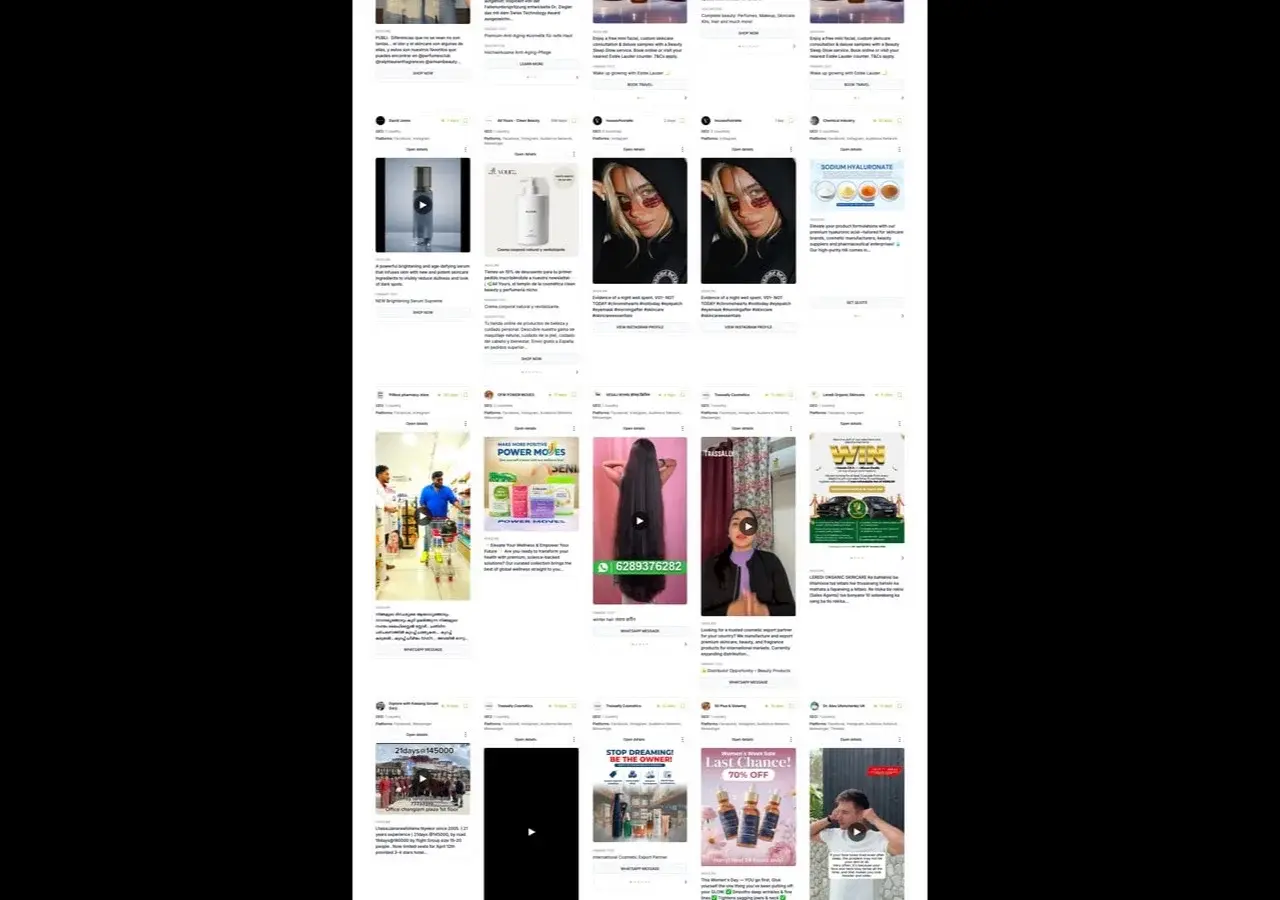 Research what creatives top e-commerce advertisers run to inform your Advantage+ creative strategy
Setting Up Advantage+ Shopping: Step by Step
If you have decided ASC is right for your account, here is how to set it up correctly.
Step 1: Verify Your Pixel Health
Before creating an ASC campaign, check Events Manager:
- Confirm you are tracking PageView, ViewContent, AddToCart, InitiateCheckout, and Purchase events
- Verify Event Match Quality is 6+ for your key events
- Check that you are generating 50+ purchase events per week
- Ensure your product catalog is connected and syncing correctly
Step 2: Define Your Existing Customer Audience
In Ads Manager, create a custom audience of existing customers. Use:
- Customer email/phone list upload
- Website purchasers (180-day window)
- App purchasers
This audience tells Meta who your existing customers are so it can report new vs returning customer performance and respect your existing customer budget cap.
Step 3: Create the Campaign
- Click Create Campaign → choose Sales as the objective
- Toggle Advantage+ Shopping Campaign on
- Set your daily budget (start with $100-200/day minimum)
- Set Existing Customer Budget Cap to 20-30%
- Select your target country/countries
- Set your attribution window (7-day click, 1-day view is standard)
Step 4: Load Creatives
Add 20-50 creative variants:
- Mix formats: static images, videos, carousels
- Mix angles: product-focused, lifestyle, UGC, testimonial
- Mix copy: benefit headlines, urgency headlines, curiosity headlines
- If using a product catalog, enable dynamic product ads alongside your manual creatives
Step 5: Launch and Wait
Do not make any changes for 7 days. The learning phase needs uninterrupted data collection. After 7 days, evaluate:
- Is CPA trending toward your target?
- Is the existing customer percentage within your cap?
- Are any creatives significantly outperforming others?
If CPA is more than 2x your target after 14 days, the campaign is unlikely to optimize — pause and investigate fundamentals (offer, landing page, creative quality).
Common Mistakes With Advantage+ Shopping
Mistake 1: Running ASC With Too Few Creatives
Loading 3-5 creatives into ASC defeats the purpose. The algorithm needs variety to test across audience segments. With too few options, ASC effectively becomes a single-audience, single-creative campaign with no manual controls — the worst of both worlds.
Mistake 2: Not Setting an Existing Customer Cap
By default, ASC will spend heavily on existing customers because they convert easily. This inflates your ROAS numbers but does not drive incremental revenue. Set an existing customer budget cap of 20-30% to force the algorithm to prioritize new customer acquisition.
Mistake 3: Judging Performance Too Early
ASC needs 7-14 days to exit the learning phase and stabilize. Killing a campaign after 3 days because CPA is high means you never let the algorithm optimize. Budget for at least a 2-week learning period.
Mistake 4: Running ASC on a New Pixel
A Pixel with 10 conversions per week does not give ASC enough data to find patterns. Build your conversion volume with manual campaigns first. Once you consistently hit 50+ conversions per week, ASC has the fuel it needs.
Mistake 5: Expecting ASC to Fix Fundamentals
ASC optimizes distribution and targeting — it does not fix bad products, weak landing pages, or uncompetitive offers. If manual campaigns do not convert, ASC will not either. Fix your funnel first.
Advantage+ Shopping vs Advantage+ Sales: What Changed
In late 2025, Meta rebranded Advantage+ Shopping Campaigns to Advantage+ Sales Campaigns. The core mechanics remained the same, but several updates were introduced:
New capabilities in 2026:
- Broader optimization events: Beyond purchase, you can now optimize for leads, registrations, and custom events
- Improved existing customer controls: More granular caps and the ability to define multiple customer tiers (first-time buyer vs repeat buyer)
- Enhanced creative tools: Automatic text variations, background generation, and format adaptation across placements
- Better reporting: New breakdown by customer segment (new, existing, lapsed) and creative performance insights
What stays the same:
- No detailed audience targeting or exclusions (beyond existing customer definition)
- All placements mandatory
- Single ad set structure
- Algorithm-driven budget distribution
The rebrand reflects Meta's push to make Advantage+ the default campaign type for all advertisers, not just e-commerce. If you see references to "Advantage+ Shopping" in older guides, the setup process and best practices still apply to the current "Advantage+ Sales" campaigns.
Measuring ASC Performance Correctly
Incrementality Testing
The biggest risk with ASC is cannibalizing organic or retargeting conversions and claiming them as prospecting wins. Run incrementality tests:
- Holdout test: Pause ASC for 1-2 weeks and measure total revenue change (not just ASC-attributed revenue)
- Geo-based lift test: Run ASC in some regions but not others, compare total sales
- Existing customer analysis: Track what percentage of ASC conversions come from existing customers vs truly new customers
Key Metrics to Monitor
| Metric | ASC Target | Manual Target |
|---|---|---|
| ROAS | Depends on your margin | Same |
| Cost per purchase | Below your target CPA | Same |
| New customer % | 70%+ of conversions | Varies by campaign type |
| Frequency | Below 2.0 per week | Below 3.0 per week |
| CPM | Market rate for your vertical | Can be controlled via audience |
| Creative fatigue signal | Frequency rising + CPA rising | Same |
Reporting Limitations
ASC provides less granular reporting than manual campaigns. You cannot see performance by audience segment, age, gender, or placement with the same detail. If stakeholders require detailed demographic breakdowns, maintain manual campaigns alongside ASC for reporting purposes.
Attribution Window Considerations
Choose your attribution window carefully when comparing ASC to manual campaigns:
- 7-day click, 1-day view (default): Best for most e-commerce with short purchase cycles
- 7-day click only: More conservative — use this if you want to compare ASC to manual campaigns on equal footing, since view-through conversions can inflate ASC numbers
- 1-day click: Most conservative — useful for impulse-buy products or when you need the most accurate incrementality picture
When comparing ASC performance to manual campaigns, always use the same attribution window for both. ASC tends to show higher ROAS with view-through attribution enabled because it reaches more users passively across all placements.
Scaling ASC Successfully
Once ASC is profitable, scaling follows simpler rules than manual campaigns:
- Budget increases: You can increase ASC budget more aggressively than manual campaigns — 30-50% increases every 3-4 days often work because the algorithm redistributes across its broad audience pool
- Creative refreshes: Add 5-10 new creatives every 2-3 weeks while keeping proven winners active
- Geographic expansion: Add new countries one at a time and monitor for 7 days before adding more
- Seasonal adjustments: Increase budget 2-3 weeks before major sale periods (Black Friday, BFCM) to give the algorithm time to learn the new spending level
The most common scaling mistake: increasing budget without adding new creatives. The algorithm needs fresh creative options to test as it reaches broader audiences. Budget up plus creative stagnation equals rising CPAs.
FAQ
Is Advantage+ Shopping better than manual campaigns?
It depends on your situation. Advantage+ Shopping typically outperforms manual campaigns for e-commerce advertisers with large product catalogs, strong Pixel data, and budgets above $100/day. Manual campaigns remain better for niche targeting, limited budgets, strict audience exclusions, and early-stage accounts with little conversion history.
Can I run Advantage+ Shopping and manual campaigns simultaneously?
Yes, and many top advertisers do. A common approach is running Advantage+ Shopping for broad prospecting and catalog sales while using manual campaigns for specific retargeting segments, niche audiences, or creative tests that need controlled conditions.
What minimum budget does Advantage+ Shopping need?
Meta does not set an official minimum, but Advantage+ Shopping performs best with at least $100/day. Below that, the algorithm does not get enough data to optimize effectively. For accounts spending under $50/day total, manual campaigns with focused targeting typically deliver better results.
Does Advantage+ Shopping work for non-e-commerce businesses?
Meta renamed the product to "Advantage+ Sales Campaigns" to reflect broader use cases. It can work for lead generation and app installs, not just e-commerce. However, it works best with product catalogs and purchase optimization — non-e-commerce advertisers may see less benefit compared to manual campaign structures.
Conclusion
Advantage+ Shopping campaigns are a powerful tool for scaling e-commerce advertising in 2026 — but they are not a replacement for manual campaigns. The right approach depends on your Pixel maturity, budget scale, catalog depth, and need for control.
For most e-commerce advertisers, the optimal setup is a hybrid: ASC for broad prospecting and scaling (60-70% of budget), manual campaigns for retargeting and testing (30-40% of budget). Let ASC handle the volume play while manual campaigns provide the precision and creative testing pipeline.
The one constant across both approaches: creative quality determines performance. Whether you run ASC or manual campaigns, you need a steady flow of fresh, proven creative concepts.
Ready to research what creatives top advertisers run? Try Adligator free
Research competitor ad creatives with Adligator
Related Reading
- Meta's Muse Image and the Future of AI Advantage+ Creative
- Facebook Ads Campaign Anatomy: Breaking Down 5 Winning Campaign Structures Across Different Verticals
- How to Run Facebook Ads for SaaS Products: Campaign Structure, Targeting, and Creative Strategy for B2B Marketers
- Facebook Ads Frequency Benchmarks by Vertical: When Creative Fatigue Hits and What to Do (2026)
