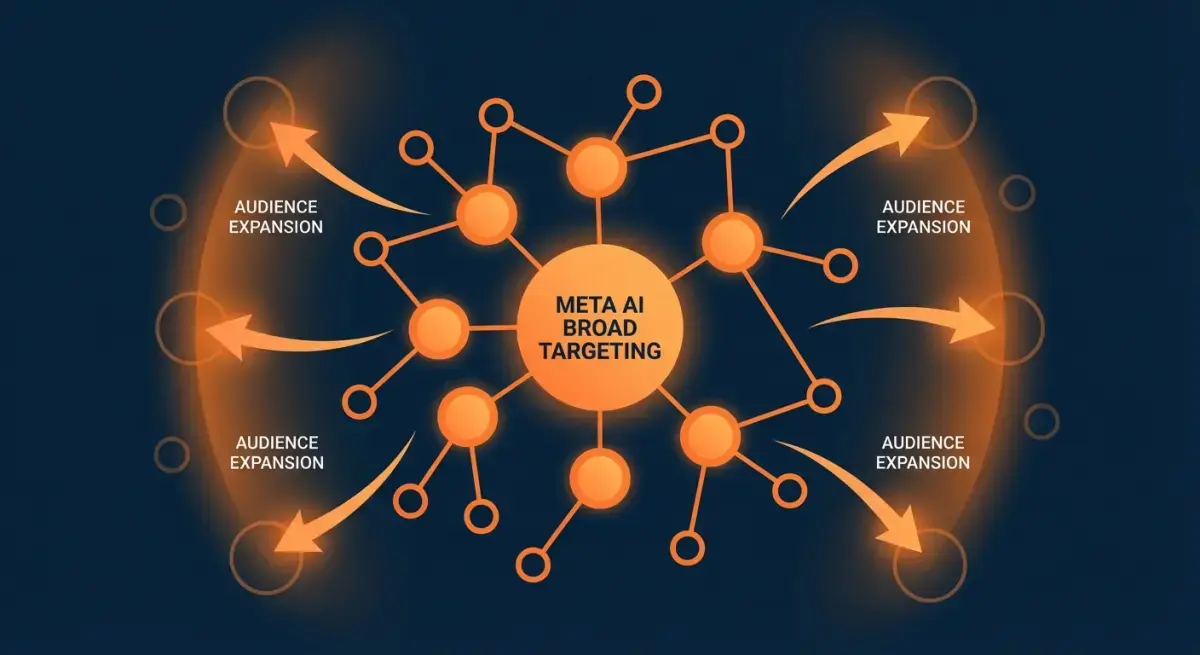
Meta Broad Targeting in 2026: Why Advantage+ Audiences Are Replacing Interest-Based Targeting
If you have been running Facebook Ads for more than a couple of years, you remember the old playbook: stack detailed interests, narrow by behaviors, layer in exclusions, and let your carefully built audience do the heavy lifting. That approach is disappearing.
Meta broad targeting 2026 looks nothing like what most media buyers learned. The platform has systematically deprecated interest categories, expanded Advantage+ audiences across every campaign type, and made it clear that AI-driven audience discovery is the default -- not the exception.
This guide is for media buyers, performance marketers, and agency teams who need to adapt their workflow without sacrificing ROAS. You will learn exactly what changed, when broad targeting outperforms manual targeting, how to structure campaigns for the new reality, and why creative strategy is now the primary lever you control.
The shift is not theoretical. If you are still relying on interest stacks as your primary audience strategy, you are likely already paying more per conversion than you need to.
The Death of Interest-Based Targeting: What Changed
The decline of interest-based targeting did not happen overnight. It was a multi-year process driven by privacy regulations, platform economics, and Meta's own AI capabilities.
2020-2021: Privacy shockwaves. Apple's ATT framework in iOS 14.5 cut off the data pipeline Meta relied on for granular user profiling. Conversion tracking degraded. Interest categories built on third-party behavioral data became less reliable.
2022-2023: The quiet deprecation begins. Meta removed thousands of detailed targeting options related to health, race, politics, and other sensitive topics. The platform started defaulting new campaigns to broader audience settings and rolled out Advantage+ Shopping campaigns with no manual targeting at all.
2024: Advantage+ goes mainstream. Meta expanded Advantage+ audience controls across all campaign objectives -- not just shopping. The "Advantage detailed targeting" toggle became opt-out rather than opt-in, meaning your interest targets were already being expanded unless you explicitly locked them.
2025-2026: Broad becomes the default. Meta's latest Ads Manager interface actively nudges advertisers away from manual audiences. Many interest categories now show "limited reach" warnings. Advantage+ campaigns deliver to algorithmically selected audiences by default, with manual inputs treated as "suggestions" rather than constraints.
 Key milestones in Meta's shift from manual targeting to AI-driven audience discovery
The practical result: the audience-building skills that defined media buying expertise for a decade are now table stakes at best, irrelevant at worst. The algorithm has access to more behavioral signals than any manual interest stack can replicate.
How Meta AI Targeting Actually Works in 2026
Understanding the mechanics helps you work with the algorithm instead of against it.
Meta AI targeting operates on three core principles:
Signal aggregation at scale
Meta's models process billions of conversion events across all advertisers, not just yours. When you launch a broad-targeted campaign, the algorithm draws on cross-advertiser patterns to predict which users are most likely to convert for your specific offer. Your pixel data is one input -- not the only input.
Exploration and exploitation cycles
The algorithm runs a continuous explore-exploit loop. During exploration, it serves your ads to diverse audience segments to gather performance signals. During exploitation, it concentrates delivery on segments showing the strongest conversion propensity.
This is why early campaign performance with broad targeting can look volatile. The algorithm needs data to calibrate. Experienced media buyers know to evaluate performance on a 7-day rolling window, not day-by-day.
Creative as the targeting signal
Here is the critical shift most media buyers underestimate: in a broad-targeting world, your creative IS your targeting. Meta's algorithm uses creative elements -- imagery, copy, video hooks, offers -- to match ads with users. A fitness product image naturally attracts fitness-interested users. A B2B SaaS headline self-selects decision-makers.
This means creative diversity directly expands the audience segments the algorithm can explore. One ad set with five distinct creative concepts will reach fundamentally different user segments than one ad set with five minor variations of the same concept.
The feedback loop
Meta AI targeting creates a feedback loop:
- Creative signals determine initial audience segments
- Engagement and conversion data refine targeting in real time
- The algorithm reallocates budget to winning creative-audience combinations
- You see performance data and iterate creatives accordingly
Your job is no longer to find the audience. Your job is to give the algorithm enough creative variety and conversion signals to find the audience for you.
Advantage+ Audiences vs Manual Targeting: Performance Data
The numbers tell a clear story, though the picture is more nuanced than "broad always wins."
Where broad targeting consistently outperforms
E-commerce and DTC brands with established pixel data see the strongest gains. Accounts with 100+ weekly conversions and diverse product catalogs typically see 15-30% lower CPA with Advantage+ audiences compared to interest stacks.
App install campaigns benefit enormously. Meta's algorithm can predict install likelihood across user profiles far more accurately than behavioral interest categories. App advertisers running broad targeting routinely report 20-40% improvements in cost per install.
Lead generation at scale -- campaigns optimizing for form submissions or sign-ups with clear conversion events -- performs well with broad targeting when creative clearly qualifies the lead.
Where manual targeting still holds value
Very niche B2B audiences with fewer than 50 weekly conversions may not generate enough signal for the algorithm to optimize. If you are selling enterprise software to CFOs at companies with 500+ employees, interest targeting (combined with custom audiences) can still outperform broad.
Geo-restricted local businesses with tight service areas sometimes see wasted spend with broad targeting, though Advantage+ with location constraints handles this better than it did a year ago.
Brand new accounts with zero pixel data need bootstrapping. Running interest-targeted campaigns for the first 2-4 weeks to build initial conversion data, then transitioning to broad, is a proven approach.
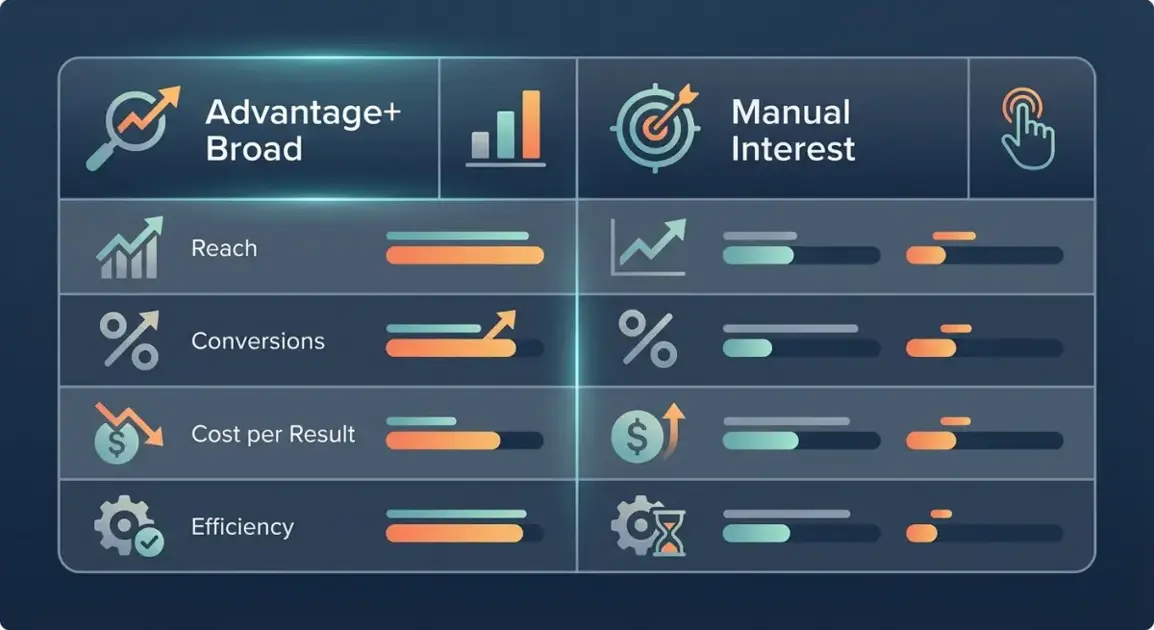 Broad targeting vs interest targeting: where each approach wins
The hybrid reality
Most sophisticated advertisers in 2026 are not running pure broad or pure interest. They use a hybrid approach:
- 70-80% of budget on Advantage+ broad-targeted campaigns
- 10-20% of budget on retargeting (custom audiences from website visitors, engagers, customer lists)
- 5-10% of budget on interest or lookalike-seeded campaigns for testing new creative concepts or markets
This allocation shifts the performance conversation from "which audience is best" to "which creative and offer combination drives the best results at scale."
When Broad Targeting Works (and When It Doesn't)
Before moving your entire account to broad targeting, run through this decision framework.
Broad targeting is likely your best move when:
- You have 50+ conversions per week per ad set. This is Meta's recommended threshold for algorithmic optimization. Below this, the explore phase takes too long and burns budget.
- Your conversion event is well-defined. Purchase, sign-up, app install -- clear, high-intent events give the algorithm a clean signal. Avoid optimizing for vague events like "page view" with broad targeting.
- You have creative diversity. At least 5-10 distinct creative concepts ready to test. If you only have 2-3 ads, the algorithm has limited signals to explore different audience segments.
- Your product or service has broad appeal. The wider the potential customer base, the more room the algorithm has to find efficient pockets.
- You have patience for the learning phase. Expect 3-7 days of volatile performance while the algorithm calibrates. Do not kill campaigns on day 2.
Stick with manual targeting (or hybrid) when:
- Your weekly conversion volume is below 20. The algorithm simply will not have enough data to optimize.
- You serve a hyper-niche audience. If only 0.1% of Meta's user base could realistically convert, broad targeting wastes spend on exploration.
- You are in a regulated industry with strict audience requirements. Financial services, healthcare, and housing have compliance constraints that require controlled audience targeting.
- Your budget is under $30/day per ad set. Low budgets combined with broad targeting create a slow, data-starved optimization cycle.
- You are launching in a new market with no pixel history. Seed with interest/lookalike targeting first, then expand.
The transition checklist
If you are moving from interest-based to broad targeting, follow this sequence:
- Audit your current campaigns -- identify which ones already have Advantage detailed targeting expansion enabled (most do by default now)
- Check conversion volume per ad set -- flag any below the 50/week threshold
- Prepare creative assets -- you need more creative concepts, not just more ads
- Set up a testing structure (covered in detail below)
- Define your evaluation window -- minimum 7 days, ideally 14 days per test
- Document current CPAs as your baseline for comparison
Campaign Structure for the Broad Targeting Era
Your campaign architecture needs to change when broad targeting is your primary approach. The old structure of multiple ad sets with different interest stacks creates audience overlap and algorithm competition.
Recommended structure: Consolidated broad
Campaign level:
- Use Campaign Budget Optimization (CBO). Let Meta allocate budget across ad sets based on performance.
- One campaign per objective per product line. Resist the urge to segment into micro-campaigns.
- Set cost cap or ROAS target at the campaign level if you have minimum profitability thresholds.
Ad set level:
- Reduce ad set count. Instead of 5-10 interest-based ad sets, run 2-3 broad ad sets differentiated by creative angle -- not audience.
- Ad set 1: "Problem-aware" creative angle (addresses the pain point)
- Ad set 2: "Solution-aware" creative angle (demonstrates the product)
- Ad set 3: "Social proof" creative angle (testimonials, results, UGC)
- Set broad targeting with only age/gender/geo constraints where necessary.
- Use Advantage+ placements -- do not restrict to Feed only unless you have a data-driven reason.
Ad level:
- 5-6 ads per ad set minimum. Mix formats: static image, video, carousel.
- Each ad should represent a distinct creative concept, not just copy variations.
- Use Dynamic Creative if testing multiple headlines/descriptions against a single visual.
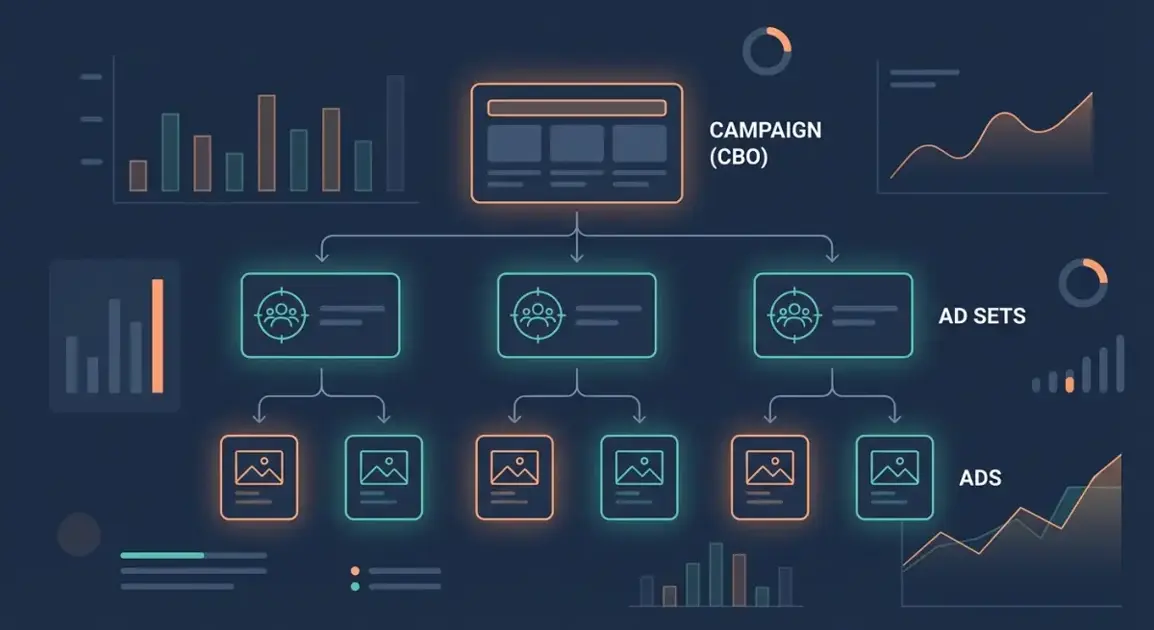 Campaign structure optimized for Advantage+ audience delivery
Budget allocation by phase
Phase 1 -- Learning (days 1-7): Allocate 120-150% of your target daily budget. The algorithm needs data volume to exit the learning phase quickly. Restricting budget during learning extends the volatile period.
Phase 2 -- Optimization (days 7-21): Scale back to target daily budget. Evaluate per-ad-set performance. Pause underperforming ad sets, but give winners room to scale.
Phase 3 -- Scale (day 21+): Increase budget by no more than 20% every 3-4 days to avoid resetting the learning phase. Add new creative concepts as you scale -- do not just increase spend on existing ads.
The Advantage+ Shopping campaign option
For e-commerce advertisers, Advantage+ Shopping Campaigns (ASC) remove ad set-level targeting entirely. You upload creatives and set a budget; Meta handles everything else.
ASC works best when:
- You have a product catalog with 50+ SKUs
- Your pixel has 6+ months of purchase data
- You can produce creative at volume (10+ new ads per week)
- Your AOV supports the minimum daily budget (typically $50+ per day)
If those conditions are met, ASC frequently outperforms manually structured broad campaigns by 10-20% on ROAS.
How to Feed Meta's Algorithm: Creative-First Strategy
In the broad targeting era, creative strategy replaces audience strategy as your primary competitive advantage. Here is how to approach it systematically.
Volume requirements
The math is straightforward. More creative concepts mean more audience segments the algorithm can test. The recommended cadence:
- Minimum viable: 5 new creative concepts per month per campaign
- Competitive: 10-15 new concepts per month
- Aggressive scale: 20+ new concepts per month with weekly refreshes
Each "concept" means a distinct angle: different hook, different visual approach, different value proposition. Swapping a background color does not count.
Creative research as competitive intelligence
This is where the shift from targeting expertise to creative expertise becomes tangible. When everyone targets the same broad audience, the advertisers who win are the ones with better creatives. And the fastest way to develop better creatives is to study what is already working.
The manual approach is to browse Meta's Ad Library, search for competitors one by one, and try to infer which ads are performing based on how long they have been running. This works at a basic level, but the Ad Library does not show performance metrics, does not let you filter by ad longevity reliably, and does not surface creative patterns across an entire vertical.
This is where dedicated competitive intelligence tools become essential. Adligator lets you filter ads by days active -- a strong proxy for performance. An ad running for 30+ days is almost certainly profitable. You can search by keyword, vertical, geo, and ad format to find exactly the creative patterns that are winning in your space.
With broad targeting, creative is your new targeting -- use Adligator to find winning creative patterns before testing.
Building a creative feedback loop
- Research: Identify 3-5 competitor creative patterns that show longevity signals (running 14+ days)
- Hypothesize: What element makes each one work? The hook? The format? The offer structure?
- Produce: Create your own versions that apply the winning pattern to your product/brand
- Test: Launch in broad-targeted ad sets with 5+ variations
- Analyze: After 7 days, identify top 2-3 performers by CPA or ROAS
- Iterate: Create 3-5 variations of each winner. Kill the losers. Add new concepts.
- Repeat: This cycle runs every 2-3 weeks
Creative types that work with broad targeting
Not all formats perform equally in a broad-targeting environment. Based on practitioner consensus in 2026:
- UGC-style video (15-30 seconds): Highest engagement, best for cold audiences. The algorithm loves distributing these because they generate strong engagement signals.
- Static comparison ads: "Before/after" or "us vs them" formats self-select high-intent users.
- Carousel with benefit progression: Each card addresses a different pain point, effectively testing multiple angles in one ad.
- Offer-led static images: Clear price point or discount. Works for bottom-funnel when paired with broad targeting for prospecting.
Testing Framework: Broad vs Narrow in Your Account
Do not flip your entire account to broad targeting based on general advice. Test it systematically.
The split-test setup
Step 1: Select a campaign with strong conversion data. Pick one with 50+ conversions per week. This ensures both test and control groups have enough signal.
Step 2: Duplicate the campaign. Keep the original (interest-targeted) running as your control. In the duplicate, switch to Advantage+ broad targeting with the same creatives and budget.
Step 3: Run for 14 days minimum. Shorter tests produce unreliable results due to learning phase volatility. Budget both campaigns identically.
Step 4: Compare on business metrics, not vanity metrics. The metrics that matter:
- Cost per acquisition (CPA) or return on ad spend (ROAS)
- Cost per qualified lead (if lead gen)
- Customer acquisition cost factoring in LTV where possible
- Conversion rate from click to purchase
Do not optimize based on CPM, CTR, or engagement rate alone. Broad targeting often shows higher CPMs but lower CPAs because the algorithm finds higher-intent users.
Interpreting results
Broad wins by 10%+ on CPA: Scale broad, reduce interest campaigns gradually (not all at once -- keep some running for creative testing).
Results are within 5%: Run for another 7 days. Small differences may not be statistically significant.
Interest targeting wins by 10%+: Your account may not have enough conversion volume for broad, or your creative set is too narrow. Add more creative diversity and retest in 30 days.
Common testing mistakes
- Comparing different creatives across test groups. Use identical ad creatives in both campaigns.
- Testing during major promotional periods. Sales events distort performance data. Test during normal-spend weeks.
- Killing the test too early. Three days of higher CPA in the broad campaign is normal learning-phase behavior.
- Not accounting for audience overlap. If both campaigns target the same geography with the same creatives, they may bid against each other. Use campaign-level budget caps to manage this.
- Ignoring creative fatigue. If your interest campaign has been running for months with the same ads, the comparison is unfair. Refresh creatives in both before testing.
What This Means for Media Buyers Going Forward
The shift to Meta broad targeting in 2026 is not just a tactical adjustment. It reshapes the entire value chain of media buying.
Skills that are declining in value
- Manual audience research and interest stacking
- Lookalike audience creation and segmentation
- Detailed exclusion strategies
- Audience testing matrices with dozens of ad sets
Skills that are increasing in value
- Creative strategy and production: Understanding what visual and copy patterns convert, and producing them at volume
- Data analysis: Reading algorithmic performance patterns, identifying creative fatigue early, attributing results across longer windows
- Competitive creative intelligence: Systematically studying what is working in your vertical and reverse-engineering the winning patterns
- Speed of iteration: The media buyers who win are the ones who can move from insight to new creative to live test fastest
Budget allocation shifts
Expect creative production to consume a larger share of your total media budget. The old ratio of 80% media spend / 20% creative production is shifting toward 65-70% media / 30-35% creative for teams that take broad targeting seriously.
This also means your creative sourcing strategy matters more. In-house design teams, UGC creator networks, and AI-assisted creative tools all become critical infrastructure -- not optional add-ons.
The competitive intelligence imperative
When everyone targets the same audience, creative differentiation is the only moat. Knowing what your competitors are running, how long their ads have been active, and which creative patterns are trending in your vertical gives you a structural advantage.
Manual Ad Library browsing cannot keep up with this need at scale. You need tools that let you filter by ad longevity, search across verticals, and identify patterns across hundreds of competitors simultaneously.
FAQ
Is interest targeting completely dead on Meta in 2026?
No. Interest targeting still exists and can work for niche audiences with very specific affinities. However, Meta has deprecated many interest categories and actively steers advertisers toward Advantage+ audiences. For most campaigns with sufficient budget and conversion volume, broad targeting now outperforms manual interest stacks.
How many creatives do I need for broad targeting to work?
Plan for at least 5-10 distinct creative concepts per ad set, with 3-5 variations of each top performer. Broad targeting relies on Meta AI testing creatives across a wide audience pool, so creative volume directly impacts how quickly the algorithm finds winning segments. Refresh creatives every 2-4 weeks to combat fatigue.
What minimum budget does Advantage+ broad targeting require?
Meta recommends at least 50 conversions per week per ad set for the algorithm to optimize effectively. At your current CPA, calculate the weekly budget needed to hit that threshold. Accounts spending under $50/day on a single ad set may see inconsistent results with fully broad targeting.
Can I still use lookalike audiences with Advantage+ campaigns?
Yes. In Advantage+ campaigns, you can add lookalike audiences as "audience suggestions" rather than hard constraints. Meta uses them as starting signals but will expand beyond them if it finds better-performing segments. Think of them as optimization hints, not audience boundaries.
Conclusion
Meta broad targeting in 2026 represents the biggest structural shift in paid social since the iOS 14 privacy changes. The advertisers who adapt fastest -- consolidating campaign structures, investing in creative volume, and building systematic competitive intelligence workflows -- will capture disproportionate value as less-prepared competitors see their CPAs climb.
The playbook is clear: stop over-engineering audiences, start over-engineering creatives. Use Advantage+ audiences as your default. Structure campaigns for algorithmic efficiency. Test rigorously. And build a creative research process that gives you a consistent edge.
The media buyers who thrive will be the ones who recognize that creative is the new targeting -- and invest accordingly in both production and competitive intelligence.
Ready to find winning creative patterns in your vertical? Use Adligator to identify long-running competitor creatives and build your broad-targeting creative strategy.
See what creatives competitors run with Advantage+ campaigns
Related Reading
- How Meta's Andromeda Algorithm Changes Ad Delivery in 2026: What Media Buyers Must Adapt
- What 120+ Active Dating Ads Targeting South Africa Reveal About Running Meta's Toughest Vertical
- Winning Meta Ads Don't Start in One Country: What 200-Country Blasts Reveal About How Evergreen Creatives Actually Scale
- Meta Advantage+ Shopping Campaigns vs Manual Setup: When to Use Each in 2026
