
How to Pitch Competitive Ad Intelligence to Agency Clients: Building a Scalable Audit Workflow
Most agencies check competitor ads when a client asks. Some do it before campaign launches. Almost none offer it as a structured, recurring service — and that is exactly where the opportunity sits.
Competitive ad intelligence agency services are one of the highest-margin, lowest-effort additions an agency can make to its offering. The data is publicly available through spy tools. The insights are immediately actionable. And clients will pay a premium for them because they directly improve campaign performance.
The challenge is not the research itself — it is packaging it into something repeatable, professional, and valuable enough to justify premium pricing. This article walks through how to build a competitive intelligence service from scratch: the audit template, the tools, the pricing, and the retention strategy.
Why Clients Pay Premium for Competitive Intelligence
Agency clients do not pay for data. They pay for decisions. When you show a client that their top competitor has been running the same ad for 45 days (a strong profitability signal), that their creative style is completely different from what is working in the market, or that three new competitors entered their space last month — you are not delivering a report. You are delivering clarity.
Here is why competitive intelligence commands premium pricing:
- It reduces creative testing waste. Instead of testing 20 random creative concepts, clients can test 5 informed ones. That alone saves thousands in ad spend.
- It creates urgency. When a client sees competitors doing something they are not, they act. Competitive intelligence is one of the few services that creates its own demand.
- It demonstrates expertise. Any agency can run ads. Agencies that bring market context and strategic insight position themselves as partners, not vendors.
- It reduces churn. Clients who receive ongoing competitive insights feel like they are getting value beyond campaign management. They are less likely to leave for a cheaper competitor.
The economics are straightforward: a competitive intelligence add-on that takes 2–3 hours per month to deliver can generate $500–$2,000 in additional monthly revenue per client. Across 10 clients, that is $5,000–$20,000/month in high-margin revenue with minimal incremental cost.
Building a Repeatable Competitor Audit Template
The key to scaling a client competitive audit service is standardization. You need a template that any team member can execute consistently, producing professional output every time.
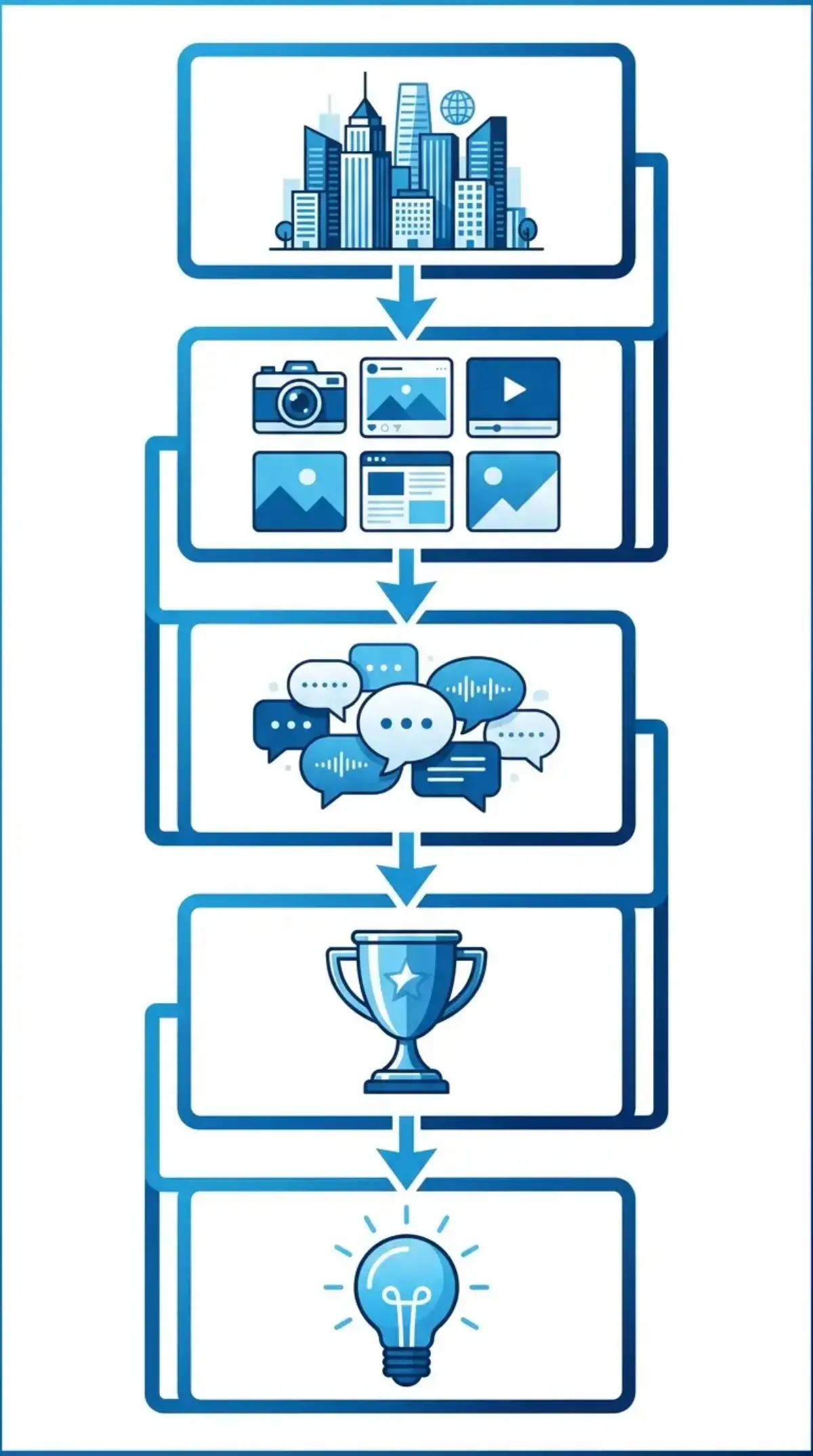 A repeatable audit template transforms ad-hoc research into a scalable service.
The Five-Section Audit Framework
Section 1: Competitive Landscape Overview
- Number of active competitors in the client's vertical/GEO
- Top 5 competitors by ad volume and longevity
- New entrants in the last 30 days
- Overall market activity trend (growing, stable, declining)
Section 2: Creative Strategy Analysis
- Dominant ad formats (video, static, carousel)
- Hook patterns used by top performers
- Visual style trends (UGC, studio, graphic design)
- CTA button types and messaging patterns
Section 3: Messaging and Offer Analysis
- Primary value propositions used by competitors
- Pricing strategies and discount patterns
- Social proof approaches (testimonials, numbers, badges)
- Landing page patterns and conversion flows
Section 4: Longevity Winners
- Ads running 14+ days (likely profitable)
- Analysis of what makes them work
- Patterns that appear across multiple long-running ads
- Creative elements the client is not using
Section 5: Tactical Recommendations
- 3–5 specific creative hypotheses based on findings
- Gaps in the competitive landscape the client can exploit
- Format or platform opportunities competitors are missing
- Priority actions ranked by expected impact
This template works for any vertical and any client size. The research itself takes 2–3 hours per client. The template ensures you capture the same data points every time, making it easy to track changes month over month.
Customizing for Verticals
While the five-section framework stays consistent, the emphasis shifts by vertical:
- E-commerce/DTC: Focus heavily on pricing, discount patterns, and seasonal promotional calendars. Clients care about when competitors run sales and what offers they test.
- SaaS/B2B: Emphasize messaging differentiation and value proposition analysis. In B2B, creative strategy is less about visual style and more about positioning.
- Lead generation: Concentrate on landing page analysis and CTA patterns. What information do competitors ask for? What do they offer in exchange?
- Local businesses: Geographic competitive density matters most. Who is advertising in the same service area, and how aggressively?
Creating vertical-specific versions of your template (with pre-filled analysis categories) further reduces the time per client and improves output quality.
Execution Tips
- Time-box the research. Set a 2-hour limit per client for monthly reports. If you find something extraordinary, note it and move on — the goal is consistency, not exhaustive analysis.
- Use screenshots liberally. Clients respond to visuals. Include screenshots of competitor ads, especially the long-running ones, with annotations explaining why they work.
- Always end with recommendations. Data without action items is just noise. Every report should include 3–5 specific things the client should try next.
Tools and Data Sources for Agency-Scale Research
For an ad spy agency workflow that scales across multiple clients, you need tools that support efficient research and ongoing monitoring.
Core Tool Stack
- Ad intelligence platform (essential): A tool like Adligator that lets you search competitor ads, filter by longevity/format/GEO, and set up trackers for ongoing monitoring. This is the backbone of the service.
- Presentation tool: Google Slides, Canva, or Notion for creating client-facing reports. Choose whatever your team is fastest with.
- Screenshot and annotation tool: For capturing and annotating competitor ads. Built-in browser tools or dedicated apps like CleanShot work well.
- Tracking sheet: A simple spreadsheet or Notion database to log insights over time per client. This lets you show trends and changes in subsequent reports.
 Adligator trackers enable ongoing competitor monitoring across multiple clients.
Why Trackers Are Essential for Agency Scale
The difference between an ad-hoc service and a scalable one is automation. Adligator's tracker feature lets you save search configurations (keywords, GEO filters, competitor page IDs) and receive updates when new matching ads appear. Instead of running the same searches manually each month, your trackers surface new competitor activity automatically.
For agency use:
- Set up 1–2 trackers per client covering their key competitors and vertical keywords
- Review tracker results weekly (15 minutes per client)
- Flag significant changes for the monthly report
- Use tracker data to identify trends over time
With a Pro plan (7 trackers) or Team plan (14 trackers), a single agency seat can monitor multiple clients efficiently.
Ready to build your agency's competitive intelligence backbone? Start building your agency's competitive intelligence service with Adligator
Packaging Insights into Client-Ready Reports
The research is only valuable if the client understands and acts on it. Packaging matters as much as the analysis itself.
Report Structure That Works
Page 1: Executive Summary (1 slide)
- 3 key findings in bullet points
- Overall competitive landscape assessment: "Your market is growing/stable/declining with X active competitors. Key insight."
Pages 2–4: Detailed Findings (3–5 slides)
- Competitor ad screenshots with annotations
- Format and creative trend analysis
- New competitor alerts
- Longevity winner breakdowns
Page 5: Recommendations (1 slide)
- 3–5 prioritized action items
- Each recommendation tied to a specific finding
- Expected impact level (high/medium/low)
Delivery Cadence
- Monthly reports: The standard for most clients. Covers the full five-section audit.
- Weekly alerts: A quick Slack or email when something significant changes (new competitor, major creative shift, trending format).
- Quarterly deep dives: A comprehensive analysis that includes trend data, competitive positioning shifts, and strategic recommendations for the next quarter.
Presentation Tips
- Lead with insights, not data. "Your competitor launched 12 new video ads last week" is data. "Your competitor is aggressively testing UGC-style video hooks, which suggests they found a winning format you should test" is an insight.
- Use before/after framing. Show what the client was doing vs. what competitors are doing. This creates natural urgency.
- Include "steal-worthy" examples. Clients love seeing specific ads they can learn from. Always include 2–3 competitor ads with analysis of why they work.
Pricing Your Competitive Intelligence Service
Pricing depends on your agency's positioning and client size, but here are proven models:
 Three pricing models for competitive intelligence services.
Model 1: One-Time Audit ($1,500–$5,000)
A comprehensive competitive analysis delivered as a presentation. Best for:
- New client onboarding
- Pre-campaign strategy sessions
- Pitch presentations (offer a free mini-audit to win the account)
Margin: Very high. A thorough audit takes 4–8 hours. At $2,500, that is $300–$600/hour effective rate.
Model 2: Monthly Retainer Add-On ($500–$2,000/month)
Ongoing competitive monitoring added to your existing management fee. Includes:
- Monthly competitive report (five-section audit)
- Weekly alert emails for significant changes
- Tracker management and monitoring
Margin: High and recurring. After the first month (template creation), each subsequent report takes 2–3 hours.
Model 3: Premium Strategic Package ($3,000–$8,000/month)
Full competitive intelligence integrated into campaign strategy. Includes:
- Everything in Model 2
- Quarterly deep dives
- Creative strategy sessions based on competitive data
- Proactive creative brief recommendations
- Priority response to competitive threats
Margin: Highest total revenue, but requires more senior involvement. Best for enterprise clients.
Pricing Psychology
- Anchor with the one-time audit. If a single audit costs $3,000, the monthly add-on at $1,000 feels like a bargain.
- Bundle, don't discount. Instead of lowering your price, add the intelligence service to your existing retainer and increase the total fee.
- Show ROI math. If competitive intelligence helps the client avoid even one failed creative test per month ($500–$2,000 in wasted spend), the service pays for itself.
Retaining Clients with Ongoing Monitoring
The real power of competitive ad intelligence is retention. Clients who receive ongoing competitive insights have a reason to stay — and switching agencies means losing that intelligence layer.
Building Stickiness
- Create institutional knowledge. Over 6–12 months of monitoring, you accumulate competitive context that no new agency could replicate quickly. Document trends, seasonal patterns, and competitor behaviors.
- Show longitudinal value. In month 3, present a trend analysis: "Here is how the competitive landscape changed since we started monitoring. Here is how our strategy adapted." This demonstrates value that a one-time audit cannot.
- Integrate intelligence into creative briefs. Do not deliver intelligence reports in isolation. Tie every finding to a specific creative recommendation and track whether those recommendations improved performance.
- Alert on threats. When a major competitor launches a new campaign or a new player enters the market, notify the client proactively. This positions you as a strategic partner, not a service provider.
- Quarterly business reviews. Use competitive data as the foundation of your QBR presentations. Show how the client's competitive position improved under your management.
Common Retention Mistakes
- Delivering reports nobody reads. If clients are not engaging with your reports, the format is wrong. Switch to shorter executive summaries with detailed appendices.
- Not connecting intelligence to results. Always close the loop: "Last month we recommended testing UGC-style hooks based on competitor data. The result: 23% lower CPA on the variants we launched."
- Inconsistent delivery. Missing a monthly report destroys trust. Automate reminders and block time for report creation.
- Not evolving the service. After 6 months, the basic competitive landscape is well-mapped. Evolve into deeper analysis: creative lifecycle tracking, seasonal pattern prediction, emerging competitor early warning.
The Retention Math
Agencies that offer competitive intelligence as a structured service report 20–40% higher retention rates compared to those offering campaign management alone. The reason is simple: competitive intelligence creates a continuous feedback loop — insight leads to action, action leads to results, results justify continued investment.
FAQ
How much should agencies charge for competitive ad intelligence services?
Most agencies add $500–$2,000/month on top of their base retainer for competitive intelligence. One-time audits typically range from $1,500–$5,000 depending on depth. The key is positioning it as a strategic service that directly improves campaign performance, not just a research add-on.
What tools do agencies need for competitive ad intelligence?
At minimum, you need an ad spy tool like Adligator for creative and strategy research, a presentation tool for client reports, and a tracking system for ongoing monitoring. The total tool cost is typically $50–150/month — well under what you can charge clients for the service.
How do I convince clients they need competitive intelligence?
Lead with outcomes, not features. Show them specific examples of competitor ads that are outperforming theirs, identify creative gaps they are missing, and quantify the potential improvement. A 5-slide deck with real competitor data is more persuasive than any pitch.
Conclusion
The competitive ad intelligence agency opportunity is hiding in plain sight. Most agencies already do ad-hoc competitor research — the leap to a productized, premium service is smaller than it seems. A repeatable audit template, a reliable spy tool, and a clear pricing model are all you need to start.
The agencies that systematize competitive intelligence into their service stack command higher retainers, reduce churn, and differentiate themselves in a market where campaign management alone is increasingly commoditized.
Stop giving away competitive insights for free. Start packaging them as the premium service they are.
Ready to build your competitive intelligence service? Start building your agency's competitive intelligence service with Adligator
Related Reading
- BigSpy vs AdSpy vs PowerAdSpy: Which Ad Intelligence Tool Fits Your Workflow?
- Meta Ad Library vs Ad Spy Tools: When Free Isn't Enough for Competitive Intelligence
- How to Use Ad Spy Tools for Agency Client Onboarding: Competitive Audit Workflow for Media Buyers
- Best AdSpy Alternatives for Meta Ad Intelligence in 2026
