
Facebook and Instagram Reels Ads Analysis: How to Spy on Competitor Short-Form Video Creatives
Short-form video has taken over Meta's ad inventory. Reels now accounts for more than half of Instagram ad impressions, and Facebook Reels is growing fast. For media buyers, this shift changes everything about competitive research.
You can no longer just analyze static image ads and call it competitive intelligence. The creatives winning auctions in 2026 are 15-30 second vertical videos with native-feeling hooks, fast-paced editing, and platform-specific CTAs. If you are not studying competitor Reels ads, you are missing the majority of the ad landscape.
This guide shows you how to use reels ads spy techniques to find, analyze, and extract actionable insights from competitor short-form video creatives on Facebook and Instagram.
Why Reels Now Dominate Meta Ad Inventory
Meta has been aggressively pushing Reels since 2022, and by 2026, the shift is undeniable. Here is why this matters for competitive research:
The numbers:
- Instagram Reels generates over 200 billion plays per day across the platform
- Reels ad placements are available in Advantage+ campaigns by default
- CPMs for Reels placements are still 15-30% lower than Feed in most verticals
- Facebook Reels has expanded to over 150 countries with full ad support
What this means for media buyers:
- Budget follows attention. As organic Reels consumption grows, ad inventory expands. Competitors are shifting spend from Feed to Reels.
- Creative format matters more. A winning static image ad rarely translates to a winning Reels ad. Format-specific creative strategy is now essential.
- First-mover advantage is real. Many advertisers still run Feed-first creatives in Reels placements. Those who create Reels-native content have a cost advantage.
- Testing velocity increases. Short-form video is cheaper to produce than polished long-form content, enabling faster creative iteration.
- Algorithm preference is real. Meta's delivery system actively favors Reels content in both organic and paid distribution. Ads formatted natively for Reels placements receive better delivery efficiency and lower CPMs compared to the same content forced into Feed placements.
The competitive landscape shift:
Many advertisers are still running the same creative across all placements and hoping for the best. The smart ones are building dedicated Reels creative pipelines — testing hooks, formats, and production styles specifically for short-form vertical video. When you spy on competitor ads and see a brand running 20+ unique Reels creatives simultaneously, that tells you they have committed resources to this format and are likely seeing results.
The implication is clear: competitive intelligence that ignores video format is incomplete. You need to specifically track what competitors are doing in Reels to stay competitive.
Anatomy of a Winning Reels Ad Creative
Before you start researching competitor Reels ads, you need a framework for evaluating what you find. Here are the structural elements that separate high-performing Reels ads from the rest:
The Hook (0-3 Seconds)
The hook determines whether someone watches or scrolls. In paid Reels, you have approximately 1.5-3 seconds before the viewer decides. Effective hooks fall into categories:
- Pattern interrupt: Unexpected visual or movement that stops the scroll
- Text-first hook: Large text overlay stating the value proposition immediately ("3 mistakes killing your ROAS")
- Problem statement: Directly addressing a pain point the audience recognizes
- Social proof lead: Starting with a result or testimonial ("We scaled from $5K to $50K/day")
- Curiosity gap: Creating intrigue without clickbait ("The ad strategy nobody talks about")
The Body (3-20 Seconds)
The middle section delivers on the hook's promise:
- Demonstration: Showing the product or process in action
- Listicle format: Quick tips or steps with text overlays for each
- Before/after: Transformation or comparison that proves value
- Story arc: Mini-narrative with tension and resolution
- UGC-style testimony: Real or actor-presented personal experience
The CTA (Last 3-5 Seconds)
The closing drives action:
- Verbal CTA combined with text overlay and native CTA button
- Urgency element (limited-time offer, scarcity)
- Benefit restatement before the ask
- Seamless transition to the CTA button (not jarring)
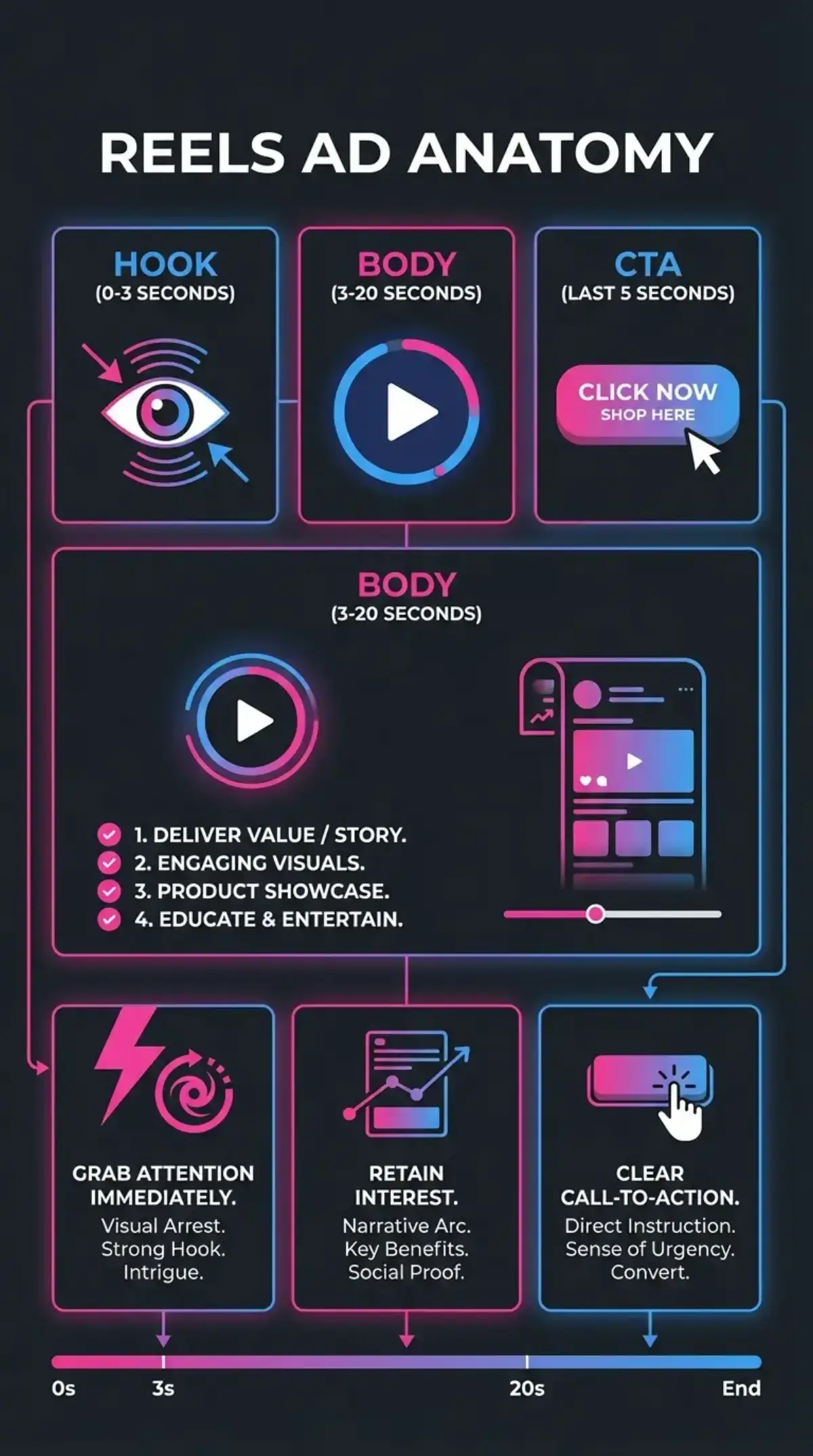 The three-part structure of high-performing Reels ads: hook, value delivery, and CTA.
Format Specifications to Watch
When analyzing competitor Reels ads, note:
| Element | Best Practice | Why It Matters |
|---|---|---|
| Aspect ratio | 9:16 vertical | Full-screen native experience |
| Duration | 15-30 seconds | Sweet spot for engagement vs. completion rate |
| Text overlays | Present in 80%+ of top performers | Many viewers watch without sound |
| Captions | Auto-generated or burned in | Accessibility and silent viewing |
| Music/audio | Trending sounds or original | Familiarity increases watch time |
| CTA button | Learn More or Shop Now | Most common for Reels placements |
How to Find and Analyze Competitor Reels Ads
Finding competitor Reels ads requires different techniques than finding static image ads. Here are your options:
Meta Ad Library Approach (Free, Limited)
Meta Ad Library shows active ads but does not let you filter by format. To find Reels ads:
- Search for a competitor by page name
- Manually scroll through results looking for vertical video creatives
- Click into each to see if it is formatted for Reels placement
Limitations: No format filter, no longevity data, no cross-competitor comparison, extremely time-consuming for video-specific research.
Using Ad Spy Tools for Video-Specific Research
Dedicated platforms solve these limitations. With Adligator, you can:
Filter by video format: Set the display format filter to "Video" to see only video creatives. This instantly surfaces Reels and Stories ads while filtering out static images, carousels, and other formats.
Filter by platform: Select Instagram specifically to focus on Instagram Reels placements, or include Facebook to see cross-platform video strategy.
Sort by days active: Long-running video ads (14+ days) indicate proven performers. Short-lived ones were likely tests or underperformers.
Keyword search in video ads: Search for niche-specific terms to find video creatives in your vertical, even from competitors you have not identified yet.
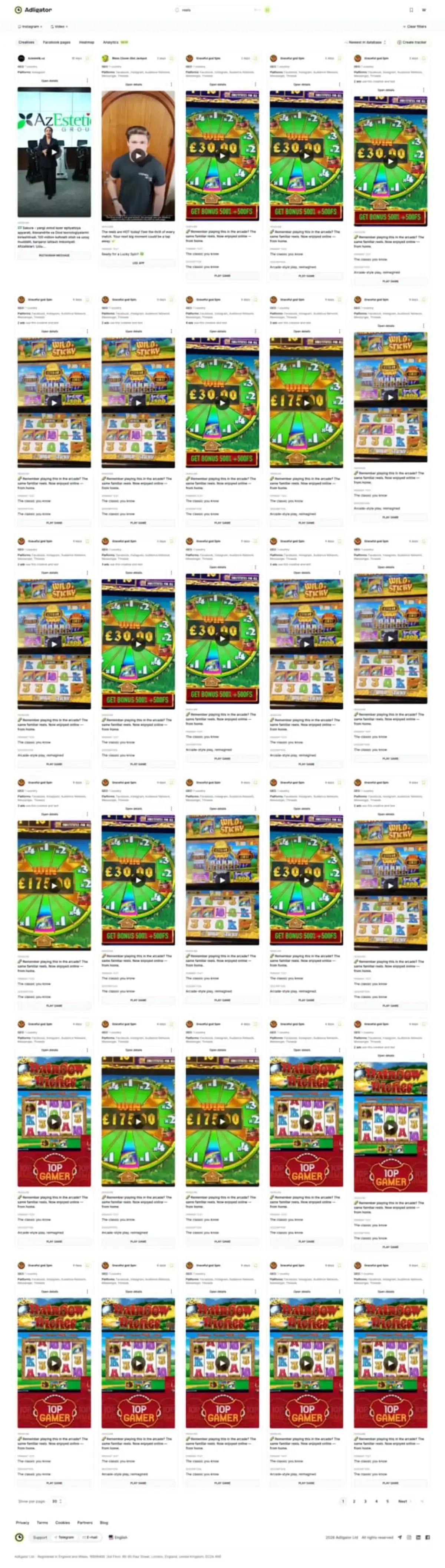 Filtering by video format in Adligator surfaces Reels and Stories ad creatives from competitors.
What to Document for Each Competitor Video Ad
Create a structured analysis for each noteworthy Reels ad:
- Hook type — Which of the hook categories does it use?
- Hook text — What is the exact opening text overlay?
- Duration — How long is the video?
- Production style — UGC, professional, screen recording, animated?
- Text overlays — How many, what font, what style?
- Audio approach — Voiceover, trending music, original audio, or silent?
- CTA type — Button type and verbal CTA
- Days active — Longevity signal for performance
- Geos targeted — Which markets is it running in?
- Ad copy — Primary text, headline, and description fields
Key Metrics: Hook Rate, Watch Time, and Engagement Patterns
While spy tools show you the creative itself, understanding the metrics behind winning Reels ads helps you evaluate what you find.
Hook Rate
Hook rate measures the percentage of viewers who watch past the first 3 seconds. Industry benchmarks for Reels ads:
- Below 25% — Weak hook, needs immediate improvement
- 25-40% — Average performance
- 40-55% — Strong hook, competitive creative
- Above 55% — Exceptional, likely a top performer in its niche
You cannot see competitor hook rates directly, but you can infer performance from longevity. An ad running 30+ days with the same creative almost certainly has a strong hook rate.
Watch Time and Completion Rate
For Reels ads, completion rate correlates with:
- Video length — Shorter videos have higher completion rates but may not deliver enough value
- Pacing — Scene changes every 2-3 seconds maintain attention
- Value density — Each second should advance the narrative or deliver information
- Sound design — Music, sound effects, and voiceover pacing affect retention
Engagement Signals from Spy Tools
Even without direct metric access, spy tools reveal engagement proxies:
- Ad count — "X ads use this creative" suggests the advertiser is scaling (positive signal)
- Geo expansion — More countries means the creative is performing well enough to justify broader targeting
- Duration persistence — Ads that run 30+ days without creative refresh are confirmed winners
- Format replication — If a competitor creates multiple variants of the same concept, the base concept is working
Want to track competitor Reels ads systematically? Start analyzing short-form video ads free with Adligator
Building a Reels Creative Research Workflow
Random browsing of competitor ads wastes time. Here is a structured workflow that delivers consistent insights:
Week 1: Foundation
- Identify top 10-15 competitors in your vertical
- Collect their Facebook page IDs from their page URLs
- Set up searches in Adligator — one per competitor + 2-3 keyword-based searches
- Filter for video format on all searches
- Document baseline — How many video ads are each competitor running? What percentage are Reels-format?
Weekly Cadence (30 Minutes)
Every week, review your saved searches:
- New creatives — What video ads launched this week?
- Longevity check — Which ads from previous weeks are still running? (Mark these as potential winners)
- Hook analysis — Watch the first 3 seconds of each new creative. Categorize the hook type.
- Copy analysis — Read the ad text. Note any new angles or offers.
- Trend spotting — Are multiple competitors shifting to a similar style or approach?
Monthly Deep Dive (1-2 Hours)
Once a month, do a comprehensive analysis:
- Winner compilation — List all competitor ads that ran 30+ days
- Pattern extraction — What hook types, production styles, and CTAs dominate?
- Gap identification — What approaches are competitors NOT using that you could test?
- Creative brief generation — Turn findings into 3-5 new creative briefs for your team
- Trend report — Document shifts in format, style, or messaging across your competitive landscape
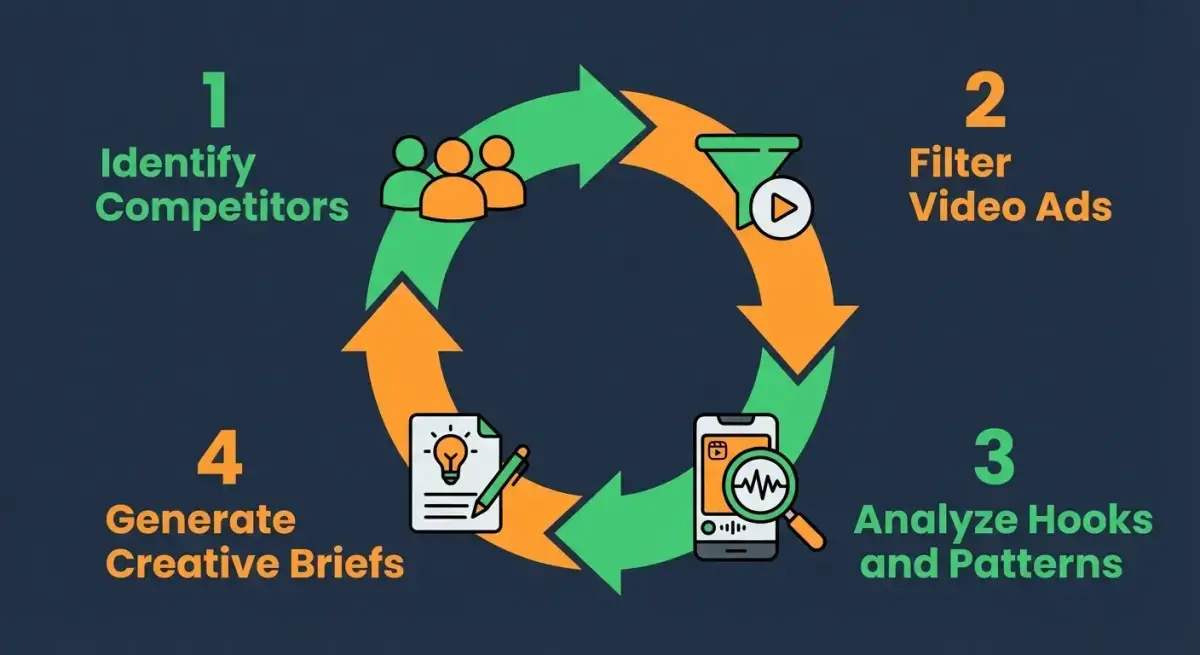 A systematic approach to monitoring competitor Reels ad trends over time.
Using Adligator to Track Short-Form Video Ad Trends
Here is how to set up Adligator specifically for Reels ad intelligence:
Filter Configuration for Reels Research
- Display format: Video (format code 1) — this captures all video creatives including Reels
- Platform: Instagram + Facebook — see cross-platform video strategy
- Days active: Set minimum to 7 for proven creatives, 14+ for confirmed winners
- Last seen active: 7 days — focus on currently running campaigns
- Geo: Your target markets
Tracker Setup Strategy
With Pro (7 trackers) or Team (14 trackers), allocate for video monitoring:
- 3-4 competitor-specific trackers — Top competitors by page ID, filtered to video only
- 2-3 keyword trackers — Industry terms + trending angles, filtered to video
- 1-2 broad trend trackers — Wide keyword searches to catch new entrants
Extracting Video Creative Intelligence
When you find a winning competitor Reels ad:
- Screenshot the thumbnail — First frame often reveals the hook strategy
- Note the ad copy — Headlines and primary text are visible in the search results
- Check the CTA — Button type tells you about the funnel (Learn More = TOFU, Shop Now = BOFU)
- Review the landing URL — Domain and path indicate the conversion goal
- Map the geo spread — Multiple countries suggest a scalable creative
- Track refresh timing — How often does this competitor launch new video variants?
Competitive Benchmarking with Video Data
Build a simple spreadsheet tracking:
| Competitor | Video Ads Active | Avg Duration | Top Hook Types | Primary CTAs | Geo Count |
|---|---|---|---|---|---|
| Competitor A | 12 | 22s | Text-first, UGC | Learn More | 8 |
| Competitor B | 8 | 18s | Pattern interrupt | Shop Now | 4 |
| Competitor C | 23 | 30s | Social proof | Sign Up | 15 |
Update monthly. Over time, this reveals strategic shifts — which competitors are investing more in video, which are pulling back, and which production styles gain traction in your vertical.
Common Mistakes in Reels Ad Research
Avoid these pitfalls when building your competitive intelligence:
- Copying creative without understanding context. A competitor's Reels ad might be part of a retargeting sequence aimed at warm audiences. Running the same creative for cold traffic will underperform.
- Ignoring the audio dimension. Many researchers only look at the visual elements. The sound design, voiceover style, and music choice are critical performance drivers in Reels.
- Focusing only on top competitors. Smaller brands and new entrants often test more aggressively. Some of the most innovative Reels ad approaches come from brands you have not heard of.
- Not tracking creative refresh cycles. How often a competitor launches new Reels ads tells you about their testing velocity and creative production capacity. A brand launching 5 new video ads weekly operates very differently from one launching 2 per month.
- Skipping the landing page analysis. The Reels ad is the top of the funnel. Where does the user go after tapping? The landing page experience matters as much as the creative for overall campaign performance.
FAQ
Can you spy on competitor Reels ads on Instagram?
Yes. Ad spy tools like Adligator index Meta ads across all placements including Reels. You can filter specifically for video format ads running on Instagram to find competitor Reels creatives, see how long they have been active, and analyze their copy and CTA patterns.
What makes a Reels ad effective compared to static image ads?
Reels ads benefit from native-looking content that matches organic Reels. The first 1-3 seconds (the hook) determine whether viewers watch or scroll. Effective Reels ads use movement, text overlays, and a clear value proposition within the opening frames.
How long should a Reels ad be for best performance?
Most top-performing Reels ads are 15-30 seconds. This gives enough time to hook, deliver value, and include a CTA without losing attention. Ads under 10 seconds often lack enough context, while those over 45 seconds see significant drop-off.
Should I create separate Reels ads or repurpose Feed video ads?
Always create Reels-native content. Repurposing landscape or square Feed videos into 9:16 format with cropping produces inferior results. The pacing, framing, and hook strategy for Reels is fundamentally different from traditional video ads. Native Reels content is filmed vertically with close framing, fast cuts, and text overlays designed for the full-screen experience. Cropped Feed videos lose visual quality and feel out of place in the Reels feed, leading to lower hook rates and higher scroll-past rates.
How many Reels ad variants should I test at once?
Start with 3-5 variants using different hook types but the same core message. Let them run for 5-7 days before evaluating. Scale winners and kill underperformers. This mirrors the testing velocity you will see from sophisticated competitors in your spy research.
Conclusion
Reels ads are no longer optional — they are where the majority of Meta ad impressions happen. Media buyers who treat Reels as an afterthought are leaving performance on the table.
The competitive advantage comes from systematic research: knowing which hooks work in your vertical, which production styles resonate, and which competitors are scaling their video creative operations. Manual browsing cannot deliver this at scale. You need reels ads spy tools that filter by video format, track longevity, and let you monitor trends across competitors and markets.
Ready to start analyzing competitor Reels ads? Start analyzing short-form video ads free with Adligator
Related Reading
- Facebook Video Ad Spy: How to Analyze Competitor Video Creatives and Extract Winning Hooks
- Short-Form Video Ads on Facebook and Instagram: Hook Patterns, Optimal Length, and Creative Frameworks That Convert in 2026
- How to Analyze Facebook Ad Creatives by GEO and Vertical: A Data-Driven Approach for Media Buyers
- The Competitor Ad Scorecard: Grade Any Facebook Ad in 5 Minutes Before You Swipe It
