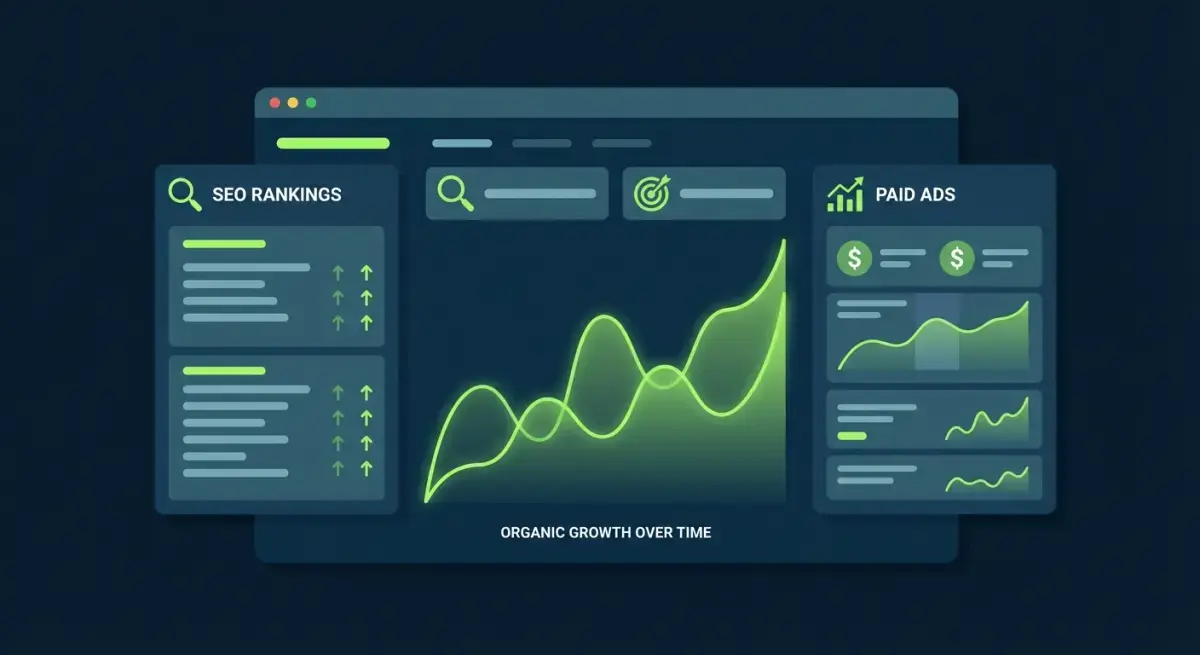
SEO for Media Buyers: How to Build Organic Traffic That Reduces Your Paid Ad Dependency
Every media buyer knows the feeling. CPMs climb quarter after quarter. Platform algorithm changes wipe out your best-performing audiences overnight. One policy update tanks an entire campaign vertical. You are renting attention at prices you do not control.
SEO for media buyers is not about abandoning paid channels. It is about building an organic traffic floor beneath your business so that every dollar in ad spend is a strategic choice, not a survival requirement. The good news: you already have the skills and data to make this work faster than most SEO beginners.
This guide is for media buyers, agency owners, and performance marketers who want to translate their paid campaign expertise into sustainable organic traffic. You will get a practical playbook covering keyword research, content strategy, technical fundamentals, and a 90-day launch plan you can execute alongside your existing paid campaigns.
Rising CPMs across Meta and other paid social platforms mean the math is shifting. Agencies that build organic traffic for agencies and brands today will have a compounding advantage over those that stay entirely dependent on paid acquisition.
Why Media Buyers Should Care About SEO
Media buyers are acquisition specialists. SEO is an acquisition channel. The disconnect between these two worlds is mostly cultural, not structural.
Here is why the gap is closing:
Paid costs are rising, organic costs are falling. Meta CPMs have increased steadily since 2022. Meanwhile, the cost of producing SEO content has dropped significantly with AI-assisted workflows and better tooling. The arbitrage opportunity is real.
Organic traffic compounds. Every article you publish is an asset that can generate traffic for years. Paid spend is linear: stop paying, stop getting traffic. One well-ranked article can deliver the equivalent of hundreds of dollars in monthly PPC value, indefinitely.
Platform risk diversification. If your entire client acquisition funnel depends on Meta or Google Ads, you are one policy change away from disaster. Organic search traffic from Google provides a separate channel with different risk characteristics.
Lower blended CAC. When organic handles your informational and educational traffic, you can focus paid budget on high-intent, bottom-funnel conversions where ROAS is highest. This drops your blended customer acquisition cost significantly.
Client retention for agencies. Agency owners who deliver organic traffic alongside paid results create stickier client relationships. Organic results take time to build, which means clients who leave lose accumulated SEO equity.
The question is not whether media buyers should care about SEO. It is whether you can afford not to when your competitors are already building this capability.
The Media Buyer SEO Advantage: What You Already Know
Most SEO guides assume you are starting from zero. As a media buyer, you are not. You have a significant head start that most SEO practitioners would envy.
You understand keyword intent deeply. Every time you write ad copy, select audience targeting, or analyze search term reports, you are working with intent signals. SEO keyword research is the same skill applied to a different channel. You already know which terms signal buying intent versus research intent.
You have conversion data. Your ad accounts contain a goldmine of keyword-to-conversion data. You know which terms drive purchases, which ones attract tire-kickers, and which audiences have the highest lifetime value. Most SEO teams spend months trying to figure this out.
You think in funnels. TOFU, MOFU, BOFU -- this is your daily vocabulary. Many content marketers create random blog posts without funnel alignment. You naturally think about where a piece of content sits in the buyer journey.
You test and iterate fast. Media buyers are trained to test headlines, copy angles, and creative variations at speed. This mindset translates perfectly to testing meta titles, content angles, and CTA placements in organic content.
You read analytics natively. CTR, conversion rate, bounce rate, time on page -- these metrics are second nature to you. SEO reporting uses the same core metrics, just measured differently.
The skills gap between a media buyer and an SEO practitioner is narrower than most people think. The main difference is timeframe: paid gives you results in hours, SEO in months. But the strategic thinking is the same.
Keyword Research for Performance Marketers
Keyword research for SEO is something you already do in a different context. Here is how to translate your paid keyword skills into an organic content strategy.
Mine Your Existing Ad Account Data
Start with what you already have. Pull your search term reports from Google Ads (if you run search campaigns) and your top-performing ad copy from Meta. Look for:
- High-converting search terms with informational intent. These are terms where people clicked your ad and converted, but the query itself suggests they were researching. These terms are perfect for organic content.
- Consistently winning ad copy angles. If a particular pain point or benefit drives clicks across multiple campaigns, that angle deserves a dedicated blog post or guide.
- Audience overlap patterns. Which interest categories and lookalike audiences perform best? These tell you which topics your ICP cares about.
Build Your Keyword Map
Organize keywords into three buckets:
- Revenue keywords (BOFU): Terms with clear purchase intent. These are your paid priority, but having organic rankings here too means free conversions.
- Consideration keywords (MOFU): Terms where prospects compare solutions, read reviews, or evaluate options. Strong organic territory.
- Awareness keywords (TOFU): Broad educational terms that attract your ICP early. These are expensive to target with paid and perfect for organic content.
For each keyword, note:
- Monthly search volume (use Google Keyword Planner, Ahrefs, or Semrush)
- Current paid CPC (you probably already know this)
- Content format that ranks (guides, lists, tools, comparisons)
- Difficulty estimate
Use Competitor Ad Intelligence for Content Ideas
Here is where media buyer content marketing gets a unique edge. Your competitors are spending money to test which messages resonate. Their longest-running ads represent proven angles that audiences respond to.
Manually checking competitor blogs and ad libraries separately to identify content opportunities works, but it is slow. You would need to cross-reference Facebook Ad Library data with organic rankings, check which landing pages get the most ad spend, and try to spot patterns across dozens of competitors.
The problem: manual cross-referencing of paid ad data with organic content gaps is time-consuming and misses patterns. You might catch the obvious competitor moves but miss the subtle ones that matter most.
 How paid keyword data flows into your organic content pipeline
Prioritize Keywords by Paid Data
Here is a framework for scoring organic keyword targets using your paid data:
| Signal | Weight | Why It Matters |
|---|---|---|
| High CPC in paid | High | Expensive clicks = high organic value |
| High conversion rate | High | Proven buyer intent |
| Competitor bidding heavily | Medium | Validates demand |
| Informational intent | Medium | Easier to rank for |
| Low organic competition | Medium | Faster time to rank |
| Aligns with content cluster | Low | Supports site authority |
Score each keyword opportunity on these signals. Start with the highest-scoring terms for your first content pieces.
Content Strategy That Attracts Your ICP Organically
Having keywords is not enough. You need a content strategy that systematically attracts your ideal customer profile through organic search. Here is how performance marketers should think about content.
Content Clusters, Not Random Posts
Think of your content strategy like a campaign structure. You have:
- Pillar pages (like campaign-level): Comprehensive guides targeting your primary keywords. These are 2000-4000 word pieces that cover a topic thoroughly.
- Cluster articles (like ad set-level): Supporting articles that target long-tail variations and link back to the pillar page.
- Updates and additions (like creative refreshes): Regular updates to keep content current and competitive.
Build clusters around the verticals you serve or the problems your product solves.
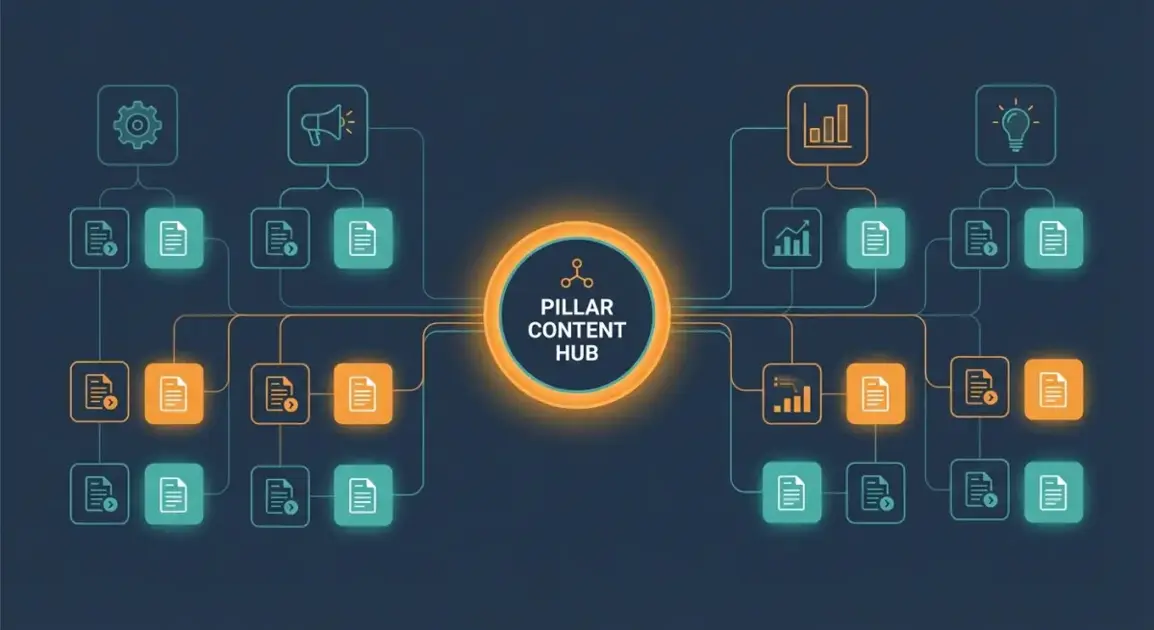 Organizing content clusters around your agency verticals
Match Content Format to Search Intent
Your paid experience already tells you this: the format of your offer matters as much as the message. In SEO:
- "How to" queries need step-by-step guides with actionable instructions
- "Best" or "top" queries need comparison lists with clear evaluation criteria
- "What is" queries need definitional content with practical examples
- "Versus" queries need honest comparison tables with a recommendation
Check what currently ranks for your target keyword. If the top 10 results are all listicles, write a listicle. If they are all comprehensive guides, write a guide. Match the format, then beat the depth.
Apply Ad Copy Testing Insights to SEO Content
Your ad copy A/B test results are directly applicable to SEO. Use them for:
- Meta titles: Your best-performing ad headlines reveal what language resonates with your audience. Use those patterns (power words, number formats, pain-point framing) in your SEO title tags.
- Meta descriptions: Think of these like ad copy. Your click-through rate in organic results depends on how compelling the snippet is. Apply the same copywriting principles you use in ads.
- Content angles: If your "save 40% on acquisition costs" angle beats "grow your business faster" in paid, lead with the cost-saving angle in your organic content too.
Content That Converts, Not Just Ranks
Every piece of content should have a clear conversion path. As a media buyer, you naturally think this way. Apply it to your content:
- Include a relevant lead magnet or tool within each article
- Add contextual CTAs that relate to the content topic
- Use internal links to guide readers deeper into your funnel
- Track content-assisted conversions, not just traffic
Technical SEO Basics for Marketing Agencies
You do not need to become a developer to get technical SEO right. Focus on these high-impact fundamentals.
Site Speed and Core Web Vitals
Think of site speed like ad load time. If your landing page is slow, your Quality Score drops and CPC rises. Same principle in SEO: slow sites rank lower.
Key metrics to monitor:
- Largest Contentful Paint (LCP): Under 2.5 seconds. Compress images, use a CDN.
- Interaction to Next Paint (INP): Under 200ms. Minimize JavaScript.
- Cumulative Layout Shift (CLS): Under 0.1. Set image dimensions, avoid dynamic content shifts.
Use Google PageSpeed Insights to check your current scores. Fix the biggest issues first.
Crawlability and Indexing
Make sure Google can find and index your content:
- Submit an XML sitemap through Google Search Console
- Use clean URL structures (your-domain.com/blog/keyword-rich-slug)
- Avoid duplicate content issues with canonical tags
- Fix broken links and 404 errors regularly
- Ensure your robots.txt file is not blocking important pages
Schema Markup
Add structured data to help Google understand your content type. For blog articles, use Article schema. For FAQ sections, use FAQPage schema. This can earn you rich snippets in search results, which increase click-through rates.
Mobile Optimization
Google uses mobile-first indexing. Your site must work perfectly on mobile devices. As a media buyer, you already know that most social traffic is mobile. Apply the same thinking to your organic content.
How to Combine Paid + Organic for Maximum ROI
The real power of SEO for performance marketers is not replacing paid. It is creating a combined SEO paid social strategy where each channel amplifies the other.
The Paid-to-Organic Flywheel
Here is how the two channels reinforce each other:
- Use paid to test content angles fast. Run small ad campaigns to test which headlines, topics, and angles get the best engagement. Winners become your SEO content priorities.
- Retarget organic visitors with paid. Someone who reads your blog post is a warm lead. Create retargeting audiences from organic traffic and serve them conversion-focused ads.
- Use organic rankings to lower paid costs. When you rank organically for a term, you can reduce paid spend on that term. The organic listing handles awareness traffic while paid targets high-intent variations.
- Use organic content as ad landing pages. Well-written blog posts can outperform traditional landing pages for informational queries. Use them as ad destinations for TOFU campaigns.
Competitive Intelligence: Bridging Paid and Organic
The most valuable insights come from understanding what your competitors do across both channels. Which keywords are they paying for? Which topics are they investing in organically? Where are the gaps?
Adligator reveals which competitor ads run longest, which means those are proven messaging angles that audiences respond to. You can use those insights as SEO content topics: if a competitor has been running the same ad angle for 60+ days, there is clearly demand for that message. Build organic content around that validated topic.
Use Adligator to find competitor content angles and ad-to-organic patterns -- start your free trial
Budget Allocation Framework
As organic traffic grows, reallocate paid budget strategically:
| Organic Maturity Stage | Paid Focus | Organic Focus |
|---|---|---|
| Month 1-3 (Building) | 90% of budget | TOFU content creation |
| Month 4-6 (Growing) | 80% of budget | MOFU content + link building |
| Month 7-12 (Compounding) | 65% of budget | BOFU content + optimization |
| Month 12+ (Mature) | 50% of budget | Content updates + expansion |
These ratios vary by vertical and competition level, but the principle holds: as organic delivers more qualified traffic, shift paid budget toward channels and placements where it has the highest marginal ROAS.
Building Your First SEO Content Calendar
Here is a practical 90-day plan for media buyers launching their first SEO content program.
Days 1-14: Foundation
- Audit existing content (if any) for keyword opportunities
- Pull search term data from ad accounts for keyword research
- Set up Google Search Console and verify your site
- Install Google Analytics 4 with conversion tracking
- Identify 3-5 content clusters aligned to your primary verticals
- Research top 3 competitors and their organic content strategies
- Fix critical technical SEO issues (site speed, mobile, indexing)
Days 15-30: First Content Sprint
- Write and publish 2 pillar pages targeting primary keywords
- Write and publish 4 cluster articles (2 per pillar)
- Optimize existing pages with updated meta titles and descriptions
- Set up internal linking between pillar and cluster content
- Create a content brief template for consistent quality
- Begin outreach for 2-3 relevant backlinks
Days 31-60: Scaling and Optimization
- Publish 6-8 additional cluster articles
- Analyze first 30 days of Search Console data
- Identify quick-win keywords (ranking positions 8-20) and optimize
- Update and expand pillar pages based on search query data
- Launch a retargeting campaign using organic blog visitors as the audience
- Test organic content as ad landing pages for TOFU campaigns
Days 61-90: Measurement and Iteration
- Review organic traffic trends and keyword ranking progress
- Calculate cost-per-organic-visitor versus paid CPC for the same terms
- Identify top-performing content and double down on similar topics
- Prune or consolidate underperforming content
- Plan the next quarter's content calendar based on data
- Report ROI metrics to stakeholders (see next section)
Maintaining Momentum
After the first 90 days, shift to a sustainable cadence:
- Weekly: Publish 1-2 new articles or update existing ones
- Monthly: Review Search Console data, identify new keyword opportunities
- Quarterly: Audit content performance, update content clusters, adjust strategy
Consistency matters more than volume. One high-quality article per week beats five mediocre ones.
Measuring SEO ROI Like a Media Buyer
Media buyers measure everything. Apply that same rigor to SEO. Here are the metrics and frameworks that translate paid-channel thinking into organic performance measurement.
The Metrics That Matter
Traffic metrics:
- Organic sessions (total and by landing page)
- Organic click-through rate (from Search Console)
- Keyword ranking positions for target terms
- Impressions growth over time
Conversion metrics:
- Organic-assisted conversions
- Lead generation from organic traffic
- Revenue attributed to organic visitors
- Email signups from blog content
Efficiency metrics:
- Cost per organic visitor (total SEO investment / organic visits)
- Organic CAC versus paid CAC
- Content ROI (revenue per article over its lifetime)
- Time to rank (how quickly new content gains positions)
ROI Comparison: SEO Compounding vs Paid Linear
Here is the math that makes SEO compelling for performance marketers.
Paid scenario: You spend $5,000/month on Meta ads. You get 10,000 visitors. When you stop spending, traffic goes to zero. Total cost after 12 months: $60,000 for 120,000 total visitors.
SEO scenario: You invest $3,000/month in content creation and optimization. Month 1 delivers 500 organic visitors. But traffic compounds. By month 6, you are getting 5,000 monthly organic visitors. By month 12, you are getting 15,000. Total cost after 12 months: $36,000 for approximately 90,000 total visitors -- and the traffic continues growing even if you reduce investment.
Blended scenario: You run both. Paid handles immediate-need traffic and testing. Organic builds a growing baseline. By month 12, your blended CAC is 30-40% lower than paid-only because organic delivers an increasing share of qualified visitors at a declining marginal cost.
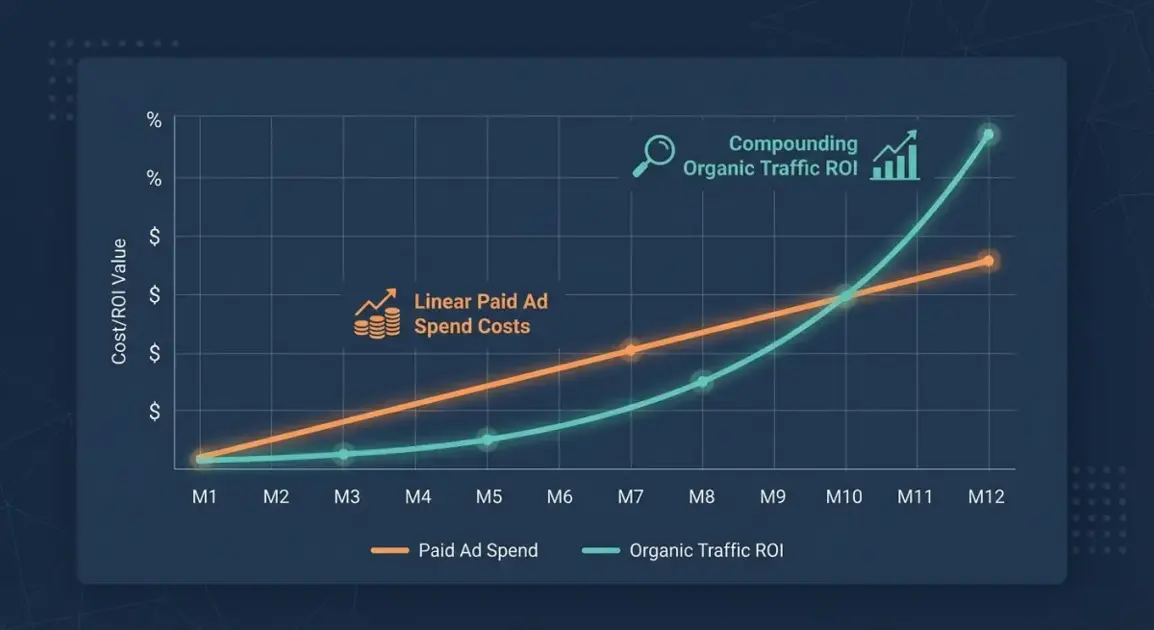 Paid spend is linear. Organic traffic compounds. This is the ROI math that matters.
Building Your SEO Dashboard
Create a monthly reporting dashboard that includes:
- Organic traffic trend (month-over-month and year-over-year)
- Keyword ranking distribution (how many keywords in top 3, top 10, top 20)
- Organic conversions and revenue
- Blended CAC (paid + organic combined)
- Content production metrics (articles published, words written, backlinks earned)
- Paid budget offset (estimated paid spend saved due to organic coverage)
The "paid budget offset" metric is particularly powerful for agency owners reporting to clients. It shows the tangible dollar value of organic rankings by comparing what those clicks would cost in Google Ads.
Common Measurement Mistakes
Avoid these traps when evaluating SEO performance:
- Judging too early. SEO takes 3-6 months to show meaningful results. Do not kill the program after 30 days because you did not see a spike.
- Ignoring assisted conversions. Many organic visitors convert later through paid retargeting or direct visits. Use multi-touch attribution to capture the full value.
- Comparing apples to oranges. Paid traffic and organic traffic have different conversion patterns. Organic visitors often convert at lower rates on the first visit but have higher lifetime values.
- Overlooking branded search. As your content marketing builds brand awareness, branded search volume increases. This is an indirect SEO benefit that does not show up in non-branded keyword reports.
FAQ
Can media buyers do SEO without a dedicated SEO team?
Yes. Media buyers already understand keyword intent, audience targeting, and conversion optimization. These skills transfer directly to SEO. Start with content built around your highest-converting paid keywords and expand from there. You may want to bring in a technical SEO specialist for site audits, but the content strategy and keyword research are well within your existing skill set.
How long does it take for SEO to reduce paid ad dependency?
Expect 3-6 months before organic traffic starts meaningfully offsetting paid spend. SEO compounds over time, so by month 12 you may see 20-40% of qualified traffic arriving organically for topics you previously paid to reach. The exact timeline depends on your domain authority, competition level, and content quality.
What is the best SEO strategy for a media buying agency?
Focus on content clusters around the verticals you serve. Use your paid campaign data to identify high-converting keywords, then build organic content targeting those same terms. This creates a dual-channel approach where paid and organic reinforce each other. Prioritize topics where you can demonstrate genuine expertise and provide actionable value.
Should media buyers stop running paid ads once organic traffic grows?
No. The goal is not to replace paid with organic but to build a blended strategy. Organic reduces your floor cost for traffic acquisition while paid lets you scale quickly for launches, promotions, and new audiences. The combination lowers overall CAC and reduces platform dependency risk.
Conclusion
SEO for media buyers is not a career change. It is a channel expansion that leverages the skills, data, and strategic thinking you already have. Your paid campaign experience gives you a genuine advantage: you understand intent, you test relentlessly, and you measure everything. Those are exactly the traits that separate successful SEO programs from the ones that stall out.
The path is straightforward. Start with your existing paid data to identify keyword opportunities. Build content clusters around your highest-value topics. Combine paid and organic so each channel amplifies the other. Measure results with the same rigor you apply to ROAS and CPA.
The agencies and media buyers who build organic traffic now will have a compounding advantage that grows every month. Those who stay purely dependent on paid will keep paying more for the same results.
Start by understanding what your competitors are doing across both paid and organic. Which ad angles have they validated with months of spend? Which content gaps exist that you can fill?
Ready to apply this workflow? Use Adligator to find competitor content angles and ad-to-organic patterns -- start your free trial
Discover what keywords your competitors are targeting in both paid and organic
Related Reading
- Programmatic Advertising Strategy: A Performance Marketer's Guide to DSPs and RTB
- How to Use Ad Spy Tools for Agency Client Onboarding: Competitive Audit Workflow for Media Buyers
- How to Analyze Facebook Ad Creatives by GEO and Vertical: A Data-Driven Approach for Media Buyers
- How to Build a Competitive Ad Intelligence Dashboard: Automated Reporting for Media Buying Teams
- How to Build a Media Buying KPI Dashboard: Metrics, Templates, and Reporting Workflow
