
Short-Form Video Ads on Facebook and Instagram: Hook Patterns, Optimal Length, and Creative Frameworks That Convert in 2026
Short-form video dominates Meta's ad ecosystem in 2026. Reels placements now account for over 50% of Instagram ad impressions, and Facebook's video-first feed algorithm prioritizes motion over static. If you are still running only image ads, you are competing with one hand tied behind your back.
But creating short form video ads facebook that actually convert is harder than it looks. You have roughly 3 seconds before a user decides to keep scrolling. Your hook has to interrupt the pattern, your message needs to land fast, and your CTA must feel like a natural next step — all in 15-30 seconds.
This guide breaks down the specific hook patterns, optimal video lengths, and creative frameworks that top advertisers use to drive conversions with short-form video ads on Facebook and Instagram in 2026. No theory — just actionable patterns you can apply to your next campaign.
Why Short-Form Video Outperforms Static Ads
Before diving into tactics, it is worth understanding why video ads consistently outperform static images in Meta's current ecosystem.
The algorithm advantage: Meta's ranking system gives video content higher initial distribution because video generates more engagement signals (watch time, replays, shares). Video ads get more impressions per dollar in most auction environments.
The attention advantage: Motion captures attention in a way static images cannot. In a feed full of text and photos, a moving image creates a pattern interrupt that draws the eye.
The information density advantage: A 15-second video can communicate a problem, solution, social proof, and CTA — the same messaging that would require a multi-image carousel or long-form copy in static formats.
The performance numbers:
- Video ads average 20-30% lower CPA than static image ads for direct-response campaigns
- Reels ads specifically show 15-25% higher conversion rates compared to feed placements
- Videos with strong hooks (3-second retention above 65%) outperform weak-hook videos by 3-5x on downstream metrics
- Instagram Reels reach 35% more unique accounts than feed-only campaigns at the same budget level
- Cost per ThruPlay (15-second view) has decreased 15% year over year as Meta prioritizes video inventory
These advantages compound with creative quality. A bad video ad is worse than a good static ad. But a good video ad beats everything else.
The opportunity is clear, but so is the challenge. Creating video ads that convert requires understanding the specific patterns that work on Meta's platforms — not YouTube best practices, not TikTok trends (though there is overlap), but Meta-native creative strategies.
The 5 Proven Hook Patterns That Stop the Scroll
The hook — your first 3 seconds — determines whether your ad lives or dies. Research across thousands of video ads reveals five hook patterns that consistently produce high 3-second retention rates.
1. The Question Hook
Open with a question that highlights a pain point your audience recognizes.
Pattern: "Still doing painful thing?" or "Why do audience segment fail at X?"
Examples:
- "Still guessing which Facebook ads to run?" (ad spy tool)
- "Why do 80% of Shopify stores fail in the first year?" (e-commerce course)
- "Spending more than $50 per lead?" (SaaS lead gen)
Why it works: Questions activate the brain's answer-seeking instinct. If the question matches a real frustration, the viewer pauses to hear the answer.
2. The Transformation Hook
Show a before/after result immediately.
Pattern: Open with the end result (the "after"), then cut to the process.
Examples:
- Show a dashboard with high ROAS numbers, then cut to "Here's how"
- Show a transformed space/product/result in the first frame
- "I went from $0 to $10K/month in 90 days" with visual proof
Why it works: Transformation creates curiosity about the "how." The viewer has seen the end state and wants the path.
3. The Pattern Interrupt
Do something visually unexpected that breaks the scroll pattern.
Pattern: Unusual visual, movement, or juxtaposition that does not look like a typical ad.
Examples:
- Start with a close-up of an unusual action (smashing something, extreme zoom)
- Use a green screen or AR effect that creates visual dissonance
- Begin mid-conversation as if the viewer walked into a room
- UGC-style "talking head" that feels like organic content, not an ad
Why it works: The brain is trained to ignore patterns (banner blindness). Anything that breaks the expected pattern triggers attention.
4. The Social Proof Hook
Lead with proof that others have already succeeded.
Pattern: "X people have already achieved result" or show testimonial immediately.
Examples:
- "12,000 media buyers use this tool daily" (with visual counter)
- Customer testimonial starting with the result: "I cut my CPA by 40%"
- Screenshots of positive reviews or results as the opening frame
Why it works: Social proof reduces skepticism immediately. If others have succeeded, the viewer's risk perception drops.
5. The Urgency/Scarcity Hook
Create time pressure in the first frame.
Pattern: "This deal/method/window is closing" or "Only X left"
Examples:
- "Meta just changed their algorithm — here's what you need to know"
- "This pricing ends Friday" (countdown overlay)
- "They just released this feature and nobody's talking about it"
Why it works: Loss aversion is powerful. The fear of missing something relevant creates an impulse to watch.
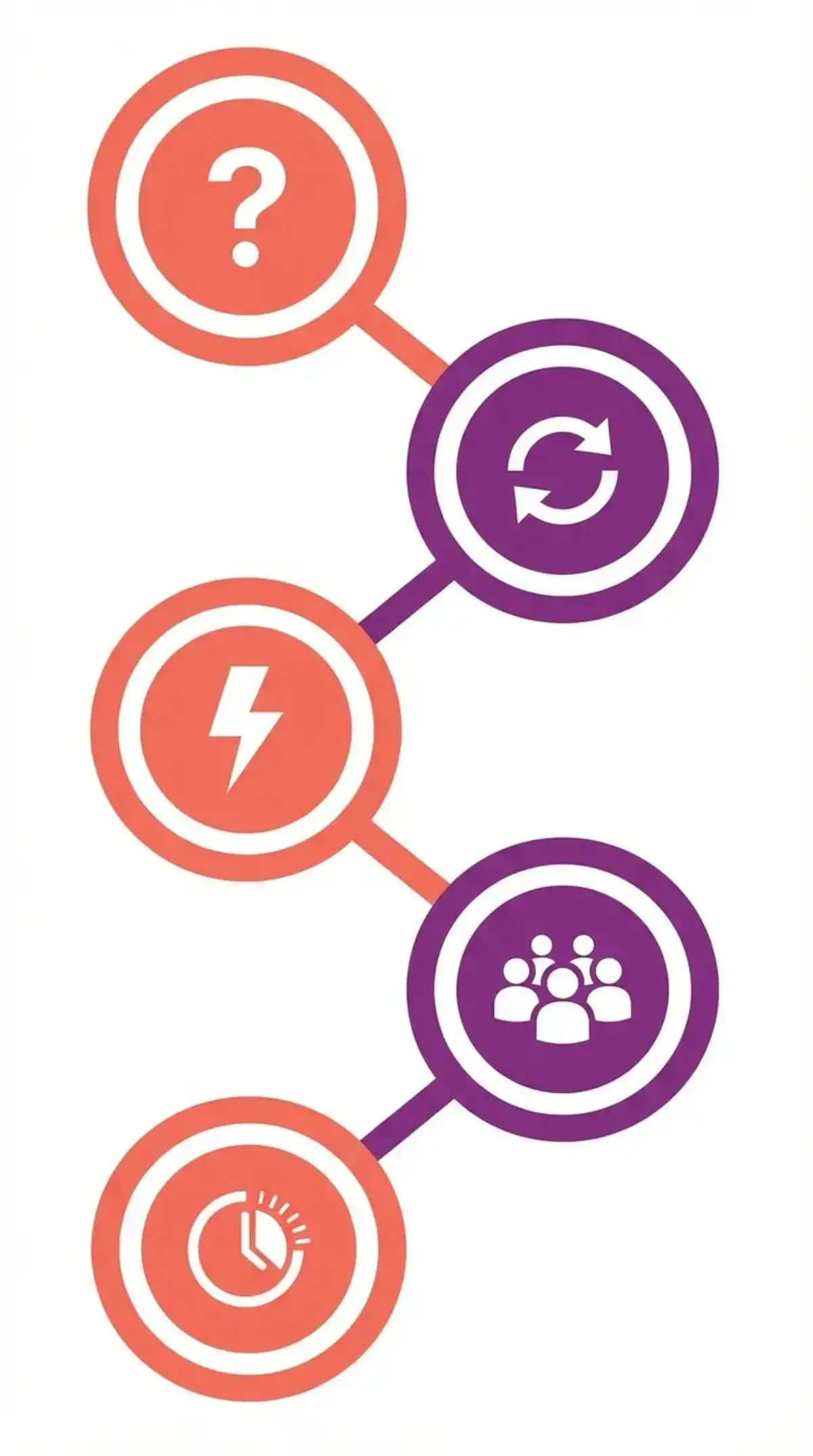 Five proven hook patterns that stop the scroll in the first 3 seconds of your video ad
Hook Testing Protocol
For every video concept, create at least 3 hook variations using different patterns. Keep the body and CTA identical — change only the first 3 seconds. This isolates the hook's impact.
Metrics to compare:
- 3-second video view rate (% of impressions that watch 3+ seconds) — target 65%+
- Hook-to-hold ratio (3-second views / ThruPlays) — shows how well the hook connects to the body
- CPA by hook variant — the ultimate measure
Optimal Video Ad Length: What the Data Shows
There is no single "best" length. The optimal length depends on your campaign objective, placement, and audience temperature.
Length by Campaign Objective
| Objective | Optimal Length | Why |
|---|---|---|
| Direct response (Purchase, Lead) | 15-30 seconds | Enough time for problem→solution→CTA without losing attention |
| Awareness / Reach | 6-15 seconds | Maximum impression frequency at low cost, builds familiarity |
| Retargeting | 10-20 seconds | Audience already knows you — go straight to the offer |
| App Install | 15-25 seconds | Show the app experience quickly with clear download CTA |
| Engagement | 30-60 seconds | Longer content drives shares and comments for algorithm boost |
Length by Placement
| Placement | Recommended Max | Notes |
|---|---|---|
| Instagram Reels | 15-30 seconds | 90-second max, but most successful ads are under 30s |
| Facebook Reels | 15-30 seconds | Same dynamics as Instagram Reels |
| Instagram Stories | 15 seconds per card | Use multi-card for longer messages |
| Facebook Feed | 15-45 seconds | More tolerance for longer content than Reels |
| Audience Network | 15 seconds | Shorter works better on third-party placements |
The 3-Second Rule
Regardless of total length, the first 3 seconds are disproportionately important:
- 65% of people who watch 3 seconds will watch at least 10 seconds
- Only 15-20% of viewers make it past the first 3 seconds of an average ad
- The gap between a good and bad hook at 3 seconds translates to 3-5x difference in downstream conversion
Practical takeaway: Spend 80% of your creative energy on the first 3 seconds. The rest of the video matters, but only for the audience that your hook already captured.
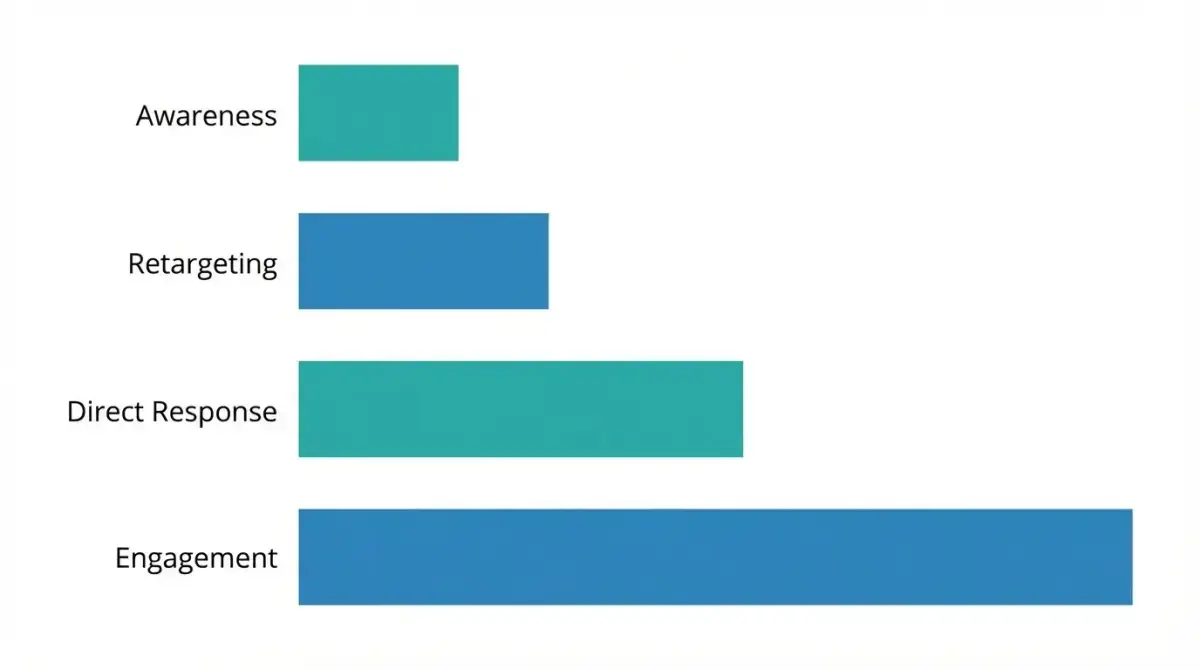 Video ad length sweet spots by campaign objective — shorter is not always better
The 3-Part Video Ad Framework
Every high-performing short-form video ad follows this three-part structure:
Part 1: The Hook (0-3 seconds)
- Use one of the five hook patterns above
- Show the most compelling visual or statement first
- No logos, no intros, no brand names — hook first, brand later
- Match the visual style to organic content (UGC, native Reels format)
Part 2: The Body (3-20 seconds)
- Deliver on the hook's promise (if you asked a question, answer it)
- Show the product/service in action solving the stated problem
- Use quick cuts (every 2-3 seconds) to maintain visual interest
- Include one proof point (stat, testimonial, demonstration)
- Transition naturally into the value proposition
Part 3: The CTA (Final 3-5 seconds)
- Clear, specific action ("Tap Shop Now to get 20% off")
- Reinforce the core benefit one final time
- Display the offer/price/deal visually
- End card with logo + CTA button alignment
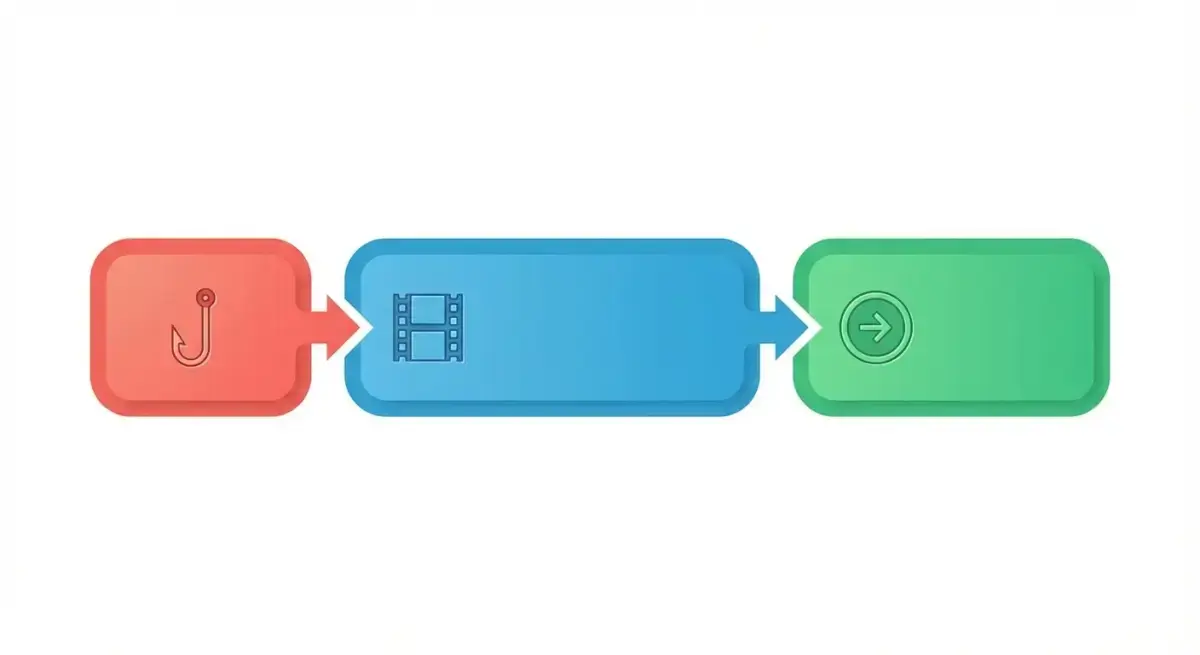 The three-part framework for structuring high-converting short-form video ads
Advanced Framework Variations
The Problem-Agitation-Solution (PAS) Video:
- Hook: State the problem dramatically
- Body: Agitate — show the consequences of not solving it
- CTA: Present your product as the solution
The Demo Video:
- Hook: Show the end result
- Body: Quick demonstration of how to achieve it
- CTA: "Get started" or "Try it yourself"
The UGC Testimonial Video:
- Hook: Customer's most impressive result ("I made $X in Y days")
- Body: Brief story of their experience
- CTA: "Join X others who already switched"
Want to see which video ad hooks are working right now in your niche? Filter competitor ads by video format to study hooks, lengths, and creative patterns at scale. See which video ad formats and hooks are working right now → Try Adligator free
Production Tips for High-Performance Video Ads
You do not need a production studio. The best-performing video ads in 2026 often look native — like organic content, not polished commercials.
Technical Requirements
- Aspect ratio: 9:16 primary (vertical), 1:1 secondary (square)
- Resolution: 1080×1920 minimum for vertical
- File size: Under 4GB (Meta limit), but keep under 100MB for faster processing
- Format: MP4 or MOV with H.264 compression
- Captions: Always — 85% of video is watched muted. Use bold, high-contrast text (not Meta's auto-generated captions)
Low-Budget Production That Works
- Smartphone filming: iPhone or Android with good lighting produces broadcast-quality video. Natural light or a $30 ring light is sufficient.
- Screen recordings: For SaaS, fintech, and digital products — show the product in use with voiceover
- UGC creators: Platforms like Billo and Insense connect you with UGC creators for $50-200 per video
- Template-based motion graphics: Tools like Canva Pro and CapCut produce polished short-form videos with templates
- Repurposed organic content: Take your best-performing organic Reels and add a CTA card at the end
Editing Techniques That Boost Performance
- Jump cuts every 2-3 seconds — maintains visual novelty and keeps attention
- Zoom-ins on key moments — draws focus to important points
- Text overlays on key claims — reinforces messaging for sound-off viewers
- B-roll cutaways — show the product/result while narrating
- Speed ramping — slow-motion on impact moments, fast-forward on transitions
Studying Competitor Video Ads at Scale
The fastest way to develop a winning video creative strategy is studying what already works for competitors.
What to analyze in competitor video ads:
- Hook type — Which of the five patterns do they use? What visual opens the video?
- Length — How long are their longest-running video ads?
- Format — UGC vs produced vs screen recording vs animation
- CTA approach — Verbal CTA, text overlay, end card, or all three?
- Messaging angle — Problem-focused, benefit-focused, or comparison-focused?
- Longevity signal — Videos running 14+ days are likely converting. Study these first.
With Adligator, you can filter ads by video format specifically, then sort by days active to find the proven winners. This gives you a systematic creative research process instead of random feed scrolling.
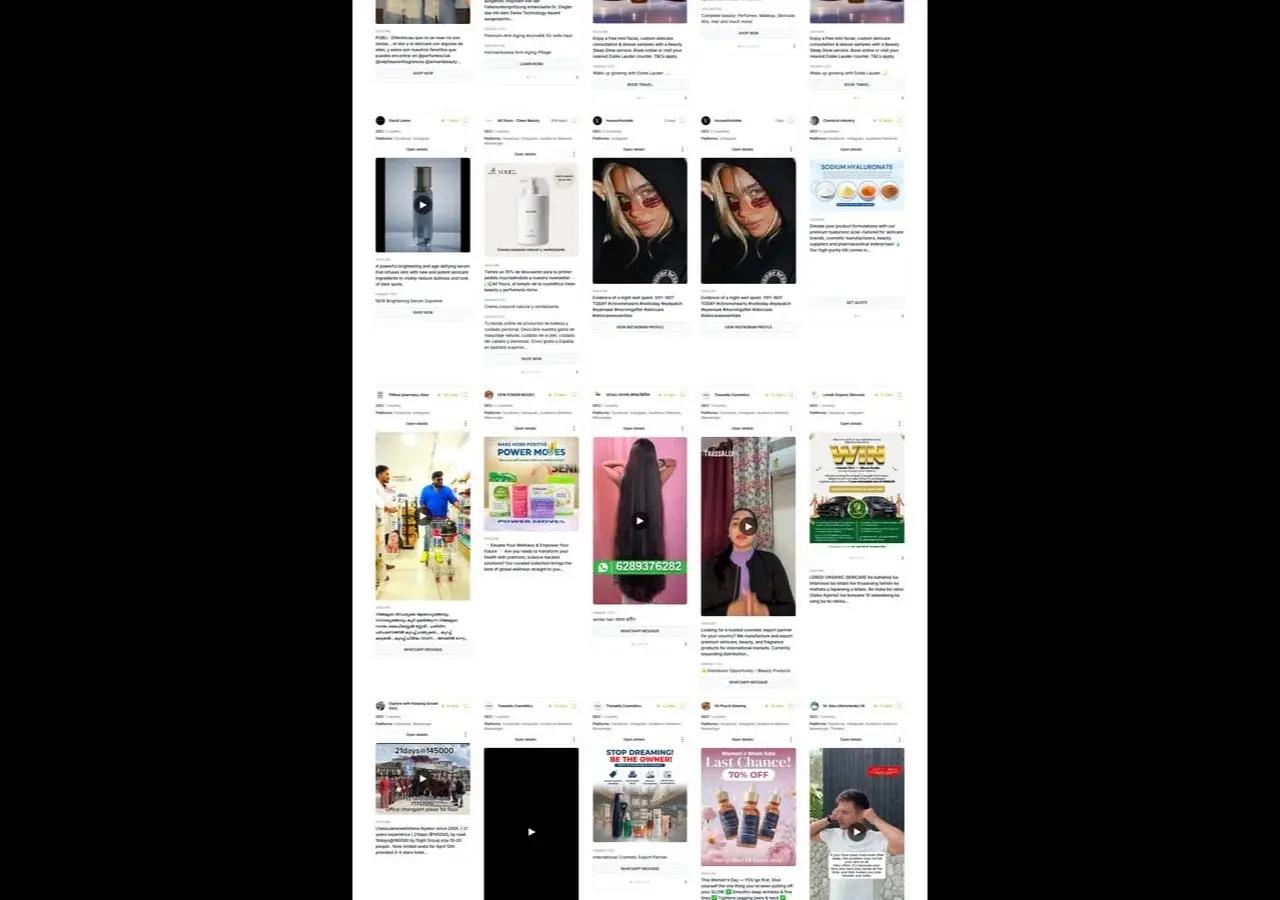 Filter competitor ads by video format in Adligator to study hooks, lengths, and creative patterns at scale
Video Ad Creative Testing Strategy
Creating video ads is only half the equation. You need a systematic testing process to find winners and scale them.
The 3×3 Testing Matrix
For each product or offer, create a testing matrix:
- 3 different hooks (question, transformation, pattern interrupt)
- 3 different body angles (demo, testimonial, problem-solution)
- 1 consistent CTA (keep this constant to isolate creative variables)
This gives you 9 creative variants to test. Launch all 9 in an ABO campaign with equal budgets per ad. After 5-7 days, you will have clear signals on which hook + body combinations resonate.
Creative Iteration Process
Once you find a winning combination:
- Scale the winner — move it to your main campaign or Advantage+ creative pool
- Create 3 more hooks for the winning body — your best body with new hooks often finds additional winning combinations
- Vary the format — if a UGC testimonial won, try the same message as a screen recording or animated version
- Test different lengths — create 15s, 25s, and 45s versions of the winning script to find the optimal length for each placement
- Refresh every 2-3 weeks — even winners fatigue. Monitor frequency and CPA trends to know when to replace
Creative Volume Benchmarks
How many video creatives should you produce?
| Monthly Ad Spend | New Creatives Per Month | Active at Any Time |
|---|---|---|
| Under $5K | 5-10 videos | 3-5 |
| $5K-$25K | 10-20 videos | 5-10 |
| $25K-$100K | 20-40 videos | 10-20 |
| Over $100K | 40+ videos | 20+ |
These numbers seem high, but remember: most creatives will not be winners. You need volume to find the 2-3 that will drive 80% of your results. Lower-quality, higher-volume production (UGC, template-based) enables this without massive budgets.
Performance Benchmarks by Vertical
Use these as starting reference points for your video ad metrics:
| Vertical | Good 3s Retention | Good CTR | Good CPA Range |
|---|---|---|---|
| E-commerce (general) | 60%+ | 1.5%+ | $15-40 |
| SaaS / B2B | 55%+ | 0.8%+ | $30-80 |
| App install | 65%+ | 2.0%+ | $2-10 |
| Lead gen (services) | 55%+ | 1.0%+ | $10-50 |
| Info products / courses | 60%+ | 1.2%+ | $20-60 |
These benchmarks vary by GEO, season, and competition level. Use them as directional guides, not absolute targets.
Common Video Ad Mistakes
Mistake 1: Logo-First Intros
Starting with a 2-second logo animation kills 50%+ of your audience before the message even begins. Brand last, hook first. Always.
Mistake 2: Music-Dependent Messaging
If your ad does not work on mute, it does not work on Facebook. Design for sound-off first, enhance with sound second.
Mistake 3: One Hook Per Concept
The hook is the highest-leverage variable. Testing one hook per video concept leaves massive performance on the table. Create 3-5 hook variants for every body + CTA combination.
Mistake 4: Treating Reels Like Feed Ads
Reels have a different consumption pattern — faster scrolling, native format expectations, and different audience mindset. Create Reels-native content (vertical, fast-paced, trends-aware), not repurposed feed content.
Mistake 5: Ignoring Audio Design
While designing for mute is essential, 50%+ of Reels viewers do have sound on. Trending audio, ASMR product sounds, and strong voiceover can significantly boost engagement when sound is active.
Mistake 6: No Clear CTA
Ending your video with your logo and no next step wastes the attention you earned. Tell viewers exactly what to do: "Tap Shop Now," "Link in bio," "Swipe up." Make the CTA verbal, visual (text overlay), and aligned with the Meta CTA button on the ad.
Mistake 7: Same Creative for All Placements
A feed video ad does not work in Reels. A Reels ad does not work in Stories. Use Meta's placement asset customization to provide format-optimized versions for each placement. At minimum, create separate versions for feed (1:1 or 4:5) and Reels/Stories (9:16).
Mistake 8: Testing Too Many Variables at Once
If you change the hook, body, CTA, and thumbnail simultaneously, you cannot attribute performance differences to any single element. Change one variable at a time. The recommended testing priority: hook first, then body angle, then CTA, then length, then format.
FAQ
What is the ideal length for Facebook video ads?
For direct-response campaigns, 15-30 seconds performs best. The key metric is not total length but whether your hook captures attention in the first 3 seconds. For awareness campaigns, 6-15 seconds can work well. Reels ads perform best at 15-30 seconds with a strong visual hook in the opening frame.
Do vertical or horizontal video ads perform better?
Vertical (9:16) videos outperform horizontal on mobile placements, which account for 95%+ of Facebook and Instagram impressions. Always create vertical as your primary format. If you need to run on desktop placements, create a square (1:1) version as a secondary option.
How many hook variations should I test per video ad?
Test 3-5 hook variations for each core video concept. The hook is the highest-leverage element — the same body and CTA with different hooks can produce 2-5x differences in performance. Use Meta's dynamic creative or separate ad variants to test hooks systematically.
Should I add captions to video ads?
Yes, always. 85% of Facebook video is watched without sound. Captions increase watch time by 12% on average and are essential for accessibility. Use bold, high-contrast captions — not Meta's auto-generated ones, which are often inaccurate and visually weak.
Conclusion
Short form video ads facebook are the highest-performing ad format on Meta's platforms in 2026. The formula is straightforward: hook in the first 3 seconds using proven patterns, deliver your message in 15-30 seconds with quick cuts and clear proof points, and close with a specific CTA.
Test 3-5 hook variations for every video concept. Produce in vertical format first. Design for sound-off with bold captions. And study what competitors are doing with their video ads — longevity signals which creative approaches are converting.
Ready to see which video ad hooks and formats are converting in your niche? Try Adligator free
Research competitor video ad creatives with Adligator
Related Reading
- Facebook Ad Format Analysis: What Spy Tools Reveal About Carousel vs Video vs Static Performance in 2026
- Facebook Video Ad Spy: How to Analyze Competitor Video Creatives and Extract Winning Hooks
- Facebook and Instagram Reels Ads Analysis: How to Spy on Competitor Short-Form Video Creatives
- How Many Ad Creatives Do You Need for Facebook Ads? A Data-Driven Framework by Budget Level (2026)
