
How to Spy on Competitor Facebook Ads by Industry: Vertical-Specific Research Strategies
Most ad spy guides treat competitor research as a one-size-fits-all exercise: search for a competitor, look at their ads, take notes. But a dropshipping brand and a B2B SaaS company operate in completely different worlds. Their ad formats, CTAs, compliance requirements, seasonal patterns, and success signals are fundamentally different.
If you spy on competitor Facebook ads by industry without accounting for these differences, you'll draw the wrong conclusions. An ad running for 90 days in e-commerce probably signals a winning product. The same longevity in insurance might just mean a compliance-approved evergreen campaign.
This guide provides vertical-specific research strategies for five major industries, each with different patterns to track, metrics to prioritize, and pitfalls to avoid.
Why One-Size-Fits-All Spy Research Fails
Generic ad research produces generic insights. Here's why vertical context matters:
Different success signals. In e-commerce, high creative velocity (many new ads per week) signals aggressive testing. In SaaS, it might signal churn problems and desperate acquisition. Same data, opposite conclusions.
Different formats dominate. E-commerce lives on carousels and short UGC videos. SaaS relies on screen recordings and founder-talking formats. Finance uses compliant static images with careful copy. Applying e-commerce creative playbooks to SaaS wastes budget.
Different compliance landscapes. Running health claims that work for a supplement brand would get a finance advertiser banned. Regulated verticals have invisible rules that reshape entire creative strategies.
Different funnel structures. E-commerce is often single-click purchase. SaaS requires multi-touch funnels with demos, trials, and nurture sequences. Your competitor research needs to map to the actual buying journey, not just the top-of-funnel ad.
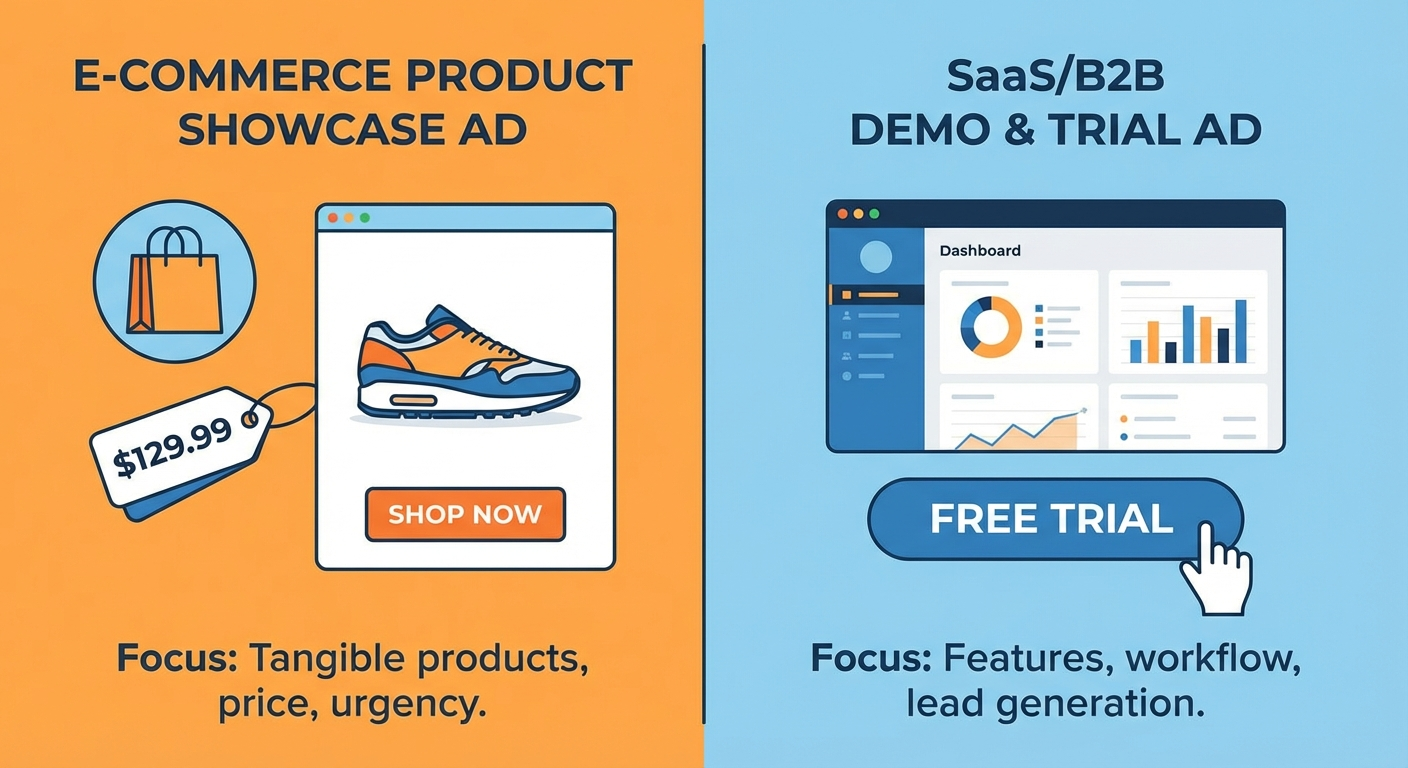 E-commerce and SaaS ads follow fundamentally different creative patterns
What to track per vertical (overview):
| Metric | E-Commerce | SaaS | Finance | Health | Education |
|---|---|---|---|---|---|
| Primary format | Carousel, UGC video | Screen recording, demo | Compliant static | UGC testimonial | Webinar/lead magnet |
| Key CTA | Shop Now, Get Offer | Start Free Trial | Learn More, Apply | Shop Now, Learn More | Sign Up, Enroll |
| Longevity signal | Winner product | Stable funnel | Compliance approved | Validated claims | Evergreen content |
| Seasonal spikes | Q4, holidays | Q1 (new budgets) | Tax season, enrollment | New Year, summer | Back-to-school, Q1 |
| Creative velocity | Very high | Moderate | Low | Moderate | Low-moderate |
E-Commerce and Dropshipping: What to Look For
E-commerce is the most saturated vertical on Facebook, which means the competitive intelligence game is both more important and more nuanced.
Key patterns to track:
1. Product discovery signals. When a competitor suddenly launches 10–20 new ads featuring a product you haven't seen before, that's a product test. If those ads survive 7+ days, the product is likely showing positive metrics. If they survive 30+ days, it's a proven winner.
2. Price and offer testing. Watch for the same product shown at different price points or with different offers (free shipping, bundle deals, percentage off). The surviving variant reveals the winning price/offer combination.
3. Creative format split. Track the ratio of carousel vs. video vs. static for each competitor. In 2026, UGC product demo videos and carousel ads dominate for e-commerce, but the exact mix varies by product category:
- Fashion/apparel: heavy on UGC try-on videos
- Electronics: product demo + comparison carousels
- Beauty: before/after UGC + ingredient-focused carousels
- Home goods: lifestyle context UGC + room scene imagery
4. Landing page patterns. The CTA destination tells you about the funnel. "Shop Now" leading to a product page means direct conversion. "Learn More" leading to a landing page suggests a pre-sell funnel — common for higher-ticket or novel products.
5. Retargeting creative. Look for ads from the same brand with different messaging angles — social proof ads, urgency/scarcity ads, objection-handling ads. These typically indicate retargeting sequences, revealing the full funnel structure.
E-commerce research checklist:
- Track new product launches (new product images = new test)
- Log offer/discount patterns (what % off, bundle vs. single)
- Monitor creative format distribution (video vs. carousel vs. static)
- Note CTA destination patterns (product page vs. landing page)
- Identify retargeting sequences (different angles, same brand)
- Check seasonal ramp patterns (when do they increase volume?)
SaaS and B2B: Long-Funnel Intelligence
SaaS competitor research is fundamentally different because the buying cycle is longer and the funnel is more complex.
Key patterns to track:
1. Top-of-funnel content ads. Many SaaS companies run educational content (blog posts, guides, webinars) as their Facebook ad entry point. Track which content topics get promoted — this reveals their keyword and audience strategy.
2. Demo vs. free trial positioning. Watch whether competitors push "Book a Demo" (sales-led) or "Start Free Trial" (product-led). Changes in CTA over time signal strategic shifts in go-to-market approach.
3. Pain-point messaging angles. SaaS ads almost always lead with a pain point. Track which problems competitors emphasize. If three competitors all run ads about "time wasted on manual reporting," that's a validated pain point worth targeting.
4. Social proof hierarchy. Note the type of social proof used: company logos, user count ("50,000 teams use…"), specific metrics ("saved 12 hours/week"), or customer testimonials. The hierarchy reveals positioning strategy.
5. Feature vs. outcome messaging. Track whether competitors lead with features ("AI-powered dashboard") or outcomes ("cut reporting time by 80%"). Outcome-led messaging typically outperforms, and you'll see this reflected in ad longevity.
SaaS research checklist:
- Map the full funnel (awareness ad → content → retargeting → trial/demo CTA)
- Track CTA changes over time (demo vs. trial vs. pricing)
- Log pain-point messaging angles per competitor
- Note social proof types and specificity level
- Monitor content promotion patterns (which topics get ad spend?)
- Identify feature launch campaigns (new product = new ad burst)
Finance and Insurance: Compliance-Aware Research
Finance advertising on Facebook operates under strict compliance constraints that fundamentally shape creative strategy. If you're not compliance-aware in your research, you'll misread the signals.
Key patterns to track:
1. Compliance language patterns. Every finance ad includes specific disclaimer language. Track the exact phrasing competitors use — this reveals what Meta's review team approves. Common patterns include:
- "Subject to eligibility"
- "Terms and conditions apply"
- "Past performance is not indicative of future results"
- State-specific licensing disclosures
2. Claim boundaries. Watch how competitors frame benefits without making prohibited guarantees. The difference between "may help reduce costs" and "will save you money" determines whether an ad survives review. Long-running ads reveal approved claim boundaries.
3. CTA restrictions. Finance ads rarely use "Buy Now" or "Shop Now." Instead, they use "Learn More," "Get Quote," "Apply Now," or "See If You Qualify." Track which CTAs are used by successful competitors — this reflects what passes Meta's financial services ad policies.
4. Creative conservatism. Finance tends toward static images and clean design rather than UGC or edgy video. This isn't because UGC doesn't work — it's because compliance review is faster and more predictable for static formats. Monitor competitors who successfully run UGC in finance; they've found an approved approach worth studying.
5. Seasonal campaigns. Insurance enrollment periods, tax season, end-of-financial-year — finance advertising has distinct seasonal peaks. Track when competitors ramp spending to identify their calendar.
Want to filter competitor ads by your exact vertical? Filter competitor ads by your exact vertical with Adligator — start free
Health and Wellness: Claim Patterns and Angles
Health advertising is the most compliance-sensitive vertical on Facebook. Meta actively restricts health claims, body image messaging, and before/after imagery. Your research must account for these invisible rules.
Key patterns to track:
1. Claim hedging language. Successful health advertisers use specific hedging patterns:
- "May help support…" instead of "Cures…"
- "Results may vary" as mandatory disclaimer
- "As part of a healthy lifestyle" qualifier
- Avoiding specific medical outcome claims
2. Before/after strategies. Meta restricts before/after imagery for body-related products, but advertisers find compliant approaches. Track how competitors show results — testimonials with text-only descriptions, side-by-side product usage (not body), or lifestyle transformation framing.
3. Ingredient and mechanism focus. Many health ads shift from outcome claims to mechanism claims: "Contains 500mg of clinically-studied ingredient" is more compliant than "Loses 10 pounds." Track which ingredients and mechanisms competitors emphasize.
4. UGC compliance. UGC testimonials in health must be carefully hedged. Watch how competitors frame customer stories — "This is Sarah's experience" with disclaimers performs differently than direct claims. Long-running UGC health ads have found the compliance sweet spot.
5. Targeting signals. Health ads often reveal their targeting through creative context — fitness enthusiasts, over-50 wellness, postpartum recovery, etc. Track which audience segments competitors target to identify underserved niches.
Health research checklist:
- Log claim hedging patterns that survive Meta review
- Track before/after strategies that remain active
- Note ingredient/mechanism messaging approaches
- Monitor UGC compliance patterns (what disclaimers appear?)
- Identify seasonal wellness trends (New Year, summer body, etc.)
- Watch for policy changes (Meta updates health ad policies regularly)
Education and Info Products: Funnel Mapping
Education and information product advertising follows a distinct pattern centered on lead generation and funnel depth.
Key patterns to track:
1. Lead magnet offers. Most education advertisers lead with free content: webinars, ebooks, checklists, mini-courses. Track what free offers competitors use — this reveals their lead generation strategy and positioning.
2. Price point revelation patterns. Info products rarely show the price in the ad. Instead, they use a funnel: free content → email sequence → sales page. Track the entry offer and use landing page analysis to map the full funnel.
3. Authority positioning. Education ads heavily rely on instructor/creator authority. Watch for credentials, social proof ("100,000 students"), and media mentions. The authority hierarchy competitors establish reveals what the market values.
4. Urgency and scarcity mechanics. "Limited enrollment," "Cohort closing," "Price increases soon" — track which urgency mechanisms competitors use and whether they appear to be genuine (seasonal) or evergreen.
5. Testimonial specificity. Education testimonials that include specific outcomes ("landed a $120K job after the bootcamp") outperform vague ones. Track the specificity level competitors use — this reflects what resonates with the target audience.
6. Platform crossover. Education advertisers often run the same funnels across Facebook, Instagram, and YouTube. Track whether competitors use platform-specific creative or repurpose the same assets. Platform-specific creative indicates higher investment and sophistication.
Content format patterns by sub-vertical:
- Coding bootcamps: Screen recordings, career outcome testimonials, salary comparison visuals
- Business courses: Revenue screenshots (compliance-sensitive), lifestyle imagery, founder authority
- Creative skills: Portfolio showcase, before/after skill demonstration, process videos
- Professional certifications: Industry recognition logos, career advancement data, employer testimonials
- Language learning: Short demo clips, progress milestone celebrations, native speaker UGC
Education research checklist:
- Map lead magnet strategies (webinar vs. ebook vs. mini-course)
- Track pricing funnel structure (free → upsell → core offer)
- Log authority positioning elements per competitor
- Monitor urgency/scarcity mechanics and timing
- Note testimonial specificity and outcome claims
- Identify enrollment period patterns (cohort launches)
- Track platform-specific creative (Facebook vs. Instagram vs. YouTube)
How to Set Up Vertical-Specific Monitoring in Adligator
The challenge with industry-specific ad research is filtering. The Meta Ad Library has no vertical filter. You can search by page or keyword, but you can't say "show me all e-commerce ads in the US."
Adligator solves this with a combination of filters that enable vertical-specific monitoring:
Keyword filtering. Search for industry-specific terms that appear in ad copy. For e-commerce: "free shipping," "shop now," "limited stock." For SaaS: "free trial," "book demo," "save time." For finance: "apply now," "get quote," "pre-qualified."
Domain filtering. Filter by landing page domain zone (.com, .io, .co) or specific competitor domains. This narrows results to your competitive set quickly.
Button type filtering. Different verticals use different CTAs. Filter by "Shop Now" for e-commerce, "Sign Up" for SaaS, "Learn More" for finance. This is one of the fastest ways to segment by industry.
Format filtering. Filter by display format (video, carousel, image) to analyze format distribution within your vertical.
Days active filtering. Set minimum days active to focus on proven ads rather than tests. In regulated verticals (finance, health), long-running ads signal compliance approval as well as performance.
Workflow for vertical monitoring:
- Create a keyword list of 10–20 industry-specific terms
- Search each term with relevant GEO and format filters
- Sort by longevity (days active) to surface winners
- Save the most relevant competitor pages to your tracking list
- Check weekly for new ads from monitored pages
- Log patterns in your vertical research playbook
Building Your Industry Research Playbook
The goal isn't to run this analysis once — it's to build a repeatable research system that keeps you ahead of competitors in your specific vertical.
Playbook structure:
1. Competitor roster (update quarterly) List your top 10 competitors by vertical. Include their Facebook page ID, primary product/service, estimated scale (ad volume), and key differentiators.
2. Weekly creative scan (30 minutes) Review new ads from your competitor roster. Log:
- New products or offers
- Creative format changes
- Messaging angle shifts
- CTA or funnel changes
3. Monthly trend analysis (1 hour) Aggregate your weekly scans to identify:
- Emerging creative patterns
- Seasonal ramp-ups
- Competitor strategy shifts
- Compliance pattern changes (for regulated verticals)
4. Quarterly playbook update (2 hours) Review your research findings and update:
- Competitor roster (add/remove)
- Vertical-specific success signals
- Creative testing priorities based on competitor intelligence
- Compliance language library (for regulated verticals)
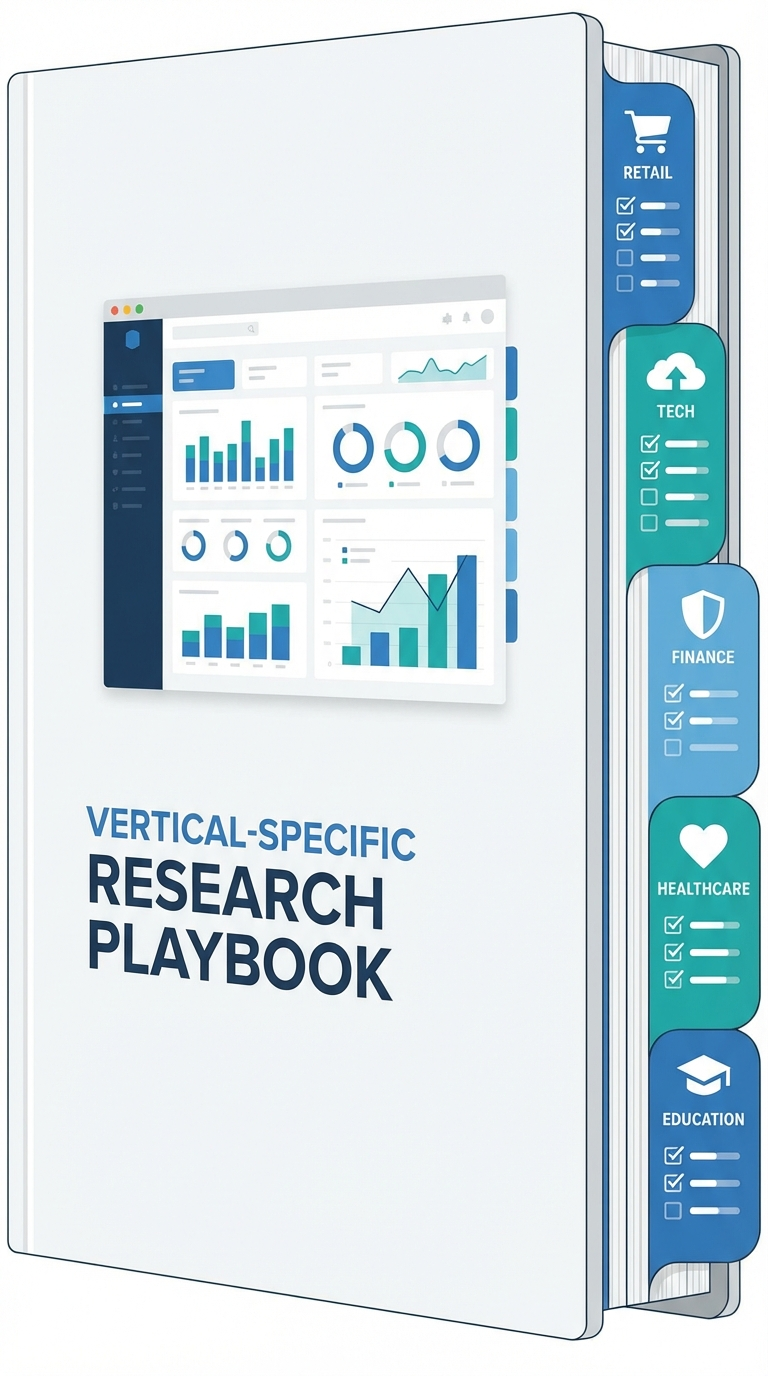 Each industry requires its own research checklist and success signals
Pro tip: Cross-vertical intelligence. Some of the best creative ideas come from studying how other verticals solve similar problems. SaaS companies can learn from e-commerce's UGC approach. Finance companies can study how education builds authority. Health brands can adapt e-commerce's product demonstration formats. Once you've built expertise in your primary vertical, spend 20% of your research time scanning adjacent verticals for transferable tactics.
Scaling your research with tools. Manual vertical research works for 5–10 competitors. Beyond that, you need automation. Adligator's saved searches and tracker features let you set up persistent monitors for industry-specific keywords, so you receive updates when new relevant ads appear rather than manually scanning weekly. This is particularly valuable for fast-moving verticals like e-commerce and health, where new competitors and products emerge constantly.
Common mistakes in vertical research:
- Applying e-commerce creative strategies to SaaS (different formats, different funnels)
- Ignoring compliance patterns in regulated industries (longevity ≠ performance alone)
- Tracking too many competitors instead of going deep on 5–10
- Not updating the playbook — vertical patterns shift quarterly
- Confusing creative volume with creative quality (more ads ≠ better strategy)
FAQ
How to research competitor ads in my specific industry?
Start by identifying 5–10 key competitors in your vertical, then use spy tools with keyword and domain filters to find their active ads. Focus on industry-specific signals: product showcase formats for e-commerce, demo/trial CTAs for SaaS, compliance patterns for finance, and claim structures for health. Each vertical has different success indicators.
What ad patterns work best for e-commerce vs SaaS?
E-commerce ads rely on visual product showcases, UGC reviews, price-driven CTAs (Shop Now, Get Offer), and carousel formats. SaaS ads focus on pain-point messaging, demo/trial CTAs (Start Free Trial, Book Demo), screen recordings, and longer consideration funnels with retargeting sequences.
How to spy on Facebook ads in regulated industries?
In finance, insurance, and health verticals, pay attention to compliance patterns: disclaimer language, claim hedging (e.g., "results may vary"), required disclosures, and CTA restrictions. Track which competitors maintain long-running ads — in regulated industries, longevity signals both performance and compliance approval.
Conclusion
The most valuable competitive intelligence comes from understanding your industry's specific patterns — not from applying generic spy techniques across every vertical. When you spy on competitor Facebook ads by industry, you see deeper: the compliance boundaries in finance, the funnel structures in SaaS, the product testing signals in e-commerce.
Build your vertical-specific research playbook, run it weekly, and update it quarterly. The media buyers who consistently outperform are the ones who understand their vertical's invisible rules and act on industry-specific signals that generalists miss.
Ready to research competitors in your specific vertical? Filter competitor ads by your exact vertical with Adligator — start free
Related Reading
- Facebook Ad Spy for SaaS and B2B: How to Research Competitor Campaigns Beyond Ecommerce
- DTC Brand Facebook Ad Research: How to Spy on Competitors and Build a Winning Creative Launch Strategy
- Facebook Ads by Country: How to Research Competitor Creatives by GEO
- How to Research Competitor Ads in iGaming and Gambling: Facebook Ad Spy Strategies for Affiliates
