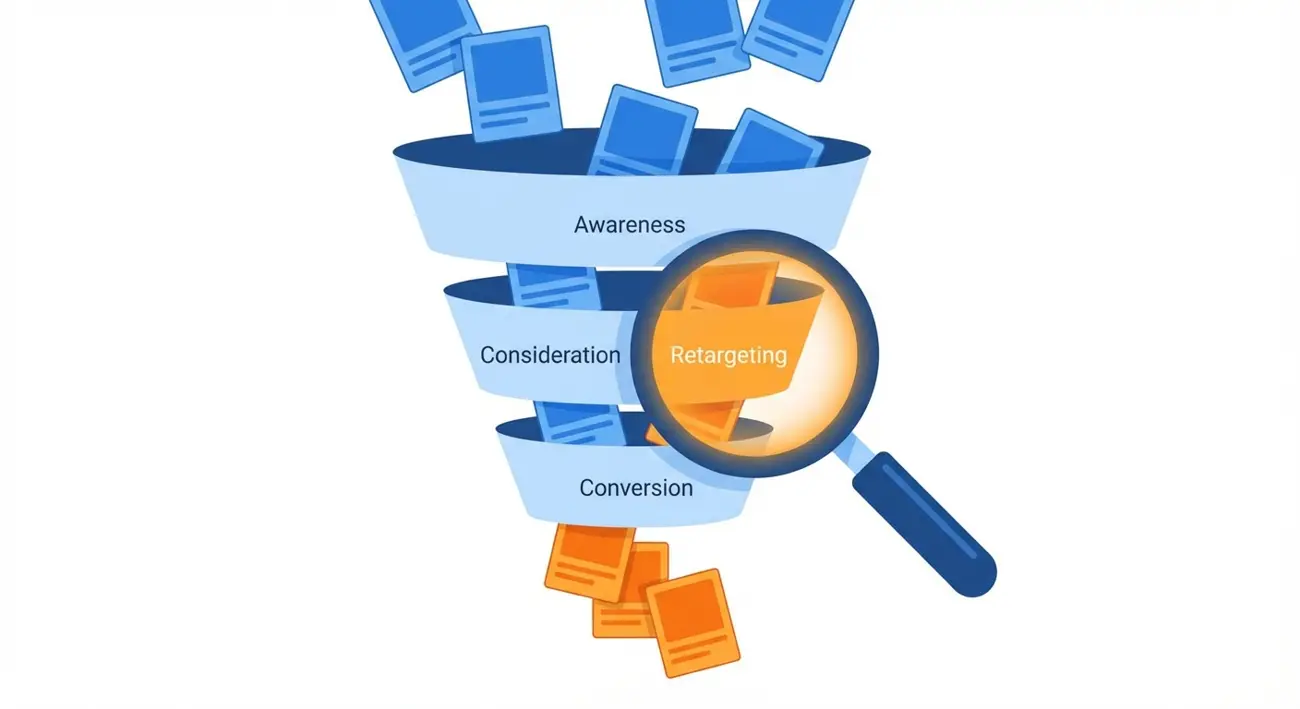
How to Spy on Competitor Retargeting Ads on Facebook
Retargeting is where the real money is made in Facebook advertising. While prospecting campaigns cast a wide net, retargeting sequences convert warm audiences into buyers. Understanding how competitors structure their retargeting funnels gives you a massive strategic advantage — you can see what messaging, offers, and creative approaches they use to close sales.
The challenge: no ad spy tool labels ads as "retargeting." Facebook doesn't publicly differentiate between prospecting and remarketing ads. But with the right approach, you can identify retargeting creatives by analyzing creative patterns, messaging shifts, and timing signals across a competitor's ad portfolio.
This guide shows you exactly how to spy on competitor retargeting ads on Facebook, decode their funnel stages, and build your own retargeting playbook from what you learn.
What Retargeting Ads Reveal About Competitor Strategy
When you can identify a competitor's retargeting ads, you unlock a window into their entire conversion strategy. Here's what retargeting creatives tell you:
Funnel Architecture
Retargeting ads reveal how many stages a competitor uses between first touch and purchase. Some brands run a simple two-step funnel (prospecting → retargeting). Others run complex multi-stage sequences:
- Stage 1: Brand awareness (video views, engagement)
- Stage 2: Consideration (product demos, comparisons, testimonials)
- Stage 3: Conversion (discount offers, urgency, cart abandonment)
- Stage 4: Post-purchase (upsells, loyalty, referral)
By mapping which retargeting creatives a competitor runs, you can infer their funnel depth and sophistication.
Offer Strategy
Retargeting ads often contain the competitor's best offers — the ones they reserve for warm audiences who've already shown interest. These might include:
- Discount percentages or dollar-off amounts
- Free shipping thresholds
- Bundle deals
- Limited-time urgency offers
- Free trial extensions
Seeing these offers tells you what incentives they need to close sales, which implies their margins and competitive positioning.
Objection Handling
The messaging in retargeting ads often addresses the reasons people didn't convert on first exposure. Common patterns:
- Social proof heavy: Testimonials, review counts, trust badges — addressing trust objections
- Comparison content: "Why choose us over X" — addressing competition objections
- Risk reversal: Money-back guarantees, free returns — addressing risk objections
- Urgency/scarcity: Limited stock, countdown timers — addressing procrastination
Each retargeting message tells you what objection the competitor has identified as a conversion barrier.
How to Identify Retargeting vs Prospecting Ads
Since ad spy tools don't label retargeting ads, you need to identify them through proxy signals. Here's your classification framework:
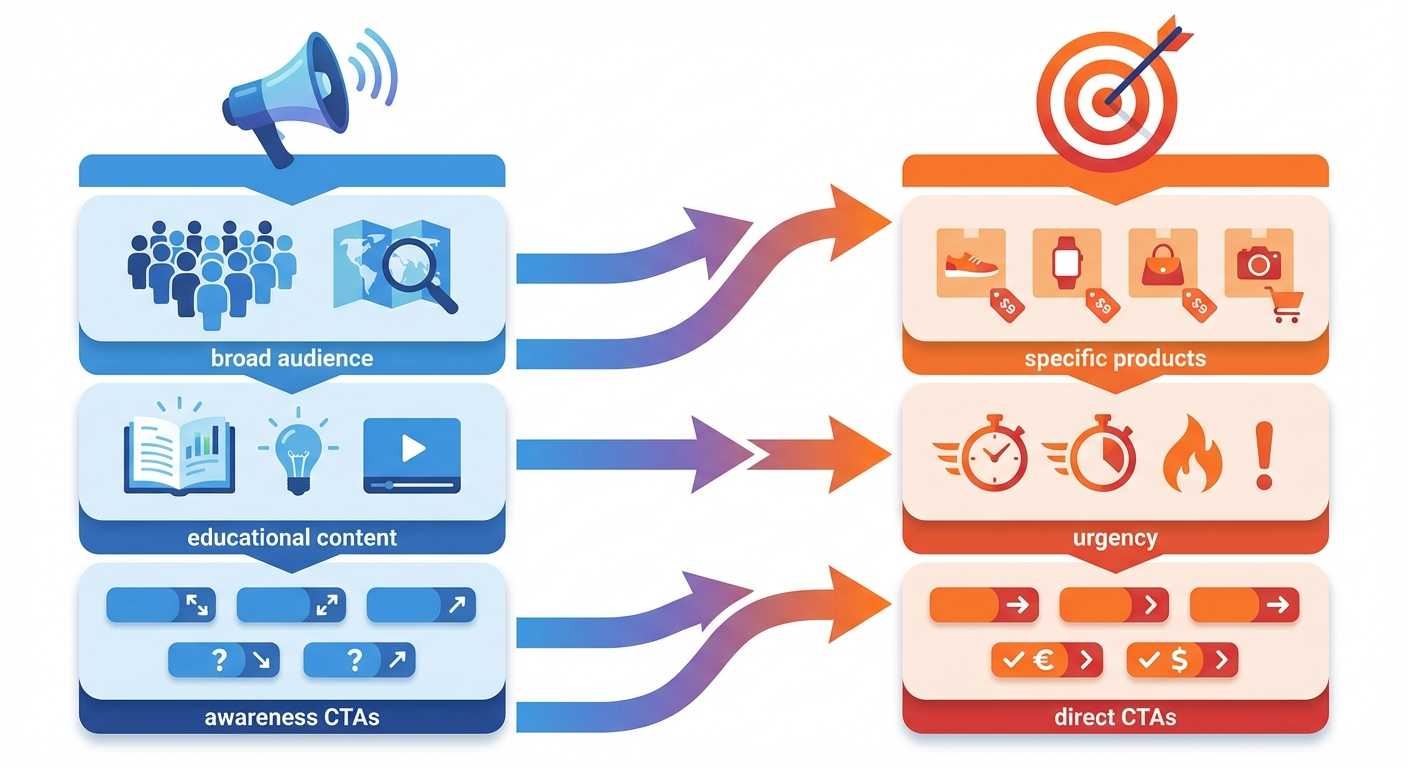 Key signals that distinguish retargeting creatives from prospecting ads in competitor portfolios.
Prospecting Ad Signals
These ads target cold audiences who may not know the brand:
- Broad messaging: "Discover," "Introducing," "Meet the new..."
- Brand-first creative: Logo prominent, brand story, value proposition overview
- Awareness CTAs: "Learn More," "Watch Video," "See More"
- Educational content: How-to videos, problem/solution framing
- Wider geo targeting: Running in many countries simultaneously
- Video format heavy: Often longer-form content designed for engagement
Retargeting Ad Signals
These ads target warm audiences who've already interacted:
- Specific product focus: Individual SKUs rather than brand overview
- Assumption of familiarity: No brand introduction, jumps straight to offer
- Direct-response CTAs: "Shop Now," "Buy Now," "Complete Your Order," "Get the Deal"
- Urgency language: "Last chance," "Only X left," "Offer expires," "Don't miss out"
- Social proof emphasis: Customer reviews, star ratings, "Join 10,000+ customers"
- Discount/offer messaging: Specific percentages or dollar amounts off
- Dynamic product creative: Carousel ads showing recently viewed products
- Shorter format: Static images or short video clips (under 15 seconds)
- Narrower geo: Often running in fewer countries (targeting existing website visitors)
The Timeline Test
The most reliable method: sort a competitor's ads by creation date. Their first ads are almost always prospecting. Ads launched 1–3 weeks later with different messaging and more aggressive CTAs are likely retargeting.
Look for this pattern:
- Week 1: Brand video, broad messaging, "Learn More" CTA
- Week 2–3: Product-specific ads, testimonials, "Shop Now" CTA
- Week 3–4: Discount offers, urgency copy, "Buy Now" or "Get X% Off" CTA
- Week 4+: Cart abandonment style ads, "Still thinking about it?" messaging
Mapping Competitor Funnel Stages Through Ad Creatives
Once you can identify retargeting ads, the next step is mapping the complete funnel structure.
Step 1: Collect All Active Ads from One Competitor
Use an ad spy tool to pull every active ad from a specific competitor's Facebook page. Sort by creation date (oldest to newest). You need at least 10–20 active ads to identify meaningful funnel patterns.
Step 2: Categorize by Funnel Stage
Group each ad into a stage based on the signals above:
TOFU (Top of Funnel) — Awareness/Prospecting:
- Brand introduction content
- Educational/value-add content
- Engagement-optimized (video views, post engagement)
MOFU (Middle of Funnel) — Consideration/Warm Retargeting:
- Product comparisons
- Detailed feature breakdowns
- Customer testimonials and case studies
- "Why choose us" messaging
BOFU (Bottom of Funnel) — Conversion/Hot Retargeting:
- Direct offers and discounts
- Urgency and scarcity messaging
- Cart abandonment creative
- Risk reversal (guarantees, free trials)
Post-Purchase — Retention:
- Upsell/cross-sell offers
- Loyalty program promotion
- Referral incentives
- New product announcements (to existing customers)
Step 3: Analyze Creative Transitions
Pay attention to how the creative approach shifts between stages:
- Visual style change: Does the brand switch from lifestyle imagery (TOFU) to product close-ups (BOFU)?
- Copy length change: TOFU often uses longer copy for storytelling; BOFU uses short, direct copy
- CTA escalation: "Learn More" → "Shop Now" → "Buy Now — 20% Off"
- Format shift: Video for awareness → carousel for consideration → single image for conversion
- Offer introduction: When in the sequence does the first discount or offer appear?
Step 4: Document the Funnel Map
Create a visual map for each competitor showing:
- Number of funnel stages
- Approximate timing between stages (based on ad creation dates)
- Creative type at each stage
- CTA and offer at each stage
- Estimated audience size signals (geo count, platform spread)
This map becomes your competitive intelligence asset. Compare multiple competitors to identify industry patterns and gaps.
Tools for Tracking Ad Sequences Over Time
Identifying retargeting patterns requires tracking competitor ads over time — not just a one-time snapshot.
What to Look For in a Tool
For retargeting analysis, you need:
- Advertiser-level filtering: Search all ads from a specific Facebook page
- Date sorting: Sort ads by creation date to map funnel sequences
- CTA filtering: Isolate ads by button type (Learn More vs Shop Now vs Buy Now)
- Format filtering: Separate video, static, and carousel creatives
- Longevity data: See how long each ad has been running
- Ongoing monitoring: Track new ads as they launch
Using Adligator for Retargeting Analysis
Adligator's filter system is well-suited for this workflow:
- Search by Facebook Page ID: Enter a competitor's page ID to see all their active ads
- Filter by CTA button type: Isolate "Shop Now" and "Buy Now" ads (likely retargeting) vs "Learn More" ads (likely prospecting)
- Sort by creation date: Map the chronological sequence of their creative launches
- Filter by days active: Long-running retargeting ads (14+ days) indicate successful conversion sequences worth studying
- Set up live trackers: Monitor a competitor's page to get notified when they launch new creatives — track how their retargeting sequence evolves
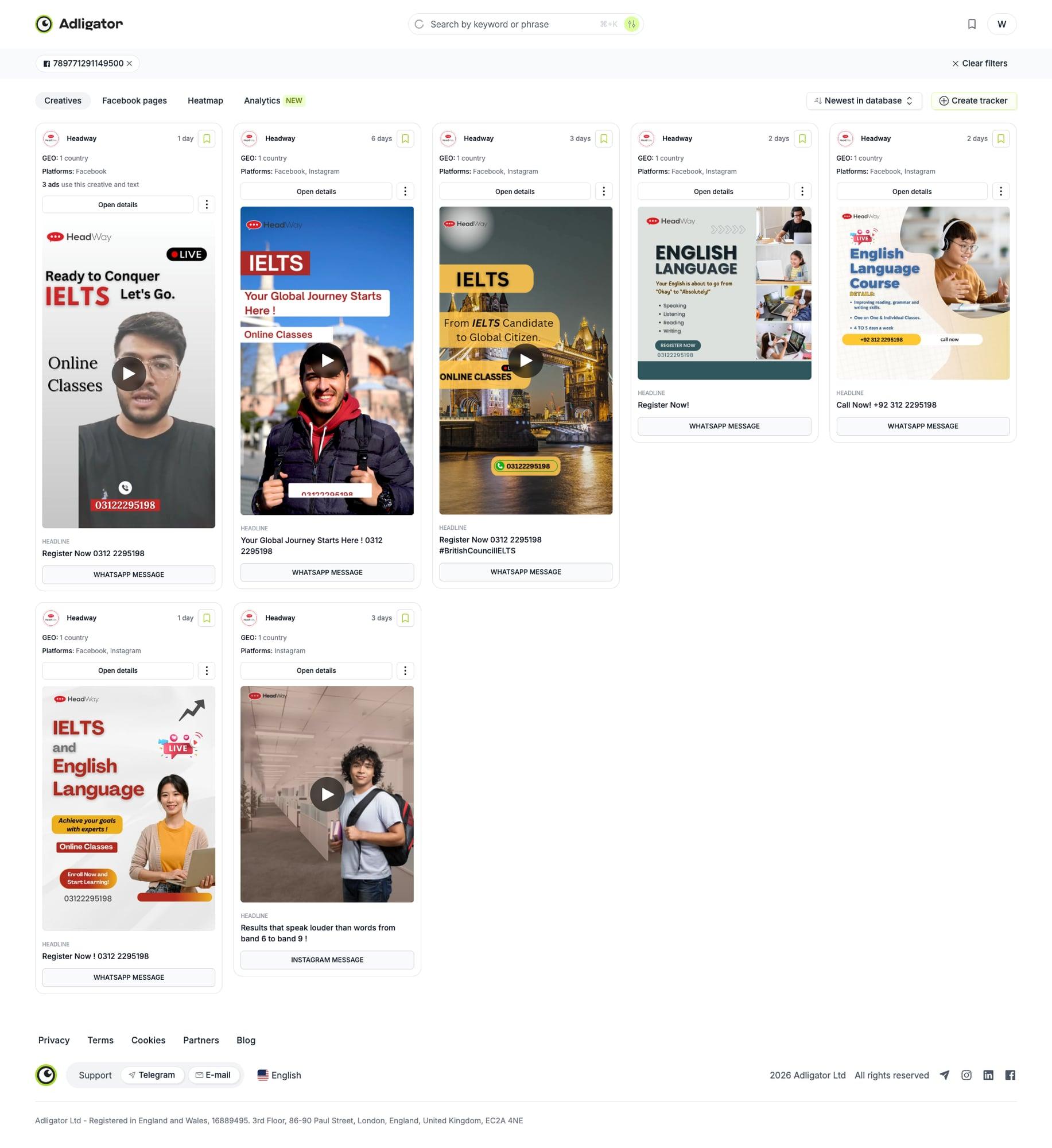 Filtering competitor ads chronologically in Adligator reveals how their funnel creative evolves over time.
Ready to decode competitor funnels? Use Adligator to filter competitor ads by recency and spot retargeting sequences
Building a Monitoring System
Set up ongoing monitoring for 5–10 key competitors:
- Track each competitor's Facebook page in your ad spy tool
- Review new ads weekly — look for retargeting indicators
- Log funnel changes in a simple spreadsheet: competitor, funnel stage, creative type, CTA, offer, date launched
- Flag significant changes: new retargeting sequences, offer changes, creative pivots
Over time, this monitoring system reveals seasonal retargeting patterns, offer testing cycles, and funnel optimization experiments your competitors are running.
Building Your Own Retargeting Playbook from Competitor Data
The goal isn't to copy competitor retargeting ads — it's to learn patterns and build a better version.
Extract Templates, Not Creatives
From your competitor analysis, identify:
- Funnel structure templates: How many stages work in your vertical? What's the typical timing between stages?
- Messaging frameworks: What objection-handling approaches get the longest run time (indicating success)?
- Offer escalation patterns: When do competitors introduce discounts? How deep do they go?
- Creative format preferences: Which formats (video, carousel, static) dominate at each funnel stage?
Build Your Retargeting Sequence
Using competitor insights as a foundation:
Stage 1: Warm Retargeting (1–3 days after first visit)
- Target: Website visitors who didn't convert
- Creative: Address most common objection identified from competitor analysis
- Format: Use the format that dominates at this stage across your competitive set
- CTA: Soft push — "See why 10,000+ media buyers trust us"
Stage 2: Product-Specific Retargeting (3–7 days)
- Target: Visitors who viewed specific products/pages
- Creative: Show the specific product with social proof
- Format: Carousel or dynamic product ads
- CTA: "Shop Now" or category-specific action
Stage 3: Offer Retargeting (7–14 days)
- Target: Engaged visitors who still haven't converted
- Creative: Introduce your first offer — match or beat competitor offer levels
- Format: Single image with clear offer in the visual
- CTA: Direct action with the offer prominently displayed
Stage 4: Last Chance (14–21 days)
- Target: High-intent non-converters
- Creative: Urgency + strongest offer
- Format: Short, direct creative
- CTA: "Last Chance — Get X% Off Before It's Gone"
Test Against Competitor Benchmarks
After launching your retargeting sequence:
- Compare your funnel timing against competitor patterns — are you retargeting too fast or too slow?
- Test competitor-inspired offers against your existing offers
- Monitor whether competitor retargeting patterns shift after you enter the market with similar approaches
- Use ad spy data to continuously benchmark your retargeting creative against competitive best practices
Common Retargeting Patterns by Industry
Different verticals use distinct retargeting approaches. Here's what to look for in each:
E-Commerce / DTC
- Pattern: Product → Review → Discount → Cart Abandonment
- Key signal: Dynamic product ads showing specific items the user viewed
- Typical discount: 10–20% first-purchase offers, free shipping thresholds
- Funnel depth: Usually 3–4 stages
- Creative emphasis: Product photography, unboxing videos, customer review quotes
SaaS / Software
- Pattern: Feature Demo → Case Study → Free Trial → Upgrade
- Key signal: Testimonial-heavy ads with specific metrics ("Saved 40 hours/month")
- Typical offer: Extended free trial, demo booking, onboarding call
- Funnel depth: 2–3 stages (shorter than e-commerce)
- Creative emphasis: Screenshots, data visualizations, customer logos
Info Products / Courses
- Pattern: Free Content → Webinar → Early Bird → Countdown
- Key signal: Video testimonials, income/result screenshots, scarcity timers
- Typical offer: Early-bird pricing, payment plans, bonus bundles
- Funnel depth: 3–5 stages (often the most complex funnels)
- Creative emphasis: Lifestyle transformations, before/after results
Mobile Apps / Gaming
- Pattern: Gameplay Preview → Social Proof → Install Incentive
- Key signal: Short gameplay clips, "Join X million players" messaging
- Typical offer: In-app currency bonuses, exclusive content for returning users
- Funnel depth: 1–2 stages (simpler funnels, focused on install/re-engagement)
- Creative emphasis: Screen recordings, app store ratings, user counts
Lead Generation / Services
- Pattern: Education → Authority → Consultation → Urgency
- Key signal: Guide/whitepaper offers, "Schedule a call" CTAs, limited spots messaging
- Typical offer: Free consultation, audit, or strategy session
- Funnel depth: 2–3 stages
- Creative emphasis: Authority signals (awards, certifications, client logos)
FAQ
Can you actually see retargeting ads in ad spy tools?
Ad spy tools don't label ads as "retargeting" directly. However, you can identify retargeting creatives by analyzing patterns: ads with specific CTAs (like "Complete your purchase"), product-specific messaging, testimonial/social proof heavy creative, and ads that appear later in an advertiser's timeline with different messaging than their prospecting ads.
How do you tell if a Facebook ad is retargeting or prospecting?
Prospecting ads typically introduce the brand, highlight broad benefits, and use awareness-stage CTAs like "Learn More." Retargeting ads assume familiarity — they reference specific products, use urgency triggers ("limited time"), include social proof, and push direct-response CTAs like "Shop Now" or "Complete Your Order."
What tools help track competitor retargeting sequences?
Adligator, AdSpy, and BigSpy all allow you to filter a competitor's ads by creation date, CTA type, and format. By sorting chronologically and analyzing messaging shifts, you can map out their funnel stages. Adligator's live trackers are particularly useful for monitoring ongoing retargeting sequences.
Conclusion
Spying on competitor retargeting ads on Facebook requires reading between the lines — no tool will hand you a labeled retargeting vs prospecting breakdown. But with the right framework, the signals are clear: CTA escalation, offer introduction timing, messaging shifts from educational to transactional, and creative format changes all reveal funnel stages.
The process: track competitor ads chronologically, classify by funnel stage, map the sequence, and extract patterns you can test in your own retargeting campaigns. Over time, this competitive intelligence compounds — you'll spot retargeting trends faster and build sequences informed by what's already proven to work in your vertical.
Ready to map competitor retargeting funnels? Use Adligator to filter competitor ads by recency and spot retargeting sequences
Start spotting retargeting patterns for free
Related Reading
- Facebook Ad Spy for SaaS and B2B: How to Research Competitor Campaigns Beyond Ecommerce
- How to Research Competitor Ads for Mobile Apps: Facebook & Instagram Ad Spy Strategies for App Marketers
- How to Use AI-Powered Ad Intelligence to Predict Winning Facebook Creatives Before You Spend
- How to Estimate Competitor Facebook Ad Spend Using Spy Tools and Ad Library Data
