
How to Spy on Competitors' Instagram Ads: Complete Guide for Performance Marketers
Instagram is where visual-first advertising thrives. With over 2 billion monthly active users and some of the highest engagement rates in social media advertising, it is also where competition for attention is fiercest. If you want to spy on competitors' Instagram ads effectively, you need more than occasional browsing — you need a system.
This guide covers everything from free methods to professional intelligence tools, with a specific focus on what performance marketers need: not just seeing competitor ads, but analyzing creative strategy, identifying format trends, and building monitoring workflows that scale.
Whether you are managing a single brand or an agency portfolio, understanding how competitors approach Instagram advertising gives you a concrete edge in creative strategy, audience targeting, and offer positioning.
Why Instagram Ad Intelligence Matters for Media Buyers
Instagram is not just another placement in your Meta campaign — it often outperforms Facebook for specific objectives, particularly among younger demographics and in visual product categories like fashion, beauty, fitness, and food.
Understanding competitor Instagram ad strategy matters for three reasons:
Creative format insights. Instagram supports more visual formats than any other Meta placement: feed images, carousels, Stories, Reels, and Explore placements. Competitors' format choices reveal what is working in your niche. If every competitor in beauty is running Reels but you are still running static images, you are likely leaving performance on the table.
Audience targeting clues. While you cannot see exact targeting parameters, Instagram ad creative tells you a lot about who competitors are trying to reach. The visual style, language complexity, cultural references, and offer type all signal demographic and psychographic targeting choices.
Trend identification. Instagram creative trends move fast. UGC-style content, lo-fi production, Reels-native editing, and influencer collaboration ads rise and fall in effectiveness. Monitoring competitors lets you spot these trends early — before they become saturated.
For media buyers spending significant budget on Instagram, Instagram ads competitor analysis is not optional. It is the difference between testing blindly and testing with informed hypotheses based on competitive data.
Free Method: Using Meta Ad Library for Instagram Ads
Meta Ad Library is the most accessible free tool for viewing competitor Instagram ads. Here is how to use it effectively.
Step 1: Access the library Go to facebook.com/ads/library. Select your country and "All ads" as the category.
Step 2: Search for competitors Enter a competitor brand name, Facebook page name, or keyword. The library shows all active ads across Meta platforms.
Step 3: Filter for Instagram Use the platform filter to show only Instagram ads. You can also filter by media type (images, videos, memes) and active/inactive status.
Step 4: Analyze the results For each ad, Meta Ad Library shows:
- The creative (image, video, or carousel)
- The ad copy (primary text, headline, description)
- Start date
- Platforms where the ad is running
- Whether it is currently active
What you can learn for free:
- What creative styles competitors currently use
- How many active ads they are running simultaneously (testing velocity)
- Which ads have been running the longest (started earliest and still active)
- What messaging and offers they promote
Tips for better Meta Ad Library research:
- Search by Facebook page name, not Instagram handle (the library indexes by Page)
- Use the "Impressions by country" data (available for ads about social issues, elections, or politics) to understand targeting
- Check multiple date ranges — an advertiser might have different seasonal strategies
- Note the ratio of active ads: a brand running 50+ ads simultaneously is testing aggressively; one running 3-5 is optimizing selectively
This free method works well for quick competitive checks and small competitive sets (1-5 brands).
Limitations of the Free Approach
Meta Ad Library is useful but has significant limitations for serious Instagram ad intelligence:
No historical data. Once an ad is deactivated, it disappears. You cannot see past campaigns, creative evolution, or seasonal patterns. If you did not check last month, that data is gone.
No performance signals. There are no engagement metrics (likes, comments, shares), no longevity data (exact days active), and no indication of scaling (number of countries or placements).
No advanced filtering. You cannot filter by CTA button type, landing page URL, ad format (carousel vs. Reel), text language, geographic targeting, or days active. Every search returns all ads for that advertiser with minimal sorting options.
No change detection. There is no way to track what changed since your last visit. New ads, paused ads, and creative updates are invisible without manual tracking.
No scaling. Checking 3 competitors takes 15-20 minutes. Checking 15 takes over an hour. There is no automation, no saved searches, and no alerts for new competitor activity.
The cost of these limitations is real. Without longevity data, you cannot distinguish a winning creative from a failed test. Without format filtering, you waste time scrolling through irrelevant ad types. Without change detection, new competitor launches slip past you entirely. And without automation, the system depends on your discipline to manually check every week — discipline that inevitably fades when deadlines pile up.
These limitations mean Meta Ad Library works as a starting point but fails as a primary intelligence tool for performance marketers managing competitive campaigns at scale. The good news: purpose-built Instagram ad spy tools fill every gap.
Best Instagram Ad Spy Tools Compared
Several tools address the limitations of Meta Ad Library. Here is how the major options compare specifically for Instagram ad intelligence.
Adligator
- Instagram coverage: Deep — part of full Meta ecosystem focus
- Key advantage: Platform filter for Instagram-only results; domain zone and URL filters reveal landing page patterns; days-active filter surfaces proven winners; live trackers automate monitoring
- Pricing: Free (5 searches/day), Pro $32/month, Team $65/month
- Best for: Performance marketers who want Meta-specific depth at affordable pricing
AdSpy
- Instagram coverage: Good — shares database with Facebook coverage
- Key advantage: Comment search feature; largest combined FB/IG database (95M+ ads)
- Pricing: $149/month (single plan)
- Best for: Users who need the largest possible Instagram ad database and comment analysis
BigSpy
- Instagram coverage: Moderate — part of multi-platform approach
- Key advantage: Covers Instagram alongside TikTok, YouTube, and other platforms
- Pricing: Free (limited), Pro $99/month
- Best for: Multi-platform managers who need Instagram plus other channels in one dashboard
Meta Ad Library (Free)
- Instagram coverage: Complete (all active ads)
- Key advantage: Free, official source
- Pricing: $0
- Best for: Quick checks and small competitive sets
For Instagram-focused competitive intelligence, Adligator offers the best value: Meta-specific depth (including Instagram, Facebook, Messenger, Audience Network, and Threads) with advanced filters at $32/month — less than a quarter of AdSpy's price.
Track competitor Instagram ads automatically with Adligator — start free
How to Build an Instagram Ad Monitoring Workflow
A one-time competitive check is not intelligence — it is a snapshot. Real intelligence requires a repeatable monitoring workflow.
Weekly Instagram ad monitoring workflow (20 minutes):
Minutes 0-5: Check tracker alerts If using Adligator or another tool with saved searches, review new matches since last week. Filter by Instagram platform placement to isolate IG-specific activity.
Minutes 5-12: Tier 1 competitor review For each direct competitor (3-5 brands):
- Any new Instagram-specific creatives?
- Format shifts? (Feed to Reels, static to carousel)
- New offers or messaging angles?
- Landing page changes in destination URLs?
Minutes 12-17: Format trend scan Look across your competitive set for Instagram format trends:
- Is Reels usage increasing or decreasing?
- Are competitors testing carousel ads more?
- Any shift toward UGC vs. polished production?
- New use of Instagram-specific features (polls in Stories, shopping tags)?
Minutes 17-20: Document and brief Log top 3 observations. Create one action item for your creative team.
 A systematic monitoring workflow turns Instagram ad research into continuous intelligence.
Pro tip: Use Adligator's platform filter to isolate Instagram placements. Then combine with the days-active filter (14+) to find ads that are proven performers on Instagram specifically. This eliminates the noise of short-lived tests.
Advanced monitoring techniques:
As your workflow matures, add these to your rotation:
- Cross-platform comparison: Filter the same competitor for Facebook vs. Instagram. Differences in creative approach between platforms reveal audience segmentation strategy.
- New entrant detection: Search by niche keywords (not competitor names) to discover new advertisers entering your space. New entrants often bring fresh creative approaches worth studying.
- Seasonal pattern tracking: Log your observations monthly. After one year, you will have a seasonal map of competitor behavior — invaluable for planning your own calendar.
- Landing page correlation: Use Adligator's URL filter to match Instagram ads with specific landing pages. Track whether competitors use different landing pages for Instagram vs. Facebook traffic — a sign of sophisticated funnel segmentation.
- CTA button analysis: Filter by CTA type across your competitive set. Shifts from "Learn More" to "Shop Now" signal that competitors are moving from awareness to conversion campaigns — they have validated the audience and are going for the sale.
Analyzing Instagram Ad Creatives: What to Look For
Instagram ads succeed or fail on creative quality more than any other factor. Here is what to analyze when reviewing competitor Instagram creatives.
Visual style analysis:
- Production quality: UGC/raw vs. polished/studio
- Color palette: Brand-consistent vs. platform-native
- Text overlays: Amount, font choice, placement
- Thumbnail strategy (for Reels/video): What frame is shown before play?
Format strategy:
- Feed image: Best for clear product showcases and single offers
- Carousel: Best for storytelling, before/after, and multi-product
- Reels/Video: Best for demonstrations, testimonials, and emotional hooks
- Stories: Best for urgency, polls, and limited-time offers
Which formats dominate in your niche? If competitors consistently use carousels for comparison content and Reels for testimonials, that pattern reveals what works with your shared audience.
Hook analysis (first 3 seconds for video, visual hook for static):
- What stops the scroll? Bold visual, human face, unexpected element?
- Does the hook match the ad copy promise?
- How quickly does the value proposition appear?
CTA and offer alignment:
- Does the Instagram creative format match the CTA? (Shop Now works better with product images; Learn More works better with educational content)
- Is the offer Instagram-appropriate? (Impulse purchases perform well; complex B2B offers usually do not)
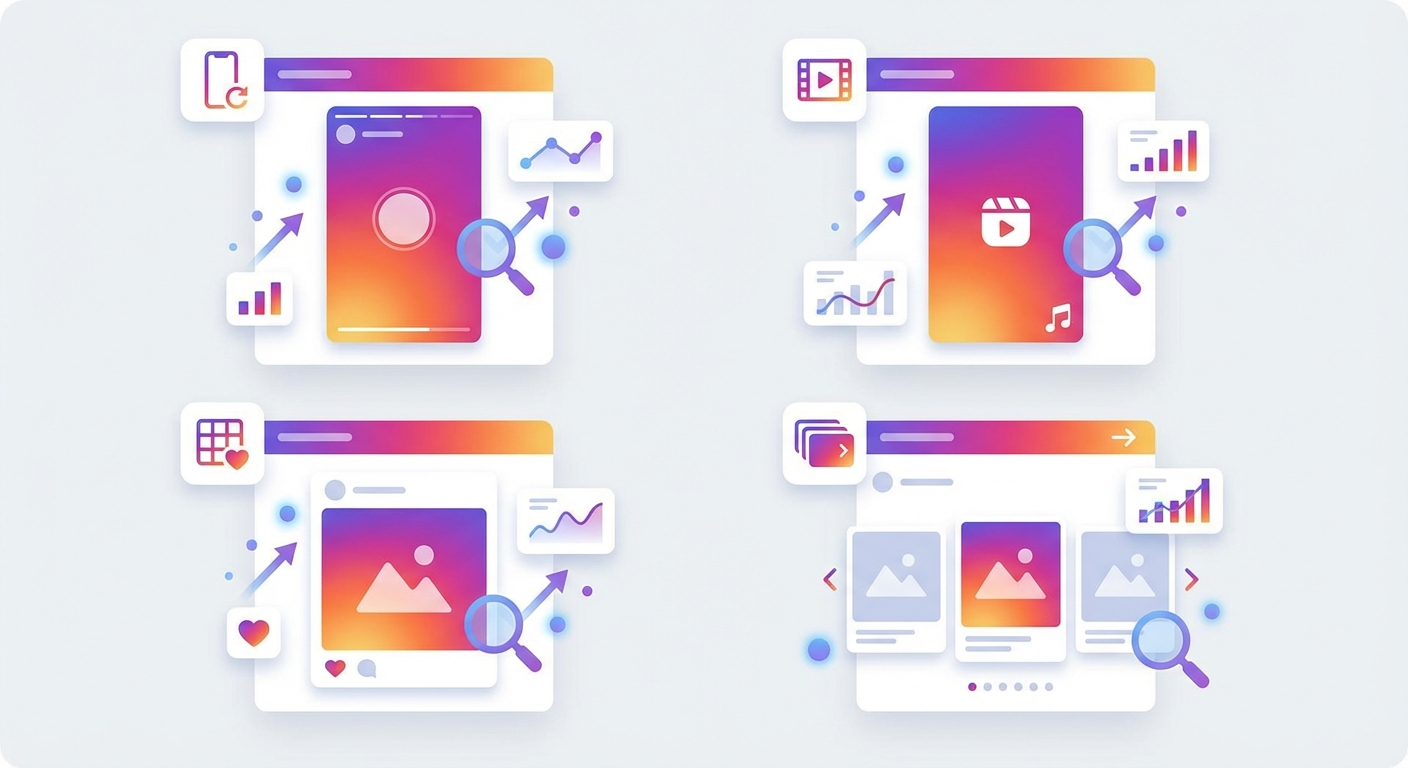 Each Instagram ad format serves different campaign objectives — analyze competitors' format choices.
Instagram-specific signals to watch:
- Shopping tags: Competitors using product tags in feed ads signal e-commerce integration maturity
- Branded content tags: Influencer partnerships — note which influencers competitors work with
- Reel remixes: Competitors using trending audio or remix formats signal platform-native strategy
- Comment section management: Are competitors actively engaging in ad comments? (Visible in Meta Ad Library)
From Insight to Action: Applying Competitor Intelligence
Competitive intelligence is only valuable when it translates into campaign decisions. Here is how to apply what you learn from Instagram ad monitoring.
Creative strategy adjustments:
- If competitors' Reels consistently outperform (long longevity, scaling signals), increase your Reels production
- If a specific visual style dominates (UGC, lifestyle, product-on-white), test it if you have not already
- If competitors use specific hooks repeatedly (question-based, shock, before/after), incorporate the pattern with your own messaging
Format allocation shifts:
- Track which formats competitors invest in most heavily (by ad count and longevity)
- Compare to your own format distribution
- Adjust your creative mix to test underrepresented formats that competitors validate
Offer and messaging testing:
- Note what offers competitors push on Instagram specifically (these may differ from their Facebook ads)
- Test similar offer structures with your own positioning
- Adapt messaging angles that show sustained longevity in competitor campaigns
Audience expansion signals:
- Competitors targeting new geographic markets (visible through GEO counts in spy tools) signal viable expansion opportunities
- Competitors shifting language in ad copy suggest audience segment exploration
- New competitor entrants in your niche signal market opportunity
Building a competitive response playbook:
Create a simple decision tree for acting on competitive intelligence:
- Competitor launches new format you don't use → Add to next sprint's test queue. Allocate 10-15% of creative budget to test.
- Competitor scales an ad across 10+ countries → Analyze the creative, landing page, and offer. Consider adapting the approach for your highest-potential market.
- Competitor pauses a long-running ad → Note the creative style. It may be fatigued in your shared audience — avoid similar approaches for the next 30 days.
- Multiple competitors adopt the same trend → Validate quickly. When 3+ competitors converge on a pattern, the audience is responding. Test your version within 1-2 weeks.
- Competitor enters your geographic market → Increase monitoring frequency to weekly or bi-weekly. Prepare defensive creative with stronger offers or differentiation.
The key discipline is testing one insight at a time. Do not overhaul your entire creative strategy based on one week of competitor data. Pick the single most promising insight, create a test, measure results, and iterate.
Measuring the ROI of competitor intelligence:
Track these metrics to validate whether your Instagram ad monitoring is worth the time and tool investment:
- Creative win rate: Are creatives inspired by competitive insights performing better than uninformed ones?
- Time to first winner: Are you finding winning creatives faster with competitive data?
- CPM/CPC trends: Are your costs improving relative to the market?
- Competitive response time: How quickly do you adapt when competitors make significant moves?
After 3 months of consistent monitoring, you should see measurable improvement in at least two of these metrics. If not, refine your analysis framework or adjust which competitors you monitor.
See your competitors' best Instagram creatives in Adligator — start free
FAQ
Can I see what ads my competitors are running on Instagram?
Yes. Meta Ad Library (facebook.com/ads/library) shows all active ads from any Instagram advertiser for free. For deeper analysis including historical data, longevity metrics, and advanced filtering, ad spy tools like Adligator provide more comprehensive intelligence.
What is the best free way to spy on Instagram ads?
Meta Ad Library is the best free method. Search by advertiser name, filter by platform (Instagram), and browse all active ads. Limitations include no historical data, no engagement metrics, no longevity tracking, and no advanced filtering by format or CTA type.
How do Instagram ad spy tools work?
Ad spy tools crawl and index Instagram ads from the Meta ecosystem, adding metadata like longevity (days active), geographic targeting, CTA buttons, and duplicate detection. They provide searchable databases with advanced filters that let you find specific types of competitor ads quickly.
Should I analyze Instagram ads separately from Facebook ads?
Yes, when possible. Creative performance varies significantly between Facebook and Instagram. An ad that works on Facebook feed may underperform on Instagram Reels due to different user behavior and format expectations. Analyze platform-specific creative choices to optimize for each placement.
Conclusion
To spy on competitors' Instagram ads effectively, you need more than occasional browsing of Meta Ad Library. You need a systematic workflow: define your competitive set, monitor weekly with proper tooling, analyze creative patterns by format and hook type, and translate insights into specific creative tests.
Instagram's visual-first environment means creative quality matters more than on any other platform. Understanding what competitors do — which formats they use, how they hook attention, what offers they promote, and how they adapt to Instagram-specific features — gives you a research-backed foundation for your own creative strategy.
Start with the free method to build familiarity. Upgrade to an ad spy tool when you need filtering, longevity data, and automated monitoring. The investment in systematic competitive intelligence pays for itself the first time it helps you avoid a creative approach that competitors have already proven does not work.
Ready to apply this workflow? Track competitor Instagram ads automatically with Adligator — start free
See your competitors' best Instagram creatives in Adligator
Related Reading
- Best Instagram Ad Spy Tools in 2026: Complete Guide to Tracking Competitor Ads
- How to Spy on Competitors' Facebook Ads: A Repeatable Weekly Workflow for Media Buyers
- How to Build a Competitive Ad Intelligence Dashboard: Automated Reporting for Media Buying Teams
- Competitor Landing Page & Funnel Analysis: How to Decode Facebook Ad Funnels
