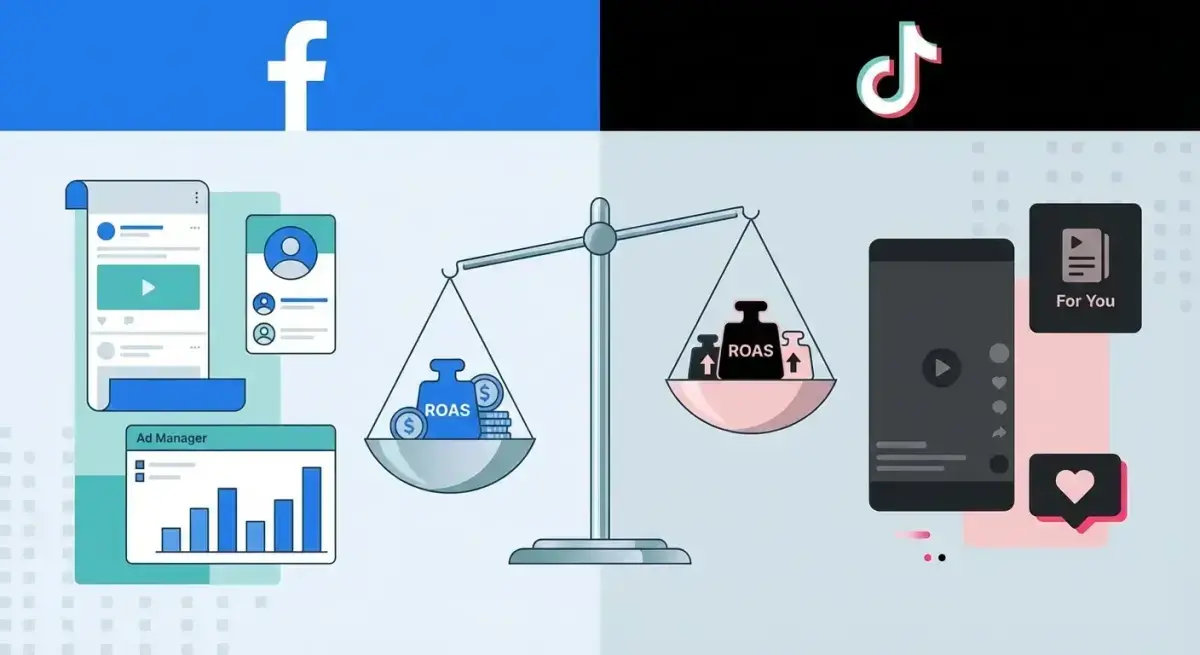
TikTok Ads vs Facebook Ads: Platform Comparison for Performance Marketers
The debate between TikTok ads vs Facebook ads has shifted from "should I try TikTok?" to "how much of my budget should go where?" TikTok's ad platform matured significantly through 2025–2026, with improved pixel tracking, Conversions API (CAPI), and auction stability that finally make fair comparison possible.
This guide breaks down both platforms across the metrics that matter to media buyers: CPM, CPC, ROAS, targeting depth, creative requirements, and scaling potential. Whether you're an ecommerce brand spending $10K/month or an agency managing seven-figure budgets, this comparison will help you make data-backed allocation decisions.
Platform Overview and Audience Demographics
Understanding who you're reaching on each platform is foundational to any allocation decision.
Facebook (Meta) in 2026:
- 3.07 billion monthly active users across the Meta family
- Strongest demographics: 25–54 age range, broad income distribution
- Dominant in developed markets (US, EU, Australia) and emerging markets alike
- Users visit with mixed intent: social connection, news, marketplace shopping
- Average session: 33 minutes/day across Meta apps
TikTok in 2026:
- 1.8 billion monthly active users globally
- Strongest demographics: 18–34, with growing 35–44 segment
- Dominant in entertainment-driven discovery
- Users visit primarily for content consumption and entertainment
- Average session: 52 minutes/day — highest engagement among social platforms
The demographic gap is closing. TikTok's user base has aged up considerably since 2023, with the 25–44 segment now representing over 40% of users. However, Facebook still reaches more high-income professionals and older demographics that matter for certain verticals like finance, insurance, and B2B services.
For ecommerce, both platforms now offer comparable reach. The real differentiator is user intent: Facebook users are often in a semi-shopping mindset (especially with Marketplace habits), while TikTok users are in discovery mode — making them receptive to impulse-driven offers.
Ad Format Comparison: What Works Where
Each platform has distinct creative strengths that fundamentally affect your campaign strategy.
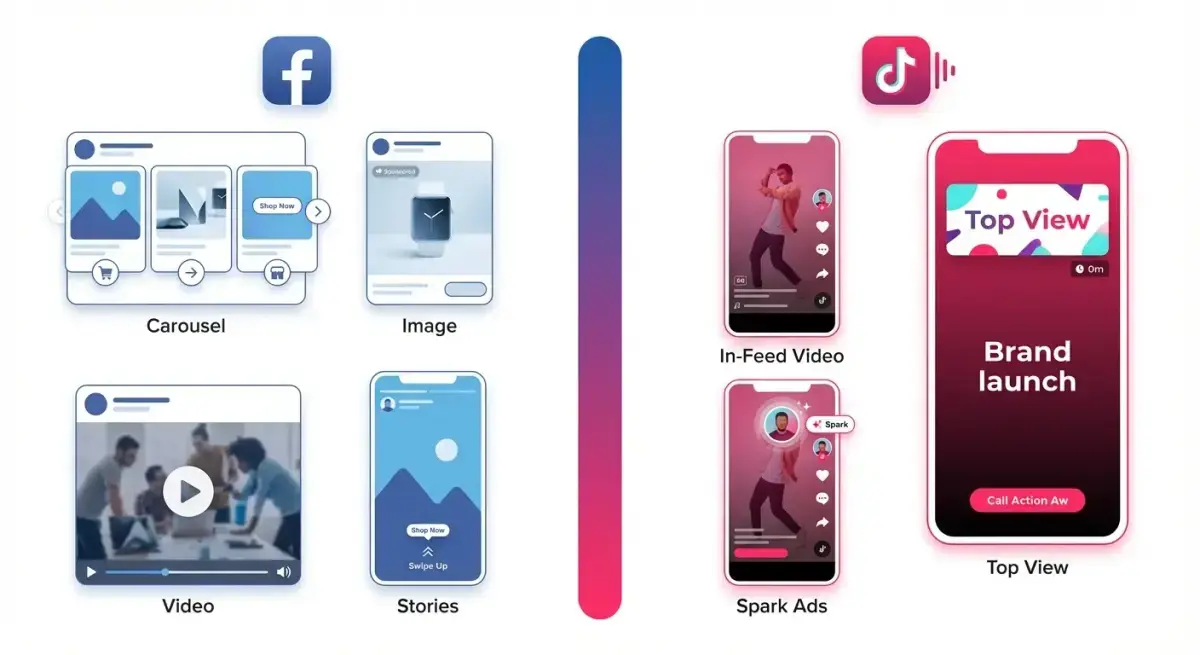 Ad format comparison between Facebook and TikTok platforms
Facebook Ad Formats
- Image ads: Still effective for direct-response with clear offers. Fast to produce, easy to test at scale.
- Video ads: 15–60 seconds, vertical or square. Work across Feed, Stories, and Reels.
- Carousel ads: Multi-card format perfect for product catalogs, step-by-step narratives, and comparison layouts.
- Collection ads: Full-screen mobile experience combining video/image with product catalog. Strong for ecommerce.
- Dynamic Product Ads (DPA): Automated retargeting showing products users viewed. Essential for ecommerce.
TikTok Ad Formats
- In-Feed ads: Native-looking video ads in the For You feed. 9:16 vertical, 5–60 seconds. The workhorse format.
- Spark Ads: Boost existing organic posts (yours or creators'). Preserves social proof and engagement metrics.
- TopView: Full-screen video on app open. Premium placement with highest visibility but highest cost.
- Branded Hashtag Challenges: User-generated content campaigns. Better for brand awareness than direct response.
- Shopping Ads: Product cards integrated into video content. Growing rapidly for ecommerce.
Key Creative Difference
Facebook rewards polished, direct-response creative. Clear value proposition, strong CTA, professional design. You can iterate by changing headlines, images, and copy independently.
TikTok rewards authentic, entertainment-first creative. The best-performing TikTok ads don't look like ads — they look like organic content. This requires a fundamentally different production approach: UGC-style shooting, trending audio, fast hooks in the first 1–2 seconds.
This creative difference is the single biggest factor in platform performance. A media buyer who repurposes Facebook creatives on TikTok will almost always underperform compared to one who creates native TikTok content.
Format Recommendations by Goal
- Direct-response ecommerce: Facebook carousels + TikTok in-feed Spark Ads
- App installs: Facebook video (15s) + TikTok in-feed (interactive end cards)
- Lead generation: Facebook lead forms (native) + TikTok in-feed with landing page
- Brand awareness: Facebook Reels + TikTok TopView or Branded Hashtag Challenge
- Retargeting: Facebook DPA (automated catalog) + TikTok Shopping Ads (product cards)
CPM, CPC, and ROAS Benchmarks by Vertical
Benchmark data helps set expectations, but remember: your results will vary based on offer, creative quality, landing page, and dozens of other factors.
 CPM and ROAS benchmarks by vertical: Facebook vs TikTok (2026 data)
Average CPM by Vertical (2026 estimates)
- Ecommerce: Facebook $12–18 | TikTok $6–12
- Gaming/Apps: Facebook $8–14 | TikTok $4–9
- Finance/Insurance: Facebook $25–45 | TikTok $15–30
- Beauty/Skincare: Facebook $10–16 | TikTok $5–10
- SaaS/B2B: Facebook $20–35 | TikTok $12–22
Average ROAS by Vertical
- Ecommerce (general): Facebook 2.5–4.0x | TikTok 2.0–3.5x
- Dropshipping/impulse: Facebook 1.8–3.0x | TikTok 2.5–5.0x
- Beauty DTC: Facebook 3.0–5.0x | TikTok 3.5–6.0x
- Finance/lead gen: Facebook 4.0–8.0x | TikTok 2.0–4.0x
- Gaming (installs): Facebook $1.50–3.00 CPI | TikTok $0.80–2.00 CPI
The pattern is clear: TikTok delivers lower CPMs across the board but doesn't always translate that into better ROAS. Facebook's more mature algorithm and richer targeting data often produce higher-quality conversions, especially for considered purchases.
TikTok excels in verticals where impulse buying is common and visual appeal drives decisions. If your product photographs or demonstrates well in video, TikTok's lower costs can deliver outsized returns.
Why CPMs Don't Tell the Full Story
Lower CPM doesn't automatically mean better performance. Consider the full funnel:
- Click-through rate (CTR): TikTok averages 0.8–1.5% CTR on in-feed ads vs Facebook's 0.9–1.8% for feed videos. The gap is smaller than CPM differences suggest.
- Landing page conversion rate: Facebook traffic often converts at higher rates because users are more accustomed to clicking out to external sites. TikTok users tend to prefer staying in-app.
- Average order value: Facebook buyers often spend more per order due to older, higher-income demographics.
- Return/refund rate: Some advertisers report 15–25% higher refund rates on TikTok purchases due to more impulse-driven buying behavior.
The takeaway: calculate your blended CPA and ROAS across the full funnel, not just top-of-funnel metrics. A platform with 40% lower CPM but 30% lower conversion rate may deliver similar or worse unit economics.
Targeting Capabilities: Meta vs TikTok
Targeting is where the platforms diverge most significantly, and where Facebook still holds a meaningful advantage for many advertisers.
Facebook/Meta Targeting
- Interest targeting: Thousands of interest categories based on user behavior and profile data
- Lookalike audiences: 1–10% lookalikes from custom audiences. Still the gold standard for prospecting.
- Custom audiences: Website visitors, customer lists, engagement audiences, app users
- Advantage+ (broad): ML-driven targeting that often outperforms manual targeting at scale
- Demographic precision: Age, gender, income level (in some markets), life events
- Detailed exclusions: Granular ability to exclude converted users, specific segments
TikTok Targeting
- Interest targeting: Improving but still less granular than Meta's. Broader categories.
- Lookalike audiences: Available but less mature. Smaller seed audiences sometimes underperform.
- Custom audiences: Website visitors (via pixel/CAPI), customer lists, engagement audiences
- Behavioral targeting: Based on video viewing behavior, hashtag interactions, creator follows
- Smart targeting: TikTok's equivalent of broad targeting. Often outperforms manual interest targeting.
- Creator-based targeting: Target audiences similar to specific creator followings (unique to TikTok)
Practical Targeting Recommendations
For Facebook: start with Advantage+ for prospecting if you have sufficient conversion data (50+ conversions/week). Fall back to lookalikes from your best customers for lower-volume accounts. Use detailed targeting as a supplement, not primary strategy.
For TikTok: lean into smart targeting and let the algorithm find your audience through creative testing. TikTok's algorithm is content-driven — it optimizes based on who engages with your specific creative, making creative quality more important than targeting precision.
Pro tip: Before setting up targeting on either platform, research what creatives your competitors are running. Use Adligator to research competitor creatives across platforms before launching — understanding competitor angles helps you differentiate your creative strategy from day one.
Creative Strategy Differences
Creative is the most important variable on both platforms, but the approach differs fundamentally.
Facebook Creative Best Practices
- Hook in first 3 seconds with a clear value proposition or problem statement
- Direct response focus: price, discount, benefit, social proof
- Test static images alongside video — images still outperform video for many offers
- Iterate on winners by changing one element at a time (headline, image, CTA)
- Use UGC as one format among many — it works but isn't mandatory
- Production quality matters — polished creative generally outperforms raw content
TikTok Creative Best Practices
- Hook in first 1 second — TikTok's scroll speed is faster
- Don't make ads, make TikToks — the platform's official advice, and it's accurate
- UGC is the dominant winning format — authentic, creator-style content outperforms polished ads
- Use trending sounds and formats — algorithm favors content that matches current trends
- Higher creative volume needed — creative fatigue happens faster (7–14 days vs 2–4 weeks on Facebook)
- Work with creators via TikTok Creator Marketplace or direct outreach
Creative Volume and Testing
Facebook allows you to test more systematically with fewer assets. A strong static image with 5 headline variations gives you 5 testable combinations from one visual.
TikTok demands higher creative volume. Plan for 3–5 new creatives per week per ad group to stay ahead of fatigue. This means either building an internal content creation workflow or working with a network of UGC creators.
This creative velocity requirement is the hidden cost of TikTok advertising that many media buyers underestimate. Lower CPMs don't help if you're spending 3x more on creative production.
Creative Cost Comparison
A realistic breakdown of creative costs per platform:
Facebook (monthly, $25K+ spend):
- 8–12 static images: $400–800 (in-house) or $1,200–2,400 (agency)
- 3–5 video ads: $500–1,500 (in-house) or $2,000–5,000 (agency)
- Total: $900–2,300 in-house / $3,200–7,400 agency
TikTok (monthly, $25K+ spend):
- 15–25 UGC videos: $1,500–5,000 (creator payments $75–200 each)
- 5–10 variations/edits: $500–1,000 (editor time)
- Trending audio licensing/adaptation: minimal (most are free)
- Total: $2,000–6,000 for creators + editing
Factor these production costs into your platform ROAS calculations. A platform with 20% better ROAS but 3x creative costs may not actually be more profitable.
When to Use TikTok vs Facebook for Your Offer
Here's a decision framework based on offer characteristics:
Prioritize TikTok when:
- Your product is visually demonstrable (before/after, unboxing, tutorial-friendly)
- Target audience skews 18–34
- Average order value (AOV) is under $75 — impulse-purchase territory
- You have access to UGC creators or can produce authentic-style video content
- Your product has viral/shareability potential
- You're in beauty, fashion, gadgets, fitness, or food verticals
Prioritize Facebook when:
- You need precise demographic or interest-based targeting
- Your product requires education or has a longer consideration cycle
- AOV is above $100 or you're generating leads
- You rely heavily on retargeting and lookalike audiences
- You're in finance, insurance, SaaS, real estate, or B2B
- You want to leverage catalog-based advertising (DPA)
Run both when:
- Monthly ad spend exceeds $15K (enough to test both meaningfully)
- You have separate creative teams or workflows for each platform
- Your attribution setup can handle cross-platform measurement
- You're seeing diminishing returns on your primary platform
Budget Allocation Between Platforms
For media buyers running both platforms, here's a practical allocation framework:
Starting Point (First Month)
- 70–80% Facebook (your proven baseline)
- 20–30% TikTok (test budget)
After 30 Days of TikTok Testing
Evaluate based on blended CPA and incremental lift:
- TikTok CPA within 20% of Facebook: increase TikTok to 35–40%
- TikTok CPA 20–50% higher: maintain at 20% but test new creatives
- TikTok CPA more than 50% higher: reduce to 10% creative-testing budget or pause
Mature Cross-Platform Split
For advertisers who've found product-market fit on both platforms:
- Ecommerce (impulse): 50% Facebook / 50% TikTok
- Ecommerce (considered): 65% Facebook / 35% TikTok
- Lead gen: 75% Facebook / 25% TikTok
- App installs: 40% Facebook / 60% TikTok (TikTok often wins on CPI)
Always maintain a 10–15% testing budget on the secondary platform for new creative and audience experimentation.
Rebalancing Triggers
Watch for these signals to adjust your allocation:
- CPA rising 20%+ on primary platform for 7+ consecutive days → shift 10% budget to secondary
- New winning creative on secondary platform → increase budget by 15–20% over one week
- Seasonal shifts → TikTok often outperforms during Q4 holiday shopping for impulse gifts; Facebook excels for considered pre-holiday purchases
- Platform algorithm changes — when one platform pushes a major update (like Facebook's Advantage+ expansion or TikTok's Smart Performance Campaigns), early adoption often yields lower CPMs
Tracking and Attribution Differences
Cross-platform attribution is one of the biggest operational challenges when running both TikTok and Facebook.
Facebook Attribution
- Mature Conversions API (CAPI) with high match rates
- Default 7-day click / 1-day view attribution window
- Advanced attribution models available through Attribution Settings
- Aggregated Event Measurement (AEM) for iOS users
- Integration with most analytics and attribution tools
TikTok Attribution
- CAPI available and improving (launched later than Facebook's)
- Default 7-day click / 1-day view window (now configurable)
- Self-Attributing Network (SAN) for mobile app measurement
- Events API for server-side tracking
- Growing but still less mature third-party integration ecosystem
Solving Cross-Platform Attribution
Without a unified attribution system, both platforms will over-report conversions due to overlap. Here's how to handle it:
- Use a third-party attribution tool (Triple Whale, Northbeam, Rockerbox) as your source of truth
- Set up holdout tests — turn off one platform for 2 weeks in a geo and measure impact
- Track blended CPA/ROAS at the business level, not platform level
- Use unique discount codes per platform for direct attribution
- Compare self-reported vs third-party numbers weekly to understand the over-report gap
iOS and Privacy Impact
Apple's App Tracking Transparency (ATT) framework affects both platforms, but differently:
- Facebook: heavily impacted since iOS 14.5. Reporting delays of 24–72 hours, limited data on iOS conversions, Aggregated Event Measurement caps events at 8 per domain. However, Conversions API and server-side tracking have largely recovered measurement accuracy over the past two years.
- TikTok: similarly impacted but had less historical data to lose. TikTok's CAPI adoption has been faster among its advertiser base because the platform launched with it as a primary integration path.
For both platforms, prioritize server-side tracking (CAPI on Facebook, Events API on TikTok) over browser pixels alone. The combination of both gives the most accurate conversion data. If you're running iOS-heavy campaigns, expect 15–30% underreporting from both platforms and calibrate your targets accordingly.
UTM Strategy for Cross-Platform Tracking
Use consistent UTM parameters to track both platforms in Google Analytics:
utm_source=facebookorutm_source=tiktokutm_medium=paid-socialutm_campaign={campaign_name}utm_content={ad_id}for creative-level trackingutm_term={ad_group_id}for audience-level tracking
This gives you a platform-agnostic view in GA4 that can serve as a tiebreaker when platform-reported numbers conflict.
Scaling Strategy for Each Platform
Scaling follows different patterns on each platform, and understanding these patterns prevents the most common budget-waste mistakes.
Scaling on Facebook
- Vertical scaling: increase budget by 20–30% every 48–72 hours on winning ad sets
- Horizontal scaling: duplicate winning ad sets into new audiences (lookalikes, interests)
- CBO (Campaign Budget Optimization): let Meta distribute budget across ad sets
- Advantage+ Shopping Campaigns: automated scaling for ecommerce — often the best scaling vehicle
- Predictable: Facebook's algorithm handles budget increases smoothly when done gradually
Scaling on TikTok
- More volatile: TikTok's algorithm is less predictable when scaling budgets
- Increase by max 20% per day — aggressive increases often break performance
- Creative rotation is essential when scaling — the algorithm needs fresh content
- Duplicate and restart works better than increasing budget on existing ad groups in many cases
- Automated Creative Optimization (ACO): TikTok's version of Dynamic Creative — useful for scaling testing
Common Scaling Mistakes
- On Facebook: scaling too fast without testing creative refresh. Algorithm fatigue compounds with audience fatigue.
- On TikTok: assuming a winning creative will keep working at 3x budget. It won't — plan for 3–5 new creatives per scaling phase.
- On both: not tracking incrementality as you scale. The 100th dollar on a platform rarely delivers the same ROAS as the first.
Platform-Specific Scaling Playbooks
Facebook Scaling Playbook (from $5K to $50K/month):
- Week 1–2: Test 10–15 creatives in Advantage+ Shopping Campaign at $100/day
- Week 3: Identify top 3 performers, increase budget 25% every 3 days
- Week 4: Launch lookalike campaigns from purchaser audiences (1%, 3%, 5%)
- Month 2: Add international markets if applicable, test new creative angles weekly
- Ongoing: Rotate 5 new creatives per week, kill underperformers at 2x target CPA
TikTok Scaling Playbook (from $3K to $30K/month):
- Week 1: Launch 5 ad groups with Smart Targeting, 3 creatives each, $50/day per group
- Week 2: Identify winning creatives, create 5 variations of each winner (different hooks, different creators)
- Week 3: Duplicate winning ad groups, increase budget 20% daily on originals
- Week 4: Test Spark Ads with organic content that shows traction
- Ongoing: Commission 5–10 new UGC videos weekly, test one new audience strategy per week
FAQ
Is TikTok better than Facebook for ROAS in 2026?
It depends on your vertical and offer type. TikTok often delivers lower CPMs and better engagement for impulse-buy products (fashion, beauty, gadgets), while Facebook typically performs stronger for considered purchases with longer sales cycles (SaaS, finance, B2B).
Should I run ads on both TikTok and Facebook?
Yes, for most advertisers a cross-platform approach works best. Start with Facebook for baseline performance, then test TikTok with 15–20% of budget. Compare incrementality data before scaling.
What budget do I need to test TikTok ads?
TikTok recommends a minimum of $50/day per ad group for their algorithm to optimize effectively. For meaningful testing, allocate at least $1,500–3,000 for a 2-week test across 3–5 ad groups.
Conclusion
The TikTok ads vs Facebook ads debate doesn't have a single winner — the right answer depends on your product, audience, creative capacity, and business goals. Facebook remains the more mature, predictable platform with superior targeting and attribution. TikTok offers lower entry costs, massive engagement, and outsized returns for products that fit its entertainment-first environment.
The best-performing media buyers in 2026 aren't choosing one platform — they're building workflows that leverage both. Start with Facebook as your performance baseline, test TikTok with dedicated native creative, and let incrementality data guide your allocation.
Before you launch on either platform, understand what's already working in your vertical. Studying competitor creative strategy saves weeks of testing and thousands in wasted spend.
Ready to benchmark your competitors? Use Adligator to research competitor creatives across platforms before launching
Start monitoring competitor Meta ads to benchmark against TikTok performance
Related Reading
- Best Ad Spy Tools for Dropshipping: Facebook, TikTok & Instagram Compared (2026)
- Facebook Ad Performance Benchmarks by Vertical in 2026: CPM, CTR, and Creative Lifespan Data for Media Buyers
- Google Ads vs Facebook Ads: Choosing the Right Platform for Your Business
- How to A/B Test Facebook Ad Creatives: A Beginner Guide to Statistical Confidence and Faster Winners
