UGC Ad Creative Research: How to Spy on Competitors Best User-Generated Content Ads
User-generated content has become the dominant creative format in Facebook advertising. The numbers tell the story: UGC-style video ads consistently outperform polished brand content on cost-per-acquisition, especially in eCommerce, health & wellness, and subscription verticals.
But here's the problem most media buyers face: knowing that UGC works and knowing which UGC patterns work in your specific vertical are two very different things. The gap between "we should do UGC" and "here's a brief for a high-performing UGC ad" is exactly where UGC ad spy competitor research comes in.
This guide shows you how to systematically find competitor UGC ads using spy tools, extract the hooks and formats that actually perform, and translate those findings into actionable creative briefs. No guesswork. No copying. Just structured competitive intelligence applied to UGC.
If you're a media buyer, creative strategist, or eCommerce brand running Facebook ads in 2026, this workflow will save you weeks of trial-and-error testing.
Why UGC Dominates Facebook Ad Performance in 2026
Before diving into research methodology, it's worth understanding why UGC outperforms — because it shapes what you should look for when analyzing competitor ads.
Algorithmic preference. Meta's algorithm increasingly favors content that looks native to the platform. UGC-style videos match the visual language of organic Reels and Stories, which means higher engagement rates and lower CPMs compared to polished brand content.
Trust signal. Consumers have developed banner blindness for traditional advertising. A real person talking about a product on camera registers differently than a studio-produced ad. This authenticity gap translates directly to higher click-through rates.
Production economics. UGC is dramatically cheaper to produce than traditional video ads. A single UGC creator can produce 10-20 variations in a day, enabling rapid testing at a fraction of the cost of a production shoot.
Format versatility. UGC works across every Meta placement: Feed, Reels, Stories, and even Audience Network. The same creator footage can be repurposed into multiple aspect ratios and lengths without losing its authentic feel.
The implication for research: When you spy on UGC ads from competitors, you're not just looking at creative execution. You're studying which hooks, scripts, and formats survive the algorithm's selection pressure. Ads that run for 30+ days have already been validated by real performance data.
How to Identify UGC Ads in Spy Tool Databases
No spy tool has a "UGC only" filter — you need to know what to look for. Here's how to systematically identify UGC ads when browsing competitor creatives.
Visual indicators of UGC:
- Selfie-style framing (front-facing camera, eye contact)
- Natural/home lighting (not studio-lit)
- Casual wardrobe and settings (bedroom, kitchen, bathroom)
- Handheld or slightly shaky footage
- Green screen or simple background
- Product held in hand, not on a display
Audio indicators:
- Conversational tone (not scripted-sounding)
- Direct address ("you guys," "I need to tell you about")
- Personal story or testimonial framing
- Background ambient noise
Structural indicators:
- Short duration (15-60 seconds typically)
- Hook in the first 1-3 seconds
- Single presenter throughout
- Product demo or unboxing element
- Text overlays reinforcing key points
The filtering workflow:
- Start in your spy tool with the Video format filter — this eliminates static images and carousels
- Add a Days Active filter (10+ days minimum) — this ensures you see performers, not tests
- Search by keyword (product category, competitor brand, or niche term)
- Visually scan the thumbnails for UGC characteristics listed above
- Save potential UGC winners to a collection for deeper analysis
This visual scanning step is important. While it requires human judgment, it gets faster with practice. After reviewing 200-300 ads, you'll identify UGC at a glance.
Filtering for High-Performing UGC: Key Signals
Not all UGC ads are worth studying. You want the ones that actually perform. Here's how to separate winners from the noise.
Longevity is your #1 signal. An ad running for 30+ days is almost certainly profitable. No rational advertiser keeps spending on a losing creative for a month. In spy tools, always filter for "Days Active" to surface long-runners.
Multiple GEOs = confidence. If a UGC ad is running across 5+ countries, the advertiser has validated it in multiple markets. This is a strong signal of a proven creative, not a test.
High ad count. Some spy tools show how many ads use the same creative. If 10+ ads use identical UGC footage (with different copy or targeting), the advertiser is scaling it — which means it works.
Platform spread. UGC running on Facebook, Instagram, and Messenger simultaneously suggests the advertiser has tested it across placements and it performs everywhere.
Recency matters. UGC trends evolve fast. Prioritize ads first seen in the last 30-90 days over older creatives. What worked 6 months ago may not work now.
Red flags to skip:
- Ads running for only 1-3 days (tests)
- Single GEO with no other signals
- Extremely polished "fake UGC" (overly produced content pretending to be authentic)
- Repurposed organic content without clear ad structure (no CTA, no hook)
Analyzing UGC Hook Patterns That Convert
The hook — the first 3 seconds of a UGC video — is the single most important element. It determines whether the viewer keeps watching or scrolls past.
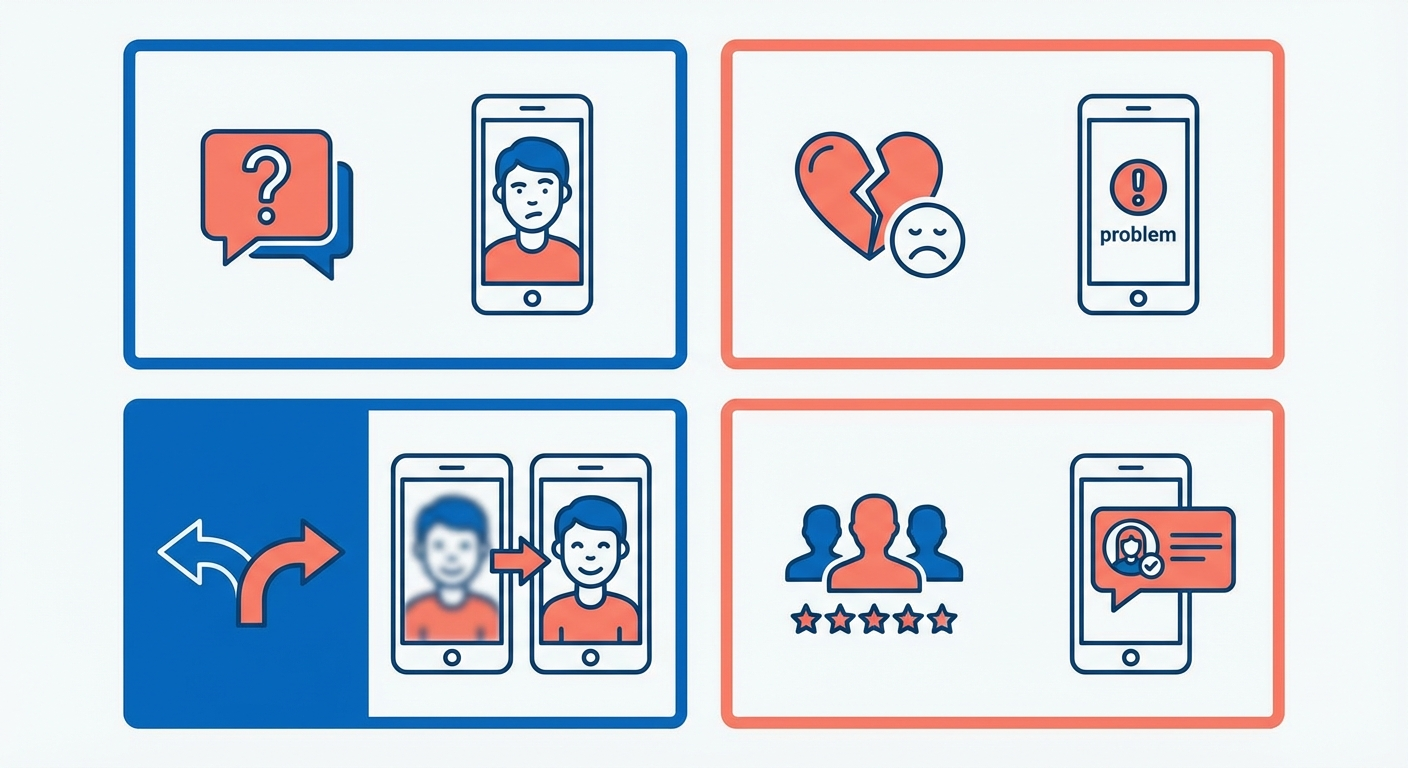 The four main UGC hook types: question, pain point, transformation, and social proof
After analyzing hundreds of high-performing UGC ads, clear hook patterns emerge. Here's the taxonomy:
1. The Question Hook "Have you ever struggled with problem?" "Want to know my secret for desired outcome?"
Why it works: Triggers curiosity and self-identification. The viewer mentally answers "yes" and keeps watching.
Best for: Problem-solution products, skincare, supplements, productivity tools.
2. The Pain Point Hook "I was so frustrated with specific pain..." "If you're tired of common complaint, watch this."
Why it works: Empathy-driven. Viewers see their own experience reflected and trust the creator understands them.
Best for: Health & wellness, home improvement, productivity, financial products.
3. The Transformation Hook "Here's my skin after 30 days of using product..." "I went from before state to after state."
Why it works: Visual proof is powerful. Before/after creates immediate desire.
Best for: Beauty, fitness, home organization, SaaS (showing dashboard transformations).
4. The Social Proof Hook "This product has 50,000 five-star reviews and I had to try it." "Everyone on TikTok is talking about this — here's my honest review."
Why it works: Leverages herd behavior. If "everyone" loves it, it must be good.
Best for: Trending products, viral items, DTC brands with strong review bases.
5. The Bold Claim Hook "This $30 product replaced my $200 routine." "The one thing that actually fixed my problem."
Why it works: Creates a value gap that demands explanation. Viewer needs to find out how.
Best for: Value-oriented products, dupes, premium alternatives.
How to track hooks systematically:
Create a simple spreadsheet with columns: Ad URL, Hook Type, Hook Script (verbatim first 5 seconds), Product Category, Days Active, GEO Count. After cataloguing 50+ UGC hooks from your vertical, patterns will emerge clearly.
UGC Format Breakdown: Talking Head vs Lifestyle vs Review
Not all UGC is the same format. Understanding the sub-types helps you brief creators more precisely.
Talking Head
- Creator speaks directly to camera
- Usually waist-up or face-only framing
- May use text overlays for emphasis
- Duration: 15-45 seconds typically
- Best for: Explaining benefits, addressing objections, personal testimonials
Lifestyle / In-Use
- Creator uses product in natural setting
- Shows product integration into daily routine
- May combine voiceover with B-roll
- Duration: 15-30 seconds
- Best for: Fashion, food, home goods, beauty routines
Unboxing / First Impression
- Creator opens and reacts to product live
- Genuine surprise/delight element
- Often includes close-up product shots
- Duration: 30-60 seconds
- Best for: DTC products, subscription boxes, premium items
Review / Comparison
- Creator gives detailed product review
- May compare against competitors
- More informational tone
- Duration: 45-90 seconds
- Best for: Tech products, skincare, supplements, high-consideration purchases
Problem → Solution
- Opens with relatable problem scenario
- Shows product as the solution
- Often includes before/after
- Duration: 15-45 seconds
- Best for: Problem-specific products (acne, back pain, clutter, etc.)
When spying on competitors, track which formats they use most and which run longest. If a competitor consistently runs talking-head UGC for 30+ days but their lifestyle UGC dies after a week, that tells you exactly which format performs in your vertical.
Discover trending UGC ad patterns by vertical with Adligator — try free
How to Brief UGC Creators Using Competitor Intelligence
The real value of UGC ad spy competitor research isn't copying — it's briefing. Here's how to translate spy data into creator briefs.
The UGC Brief Template (from spy data):
BRIEF: [Product Name] UGC Video Ad

HOOK (first 3 seconds):
Type: [Question / Pain Point / Transformation / Social Proof / Bold Claim]
Script: "[Write 1-2 sentences based on winning hook patterns from research]"

FORMAT: [Talking Head / Lifestyle / Unboxing / Review / Problem-Solution]

KEY MESSAGES (mid-section):
1. [Main benefit — from competitor ad analysis]
2. [Supporting proof point]
3. [Differentiator or unique angle]

PRODUCT DEMO:
- Show: [Specific product use moment]
- Duration: [5-10 seconds]
- Style: [Natural, in-hand, close-up]

CTA (last 3-5 seconds):
Script: "[Natural-sounding call to action]"
Button: [Shop Now / Learn More]

TECHNICAL:
- Aspect ratio: 9:16 (Reels/Stories primary) + 1:1 (Feed)
- Duration: [15-30 seconds for Reels / 30-60 for Feed]
- Lighting: Natural daylight preferred
- Setting: [Based on competitor patterns — home, bathroom, kitchen, etc.]
- Wardrobe: Casual, [demographic-appropriate]

REFERENCE ADS:
- [Link to competitor ad 1 — explain what to emulate]
- [Link to competitor ad 2 — explain what to emulate]
- [Link to competitor ad 3 — what NOT to do]
The research-to-brief workflow:
- Identify 10-15 high-performing competitor UGC ads in your vertical
- Categorize by hook type and format
- Note the most common patterns (hook types, settings, product demo style)
- Identify one pattern your competitors are NOT using (your differentiation opportunity)
- Write 3-5 briefs: 3 following proven patterns, 2 testing fresh angles
- Assign to UGC creators with specific reference ads
Key principle: You're not copying scripts. You're identifying patterns that survive the market's selection process and building original executions within those proven frameworks.
Using Adligator to Track UGC Trends by Vertical and GEO
Adligator's filter system is particularly useful for UGC research because it lets you combine format, longevity, and vertical filters that the free Meta Ad Library doesn't offer.
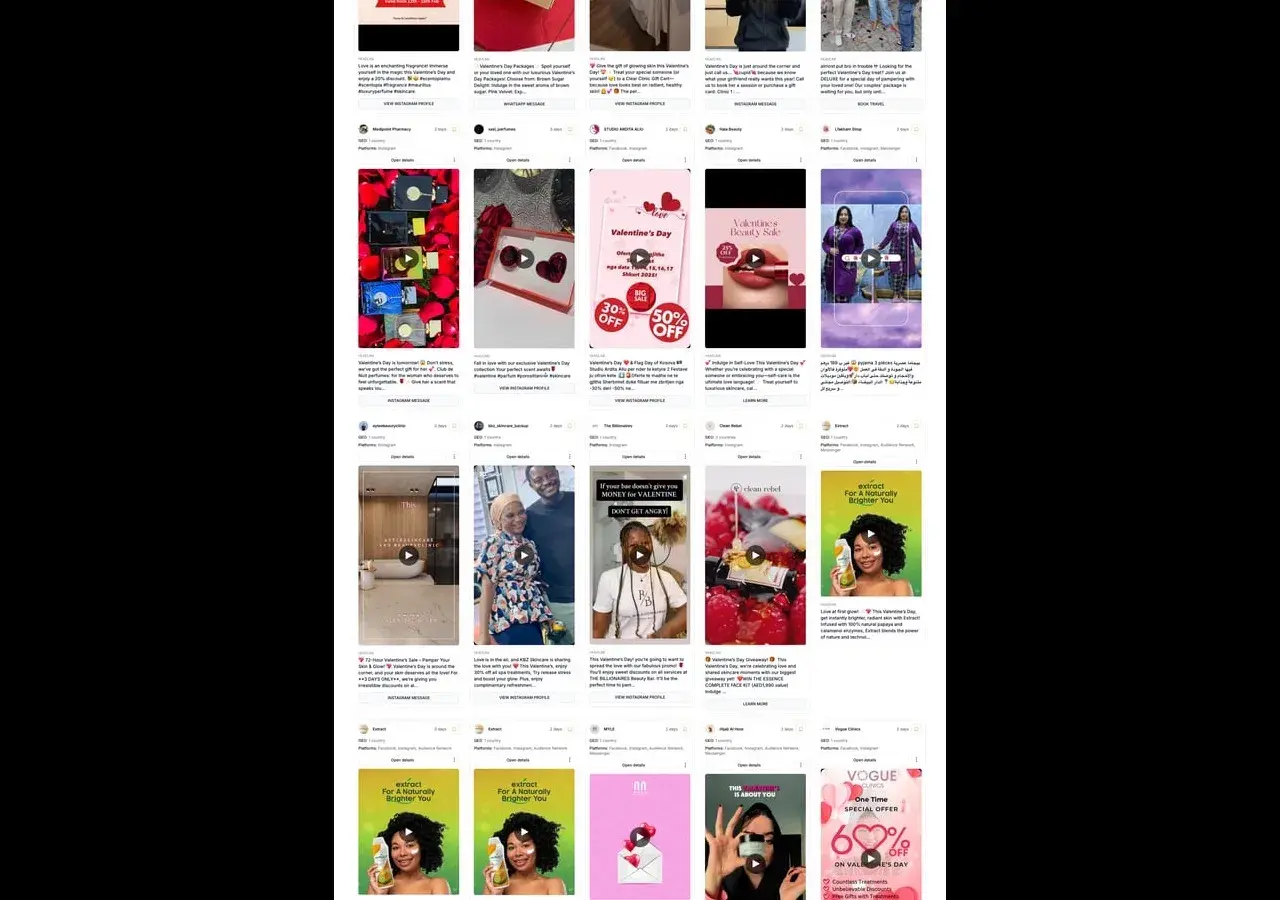 Adligator: filtering video ads in the skincare vertical to find UGC patterns
UGC research workflow in Adligator:
Step 1: Set format filter to Video. This immediately narrows results to video creatives, where most UGC lives. Use the Display Format filter and select "Video."
Step 2: Add a keyword for your vertical. Search for your product category (e.g., "skincare," "supplements," "pet food") or competitor brand name.
Step 3: Filter by Days Active. Set minimum to 10+ days to see only validated creatives. For finding true winners, try 30+ days.
Step 4: Apply GEO filter if needed. If you're targeting specific markets (US, UK, EU), filter by country to see what works in your target GEO.
Step 5: Scan and save. Browse the results visually, identify UGC-style creatives, and save them to a Collection for later analysis.
Step 6: Set up a Tracker. On Pro or Team plans, save this filtered search as a live Tracker. Adligator will monitor for new UGC ads matching your criteria and alert you to emerging trends. Pro plans get 7 trackers; Team plans get 14.
Vertical-specific research tips:
- Skincare/Beauty: Filter for video + "skincare" or specific ingredients. UGC in this vertical heavily uses the transformation hook with before/after.
- Supplements: Search by ingredient or benefit keyword. Talking head format dominates with bold claim hooks.
- Fashion/DTC: Search by brand name or product category. Lifestyle and unboxing formats perform well.
- Apps/SaaS: Search by competitor name. Screen recording + voiceover is a common UGC variant in tech.
Cross-GEO pattern discovery: Run the same search across different countries to spot UGC trends that are working internationally. A hook pattern gaining traction in the US market often migrates to UK, AU, and EU within weeks. Early adoption gives you a competitive edge.
Building Your UGC Creative Playbook from Spy Data
Individual ad analysis is useful, but the real power comes from building a systematic playbook over time. Here's how to structure your ongoing UGC research.
Monthly UGC Research Cadence:
Week 1: Vertical scan.
- Run your saved searches in Adligator
- Identify 20-30 new high-performing UGC ads
- Categorize by hook type and format
- Note any new patterns or trend shifts
Week 2: Deep analysis.
- Select the top 10 ads from your scan
- Transcribe the first 10 seconds of each
- Map the complete ad structure (hook → problem → solution → CTA)
- Identify common elements across winners
Week 3: Brief creation.
- Write 5-8 new UGC briefs based on findings
- Include reference ads for each brief
- Assign to creators with specific guidelines
- Prioritize proven patterns but include 1-2 experimental angles
Week 4: Performance review.
- Compare your UGC ad performance against spy data benchmarks
- Which patterns from competitor research performed best for you?
- Update your playbook with learnings
- Archive underperforming patterns, double down on winners
Your UGC Playbook should include:
- Hook library: Organized by type, with example scripts and performance notes
- Format preferences: Which UGC formats work best in your vertical
- Creator archetype notes: What type of creator (age, style, energy level) resonates with your audience
- Seasonal patterns: UGC approaches that work for different seasons or events
- Anti-patterns: What you've tested and confirmed doesn't work
- Competitor tracker: Ongoing log of competitor UGC evolution
Mistakes to avoid when building your playbook:
- Copying verbatim. Extract patterns, not scripts. Your UGC needs to be authentic to your brand.
- Ignoring the mid-section. Most people focus on hooks, but the body (problem elaboration, benefit explanation) matters for conversion.
- Overlooking the CTA. UGC CTAs should feel natural, not forced. Study how top-performing UGC transitions to the ask.
- Static playbook. UGC trends shift every quarter. If your playbook hasn't been updated in 3 months, it's stale.
- Single-format dependence. Even if talking head works great, test other formats. The market evolves and so should your creative mix.
FAQ
How do I find competitors UGC ads?
Use spy tools like Adligator to filter by video format, then visually scan for UGC characteristics: selfie-style framing, natural lighting, casual speech patterns, and authentic product demonstrations. Filter by longevity (10+ days active) to find UGC that actually performs rather than test creatives that were quickly killed.
What makes a UGC ad perform well on Facebook?
High-performing UGC ads share common traits: a strong hook in the first 3 seconds, authentic delivery style, clear problem-solution framing, and a natural-feeling CTA. The best UGC doesn't feel like an ad — it feels like a friend recommending something. Longevity in spy tool data (30+ days active) is the strongest signal of real performance.
Can spy tools filter specifically for UGC content?
No spy tool can automatically identify UGC vs polished ads. However, you can filter by video format and then visually identify UGC patterns. In Adligator, use the Display Format filter for Video, combine with long-running ads (Days Active filter), and you'll find UGC winners quickly. With practice, you can scan 100 results and identify UGC in minutes.
How do I analyze UGC hooks and scripts?
Watch the first 3 seconds of each UGC ad and categorize the hook type: question, bold claim, pain point, transformation, or social proof. Track which hooks appear most frequently among long-running ads. Transcribe the first 10 seconds verbatim. After cataloguing 50+ hooks from your vertical, clear winning patterns will emerge.
Conclusion
UGC ad spy competitor research isn't about copying what competitors are doing. It's about understanding which patterns survive the market's brutal selection process — and using those insights to brief better UGC, faster.
The framework is straightforward: filter for video ads, identify UGC, analyze hooks and formats, build briefs from patterns, and iterate monthly. Media buyers who systematize this process consistently produce winning UGC creatives while competitors rely on guesswork.
The key advantage of using spy tools for UGC research is scale. You can't manually track UGC trends across 10 competitors, 5 verticals, and 20 GEOs. But with the right filters and a systematic workflow, you can do it in an hour per week.
Ready to find winning UGC patterns in your vertical? Discover trending UGC ad patterns by vertical with Adligator — try free
Get our UGC research brief template
Related Reading
- Copying Competitor Facebook Ads Is Quietly Killing Your ROAS — Here's What to Do Instead
- DTC Brand Facebook Ad Research: How to Spy on Competitors and Build a Winning Creative Launch Strategy
- Facebook Ad Spy for Crypto and Fintech: How to Research Competitor Campaigns in Regulated Verticals
- Facebook Ads by Country: How to Research Competitor Creatives by GEO
