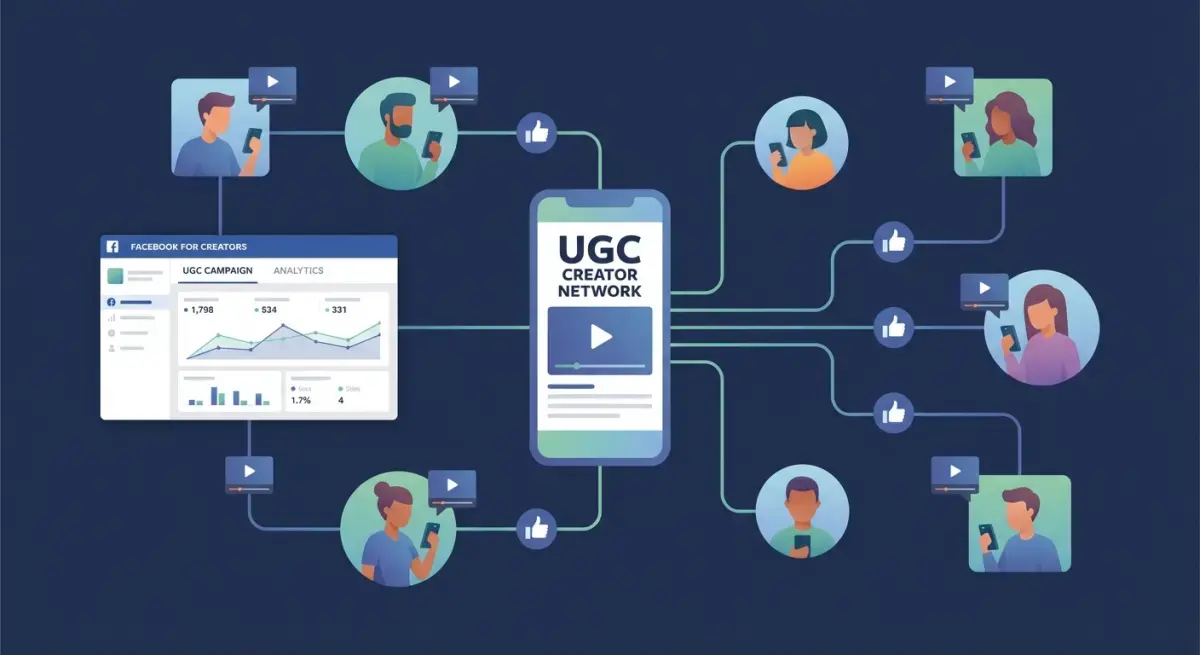
How to Build a UGC Creator Network for Facebook Ads: Sourcing, Briefing, and Managing Creators at Scale
User generated content ads dominate Facebook performance metrics in 2026. Meta's Advantage+ system rewards authentic-looking creative, and media buying teams that feed it a steady stream of UGC consistently outperform those relying on polished studio assets alone.
The problem is not convincing anyone that UGC works. The problem is building a reliable UGC creator network for Facebook Ads that delivers usable content on a predictable schedule, at a cost that makes sense for your margins.
This guide is the operational playbook for creative strategists, media buyers, and agency teams who need to move beyond one-off creator experiments. You will get sourcing channels, vetting frameworks, brief templates, payment structures, and a complete production pipeline -- everything required to build a creator network that scales with your ad spend.
If you are spending more than $10K/month on Meta and still scrambling for fresh creative every week, this is the system you need.
Why UGC Outperforms Polished Creatives on Facebook in 2026
The data pattern is clear: ads that look like organic content from real people consistently beat branded studio creative on cost-per-acquisition. This is not new, but the gap has widened.
Three forces drive this in 2026:
Advantage+ creative optimization favors variety. Meta's algorithm tests creative variants at scale. The more diverse, authentic-looking assets you feed it, the more efficiently it finds winning combinations. UGC gives you that variety at a fraction of studio production costs.
Ad blindness is at an all-time high. Users scroll past anything that looks like an ad. UGC breaks through because it matches the visual language of organic content in the feed -- shaky phone cameras, natural lighting, conversational tone.
Trust signals matter more than production value. A real person demonstrating a product in their kitchen carries more credibility than a model in a studio. For DTC brands and app advertisers, this trust gap directly impacts conversion rates.
The practical implication: you need a system that produces 10-20 new UGC assets per month, not one hero video per quarter. That requires a creator network, not a production agency.
Where to Find UGC Creators: Platforms and Outreach Methods
Sourcing UGC creators is the first bottleneck most teams hit. Here are the channels that consistently deliver results, ranked by reliability and speed.
UGC Marketplace Platforms
These platforms connect brands with creators who specialize in UGC-style content:
- Billo -- Best for product-focused video UGC. Creators ship content within days. Pricing is transparent ($75-150 per video). Strong for e-commerce and DTC.
- Insense -- Connects with creators who can produce both UGC and whitelisted influencer content. Good for teams that want to combine UGC production with paid partnership ads.
- Fiverr -- Lower cost entry point. Quality varies significantly, but you can find hidden gems. Filter by portfolio quality and reviews. Best for static UGC and simple unboxing videos.
- TikTok Creator Marketplace -- Creators here understand short-form vertical video natively. Many are willing to produce content for Facebook/Instagram ads as a side revenue stream.
Direct Outreach Methods
Marketplace fees add up at scale. Direct relationships give you better rates and more control:
- Instagram hashtag mining -- Search hashtags like #ugccreator, #ugccontentcreator, and niche-specific tags. Look for creators with 1K-50K followers who post portfolio content.
- TikTok search -- Search "UGC creator" or "UGC portfolio" to find creators actively looking for brand deals.
- Facebook Groups -- Groups like "UGC Creator Community" and "UGC Creators and Brands" have thousands of active members. Post your brief and filter responses.
- LinkedIn outreach -- More effective for B2B and SaaS UGC. Search for "UGC creator" or "content creator for brands."
Competitor UGC Research
One of the most effective sourcing strategies is reverse-engineering what works for competitors. If a competitor runs UGC ads that have been active for 30+ days, that creative is performing.
The manual approach is scrolling through Meta Ad Library page by page, trying to identify which ads use UGC versus studio content. This works for a quick check but breaks down when you need to analyze patterns across dozens of competitors.
You cannot filter Ad Library by creative type. You cannot see how long specific ads have been running. You cannot compare hook styles across multiple advertisers at once. These limitations make systematic competitor UGC research impractical without tooling.
How to Vet and Select the Right Creators for Your Niche
Not every UGC creator is right for your brand. A creator who is great for skincare unboxings may be wrong for a SaaS product demo. Vetting saves you from wasted briefs and revision cycles.
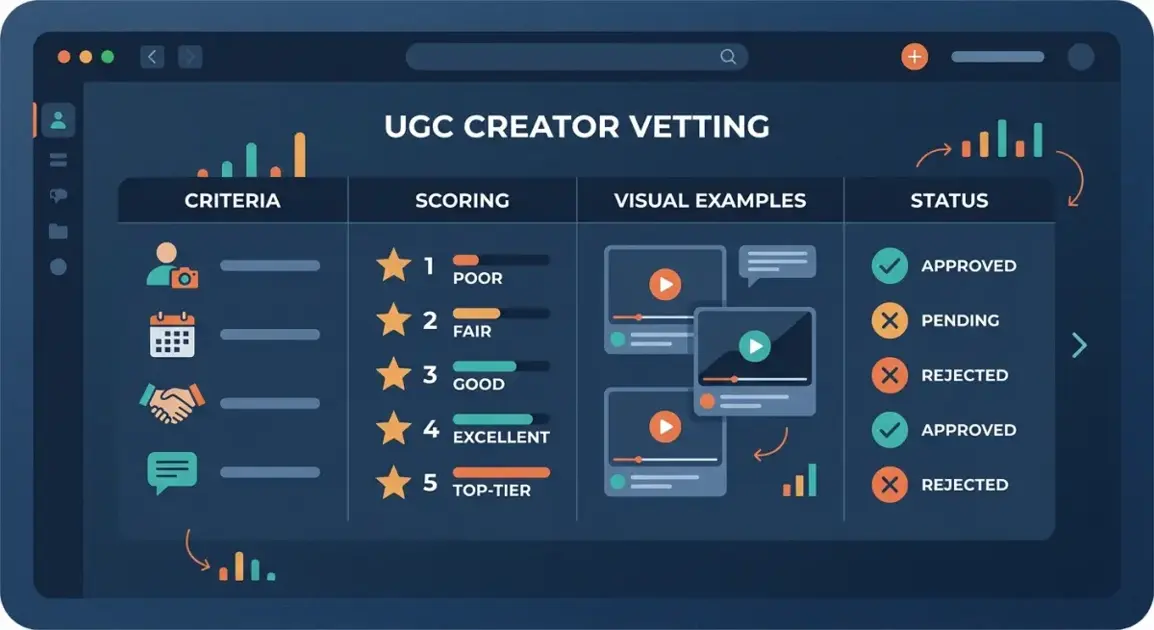 Use this scoring checklist to evaluate potential UGC creators before onboarding.
Creator Vetting Checklist
Score each creator on these criteria before sending a paid brief:
Portfolio quality (weight: 40%)
- Does their existing content match the visual style you need?
- Is the audio quality acceptable (clear voice, no background noise)?
- Do they demonstrate products naturally, or does it feel scripted?
- Can they deliver both vertical (9:16) and square (1:1) formats?
Niche relevance (weight: 25%)
- Do they look and sound like your target customer?
- Have they created content in your product category before?
- Would their appearance and setting feel authentic for your brand?
Reliability signals (weight: 20%)
- Response time to initial outreach (under 24 hours is ideal)
- Portfolio shows consistent posting/production schedule
- Reviews or testimonials from other brands
- Clear rate card and deliverable expectations
Technical capability (weight: 15%)
- Lighting quality in portfolio samples
- Ability to follow specific framing and composition requirements
- Experience with hooks and call-to-action delivery
- Willingness to do multiple takes
The Test Brief Approach
Never commit to a large order before running a test. Send one paid brief ($75-150) with clear deliverables. Evaluate:
- Did they follow the brief exactly?
- Was the content usable without major edits?
- Did they deliver on time?
- How did they handle feedback?
Creators who pass the test brief get added to your active roster. Those who deliver exceptional work get priority on future briefs and volume commitments.
Writing UGC Briefs That Get Usable Content: Templates and Examples
The brief is where most UGC operations fail or succeed. A vague brief produces unusable content and costly revision cycles. A precise brief gets you ad-ready content on the first take.
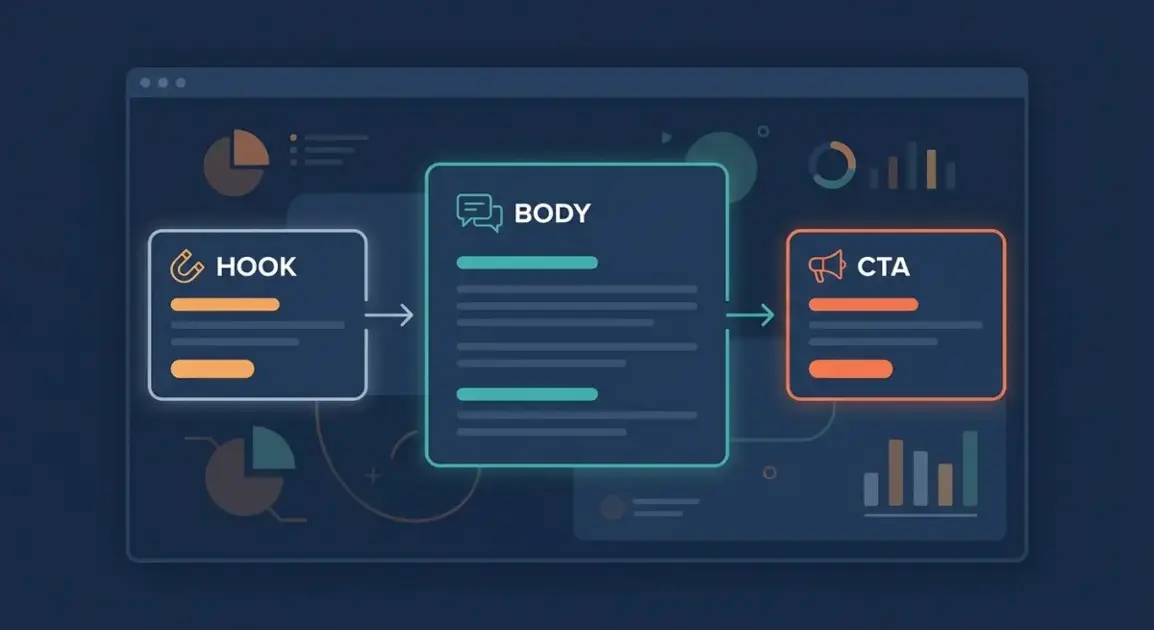 A structured UGC brief template that reduces revision cycles and gets usable content on the first take.
UGC Brief Template
Use this framework for every creator brief:
Section 1: Context
- Product name and one-sentence description
- Target audience (age, interests, pain points)
- Where this ad will run (Facebook feed, Instagram Reels, Stories)
- Aspect ratio required (9:16, 1:1, or both)
Section 2: The Hook (first 3 seconds)
- Write 2-3 hook options the creator can choose from
- Specify the opening action (hold product, face camera, text overlay)
- Example hooks:
- "I stopped common mistake and here is what happened..."
- "Nobody talks about this product category hack..."
- "I tried product for 30 days -- honest review"
Section 3: Body (15-45 seconds)
- 3-5 key talking points in order of importance
- Specific product benefits to demonstrate (not just mention)
- Any required product shots or usage demonstrations
- Transition instructions between talking points
Section 4: Call to Action (last 5 seconds)
- Exact CTA line or approved variations
- Whether to point down, show screen, or use text overlay
- Urgency element if applicable ("link in bio," "limited time")
Section 5: Technical Requirements
- Video length range (e.g., 30-60 seconds)
- Lighting requirements (natural daylight preferred)
- Audio requirements (no background music, speak clearly)
- File delivery format (MP4, minimum 1080p)
- Deadline for first draft and final delivery
Section 6: Do's and Don'ts
- DO: speak naturally, show real usage, include personal opinion
- DON'T: use competitor names, make medical/income claims, read from a script verbatim
- Legal disclosures required (if applicable)
Hook Formulas That Work for Facebook UGC
The hook determines whether your ad gets watched or skipped. These formulas consistently perform:
- Problem-agitation: "I used to pain point until I found this..."
- Curiosity gap: "This is the product category everyone is switching to and nobody is talking about why..."
- Social proof: "My friend/dermatologist/trainer recommended this and I was skeptical, but..."
- Direct challenge: "Stop wasting money on alternative. Here is what actually works."
- Before/after: "Here is my result area before. And here is after 3 weeks of using product."
Tip: Research competitor UGC ads to identify which hook styles get long run times in your vertical. Ads that stay active for 30+ days have proven hooks worth studying. Research competitor UGC ads with Adligator to write better creator briefs -- start free trial
Managing Creator Relationships and Payment at Scale
UGC creator management becomes a real operational challenge once you are working with more than five creators simultaneously. Without systems, you lose track of briefs, miss deadlines, and overpay for inconsistent quality.
Payment Structures That Work
Per-deliverable pricing -- The standard for most UGC engagements:
- Simple talking-head video (30-60s): $75-200
- Product demonstration video with b-roll: $150-350
- Photo set (5-10 images): $50-150
- Video + 3 variations (different hooks): $200-500
Monthly retainer -- For creators on your core roster:
- 4 videos/month: $400-800 depending on complexity
- 8 videos/month: $700-1,400
- Retainers give you priority access and faster turnaround
Performance bonuses -- Tie a portion of compensation to ad performance:
- Bonus of $50-100 when a creator's content stays active for 14+ days
- Quarterly bonus for the top-performing creator
- This aligns incentives and rewards quality over volume
Contracts and Usage Rights
Every creator relationship needs a written agreement covering:
- Usage rights scope: specify all platforms where you will run the content (Meta, TikTok, YouTube, CTV)
- Usage duration: most agreements cover 12 months, with renewal options
- Exclusivity: whether the creator can work with direct competitors (specify a list)
- Revision policy: include 1-2 revision rounds in the base price, charge for additional rounds
- Content ownership: you own the final content; creator retains the right to use in their portfolio
- Payment terms: net 7 or net 14 after content approval
Tracking and Communication Systems
At scale, you need a centralized system:
- Project management: use Notion, Airtable, or Monday.com to track brief status, deadlines, and payments per creator
- Communication: consolidate to one channel per creator (Slack, email, or platform DMs -- pick one)
- Asset library: organize delivered content by creator, product, hook type, and performance status
- Payment tracking: batch payments weekly or bi-weekly to reduce admin overhead
UGC Production Pipeline: From Brief to Published Ad
A repeatable pipeline eliminates guesswork and keeps creative flowing on schedule. Here is the full workflow from brief to live ad.
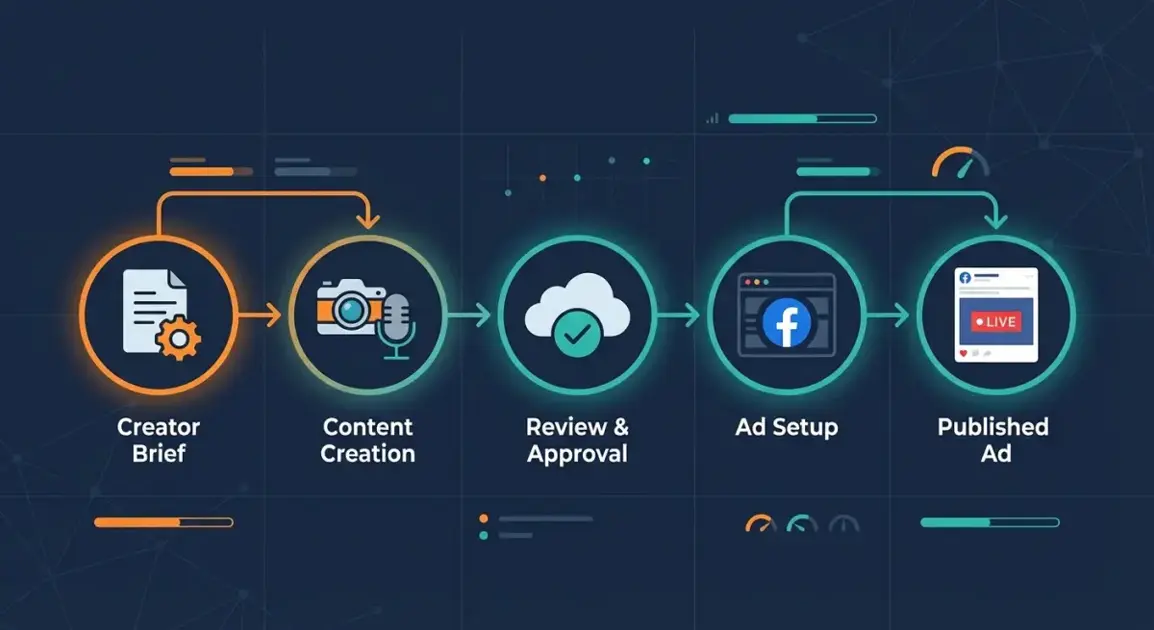 The full UGC production pipeline from brief assignment to live ad deployment.
Week-by-Week Production Cycle
Monday: Brief creation and assignment
- Review performance data from previous week's ads
- Identify which angles, hooks, and products need fresh creative
- Write 3-5 briefs using the template above
- Assign briefs to creators from your roster based on niche fit
Wednesday: Check-in and first drafts
- Send a quick check-in message to all assigned creators
- Review any early submissions
- Provide feedback within 4 hours of receiving drafts
Friday: Final delivery and QC
- Collect all final deliverables
- Run quality control check on each piece:
- Audio clarity and volume levels
- Visual quality (lighting, framing, focus)
- Brief compliance (all talking points covered, correct CTA)
- Technical specs (resolution, aspect ratio, file format)
- Request revisions for anything that does not pass QC
Following Monday: Post-production and upload
- Add captions/subtitles (80% of Facebook video is watched without sound)
- Create thumbnail variations
- Add branded end cards if required
- Upload to ad account and create ad variations
- Launch into existing Advantage+ campaigns or dedicated test campaigns
Quality Control Workflow
Every piece of UGC should pass through this checklist before going live:
- Hook is attention-grabbing in the first 2 seconds
- Audio is clear and at consistent volume
- Product is shown clearly and in use
- Talking points match the brief
- CTA is delivered naturally
- No competitor mentions or prohibited claims
- Video meets technical specs (resolution, length, aspect ratio)
- Captions are accurate and timed correctly
- Content feels authentic, not over-produced
Analyzing UGC Performance: What to Measure and Iterate
Producing UGC at volume only makes sense if you are measuring what works and feeding those insights back into your briefs. Performance tracking by creator is essential for optimizing your network over time.
Key Metrics to Track Per Creator
Build a simple dashboard (spreadsheet or Airtable) tracking:
| Metric | Why It Matters |
|---|---|
| Hook rate (3-second video views / impressions) | Measures whether the opening grabs attention |
| Hold rate (ThruPlays / impressions) | Measures whether viewers watch the full message |
| CTR (link clicks / impressions) | Measures whether the content drives action |
| CPA (cost per acquisition) | The bottom line -- does this creative convert? |
| Active days | How long Meta keeps serving the ad (longevity = winner signal) |
| Revenue per creative | For DTC: total attributed revenue from this specific asset |
What the Data Tells You
After 2-3 months of tracking, patterns emerge:
- Creator A consistently produces high hook rates but lower CTRs -- their openings are strong but the body needs work. Solution: give them better product demonstration instructions.
- Creator B has average hook rates but the best CPAs -- their authentic delivery style builds trust. Solution: increase their brief volume and test more hook variations.
- Creator C delivers beautiful content that never performs -- their style might be too polished for UGC. Solution: ask them to scale back production quality or reassign to a different product.
Competitive UGC Analysis
The most valuable performance signal often comes from outside your own account. When a competitor's UGC ad has been running for 60+ days, that is a proven creative approach worth studying.
Manually monitoring competitors through Meta Ad Library lets you see active ads, but you cannot filter by format type, sort by longevity, or analyze hook patterns across multiple pages. You end up spending hours scrolling with no systematic way to extract insights.
Adligator solves this by letting you filter competitor ads by creative type and see exactly how long each ad has been active. You can identify which UGC styles, hooks, and formats are working in your vertical -- then feed those insights directly into your creator briefs. Instead of guessing what hooks to test, you are briefing creators based on proven patterns from your competitive landscape.
See the top-performing UGC ads in your vertical right now
Building a Creator Roster for Consistent Output
A one-off creator relationship is not a network. The goal is a roster of reliable creators you can activate on short notice with minimal onboarding friction.
Roster Structure
For a team spending $20K-100K/month on Meta ads, aim for this roster composition:
- Core creators (3-5): Your top performers. They know your brand, require minimal direction, and deliver consistently. Give them retainer agreements and first priority on briefs.
- Growth creators (5-10): Passed the test brief and show potential. Rotate them through briefs to find the next core creator. Evaluate monthly based on ad performance.
- Pipeline creators (10-20): Vetted but not yet tested with a paid brief. Keep them in a database for when you need to expand or replace roster members.
Roster Maintenance
Monthly roster review:
- Promote: Move growth creators with 2+ winning ads to core status
- Maintain: Keep core creators engaged with steady brief flow and performance bonuses
- Replace: Remove creators who have delivered 3+ briefs with no ads passing QC or performance thresholds
- Recruit: Add 2-3 new pipeline creators per month to keep the funnel healthy
Scaling Across Product Lines
When you manage multiple products or clients:
- Maintain separate rosters per product vertical (a skincare UGC creator is not necessarily right for a fitness app)
- Cross-pollinate when demographics overlap
- Track creator performance at the product level, not just overall
- Brief creators on one product at a time to maintain authenticity
Creator Retention Tactics
Good creators get poached. Keep your best ones:
- Pay on time, every time (this alone puts you ahead of 70% of brands)
- Share performance data with creators -- they want to know their content is working
- Offer rate increases proactively after 3 months of strong performance
- Give them creative freedom within the brief framework -- the best UGC comes from creators who feel ownership
- Send product early and let them genuinely experience it before filming
FAQ
How much should you pay UGC creators for Facebook ad content?
Rates vary by experience and deliverable type. Expect $75-150 per video from newer creators on marketplace platforms, $200-500 per video from experienced UGC specialists, and $50-100 per static photo set. Always negotiate based on usage rights and volume commitments. Retainer deals at 4+ videos per month typically offer 15-25% savings over per-deliverable pricing.
What is the difference between UGC creators and influencers?
UGC creators produce content that looks authentic and user-generated, but it is made specifically for brand advertising. They do not post on their own channels. Influencers post branded content to their own audience for reach and engagement. UGC is about the content format and production style; influencer marketing is about audience distribution. Many brands use both, but the sourcing, briefing, and payment models are different.
How many UGC creators do you need for a Facebook ad account?
For consistent creative testing, maintain a roster of 5-10 active creators per product line. This gives you enough variety in faces, styles, and hooks to run meaningful A/B tests each week without over-relying on a single creator. Accounts spending over $50K/month on Meta typically need 10-15 active creators to sustain the creative volume Advantage+ demands.
Can you use UGC content across multiple ad platforms?
Yes, but negotiate usage rights upfront in your creator agreement. Most standard UGC agreements cover Meta platforms (Facebook, Instagram, Messenger) by default. If you want to repurpose content on TikTok, YouTube, Google Display, or connected TV, specify multi-platform rights in your contract. Some creators charge a 20-50% premium for expanded usage rights, but this is almost always cheaper than producing separate content for each platform.
Conclusion
Building a UGC creator network for Facebook Ads is not a creative problem -- it is an operations problem. The brands winning with user generated content ads in 2026 are not necessarily the ones with the most talented creators. They are the ones with the most reliable systems for sourcing, briefing, producing, and iterating on UGC at scale.
Start by establishing your sourcing channels and running test briefs with 5-10 creators. Build your brief template using the framework in this guide. Set up performance tracking from day one so you can identify your best creators early and double down on what works.
The competitive advantage compounds over time. Every week of data makes your briefs sharper, your roster stronger, and your cost-per-acquisition lower. The teams that systematize this process now will have an insurmountable creative advantage by the end of the year.
Ready to see which UGC styles and hooks actually work in your vertical? Research competitor UGC ads with Adligator to write better creator briefs -- start free trial
See the top-performing UGC ads in your vertical right now
Related Reading
- How Many Ad Creatives Do You Need for Facebook Ads? A Data-Driven Framework by Budget Level (2026)
- Copying Competitor Facebook Ads Is Quietly Killing Your ROAS — Here's What to Do Instead
- How to Build a Creative Brief from Ad Spy Data: A Reusable Template for Media Buying Teams
- Facebook Ad Creative Testing Framework: How to Validate Winners Faster Using Competitor Intelligence
