
How to Use Ad Spy Data to Scale Facebook Campaigns: From Testing to Six-Figure Spend
Most media buyers use spy tools backward. They browse competitor ads for "inspiration," screenshot a few creatives they like, and try to reproduce something similar. Then they wonder why the results don't match the competitor's apparent success.
The real value of ad spy data isn't inspiration — it's intelligence. When you use ad spy data to scale facebook campaigns systematically, competitor intelligence becomes the engine that feeds your creative testing pipeline, identifies what the market rewards, and tells you when to scale aggressively versus when to pull back.
This guide covers a four-phase framework that takes you from raw spy data to six-figure monthly spend. It's built for media buyers and growth teams who want a repeatable system, not a one-time creative swipe.
Why Most Media Buyers Use Spy Tools Wrong
Before the framework, let's address the three most common mistakes:
Mistake 1: Copying instead of pattern-mining. Copying a competitor's ad creative gives you a worse version of something optimized for their audience, their funnel, and their brand. What works is extracting the underlying pattern — the hook structure, the format choice, the messaging angle, the CTA position — and applying it to your own context.
Mistake 2: Looking at snapshots instead of trends. A single competitor search shows you one moment in time. The real intelligence comes from tracking changes over time: which creatives survive (longevity signals), which formats are increasing in share, which messaging angles are being tested aggressively. Trends beat snapshots every time.
Mistake 3: Researching without a testing plan. Spy data is only valuable if it feeds a structured testing process. Without a clear pipeline from research → test batch → scaling decision, spy tools become an expensive browsing habit. Every research session should produce a specific list of creative hypotheses to test.
The mindset shift: Treat spy tools as a data source that feeds your testing machine, not as a gallery for creative inspiration.
The Research-to-Scale Framework
The framework has four phases that run continuously:
- Mine — Extract patterns from competitor creative data
- Build — Construct test batches based on mined patterns
- Identify — Recognize scaling signals from test results
- Scale — Expand winners with continuous intelligence feedback
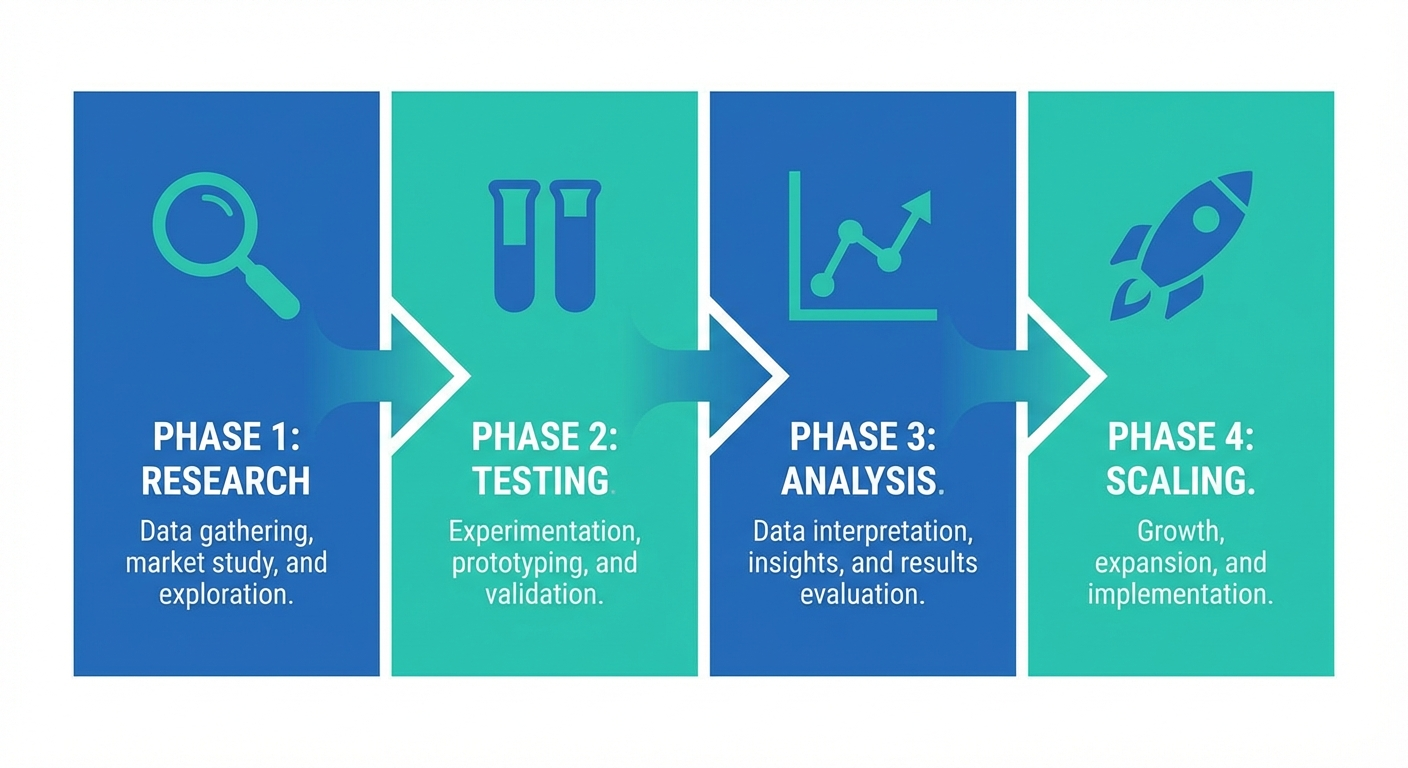 The 4-phase pipeline that turns competitor intelligence into scaling fuel
This isn't a one-time exercise. The cycle repeats weekly, with each iteration refining your understanding of what the market rewards and expanding your portfolio of scaling-ready creatives.
Phase 1: Mining Patterns from Spy Data
Pattern mining is the foundation. Here's a systematic approach:
Step 1: Define your competitive set. Identify 10–15 competitors in your space. Include direct competitors (same product/service), adjacent competitors (different product, same audience), and aspirational competitors (bigger players you want to learn from).
Step 2: Filter for proven winners. Set your spy tool to show ads active for 14+ days minimum. This filters out tests and failures, leaving you with ads that are delivering positive results. For high-confidence signals, filter for 30+ days.
Step 3: Extract pattern categories.
For each proven ad, log:
- Format: Video, carousel, static, UGC, studio-produced
- Hook type: Question, result-first, pattern interrupt, controversy, curiosity gap
- Messaging angle: Pain-point led, benefit-led, social-proof led, comparison-led
- CTA: Button type + copy (e.g., "Shop Now" vs. "Learn More")
- Visual style: UGC, lifestyle, product-focused, data/chart-based, text-heavy
- Offer structure: Discount, free trial, free shipping, bundle, urgency
Step 4: Identify pattern clusters. After logging 30–50 proven ads, patterns emerge. You'll notice: "70% of long-running ads in my space use UGC video with a question hook and Shop Now CTA." That's not one competitor's strategy — that's market validation.
Step 5: Rank patterns by frequency and cross-competitor appearance. A pattern used by 6 out of 10 competitors in their longest-running ads is a stronger signal than one used by just one competitor. Frequency across competitors = market-validated pattern.
Step 6: Analyze seasonal and temporal patterns. Some creative patterns are evergreen; others spike during specific periods. Track when competitors launch new creative bursts versus when they maintain steady-state campaigns. A competitor suddenly launching 20 new creatives in January signals either a new product, a budget refresh, or a seasonal push. Understanding the timing helps you plan your own testing calendar.
Step 7: Document negative patterns. Equally valuable: what isn't working. If competitors consistently avoid certain formats or messaging angles, that's useful intelligence. A pattern that no successful competitor uses has likely been tested and failed. Don't waste your testing budget re-discovering what the market already rejected.
Common pattern mining mistakes:
- Mining from too few competitors (minimum 8–10 for reliable patterns)
- Not filtering by longevity (you'll analyze failed tests alongside winners)
- Confusing one competitor's brand strategy with a market-wide pattern
- Ignoring the format signal (video vs. static vs. carousel distribution matters as much as messaging)
Output: A ranked list of 5–10 creative patterns to test, ordered by market validation strength.
Phase 2: Building Test Batches from Competitor Insights
Now translate patterns into test creative.
The 3×3 testing matrix: For each top pattern, create three creative variations across three elements:
| Element | Variation A | Variation B | Variation C |
|---|---|---|---|
| Hook | Question | Result-first | Pattern interrupt |
| Body | Pain-point led | Benefit-led | Social proof |
| CTA | Direct ("Shop Now") | Soft ("Learn More") | Urgency ("Limited Time") |
This gives you 9 creative concepts per pattern. With 3 top patterns, that's 27 test creatives — enough volume to generate meaningful data.
Production rules:
- Don't polish test creatives excessively. Speed matters more than production value at the testing stage.
- Match the format that the pattern data suggests (if UGC dominates, produce UGC).
- Include one "control" creative that doesn't follow spy data patterns — this validates that the spy-informed approach actually outperforms.
Budget allocation for testing:
- Allocate $10–$20/day per creative variation
- Run tests for 72 hours minimum before making decisions
- Use broad targeting (let Meta's algorithm find the audience)
- Measure CPA and ROAS, not vanity metrics
What to avoid:
- Don't test more than 30 creatives simultaneously (data gets too thin)
- Don't change targeting and creative simultaneously (isolate variables)
- Don't kill tests before 72 hours unless CPA is 5x+ your target
Ready to systematize your creative pipeline? Feed your scaling pipeline with Adligator competitor intelligence — start free
Phase 3: Identifying Scaling Signals
After 72 hours of testing, you need clear criteria for what to scale, what to iterate, and what to kill.
Scale signals (green light):
- CPA within target range and stable over 72 hours
- ROAS meeting or exceeding your minimum threshold
- Spend delivery is smooth (Meta is finding audience consistently)
- CTR above vertical average (indicates creative resonance)
- No significant performance decay after day 2
Iterate signals (yellow light):
- CPA within 20% of target but not quite there
- Strong CTR but weak conversion (landing page issue, not creative)
- Good early performance but declining on day 3 (creative fatigue may hit fast)
- High engagement but low click-through (entertaining but not compelling)
Kill signals (red light):
- CPA 3x+ above target after 72 hours
- CTR below vertical average with no improvement trend
- Zero or near-zero conversions
- Delivery stalling (Meta can't find audience)
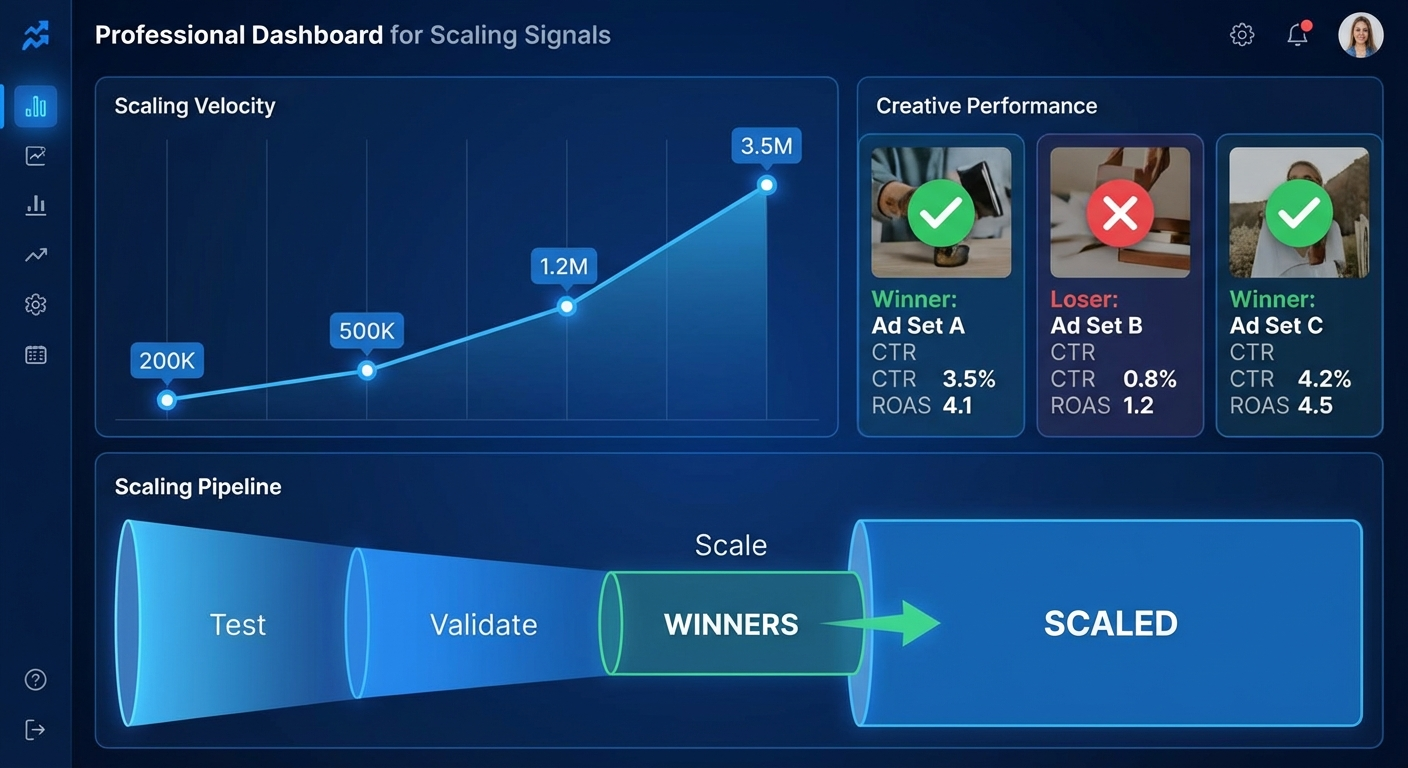 Recognizing scaling signals is the difference between profitable growth and wasted spend
The 72-hour decision matrix: After the test period, categorize every creative into one of three buckets:
- Scale (20–30% of creatives): Increase budget 20–30% every 48 hours
- Iterate (30–40% of creatives): Create 3 new variations of the concept with different hooks or angles
- Kill (30–50% of creatives): Turn off immediately, log the learnings
Critical rule: Your kill rate should be 30–50%. If everything "works," your tests aren't ambitious enough. If nothing works, your pattern mining is off.
Phase 4: Scaling Winners with Continuous Intelligence
Scaling is where spy data becomes a continuous feed rather than a one-time input.
Budget scaling rules:
- Increase budget 20–30% every 48 hours for winners
- If CPA remains stable after a 30% increase, continue scaling
- If CPA spikes >20% after an increase, hold for 48 hours before trying again
- At $500+/day per creative, diversify across ad sets and audiences
- At $1,000+/day, begin testing new GEOs with the same creative
Continuous intelligence loop: While scaling, maintain your spy research cycle:
- Weekly: Check competitors for new creative launches. Are they testing new formats? New hooks? New offers?
- Bi-weekly: Refresh your pattern analysis. Has the market shifted since your last mining session?
- Monthly: Full competitive audit. New competitors entering? Existing competitors scaling back?
Creative refresh cadence: Even winning creatives have a shelf life. Spy data helps you plan refreshes proactively:
- Track when competitor ads that were long-running start getting replaced
- If competitors are refreshing every 4–6 weeks, plan your own refresh cycle accordingly
- Build "next generation" creatives before current winners fatigue, using updated spy patterns
GEO expansion using spy data: When a creative performs well domestically, use spy tools to check if competitors run similar creative in other markets. If the same patterns work across GEOs, it's a strong signal that your creative will travel well.
Scaling from $10K to $100K monthly: The path looks like this:
- $10K/month: 3–5 winning creatives, single GEO, focused testing
- $25K/month: 8–12 winning creatives, 2–3 GEOs, weekly testing cycle
- $50K/month: 15–20 winning creatives, 5+ GEOs, bi-weekly refresh cycle
- $100K/month: 25+ winning creatives, multiple GEOs, continuous testing pipeline, dedicated creative production team
At each stage, spy data feeds the creative pipeline. The difference between getting stuck at $25K and breaking through to $100K is almost always creative volume and variety — not targeting or bidding optimization.
How Adligator Feeds Your Scaling Pipeline
Manual pattern mining works at small scale. But when you're running a continuous research → test → scale cycle across multiple competitors and GEOs, you need automation.
Adligator supports the scaling pipeline at each phase:
Phase 1 (Mining): Filter by format, days active, and GEO to instantly surface proven patterns. The longevity filter (days active) is particularly valuable — it replaces hours of manual checking with a single filter selection.
Phase 2 (Building): Browse competitor creatives organized by format type. See which carousel structures, video styles, and hook approaches competitors use. This speeds up creative briefing.
Phase 3 (Identifying): Track competitor ad count and creative velocity over time. If a competitor suddenly reduces their ad volume, it may signal that your winning creative is taking their market share.
Phase 4 (Scaling): Monitor competitors in new GEOs before you expand. Adligator's GEO filtering shows you which competitors already operate in target markets, what creative they use, and how long those ads run.
The key advantage is speed. Instead of spending 3–4 hours per week on manual research, you can complete a full pattern mining session in 30–45 minutes, freeing time for the strategic work that actually moves the needle.
Practical Adligator workflow for scaling teams:
- Monday morning: Run a 30-minute spy session. Filter by your vertical keywords + 14+ days active + target GEOs. Log new patterns.
- Monday afternoon: Brief creative team on 3–5 new test concepts based on spy findings.
- Wednesday: Launch test batch (aim for 9–15 new creatives per week at scale).
- Friday: Review 72-hour test data. Scale winners, iterate yellows, kill reds.
- Repeat weekly. The cycle becomes muscle memory within 3–4 weeks.
This cadence ensures your creative pipeline never runs dry. Most scaling plateaus happen because the creative testing pipeline stalls — either new concepts stop flowing or the team falls back on gut instinct instead of data-informed decisions. A weekly spy-informed cycle prevents both failure modes.
Case Study: $10K to $100K in 90 Days Using Spy-Informed Creatives
Here's how the framework plays out in practice. This is a directional example based on typical scaling patterns (not a specific client case).
Month 1: Foundation ($10K → $25K)
- Mined patterns from 12 competitors across 3 GEOs
- Identified 5 dominant creative patterns: UGC unboxing, problem/solution video, carousel comparison, testimonial compilation, and product demo
- Built 27 test creatives across the 5 patterns
- Results: 8 creatives met scaling criteria, 11 went to iteration, 8 killed
- Scaled 8 winners from $15/day to $100/day each
- End of month: $25K spend, CPA within target
Month 2: Expansion ($25K → $60K)
- Refreshed spy research, found 3 new patterns emerging (competitor pivot to short-form vertical video)
- Built 18 new test creatives incorporating new patterns + iterations of Month 1 winners
- Added 2 new GEOs based on competitor GEO analysis
- Results: 6 new winners, 4 refreshed versions of Month 1 winners
- End of month: $60K spend across 3 GEOs, CPA improved 15% from Month 1
Month 3: Scale ($60K → $100K+)
- Continuous spy monitoring revealed competitors pulling back on carousel (fatigue signal)
- Doubled down on UGC video format based on spy data
- Launched creative refresh cycle (new hooks on proven body concepts)
- Expanded to 5 GEOs
- End of month: $105K spend, 18 active scaling creatives, stable CPA
Key takeaway: The spy data didn't guarantee success. It shortened the path to success by eliminating creative directions that the market had already rejected and highlighting patterns the market was rewarding.
What the numbers reveal about the spy-informed approach:
The hit rate on spy-informed creatives was roughly 30% (8 winners out of 27 initial tests). Compare that to the typical industry benchmark of 10–15% for creative testing without competitive intelligence. That 2x improvement in hit rate means:
- Fewer wasted testing dollars
- Faster time to first scaling creative
- Earlier revenue from winning ads
- More creative budget available for iteration rather than blind exploration
Lessons learned from the scaling process:
- Pattern mining quality matters more than pattern quantity. Five well-validated patterns produce better test batches than twenty weakly-validated ones.
- Creative refresh is non-negotiable. Even the best-performing creatives show fatigue signals after 4–8 weeks. The spy tool data gives you early warning by showing when competitors start replacing their long-runners.
- GEO expansion should follow competitor presence data. Markets where multiple competitors already run similar creatives have validated demand. Markets with no competitor presence may indicate either opportunity or lack of demand — proceed cautiously.
- The framework compounds. Month 3 was dramatically more efficient than Month 1 because the team had built pattern recognition skills and had a library of tested concepts to iterate on.
FAQ
How do you use ad spy tools to improve Facebook campaigns?
Use spy tools to identify winning patterns (formats, hooks, CTAs, messaging angles) from competitors with long-running ads. Build test creative batches inspired by — not copied from — these patterns. Track which spy-informed creatives outperform your existing ones, then scale the winners.
Can spy tool data help you scale faster?
Yes. Spy data reduces the guesswork in creative testing by showing you what's already working in your market. Instead of testing random creative concepts, you test concepts informed by proven patterns — which increases your hit rate and lets you find scalable winners faster.
What patterns should you look for in competitor ads before scaling?
Focus on: ad longevity (30+ days active = likely profitable), creative format distribution (which formats dominate?), hook structure (first 3 seconds of video), CTA type and messaging angle, and GEO expansion patterns. These signals indicate what the market rewards.
Conclusion
The difference between media buyers who plateau at $10K/month and those who scale to six figures is usually not targeting expertise or bid strategy — it's creative volume and creative intelligence. When you use ad spy data to scale Facebook campaigns, you're plugging into a continuous stream of market-validated creative patterns.
Build the pipeline: mine patterns weekly, construct test batches from those patterns, identify scaling signals with clear criteria, and feed winners with continuous competitive intelligence. The framework compounds over time — each cycle makes your pattern recognition sharper and your creative hit rate higher.
Ready to build your spy-to-scale pipeline? Feed your scaling pipeline with Adligator competitor intelligence — start free
Related Reading
- How to Estimate Competitor Facebook Ad Spend Using Spy Tools and Ad Library Data
- Facebook Ad Creative Testing Framework: How to Validate Winners Faster Using Competitor Intelligence
- How to A/B Test Facebook Ad Creatives: A Beginner Guide to Statistical Confidence and Faster Winners
- How to Use AI-Powered Ad Intelligence to Predict Winning Facebook Creatives Before You Spend
