
Facebook Advantage+ Creative Optimization: How Spy Data Helps You Feed the Algorithm Winning Variations
Facebook's Advantage+ creative optimization shifted the game for media buyers. The algorithm handles audience targeting, budget allocation, and placement optimization — but it cannot create the ads. That job still belongs to you.
The uncomfortable truth about advantage+ creative optimization facebook campaigns is that the algorithm is only as good as the creative fuel you give it. Feed it five mediocre variations, and it will find the least bad one. Feed it thirty well-crafted variations informed by real market data, and it will find combinations that outperform anything you could have predicted.
This is where most media buyers hit a bottleneck. Generating enough high-quality creative variations at scale requires more than brainstorming sessions and internal meetings. The top performers use a different source: competitor intelligence data that reveals which creative patterns are already winning in their market.
This article shows you how to combine Advantage+ automation with ad spy creative strategy to build a systematic creative pipeline — one that consistently produces better inputs and lets the algorithm do what it does best.
What Advantage+ Actually Needs to Work
Before diving into the creative strategy, it helps to understand what Advantage+ actually does and what it needs from you.
How Advantage+ Creative Optimization Works
Advantage+ is Meta's machine learning system that automatically tests combinations of your creative elements — images, videos, headlines, primary text, descriptions — across audiences and placements. It identifies which combinations perform best and allocates budget accordingly.
Key mechanics:
- Dynamic creative combinations: Advantage+ mixes and matches your creative elements. If you provide 5 images and 5 headlines, the system tests up to 25 combinations.
- Automatic placement optimization: It adjusts creative presentation for each placement (Feed, Stories, Reels, Messenger) without you creating separate assets.
- Audience signal processing: The algorithm uses engagement signals (clicks, views, conversions) to refine which combinations work for which audience segments.
- Learning phase: New creative sets need approximately 50 optimization events before the algorithm stabilizes. During this phase, performance may be volatile.
What You Control vs. What the Algorithm Controls
You control:
- Creative assets (images, videos, copy)
- The volume and diversity of variations
- The strategic direction (what to test)
- When to add fresh creative and retire fatigued assets
The algorithm controls:
- Which combination to show to which person
- Budget allocation across variations
- Placement optimization
- Bid and delivery optimization
The implication is clear: your competitive advantage in an Advantage+ world is not targeting (the algorithm handles that) or bidding (automated) — it is creative quality and creative volume. The media buyers winning with facebook advantage+ ads are the ones who can generate the most high-quality variations the fastest.
Why Creative Volume Is the New Targeting
In the pre-Advantage+ era, media buyers spent 80% of their time on audience targeting and 20% on creative. Advantage+ flipped that ratio.
Here is why creative volume matters more than ever:
- The algorithm needs diversity to learn. With 3 variations, it picks the best of 3. With 30 variations, it can identify patterns across combinations you would never have tested manually.
- Creative fatigue is the primary performance killer. In an automated system, the algorithm will keep showing winning creative until it fatigues. More variations mean more runway before you need to refresh.
- Different audience segments respond to different creative. Advantage+ segments your audience behind the scenes. More creative variations mean the algorithm can match the right message to the right person.
- Testing velocity compounds. Each creative variation testing cycle gives you data. More variations per cycle means faster learning about what works for your audience.
The math is simple: if your competitor runs Advantage+ with 5 variations and you run it with 25, and your variations are informed by market data while theirs are based on guesswork, the algorithm will find better combinations for you faster. Over weeks and months, this compounds into a significant performance advantage.
Consider this: a campaign with 25 variations has 4–5x more data points per learning cycle than one with 5. Each cycle teaches the algorithm more about what works with your audience. After 4 weeks, the campaign with more variations has effectively completed months of learning compared to the under-fed one. This is not theoretical — it is the fundamental reason why creative-first media buyers are outperforming targeting-first media buyers in the Advantage+ era.
But generating 25+ quality variations is hard. That is where spy data changes the equation.
Using Spy Tools to Generate Creative Hypotheses at Scale
The traditional approach to creative variation testing is brainstorming: your team sits in a room, generates ideas, and produces 5–10 variations. The problem with this approach is that it is limited by your team's experience and imagination — and it misses patterns that are already proven in the market.
Spy tools give you a fundamentally different input source. Instead of guessing what might work, you analyze what is already working at scale for competitors in your vertical.
The Research-to-Hypothesis Workflow
Step 1: Identify long-running competitor creatives
In Adligator, search your vertical keywords and filter by days active (14+). These are ads that have survived the algorithm's natural selection — they are almost certainly profitable.
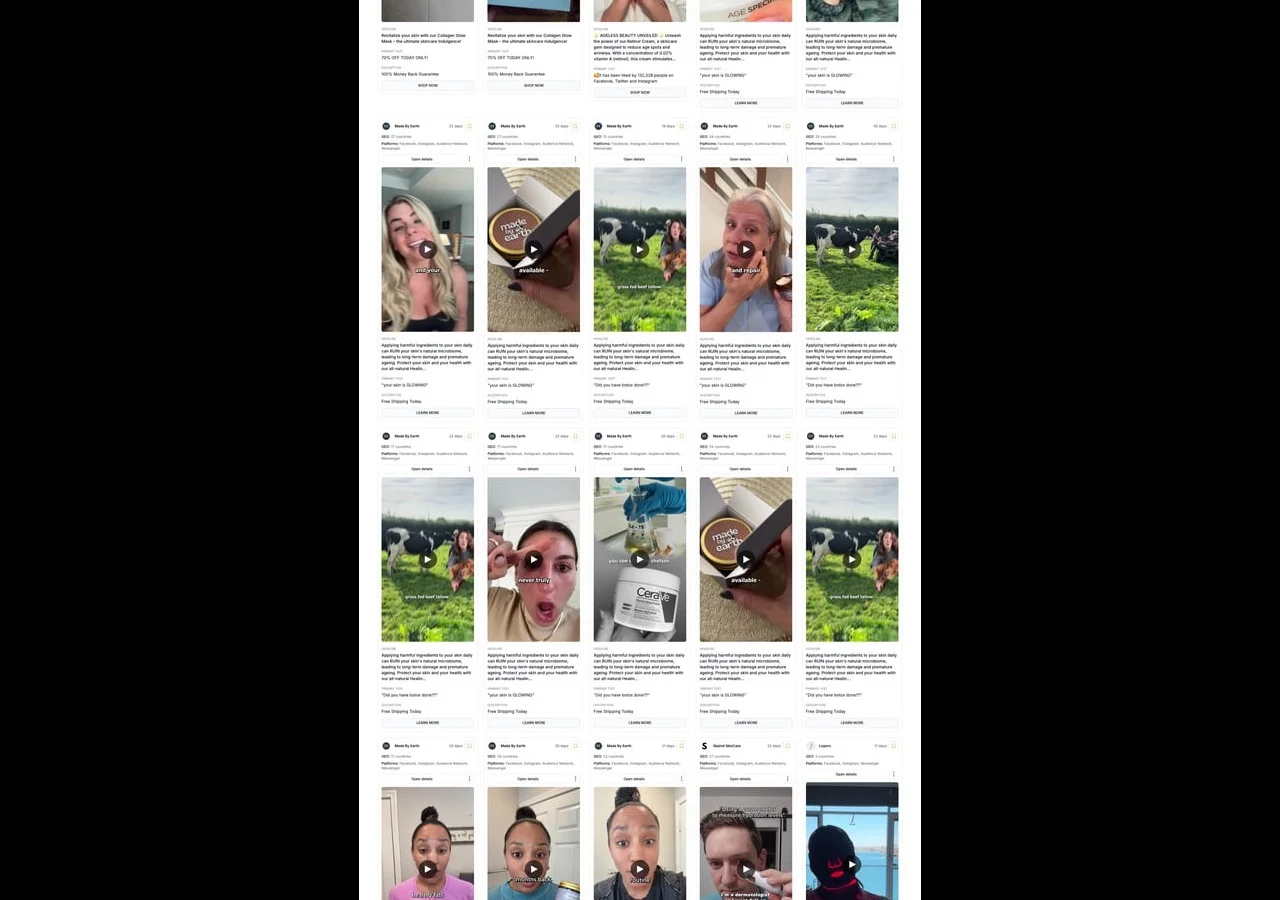 Filtering long-running competitor creatives to identify proven patterns for your Advantage+ pipeline.
Step 2: Categorize winning patterns
For each long-running ad, document:
- Format: video, static image, carousel, or UGC
- Hook type: question, bold stat, curiosity gap, before/after, problem-agitation
- Visual style: studio, UGC, graphic design, screen recording, meme
- CTA approach: direct ("Shop Now"), soft ("Learn More"), urgency-based ("Limited Time")
- Copy structure: short vs. long primary text, bullet points vs. paragraph, emoji usage
- Offer framing: percentage discount, dollar amount off, free shipping, BOGO, free trial
After analyzing 15–20 long-running ads, you will have a clear picture of which patterns dominate in your market.
Step 3: Generate hypotheses
Transform patterns into testable creative hypotheses:
- "If 70% of winning skincare ads use UGC-style video with a question hook, we should test UGC video with question hooks."
- "If the top 3 competitors all use before/after imagery, we need before/after variations."
- "If nobody in our vertical is using carousel format, there may be an untapped opportunity."
Each pattern becomes a creative direction, and each direction can produce 3–5 variations.
Step 4: Map hypotheses to creative production
For a single Advantage+ campaign, aim for 15–30 variations across 3–5 creative directions:
| Creative Direction | Source Insight | Variations to Produce |
|---|---|---|
| UGC question hook video | 60% of winning competitors use this | 5 videos with different hooks |
| Before/after static images | Top 3 competitors all use this format | 4 images with different transformations |
| Bold stat headline | Stat hooks have longest average run time | 3 headlines paired with 2 image styles |
| Carousel format (untested gap) | Zero competitors using carousel in vertical | 3 carousel concepts |
| Problem-agitation copy | Rising trend in competitor copy | 5 text variations with 2 image styles |
This approach generates 20+ high-quality variations, each backed by market evidence instead of guesswork.
Ready to start building your creative pipeline from real market data? Start building your Advantage+ creative pipeline with Adligator
Building a Creative Variation Pipeline from Competitor Data
The one-time research exercise is valuable, but the real advantage comes from building a repeatable pipeline that continuously feeds your Advantage+ campaigns with fresh, data-informed creative.
 A data-driven creative pipeline for Advantage+ campaigns.
The Weekly Pipeline
Monday: Research scan (30 minutes)
- Check your Adligator trackers for new competitor activity
- Note any new formats, hooks, or angles that appeared
- Flag long-running ads that passed the 14-day mark
Tuesday–Wednesday: Creative production (2–4 hours)
- Produce 5–10 new variations based on the week's research insights
- Mix proven patterns (validated by competitor data) with original concepts (differentiation)
- Ensure each variation tests a specific hypothesis
Thursday: Upload and launch (30 minutes)
- Add new variations to your Advantage+ campaigns
- Pause any creative that has been running for 3+ weeks with declining performance
- Ensure the campaign has at least 15 active variations
Friday: Performance review (30 minutes)
- Review which variations are getting the most spend (algorithm signal of quality)
- Compare performance against the spy-informed benchmarks (see next section)
- Update your creative hypothesis log with results
The Creative Mix Formula
For optimal Advantage+ performance, balance your creative variations across three categories:
60% Market-validated (from spy data) These are variations inspired by patterns you found in long-running competitor ads. They have the highest base probability of success because the patterns are already proven with a similar audience.
30% Differentiated originals These are unique creative concepts that no competitor is running. They may or may not outperform market-validated patterns, but they are essential for finding breakthrough creative that gives you a unique advantage.
10% Experimental wildcards Unconventional formats, unusual angles, or provocative hooks that test the boundaries. Most will underperform, but the occasional winner from this category can become your best-performing creative.
This mix ensures you are not just copying competitors (which leads to market saturation) while still building on what works.
Why not 100% market-validated? Because if everyone in your vertical runs the same creative patterns, the audience develops ad blindness to those patterns. Your 30% differentiated originals are what prevent this and what can give you breakthrough moments when you discover something competitors have not. The spy data tells you what the baseline looks like — your originality is what lets you beat it.
Scaling Creative Production
For high-spend accounts, the weekly pipeline needs to scale. Practical approaches:
- Template-based production: Create reusable templates for your winning formats. A UGC-style video template might need only a new script and talent — the structure stays the same.
- Modular creative: Build assets that can be recombined. 5 background images × 5 headline overlays = 25 variations from 10 assets.
- AI-assisted copywriting: Use AI tools to generate copy variations from a single brief. Then filter through your hypothesis framework to keep only the strategically relevant ones.
- Batch production: Instead of making one creative at a time, produce 10–15 in a single session. This is more efficient and ensures variety.
Measuring Advantage+ Performance with Spy-Informed Benchmarks
Standard performance benchmarks (industry average CTR, CPA, etc.) are useful but generic. Spy data lets you create vertical-specific benchmarks that are far more actionable.
 Measuring Advantage+ performance against market benchmarks.
Building Your Benchmarks
Creative longevity benchmark: Track how long your best-performing creatives run before fatiguing. Compare this to the average longevity of competitor ads in your vertical. If competitors average 21 days and your creative fatigues at 10, your creative quality is below market standard.
Variation win rate: Track what percentage of your creative variations receive meaningful spend from the algorithm (>5% of total budget). A healthy win rate is 20–30%. Below 15% means you are producing too many variations the algorithm does not value.
Hypothesis accuracy: Track which of your creative hypotheses (based on spy data) actually produced winning variations. Over time, this tells you which types of competitive patterns are most transferable to your account.
Creative velocity: Measure how many new variations you add per week vs. how many you retire. A healthy pipeline should add more than it retires, maintaining or growing the total active variation count.
Red Flags to Watch
- Algorithm consolidation: If Advantage+ allocates 80%+ of budget to a single variation, your creative diversity is insufficient. Add more variations.
- Rapid fatigue: If new creative fatigues within 5 days, your variations may be too similar to each other. Increase diversity across hook types, formats, and visual styles.
- Declining baseline performance: If each batch of new creative performs worse than the last, your market may be saturating. Look for new angles competitors are not using.
- Low learning rate: If the algorithm stays in learning phase for more than 7 days, you may have too few conversions or too many variations. Reduce variations or increase budget.
Common Mistakes: What NOT to Feed the Algorithm
Even with spy-informed creative, certain mistakes can sabotage your Advantage+ campaigns:
Mistake 1: Too Many Similar Variations
Producing 20 versions of the same concept with slightly different wording is not creative variation testing — it is redundancy. The algorithm cannot learn from variations that are essentially identical. Each variation should test a meaningfully different hypothesis: different hook, different format, different visual style, or different offer framing.
Mistake 2: Ignoring Format Diversity
If all your variations are static images, you are leaving performance on the table. Advantage+ can optimize across formats (video, static, carousel, Reels) — but only if you give it options. A healthy mix includes at least 2–3 different formats.
Mistake 3: Copying Competitors Directly
Spy data should inform your creative, not dictate it. Copying a competitor's ad verbatim is a legal risk, a brand risk, and usually performs poorly because the audience has already seen the original. Instead, extract the pattern (e.g., "UGC-style testimonial with problem-agitation hook") and apply it to your own product and brand voice.
Mistake 4: Never Retiring Creative
Even winning creative eventually fatigues. If you only add new variations without pausing old ones, your campaign becomes bloated and the algorithm has too many options to test efficiently. Set a clear retirement rule: pause any variation with CPA 30%+ above campaign average for 7+ consecutive days.
Mistake 5: Setting and Forgetting
Advantage+ automates optimization, not strategy. You still need to monitor performance, refresh creative, and adjust your approach based on results. The media buyers who treat Advantage+ as "set it and forget it" consistently underperform those who actively manage the creative pipeline.
Mistake 6: Skipping the Learning Phase
Every time you add new creative, the algorithm needs time to test it. Adding and removing variations too frequently prevents the algorithm from completing its learning phase. Batch your additions (weekly is ideal) and let the algorithm run for at least 3–5 days before evaluating new variations.
FAQ
How many creative variations does Advantage+ need to work effectively?
Meta recommends providing at least 5–10 creative variations per campaign for Advantage+ to optimize effectively. However, top performers often test 15–30 variations simultaneously. The algorithm needs enough diversity to identify patterns — too few variations limit its ability to find winners.
Can spy tools replace creative testing in Advantage+ campaigns?
No — spy tools inform your creative hypotheses but do not replace testing. They help you generate higher-quality variations based on market-proven patterns instead of guessing. The algorithm still needs to test these variations with your specific audience. The advantage is starting with better inputs.
How often should I refresh creatives in Advantage+ campaigns?
Monitor creative fatigue weekly. When your cost per result increases by 20%+ with stable audience size, it is time to add fresh variations. Most high-spend accounts refresh creative every 2–4 weeks. Use spy tools to identify new patterns and trends as source material for refreshes.
Conclusion
Advantage+ creative optimization facebook campaigns are only as good as the creative variations you feed them. The algorithm is powerful — but it optimizes within the boundaries you set. Better inputs produce better outputs.
The media buyers consistently winning with Advantage+ have built systematic creative pipelines that combine competitor intelligence with structured variation testing. They do not guess what to test — they study what is already working, generate informed hypotheses, and let the algorithm validate them at scale.
The creative variation testing game has changed. It is no longer about producing one great ad. It is about producing many good variations, informed by real data, and letting the algorithm find the combinations that work.
Ready to build your data-driven creative pipeline? Start building your Advantage+ creative pipeline with Adligator
For more on creative strategy, read our guides on Facebook ad creative trends for 2026 and top Facebook ad hook patterns.
