
How Meta's Andromeda Algorithm Changes Ad Delivery in 2026: What Media Buyers Must Adapt
If you are still building campaigns the way you did in 2024 -- layering interest stacks, refining lookalike audiences, and hoping the algorithm finds your buyers -- you are working against the system, not with it. Meta's Andromeda algorithm has fundamentally changed how ad delivery works, and the media buyers who haven't adapted are watching their CPMs climb and their ROAS shrink.
Andromeda replaced the audience-selection model that advertisers relied on for a decade. Instead of starting with your targeting inputs to find users, the meta ads algorithm 2026 now reads your creative to decide who sees it. The competitive edge no longer goes to whoever builds the best audience. It goes to whoever produces the strongest creative.
This guide breaks down what Andromeda actually changes, what stays the same, and what you need to do differently to maintain -- or improve -- your campaign performance.
What Is Meta's Andromeda Algorithm and Why It Matters
Andromeda is Meta's AI-driven ads retrieval system, fully deployed across most objectives and placements by late 2025. It determines which ads are eligible to be shown to a given user at a given moment.
The old system worked like this: you defined an audience (interests, behaviors, lookalikes), and Meta found users within that audience to show your ad. Andromeda works in reverse. It evaluates your ad creative -- copy, visuals, format, historical engagement -- and predicts which users across Meta's entire network are most likely to take the desired action.
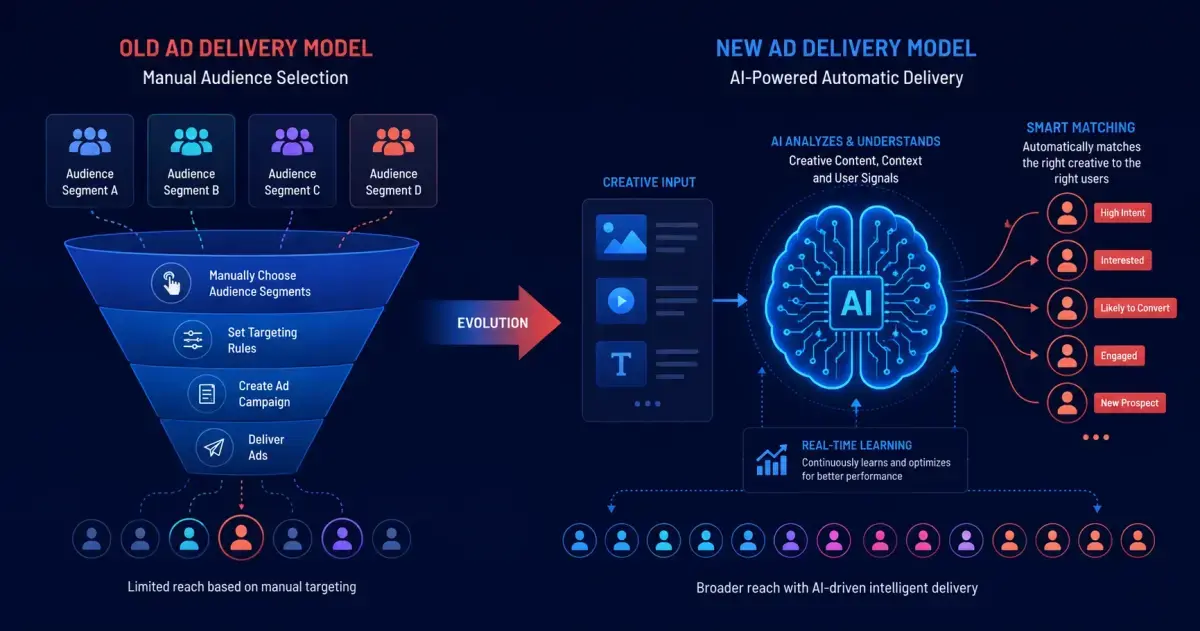 The fundamental shift: from audience-first targeting to creative-first delivery under Andromeda
This is not a minor tweak. It is a structural change to how the ad auction functions:
- Creative is your targeting. The signals Andromeda reads from your creative (hooks, CTAs, visual cues, text themes) determine which users see it. A well-crafted creative reaches the right people without manual audience refinement.
- Audience constraints limit delivery. Adding narrow interest or lookalike targeting now acts as a ceiling on Andromeda's reach. The algorithm's behavioral signals already exceed what a seed audience can define.
- Quality determines cost. Andromeda deprioritizes low-engagement ads faster, which means weak creatives pay higher CPMs while strong creatives get rewarded with cheaper delivery.
How Andromeda Changes Your Targeting Strategy
The most practical facebook ad delivery change under Andromeda is this: your targeting inputs matter less, and your creative inputs matter more. Here is what that means for specific tactics.
Lookalike Audiences: No Longer the Default
Lookalike audiences used to be the backbone of Meta prospecting. Under Andromeda, they are redundant in most cases. The algorithm's predictive model already considers the behavioral patterns that a lookalike audience would capture -- and it does it across a much larger signal set.
When to still use lookalikes:
- Very small niches with highly specialized products where Andromeda's broad signals are not enough
- New accounts with limited pixel data where you need to seed the algorithm
- Specific geographic constraints where broad targeting would waste budget in irrelevant markets
In all other cases, broad targeting (age, gender, location only) outperforms lookalikes under Andromeda. Multiple advertisers and agencies have confirmed this through extensive testing since late 2025.
Interest-Based Targeting: Use Sparingly
Interest targeting is not dead, but its role has changed. Think of it as a hint to the algorithm rather than a constraint. If you are using 5+ interest layers, you are almost certainly limiting Andromeda's ability to find optimal users.
Practical approach:
- Start with broad targeting (no interests)
- Run for 7 days with sufficient budget
- If performance is acceptable, keep broad
- If delivery is scattered, add 1-2 broad interest categories as hints
- Never stack more than 3 interest layers
Advantage+ Campaigns: Built for Andromeda
Advantage+ Shopping and Advantage+ App campaigns are designed to work with Andromeda natively. They remove most manual targeting options and let the advantage plus algorithm handle delivery entirely based on creative quality and user signals.
If you are in e-commerce or app marketing, Advantage+ should be your default campaign type. The simplified structure is not a limitation -- it is the way Andromeda performs best.
Creative-First Strategy: The New Competitive Edge
Under Andromeda, modern paid social is approximately 80% creative operations and 20% media buying. This is not hyperbole -- it reflects how the algorithm distributes delivery.
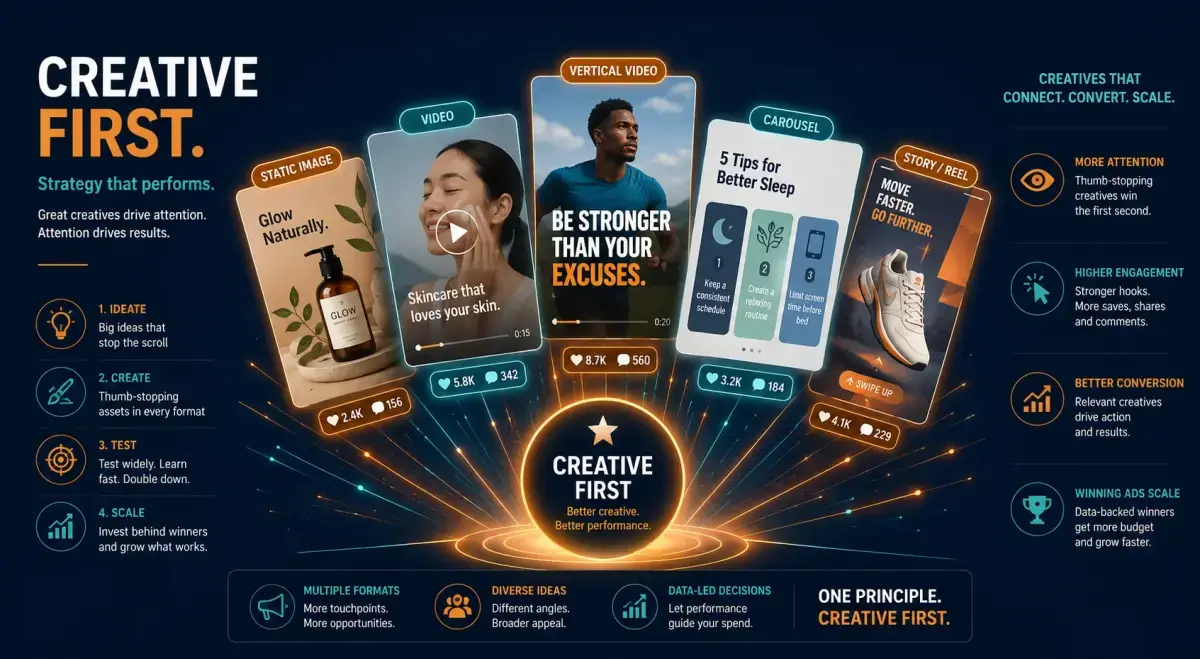 Creative diversity is now the primary competitive advantage under Andromeda
Volume Requirements
The data is clear: brands testing 20+ new ads per month see significantly higher ROAS than those testing fewer than 10. The algorithm performs best when it has 8-12 unique creatives per campaign to evaluate and optimize against.
This means your creative production pipeline needs to produce at scale:
- Weekly: 5-6 new creative variations
- Monthly: 20+ unique concepts tested
- Per campaign: 8-12 active creatives at any time
Format Diversity
Andromeda rewards format diversity. Different formats reach different user segments, and the algorithm can optimize across formats when you provide variety:
- Short-form video (15-30s): highest engagement, strongest signal for Andromeda
- UGC and testimonials: perceived as authentic, lower CPMs in most verticals
- Static images: still effective for simple offers with clear CTAs
- Carousels: strong for product catalogs and multi-feature storytelling
- Comparison ads: direct competitor comparisons drive high intent engagement
Creative Quality Signals Andromeda Reads
Understanding what Andromeda evaluates helps you build creatives that the algorithm will reward:
- Hook strength (first 3 seconds of video, headline of static): early engagement predicts overall performance
- Text clarity: clear value proposition in primary text helps Andromeda classify the ad correctly
- CTA alignment: the CTA button type should match the creative's promise
- Visual distinctiveness: unique visuals stand out in the feed and generate higher stop-scroll rates
- Format-audience fit: Andromeda learns which formats work for which user segments over time
Campaign Structure Under Andromeda
The old campaign structure of multiple ad sets targeting different audiences is counterproductive under Andromeda. The algorithm performs better with consolidated structures.
Recommended Structure
- 1-2 campaigns per objective (not 5-10)
- 1-3 ad sets per campaign (consolidated, not segmented by interest)
- 8-12 creatives per ad set (diverse formats)
- Broad targeting (minimal audience constraints)
Budget Allocation
With fewer campaigns, budget allocation becomes simpler but more impactful:
- 70% to proven performers: campaigns with established creative winners
- 20% to testing: new creative concepts in a separate testing campaign
- 10% to retargeting: warm audiences with specific messaging
The Learning Phase Under Andromeda
Andromeda's learning phase behaves differently from the old system. Because the algorithm evaluates creative quality across a broader user set, the initial learning period can be faster -- but only if you provide enough creative diversity. With 8-12 creatives per ad set, Andromeda typically exits learning in 3-5 days. With 2-3 creatives, it can take 7-10 days or never fully optimize.
Key rules during learning:
- Do not edit creatives, budget, or targeting during the first 5 days
- Ensure daily budget is at least 10x your target CPA for sufficient learning volume
- If a campaign is stuck in learning after 7 days, add 3-4 new creatives rather than changing targeting
What to Monitor
The metrics that matter under Andromeda shift slightly:
- CTR by creative: which creatives Andromeda is pushing and which are getting deprioritized
- CPM trends: rising CPM on a specific creative signals the algorithm is losing confidence in it
- Frequency by creative: Andromeda should be finding new users; high frequency means the creative is exhausting its audience
- Cost per result by creative: the ultimate measure of creative effectiveness
For a detailed checklist on detecting creative fatigue before it kills ROAS, see our creative fatigue detection guide.
Sourcing Creative Ideas at Scale
The biggest operational challenge under Andromeda is not campaign setup -- it is producing enough quality creatives to feed the algorithm. When you need 20+ new concepts per month, in-house brainstorming alone is not sustainable.
 Spy tools help you source winning creative patterns faster than brainstorming alone
Competitive Intelligence as a Creative Pipeline
Ad spy tools turn competitor analysis into a creative production input. Instead of guessing what angles might work, you study what is already working in your vertical:
- Filter by ad longevity: ads running 10+ days have proven their ROI. Study their hooks, formats, and CTAs.
- Analyze by format: identify which formats dominate in your niche. If competitors are winning with UGC but you are only running static images, that is your gap.
- Study seasonal patterns: see how top advertisers adapt their creatives for different seasons and promotions.
- Track new entrants: new competitors often bring fresh creative angles that established players haven't tested.
See what creatives your competitors are running on Meta: Try Adligator free -- 5 searches per day
In Adligator, you can filter by platform, format, country, language, and active days -- narrowing from millions of ads to the specific patterns that matter for your campaigns. Learn more in our guide to spying on competitor Facebook ads.
Building a Creative Testing Framework
Under Andromeda, testing is not optional -- it is the core workflow:
- Hypothesis: based on competitive analysis, define what you are testing (hook, format, angle, CTA)
- Production: create 3-4 variations of the hypothesis
- Launch: add to testing campaign with equal budget distribution
- Evaluate: after 3-5 days with sufficient spend, identify winners by cost per result
- Scale: move winners to main campaign, pause losers, generate next hypotheses
For a step-by-step testing methodology, check our A/B testing guide for Facebook ad creatives.
Common Mistakes Media Buyers Make Under Andromeda
Mistake 1: Over-Constraining Targeting
The most common mistake is running Andromeda campaigns with the same narrow targeting you used before. Every audience constraint you add is a wall the algorithm has to work around. Start broad, let the algorithm learn, and only add constraints if broad delivery is genuinely scattered.
Mistake 2: Running Too Few Creatives
If your campaign has 2-3 creatives, Andromeda does not have enough variation to optimize effectively. The algorithm needs options. Aim for 8-12 creatives per ad set, across multiple formats.
Mistake 3: Ignoring Creative Fatigue
Andromeda deprioritizes fatigued creatives faster than the old system. If you are not monitoring frequency and CTR trends at the creative level, you will lose delivery without understanding why. Set up automated rules for frequency thresholds and CTR drops.
Mistake 4: Duplicating Campaigns for Scale
Under the old system, duplicating campaigns with the same audience and different creatives was a common scaling tactic. Under Andromeda, this causes auction overlap and drives up your own CPMs. Consolidate into fewer campaigns with more creatives.
Mistake 5: Neglecting Video
Andromeda strongly favors video content because it provides more engagement signals. If your creative mix is 90% static images, you are leaving the algorithm's strongest optimization lever unused. Even simple product videos or animated statics outperform standard image ads in most verticals.
Mistake 6: Optimizing for the Wrong Metrics
Under Andromeda, some traditional metrics become misleading. High reach with low engagement means the algorithm is struggling to find responsive users for your creative -- not that your audience is too small. Focus on cost per result and creative-level CTR rather than vanity metrics like impressions and reach.
Mistake 7: Not Iterating on Winners
When a creative outperforms others, many media buyers leave it running until it fatigues. Under Andromeda, the better approach is to immediately create 3-5 variations of the winning concept. The algorithm recognizes thematic similarity and uses winning creative signals to accelerate learning for related variations. This extends the lifecycle of your best ideas significantly.
FAQ
What is Meta's Andromeda algorithm?
Andromeda is Meta's AI-driven ad retrieval system that replaced the traditional audience-selection model. Instead of starting from advertiser-defined audiences, it analyzes ad creative, engagement signals, and user behavior to predict which users will respond best to each ad. It was fully deployed across most objectives by late 2025.
Do lookalike audiences still work with Andromeda?
Lookalike audiences are less effective under Andromeda. The algorithm's behavioral signals already exceed what a seed audience can define, so adding a lookalike constraint often limits delivery without improving targeting quality. Broad targeting tends to outperform lookalikes in most cases, with exceptions for very small niches or new accounts.
How many creatives should I test per month under Andromeda?
Brands testing 20+ new ads per month see significantly higher ROAS than those testing fewer than 10. Aim for 8-12 unique creatives per campaign and introduce 5-6 new variations per week. The key is format diversity -- mix video, static, carousel, and UGC to give the algorithm maximum optimization surface.
How does Andromeda affect CPMs?
CPMs have increased roughly 20% year over year as Andromeda redistributes delivery toward higher-quality ads. Advertisers with strong creatives see lower CPMs than average, while those with weak creatives pay more. Creative quality is now a direct cost lever -- investing in better creatives directly reduces your delivery costs.
Conclusion
Meta's Andromeda algorithm represents the biggest shift in paid social strategy since the iOS 14 privacy changes. The playbook has changed: audience building is no longer your competitive advantage. Creative quality and volume are.
The practical takeaways:
- Simplify targeting: broad audiences outperform narrow targeting under Andromeda in most cases
- Scale creative production: 20+ new concepts per month, 8-12 per campaign
- Consolidate campaigns: fewer campaigns with more creatives, not more campaigns with fewer creatives
- Monitor at creative level: CTR, CPM, and frequency per creative, not per campaign
- Use competitive intelligence: spy tools turn competitor success into your creative pipeline
The meta andromeda algorithm rewards advertisers who feed it strong, diverse creatives. Those who adapt will see better performance at lower costs. Those who don't will keep paying more for less.
Ready to source winning creative ideas? Try Adligator free -- see what competitors are running on Meta
Related Reading
- Meta Quietly Emptied Three Reporting Breakdowns — What Media Buyers Lose
- How to Analyze Competitor Ad Copy and Hooks: A Data-Driven Framework for Media Buyers
- How to Localize Facebook Ad Creatives for Different GEOs: A Media Buyer's Playbook
- Winning Meta Ads Don't Start in One Country: What 200-Country Blasts Reveal About How Evergreen Creatives Actually Scale
