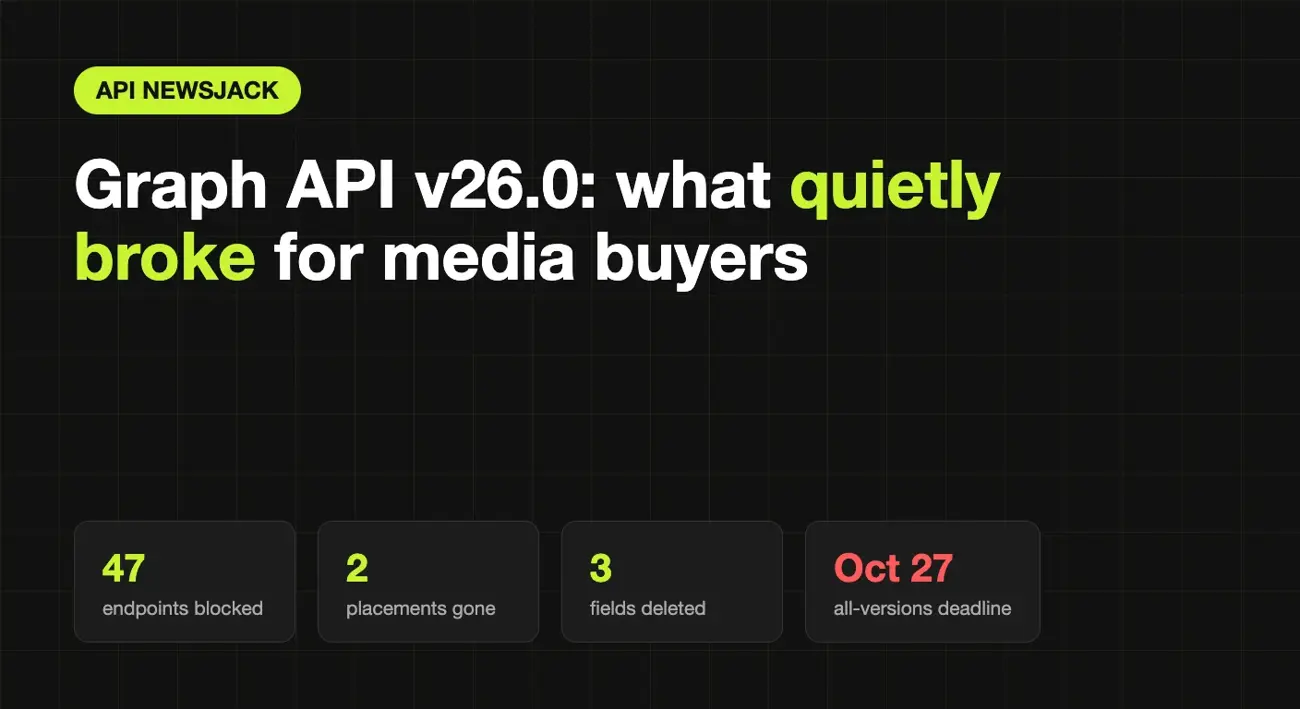
Meta Graph API v26.0: What Quietly Broke for Media Buyers — and the October 27 Deadline
On July 29, 2026, Meta shipped Graph API and Marketing API v26.0 — and killed two placements in the same release. Only one of them tells you it's gone. Ask for Instagram Explore Feed and the API throws an error you'll catch in minutes. Ask for Messenger Stories and the API returns success, silently drops the placement, and your ads simply stop serving there. Nothing errors. The gap surfaces weeks later, in a report.
If you run campaigns or competitor monitoring through the meta graph api v26 surface — or through tooling that quietly upgraded to it — this is the practitioner's translation of the changelog: what broke loudly, what broke silently, and the audit to run before October 27, 2026, when the same restrictions hit every remaining API version.
What shipped in v26.0 on July 29 (the 60-second version)
The verified changes, straight from Meta's changelog:
- Instagram Explore Feed placement removed. Requests that explicitly specify it now return an error.
- Messenger Stories silently stripped. The
storyvalue inmessenger_positionsis removed without error on v26.0+ calls. - 47 Commerce Order Management endpoints blocked — orders, items, payments, refunds, shipments, cancellations. No replacement API.
- Three delivery-estimate fields deleted:
daily_outcomes_curve,budget_guardrail,estimate_dau. - Special-ad-category gotcha: housing, employment, credit and finance campaigns now require an explicit
advantage_audienceflag. - Legacy protocol cleanup:
pretty,debuganddate_formatparameters deprecated; poll ad creation retired.
Individually, none of these is dramatic. Together they're nine simultaneous changes — and the failure modes range from "instant error" to "nothing happens, which is the problem."
The silent trap: Messenger Stories stripped without errors
This is the change most likely to surface in your August reports rather than your logs. On any v26.0+ call that creates or updates an ad set, Meta removes story from messenger_positions — and returns a normal success response.
// What you send (v26.0)
"messenger_positions": ["messenger_home", "story"]

// What Meta saves — HTTP 200, no warning
"messenger_positions": ["messenger_home"]
Every automation that touches the targeting spec re-triggers the strip: a budget-rule tool that rewrites ad sets, a bulk editor, a sync from your own campaign database. If your delivery was skewed toward Messenger Stories in some GEOs, you'll see reach dip with no corresponding error anywhere.
The detection method is blunt but reliable: read back what you wrote. After any ad-set write, fetch the targeting spec and diff it against what you sent. A placement that vanishes between request and response is v26.0 talking to you.
Instagram Explore Feed placement: hard errors now
The second placement death is the polite one. Explore Feed (instagram_positions value for the Explore feed surface, as distinct from Explore itself) is no longer available in v26.0, and requests that explicitly specify it fail with an error.
Loud failures are cheap to handle: your tooling either already logs them or crashes visibly. The task here is inventory, not detective work — grep your codebase and saved ad-set templates for the Explore Feed position value, remove it, and let Advantage+ placements reallocate. If you rely on placement customization at scale, this is also a nudge to re-read how much of your delivery actually came from that surface before mourning it.
47 commerce endpoints blocked: who is affected
Meta blocked calls to 47 Commerce Order Management endpoints on v26.0+ the day the version shipped — order listing, shipment tracking, refund processing, tax settings, the lot. Per Meta's changelog, no replacement API is available.
Who feels this: anyone running Facebook/Instagram Shops order flows through the API — typically e-commerce operators with custom order-sync middleware, and agencies managing Shops fulfillment for clients. If your stack syncs Meta Shop orders into an OMS or ERP, those jobs fail immediately on v26.0, and on every version from October 27.
Who doesn't: pure media-buying stacks. Campaign management, insights and creative endpoints are untouched by this particular block. But check before you relax — "we don't use commerce endpoints" has a way of being false in one forgotten cron job.
Deleted delivery-estimate fields and special-ad-category gotchas
Two smaller changes with outsized reporting impact:
- Delivery estimates:
daily_outcomes_curve,budget_guardrailandestimate_dauare gone from v26.0 onward. Budget-planning tools that projected outcomes from these curves will return nulls — check any internal dashboard that promised "estimated daily results." - Special ad categories: campaigns in housing, employment, credit or finance must now pass an explicit
advantage_audienceflag. Automated campaign-creation flows for lead-gen verticals — think mortgage, hiring, insurance — should be tested end-to-end, not assumed.
Neither of these errors loudly in a running system. Both quietly degrade the numbers your Monday reports are built on. They're cousins of the pricing-visibility problems we covered in Meta's location-fee CPM changes — platform shifts that show up as unexplained deltas first.
The real deadline: October 27, 2026, every API version
Here's the part that turns "we'll migrate later" into a countdown. The July 29 restrictions applied only to calls pinned to v26.0+. On October 27, 2026, Meta extends the same restrictions to every remaining supported API version.
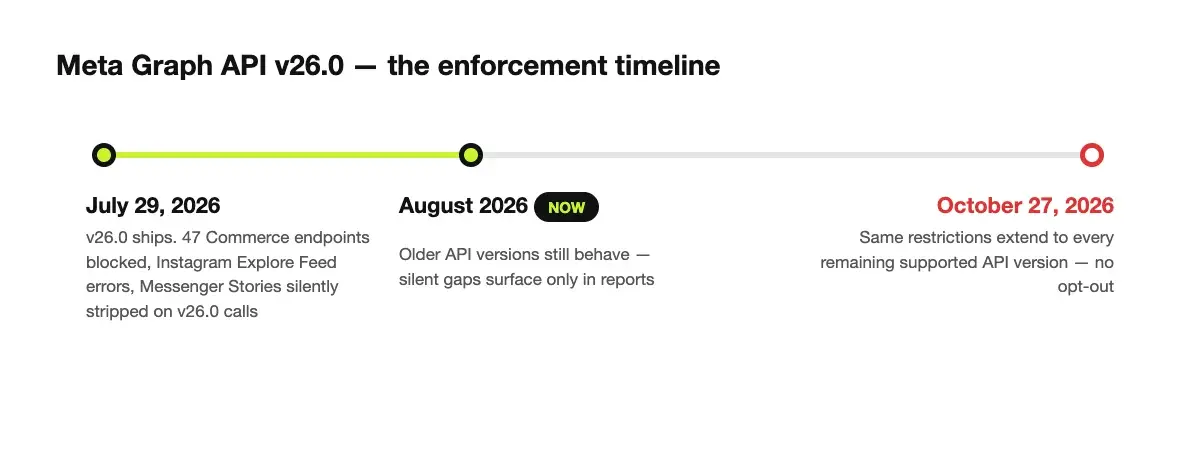 The enforcement timeline: what shipped July 29 hits every remaining API version on October 27
That means version-pinning — the classic "stay on v24.0 until the fires die down" move — stops working entirely. Anything in your stack that still depends on blocked commerce endpoints, dead placements or deleted fields breaks on that date regardless of the version string in the URL. August and September are your testing window; treat October 27 as the day the old behavior ceases to exist.
Audit checklist: find the breakage before your reports do
Run this once now and once in early October. Total time: about an hour for a typical stack.
□ 1. Inventory API surface: grep code, ETL jobs and no-code tools for
     graph.facebook.com calls; note the pinned version of each.
□ 2. Placements: search ad-set templates and automation rules for
     "story" in messenger_positions and the Explore Feed position value.
□ 3. Write-then-read: after your next automated ad-set update, fetch
     the targeting spec and diff it against what you sent.
□ 4. Commerce: list any job touching Shops orders, refunds, shipments
     or tax settings — these are blocked with no replacement.
□ 5. Reporting: find dashboards using daily_outcomes_curve,
     budget_guardrail or estimate_dau; expect nulls.
□ 6. Special ad categories: test campaign creation for housing /
     employment / credit / finance flows with advantage_audience set.
□ 7. Third-party tools: ask vendors which API version they call with —
     their migration schedule is your migration schedule.
□ 8. Re-run everything the week of October 20, before enforcement.
The checklist's theme is the article's thesis: the loud failures find you, so spend your audit time on the silent ones — steps 3 and 5 catch more real-world damage than the rest combined.
Skip the maintenance entirely for monitoring workflows: monitor competitors without maintaining API code — try Adligator free
What this means for competitor-monitoring automations
There's a second population affected by every version bump: teams that built competitor monitoring on self-maintained scripts — usually against the Ad Library API. The v26.0 headline changes don't gut Ad Library endpoints, but the treadmill is the point: a new version every few months, each with its own removals, each demanding a migration your monitoring script has to survive. Miss one, and your "what did competitors launch this week" pipeline silently returns stale data — the same failure mode as Messenger Stories, applied to your intelligence layer.
The alternative is to make API churn someone else's job. In Adligator, a tracker is a saved search — a keyword or a competitor's Facebook page — that collects new creatives daily on the platform side. There's no version string anywhere for you to maintain:
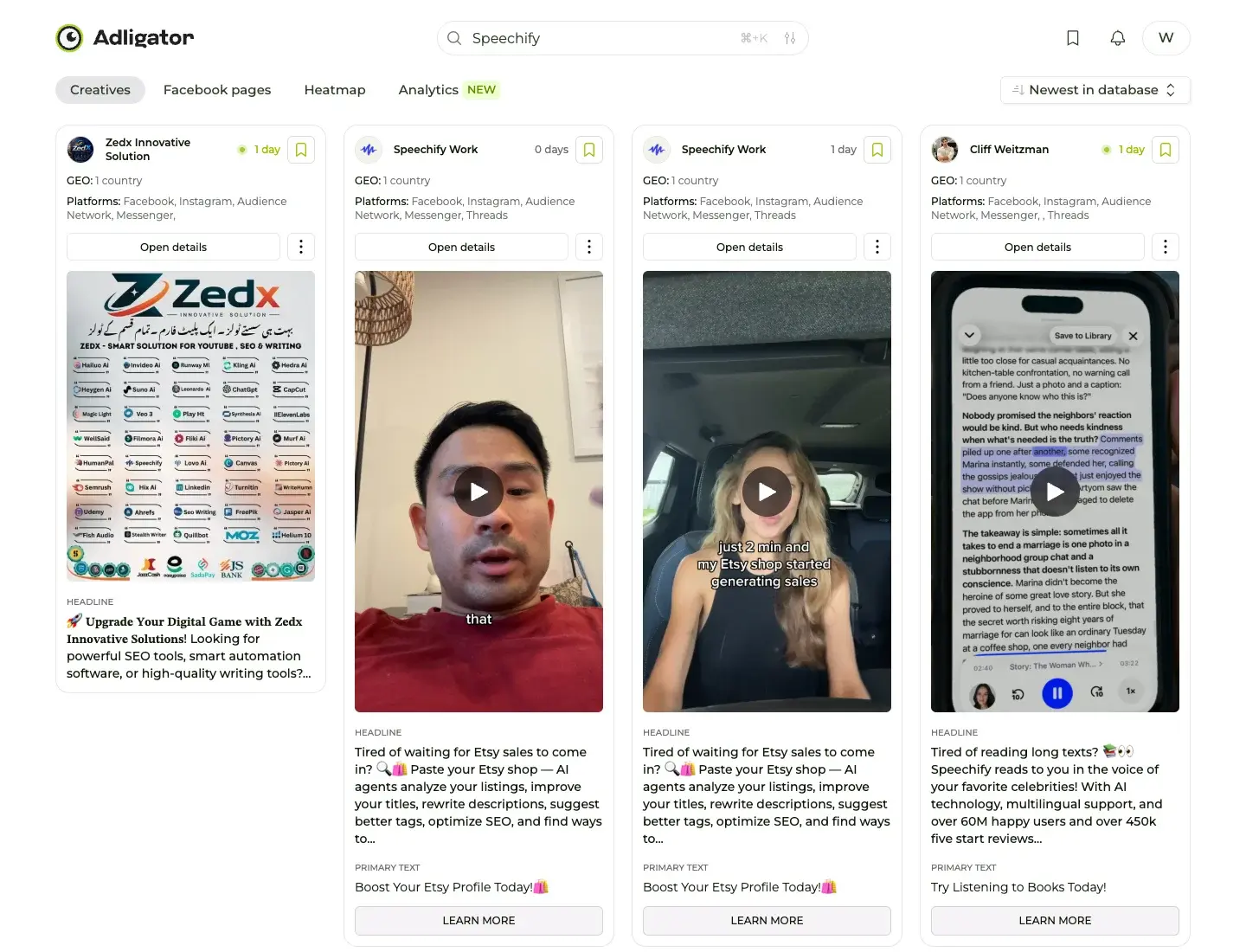 A tracker feed the morning after: fresh 0–1 day creatives, collected without a line of API code
And the Analytics tab replaces the aggregation layer you'd otherwise script yourself — launch cadence, language mix, funnel destinations, computed over everything the tracker collected:
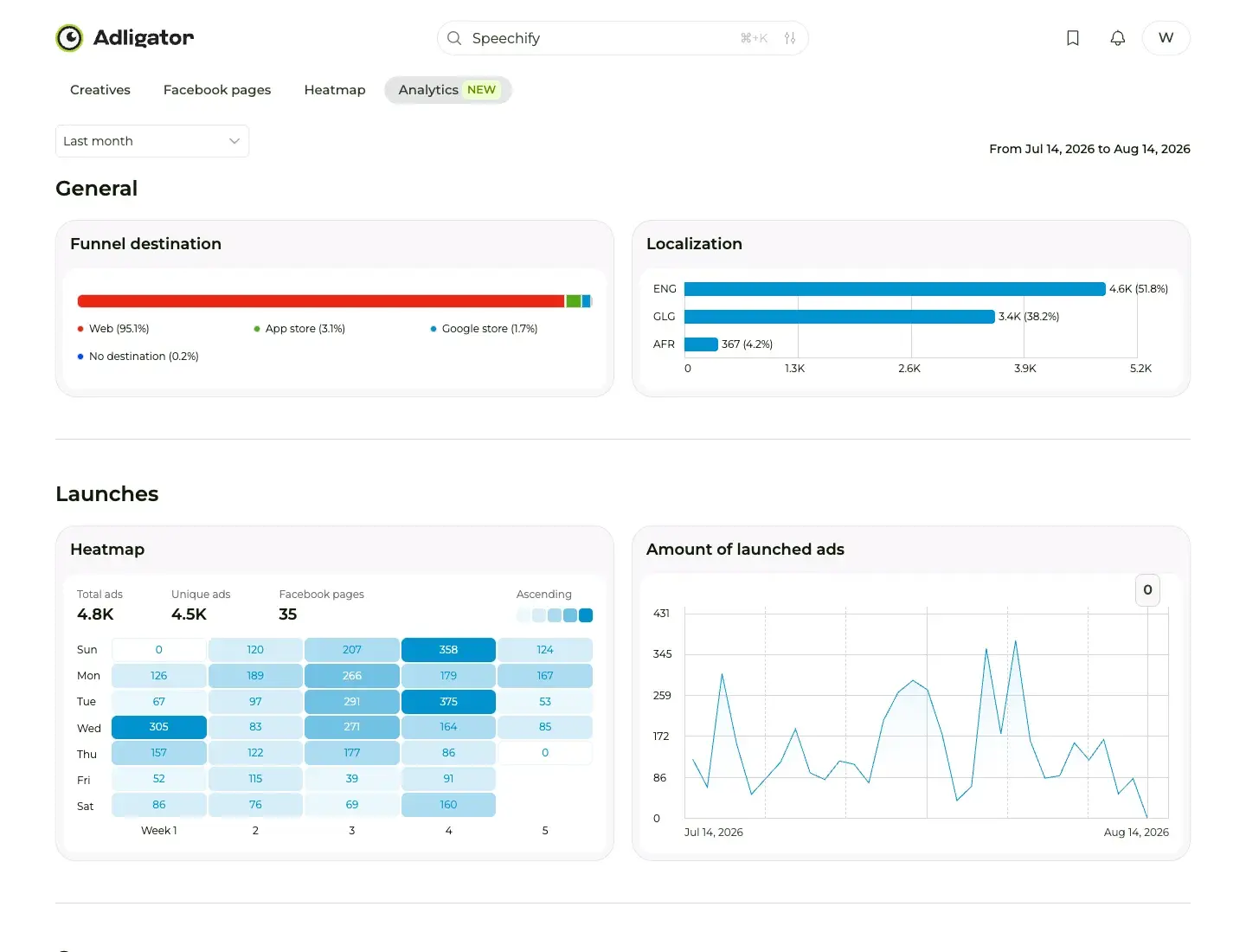 The same monitoring, one screen: 4.8K ads analyzed over the last month, zero version migrations
Campaign automation has to survive v26.0 — that's unavoidable engineering. Competitor monitoring doesn't. Move it to a managed layer once, and October 27 becomes a date on someone else's calendar. If your targeting strategy leans on Advantage+ audiences, the same logic applies: let the platform absorb the churn where a platform exists to absorb it.
One setup, no migrations: set a tracker once; we handle the Meta churn
FAQ
When does Graph API v26.0 become mandatory?
v26.0 shipped July 29, 2026, and its restrictions apply immediately to any call pinned to v26.0 or later. The hard date is October 27, 2026: Meta extends the same restrictions to every remaining supported API version, so staying on an older version stops protecting you.
Why did my Messenger Stories placement disappear?
In v26.0, Meta silently removes the story value from messenger_positions when you create or update ad sets. The API returns success and simply drops the placement — no error, no warning. Ad sets managed through v26.0 tooling stop serving in Messenger Stories without any signal in your logs.
Do these changes affect the Ad Library API?
The headline v26.0 removals target Marketing API surfaces — placements, commerce endpoints, delivery estimates — not Ad Library API endpoints. But the Ad Library API rides the same Graph API versioning, so every version sunset still forces migrations on scripts built against it.
What happens to older API versions on October 27, 2026?
Meta applies the v26.0 restrictions across all remaining supported versions on that date. Blocked commerce endpoints, removed placements and deleted fields behave identically no matter which version your calls are pinned to — version-pinning stops being an escape hatch.
Conclusion
The meta graph api v26 release is a quiet lesson in failure modes: the Explore Feed error you'll fix in an afternoon; the Messenger Stories strip you'll find in a report three weeks late. Run the audit now, re-run it before October 27, and be deliberately suspicious of every automation that writes targeting specs.
And separate the two kinds of API dependency in your stack. Campaign automation is yours to migrate — no way around it. Monitoring is not: it can live on a layer that absorbs Meta's churn for you.
Ready to retire one migration forever? Monitor competitors without maintaining API code — try Adligator free
Sources consulted: Graph API v26.0 changelog — developers.facebook.com · "Meta blocks 47 commerce endpoints as Graph API v26.0 lands" — ppc.land
Related Reading
- Meta Quietly Emptied Three Reporting Breakdowns — What Media Buyers Lose
- How Meta's Andromeda Algorithm Changes Ad Delivery in 2026: What Media Buyers Must Adapt
- How to Use Ad Spy Tools for Agency Client Onboarding: Competitive Audit Workflow for Media Buyers
- How to Analyze Competitor Ad Copy and Hooks: A Data-Driven Framework for Media Buyers
