Meta Quietly Emptied Three Reporting Breakdowns — What Media Buyers Lose
On August 6, 2026, three reporting breakdowns that every Meta media buyer has used for years — impression_device, hourly-stats, and frequency_value — stopped returning data for most ad accounts. There was no error message, no deprecation email, no red banner in Ads Manager. Requests simply started coming back successful and empty.
If your device reports flatlined, your dayparting dashboard went blank, or your frequency histogram disappeared in early August, nothing is broken on your side. Here's exactly what changed, who's affected, and — since Meta offers no full rollback — how to rebuild the lost signal.
What exactly went dark on August 6
Since August 6, 2026, three breakdown families in the Ads Insights API return results only for ad accounts that have opted in:
impression_device— which devices your impressions landed on. The restriction applies to any breakdown combination that includes it.hourly-stats— both aggregations:hourly_stats_aggregated_by_advertiser_time_zoneandhourly_stats_aggregated_by_audience_time_zone. This is the field pair behind every dayparting analysis.frequency_value— the distribution of how many times users saw your ads. This was the standard first-party input for creative-fatigue detection.
Accounts that were already using an opted-in integration keep their data. Everyone else gets the new default: nothing.
Silent failure: 200 responses with empty arrays
The dangerous part isn't the removal — it's the failure mode. A non-opted-in request doesn't fail. It succeeds:
{
  "data": [],
  "paging": {}
}
HTTP 200. Valid JSON. Empty array. No error object, no warning header.
That means no alerting system built on API errors will fire. Dashboards render zero rows, which looks like a delivery collapse rather than a reporting change. Agencies reported spending days debugging "performance drops" that were actually this restriction. The only reliable self-diagnosis is comparing the same query across August 5 and August 6: data on one side, emptiness on the other, spend unchanged in between.
Who is affected (and how to check your account)
Scope matters, because this did not hit everyone:
- Affected: accounts that never explicitly opted into these breakdowns — which, in practice, is the majority of self-serve advertisers and most third-party dashboard users.
- Not affected: accounts with existing opted-in access; their queries return data as before.
The 60-second check: run your usual insights query with breakdowns=impression_device for a date range before August 6. If historical dates return data but recent dates return an empty array while spend is nonzero, your account is in the restricted group. An account administrator can then request access re-enablement through Ads Manager — vendor bulletins confirm approvals are being granted, but with no published SLA. Do this first; just don't build your Q4 plan on the assumption it comes back quickly.
What v26.0 removed alongside it
The breakdown restriction landed one week after Marketing API v26.0 (released July 29, 2026), which removed three delivery-estimation fields outright — confirmed in Meta's official changelog:
daily_outcomes_curvebudget_guardrailestimate_dau
All three are gone from the delivery_estimate endpoints "because the service powering these values has been deprecated" — no replacement offered. Per the changelog, the removal extends to all supported API versions by October 27, 2026, so pinning an old version won't save budget-planning tools built on these fields. They don't error either. They just go quiet.
The pattern: first-party visibility keeps shrinking
Treat August 6 as one data point and it's an annoyance. Put it on a timeline and it's a strategy:
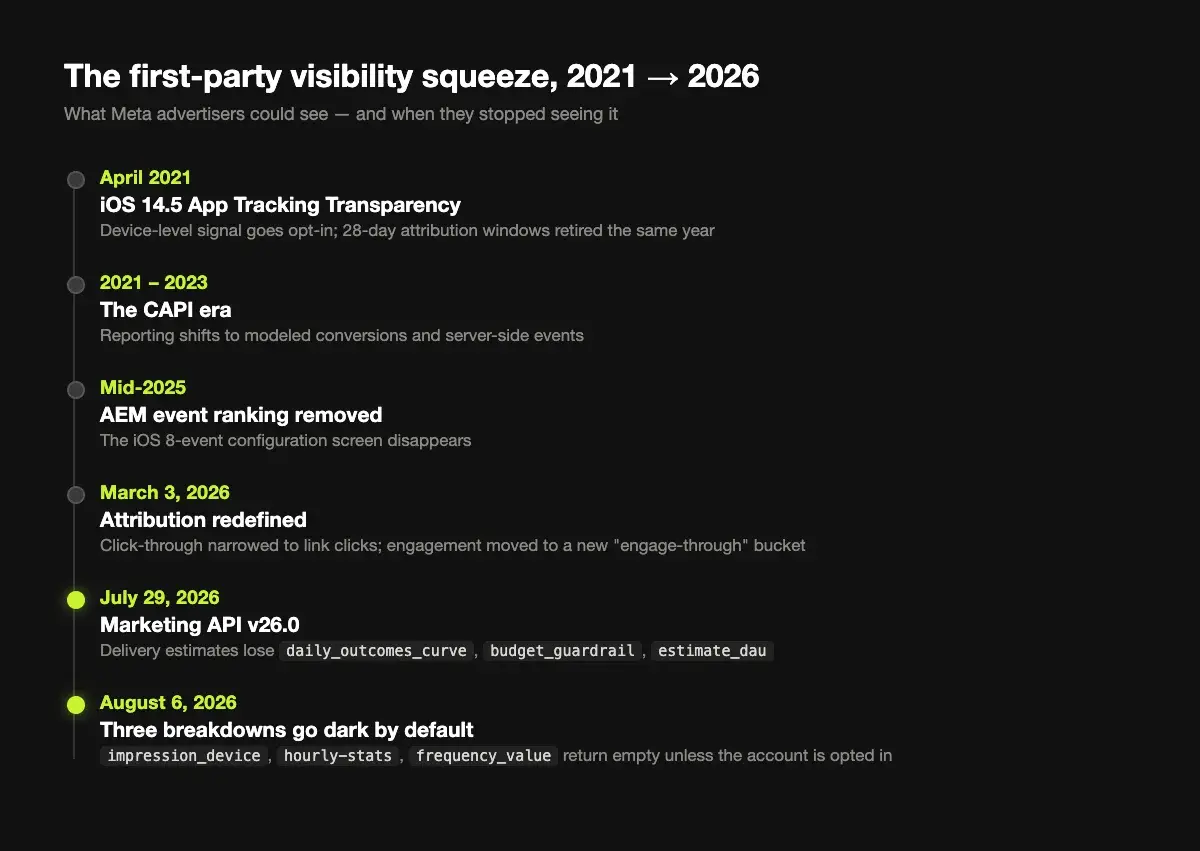 Five years of the same trend: each step removed a slice of first-party visibility.
iOS 14.5 took device-level signal. The CAPI era replaced observed conversions with modeled ones. Mid-2025 removed AEM event ranking; March 2026 redefined attribution itself. Now delivery estimates and three reporting breakdowns.
We won't speculate about motive — Meta hasn't stated one. The operational reality is enough: each cycle, your own dashboards answer fewer questions, while Meta's automated products (Advantage+ above all) ask you to trust them with more. Planning around that trend beats being surprised by the next removal.
Rebuilding the lost signal: frequency and fatigue without frequency_value
frequency_value had one big job: telling you when an audience was saturated and a creative was burning out. That question still needs answering weekly. Two proxy layers rebuild it.
Layer 1 — your own account. Per-creative CPM and CTR trends still exist. Fatigue shows up as CPM drifting up while CTR drifts down on stable spend. Cruder than a frequency histogram, but directional.
Layer 2 — the public ad ecosystem, which Meta can't switch off. Every advertiser's ads — including yours and your competitors' — remain publicly visible, and their behavior over time encodes exactly the fatigue signal you lost:
- Longevity. An ad that has run for 60, 300, or 2,900 days is an ad that never fatigued its economics to death. Sort any competitor set by runtime and the survivors self-identify:
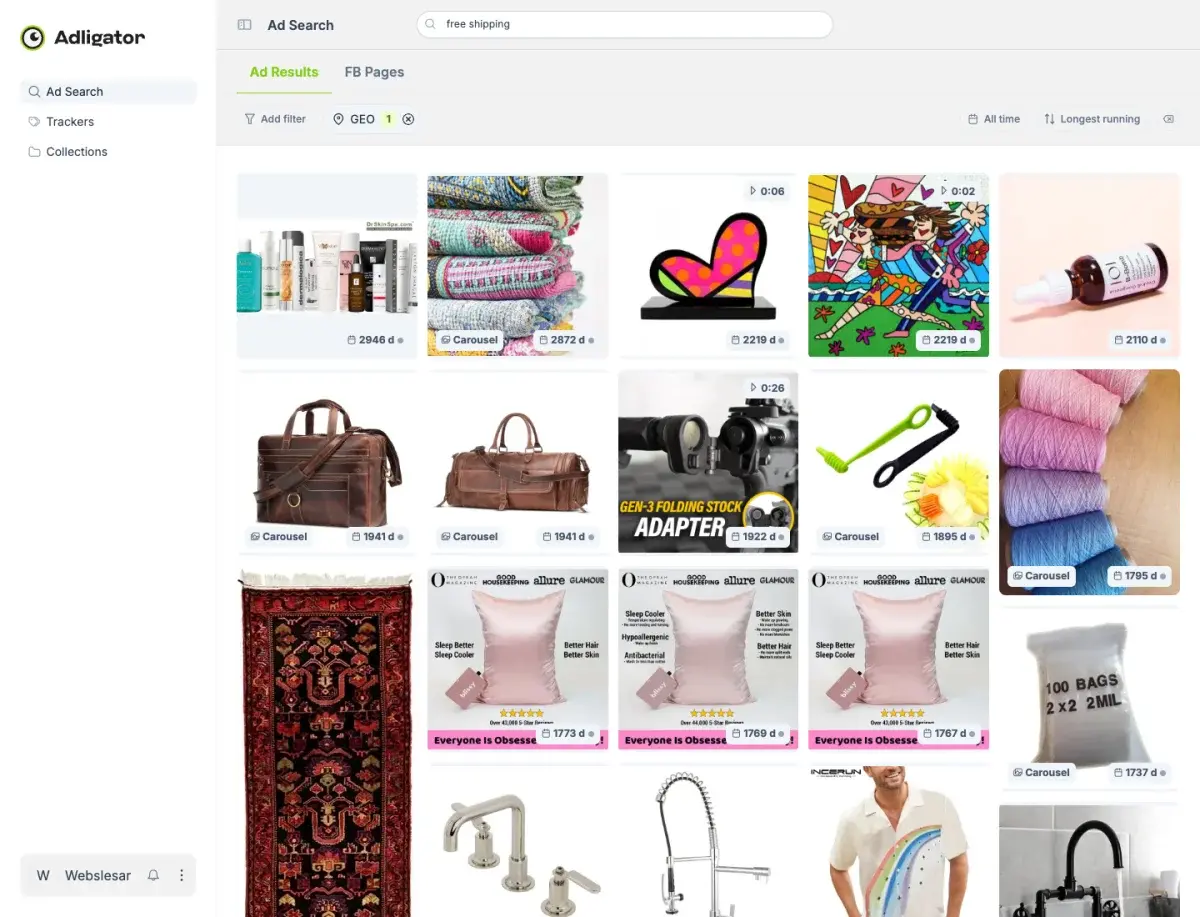 Longevity as a fatigue proxy: a search sorted by "Longest running" puts each ad's runtime on the card — the ads still alive after months are the ones still converting.
- Copies count. When an advertiser duplicates one creative into 3+ ads, they're scaling something that works; when the duplicates vanish within days, that test died. Duplication + runtime together separate scaling from spray-and-pray.
- Creative turnover. On a tracked advertiser, the Analytics view charts launch cadence over time — how often a competitor replaces creatives is their observable answer to fatigue:
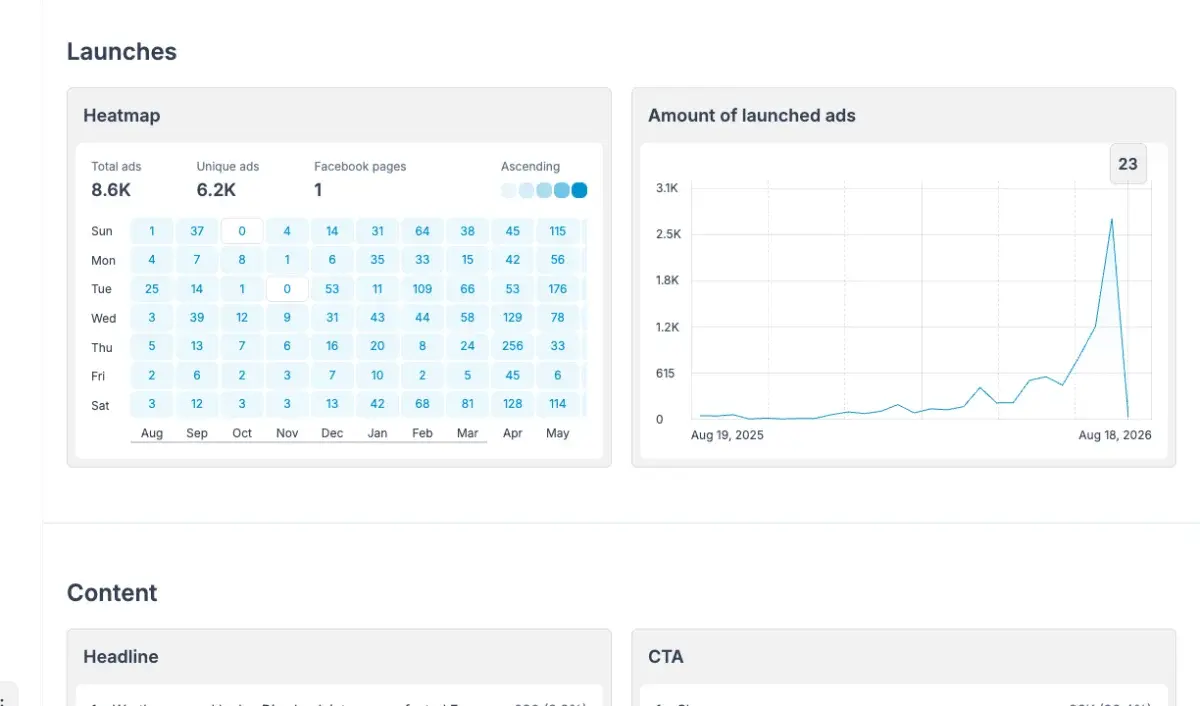 Creative turnover on a tracked advertiser: 8.6K collected ads, launch cadence by weekday, and refresh spikes you can time your own rotations against.
If a rival refreshes hooks every three weeks, that's your market's empirically observed fatigue cycle — a number frequency_value never gave you even when it worked.
Action checklist for this week
- Audit your reports for anything reading
impression_device,hourly_stats_*, orfrequency_value— including third-party dashboards that query on your behalf. - Run the Aug 5 vs Aug 6 check on each ad account to confirm which ones are restricted.
- Have an admin request breakdown access via Ads Manager — recovery is possible; timing isn't guaranteed.
- Patch planning tools that consume
daily_outcomes_curve,budget_guardrailorestimate_daubefore October 27, 2026, when the removal reaches all API versions. - Stand up fatigue proxies now: per-creative CPM/CTR trendlines in-account, plus a tracked competitor set for longevity, copies and turnover. The Ad Library API route works if you want to build it yourself; a tracker does it without code.
- Bookmark this checklist — on current form, another visibility removal within a year is the safe bet.
Sources consulted: Meta Graph API changelog v26.0 (developers.facebook.com) · Dataslayer support bulletin (dataslayer.ai) · AppsFlyer help center (appsflyer.com) · AdBeacon (adbeacon.com) · AdMake AI changelog (admakeai.com).
FAQ
Why is my impression_device breakdown empty?
Since August 6, 2026, the impression_device, hourly-stats and frequency_value breakdowns only return data for opted-in ad accounts. Everyone else gets HTTP 200 with an empty data array — no error, no warning. An account admin can request access back through Ads Manager.
Did Meta remove hourly stats?
Not for everyone. Both hourly aggregations still exist, but since August 6, 2026 they return data only for opted-in accounts. If your dayparting reports went blank in early August, this restriction — not a delivery change — is the likely cause.
How do I detect creative fatigue without frequency data?
Watch per-creative CPM and CTR trends in your own account, and add competitor-side proxies Meta can't switch off: ad longevity, copies count, and creative turnover. All three are readable from the public ad ecosystem with an ad intelligence tool.
Conclusion
The August 6 change is small in isolation and large in aggregate: meta reporting breakdowns removed quietly, delivery estimates gone a week earlier, and a five-year pattern that says your first-party window keeps narrowing. The competitive window, meanwhile, stays open by law and by design.
Reweight your stack accordingly. Set up a competitor tracker in Adligator free — and keep the checklist above where your Monday-morning self can find it.
Related Reading
- Meta Graph API v26.0: What Quietly Broke for Media Buyers — and the October 27 Deadline
- How Meta's Andromeda Algorithm Changes Ad Delivery in 2026: What Media Buyers Must Adapt
- How to Build a Competitive Ad Intelligence Dashboard: Automated Reporting for Media Buying Teams
- Winning Meta Ads Don't Start in One Country: What 200-Country Blasts Reveal About How Evergreen Creatives Actually Scale
