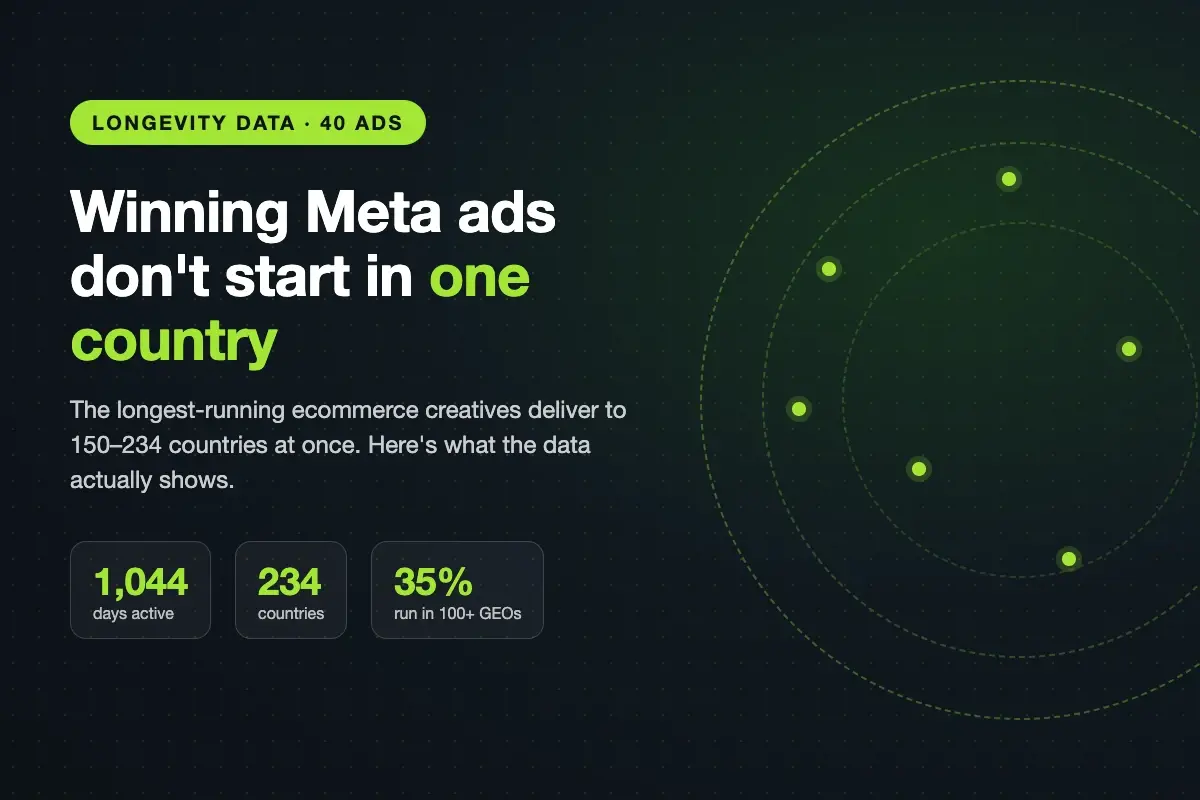
Winning Meta Ads Don't Start in One Country: What 200-Country Blasts Reveal About How Evergreen Creatives Actually Scale
Every media buying course teaches the same launch ritual: pick one test GEO — usually the US, the UK, or a cheap tier-2 market — prove the creative there, then expand country by country. It's tidy, it feels controlled, and it's the closest thing to a universal facebook ads worldwide targeting strategy the industry has.
So we checked whether the longest-running ecommerce ads on Meta actually follow it.
They don't. In a 40-ad sample of the most durable active creatives we could find in August 2026, the single most common pattern was near-global delivery — 100 to 234 countries at once. The tidy middle ground the courses recommend, testing in a handful of markets, was the rarest pattern in the data. This article walks through the numbers, the four most striking cases, the mechanism that explains them, and — just as important — where the one-country playbook still wins.
The conventional advice, and what we found instead
The standard argument for narrow launches is statistical cleanliness: one market, one currency, one CPM baseline, no noise. Expansion comes later, guided by per-country CPM benchmarks and tier lists.
The observed behaviour of long-lived ads points the other way. Sorting Meta's ad universe by how long creatives have survived, the two longest-running ecommerce ads in our entire sample are both global blasts: a Thailand travel advertiser at 1,044 days active across 208 countries, and a leather goods brand at 752 days across 231 countries. Not one of the courses would have told either of them to launch that way.
One sentence of honesty before the data: we can see where ads are delivered, not what the advertiser typed into Ads Manager. Delivery countries and targeting settings are related but not identical — a worldwide setting can deliver to 60 countries in practice, and delivery lists update as the algorithm reallocates. Everything below is a delivery observation.
The methodology: 40 ads, three buyer phrases, one sort
We pulled the sample from the Adligator library on August 9, 2026, using three classic ecommerce buyer phrases: "free shipping", "limited time", and "50% off" (the planned "as seen on" returned zero results, so we substituted it). For each phrase we took the top 15 still-active ads with at least 60 days of runtime, sorted by days active, then deduplicated — 40 unique ads from 23 advertisers.
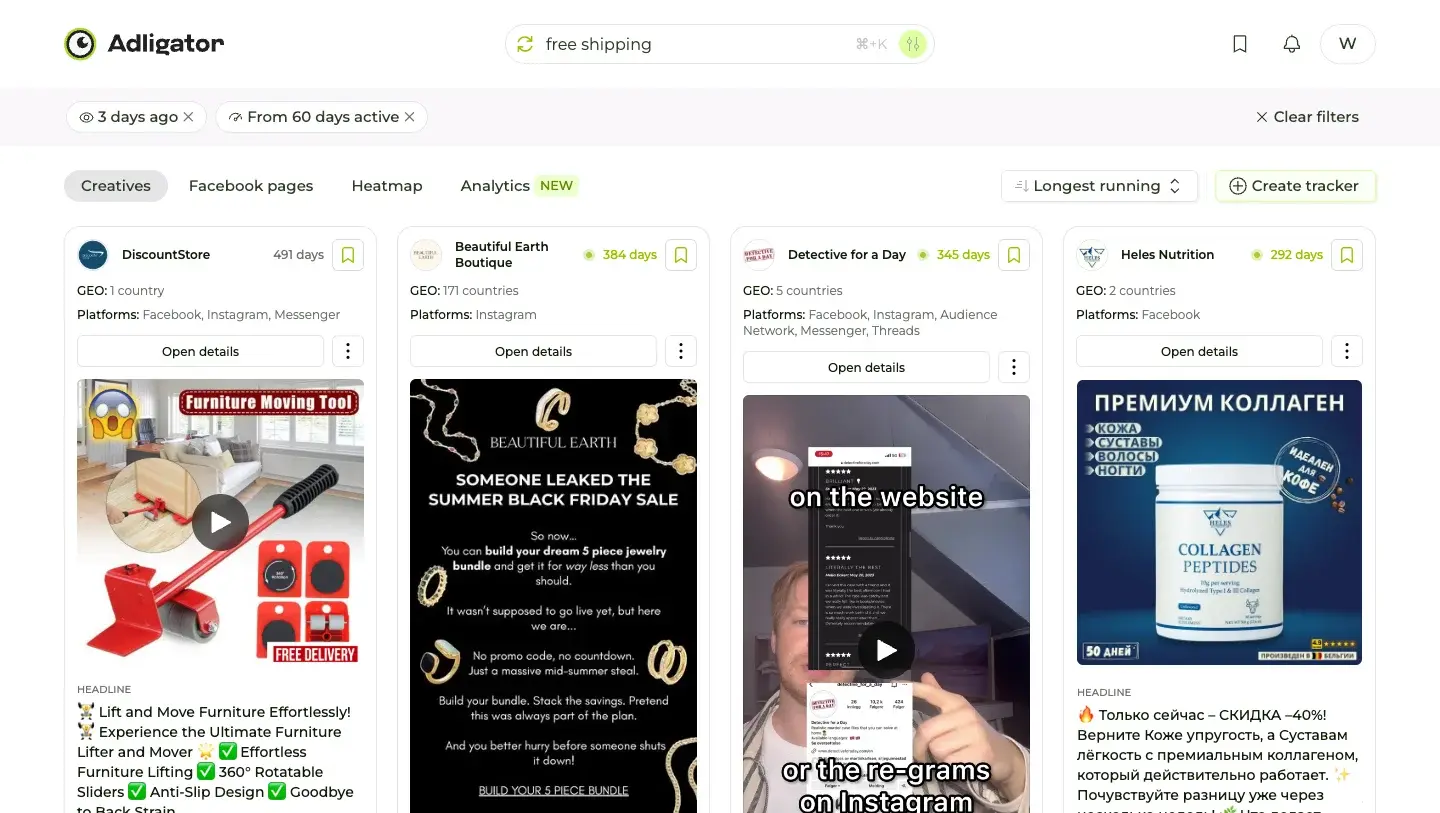 The top of the longevity leaderboard for 'free shipping' ads: 491 days in 1 country next to 384 days in 171 countries
Here's the delivery-country distribution across those 40 ads:
| Delivery countries | Ads | Share |
|---|---|---|
| Exactly 1 | 11 | 28% |
| 2–9 | 5 | 12% |
| 10–29 | 5 | 12% |
| 30–99 | 5 | 12% |
| 100–149 | 6 | 15% |
| 150–234 | 8 | 20% |
Two spikes, thin middle. 35% of the longest-running ads deliver to 100+ countries; 28% deliver to exactly one. The "test in a few countries" configuration that dominates the advice — 2 to 9 markets — is the least common state for a long-lived ad. At the advertiser level it's the same story: of 23 advertisers, 8 run at least one 100+ country ad and 7 run single-country only.
The distribution isn't a random spread. It's two different strategies, both of which demonstrably sustain ads for months — and almost nobody lives between them.
Four ads that break the one-GEO rule
The St. Patrick's Day hoodie that never went home. StPaddy Shop has an image ad live for 240 days across 234 countries — the maximum country count Meta delivery reaches. It's a leprechaun hoodie, it's August, and the ad is still collecting impressions from the United States to Ethiopia. Seasonal product, permanent campaign, planetary delivery.
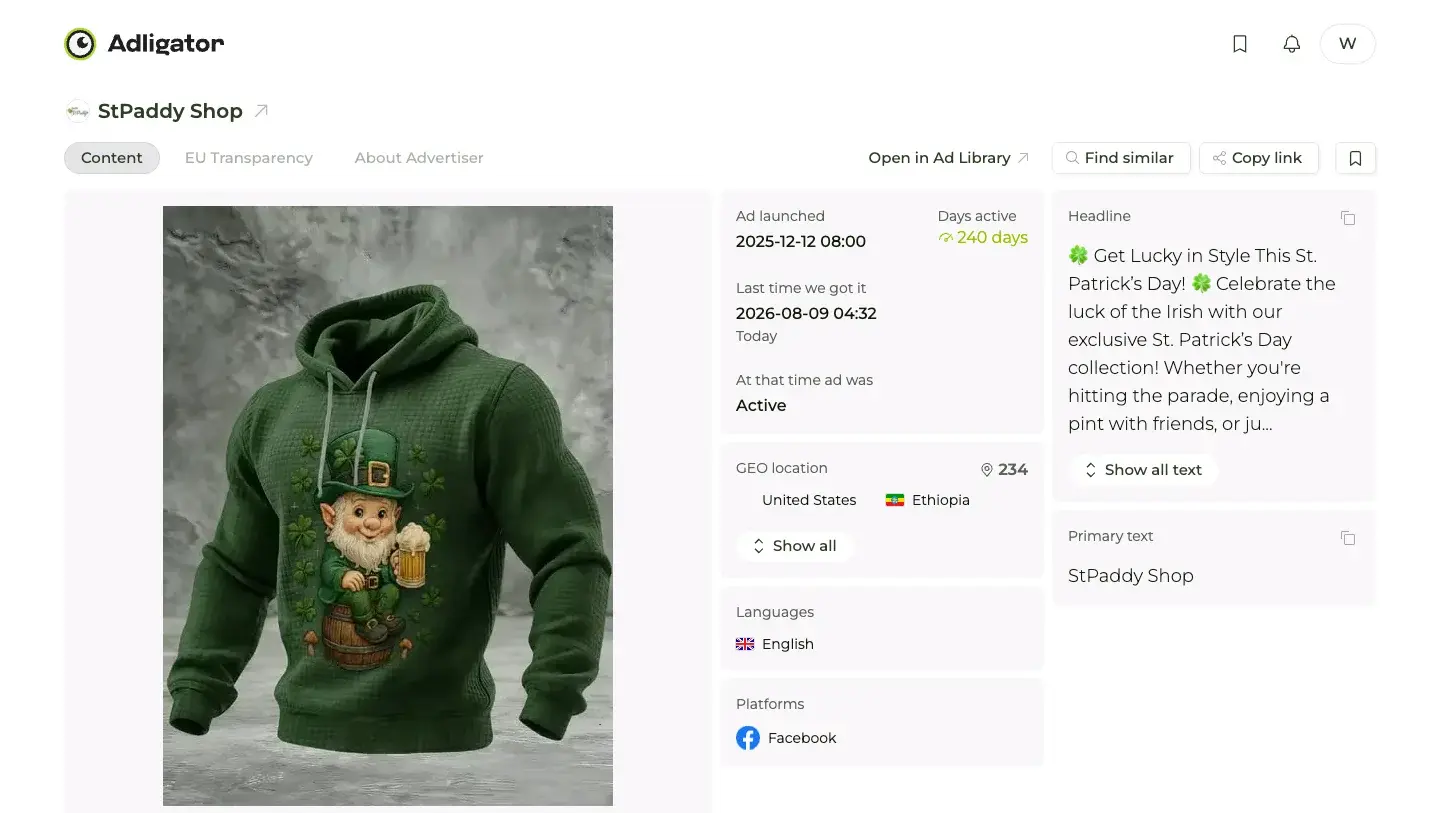 A St. Patrick's Day hoodie ad, still active in August, delivering to 234 countries
The Nordic lamp store running catalog ads everywhere. Lights of Scandinavia's dynamic product ad has run for 163 days across 157 countries — a DPA carousel pulling products straight from the catalog, with worldwide free shipping doing the heavy lifting in the copy. No localization, no per-market creative: one feed, one message, planetary delivery.
The anti-snoring advertorial. Honex, a mouthpiece brand, has an 81-day video ad delivering across 211 countries — long-form advertorial copy, one English script, no market adaptation at all.
The superfood coffee counterexample. Erthlabs ran a video ad to 92 countries for 81 days — and it stopped delivering at the end of July. A useful reminder that broad ads die too; breadth is a strategy, not an immortality spell.
The pattern across all four: one creative, one language, zero localization — the opposite of the per-GEO creative adaptation playbook, running as a deliberate volume play.
The mechanism: why broad delivery keeps creatives alive
Why would near-global delivery correlate with long runtimes? Three reinforcing forces.
Delivery optimization does the geographic testing for you. Under Advantage+ shopping campaigns, Meta's delivery system allocates spend toward the cheapest conversions available — including geographically. A 200-country footprint is effectively 200 parallel micro-tests where losing markets get starved automatically, without the advertiser pausing anything. The 2015-era reason to test one GEO at a time — protecting your budget from bad markets — is now partially handled by the machine.
Broad footprints smooth out fatigue. A creative that exhausts its audience in one mid-size market can keep finding fresh impressions across dozens of others. Several ads in our sample rotate delivery between country sets: one boxing-fitness advertiser runs seven variants of the same campaign whose delivery lists range from 10 to 211 countries — the delivery system splitting one budget across geographic pockets as they respond.
Blast targeting is the default posture, not a precision choice. The clearest evidence is in the heatmap. Among our long-running "free shipping" ads, the top delivery locations by ad count include the Falkland Islands, Macau, Sint Maarten — and Antarctica, with 27 active ads. Nobody is targeting penguin researchers. Tiny territories rank at the top precisely because near-global blasts include them by default while single-market ads never do.
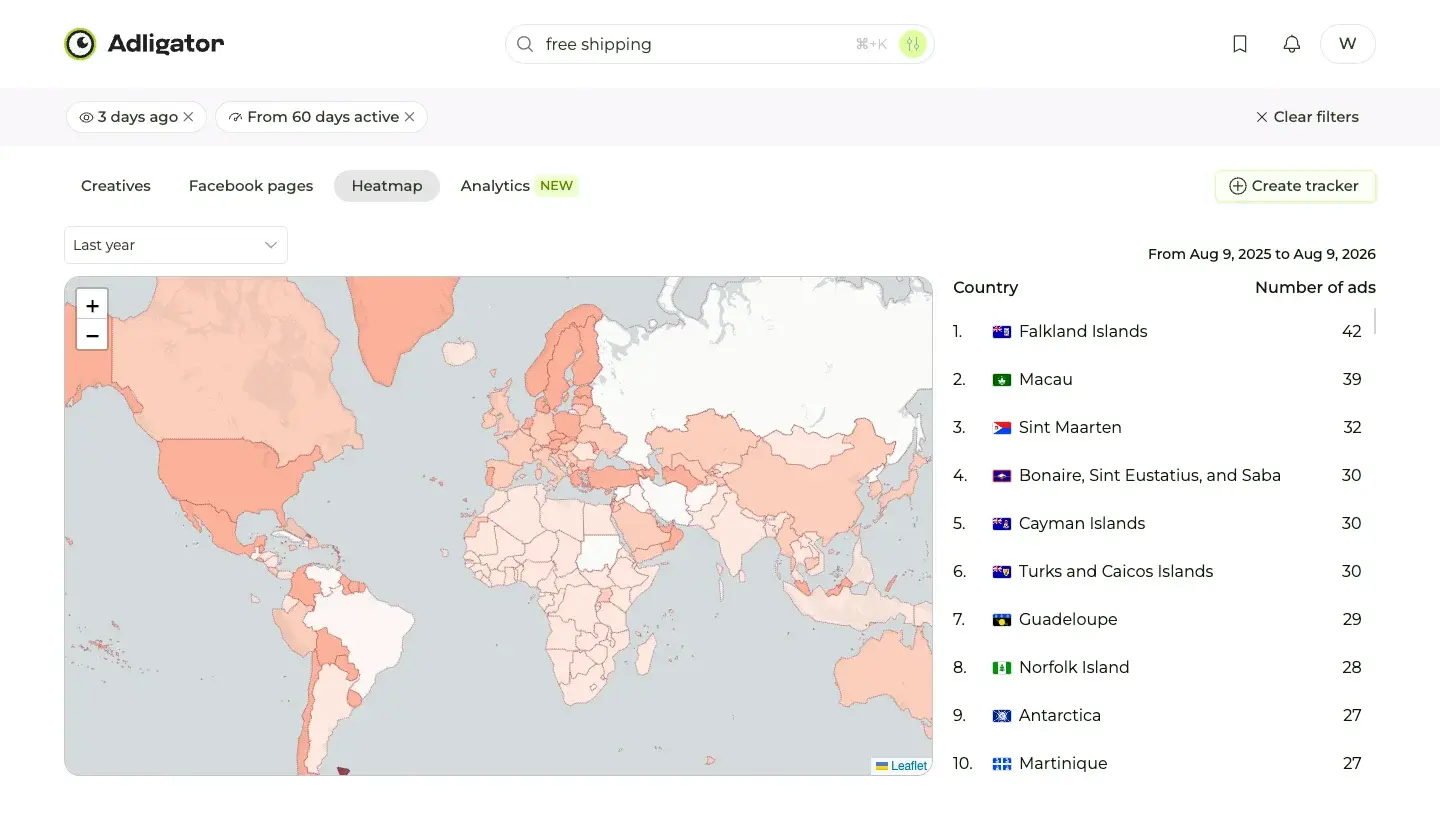 When everyone blasts everywhere, Antarctica ends up with 27 active 'free shipping' ads
The survivorship caveat
This dataset has a built-in bias, and it's the hinge of the whole piece: we can only observe survivors. For every 234-country blast that ran 240 days, an unknown number of identical blasts burned out in a week and vanished from the "still active" pool. A longevity sort is a study of what lasted, not of what usually works.
Three disciplined limits on what the data proves:
- Longevity is not profitability. An ad running 200+ days tells you the advertiser keeps funding it — a meaningful revealed preference for a lean ecommerce operation, but not an audited P&L.
- Delivery is not targeting. We observe where impressions landed, not the settings behind them.
- 40 ads is a sample, not a census. It's ~10x better than the four anecdotes this article started from internally, but your vertical may skew differently — which is exactly why you should check it (more on that below).
What the data does support: near-global delivery is not a fringe tactic. It is one of the two dominant states among the most durable ecommerce creatives on Meta, and any worldwide targeting strategy discussion that ignores it is arguing with reality.
When narrow is still right
The single-country column — 28% of the sample — isn't noise. Look at who's in it:
- A Pakistani deals store at 491 days in Pakistan only: cash-on-delivery fulfillment, local logistics.
- A US jewelry brand at 251 days, US only: premium positioning, domestic shipping promise.
- A mobile detailing service at 185 days, US only: physically local business.
- An Indian home goods brand at 112 days in India: COD, local marketplace dynamics.
- A Baltic supplements brand at 292 days in Estonia and Latvia: five languages in the creative, regulated product category.
The rule hiding in the data: geographic breadth follows fulfillment breadth. Global digital-friendly product with worldwide shipping → the blast pattern is available to you. COD, local services, regulated verticals, language-dependent offers → the narrow pattern isn't a compromise, it's correct. If you're choosing markets deliberately, do it with structured per-country competitor research rather than tier-list folklore.
And to be blunt for beginners: if you're on a small budget with an unproven product, "blast 234 countries" is not the takeaway. The takeaway is that the one-GEO ritual is a choice with trade-offs, not a law.
What this means for your next launch
A practical middle path that respects both the data and your budget:
- Match breadth to fulfillment first. List where you can actually ship, convert currency, and provide support. That's your ceiling.
- If your ceiling is global, consider testing broad from day one. One campaign, wide GEO list, let delivery allocate. Watch the delivery report weekly and exclude only the markets that spend without converting.
- If you launch narrow, treat expansion as the default next step, not a someday project. The evergreen ads in this dataset didn't earn their runtimes in one market.
- Steal the survivors' structure, not their settings. Every blast ad in our sample shares traits: shipping-inclusive offer, price-anchored copy, no market-specific references. That's what makes a creative breadth-compatible.
Reproduce this analysis yourself
Everything above took about twenty minutes, and the manual alternative — opening the Meta Ad Library and clicking into ads one at a time to read their country lists — cannot sort by longevity at all. The workflow in Adligator:
- Search a buyer phrase from your vertical ("free shipping", your product type, a competitor name).
- Filter: Days active from 60, Last seen active: 3 days.
- Sort by Longest running.
- Read the GEO count on each card; open any card to see the full country list and runtime.
Is your niche a blast niche or a narrow niche? Sort your niche by days active and see what survived.
FAQ
Should I target one country or many when testing a new Facebook ad?
It depends on your fulfillment and offer. If you can sell and ship globally, the longevity data suggests broad delivery is a legitimate first move, not just a scaling step — Meta's delivery system finds the pockets that respond. If your offer is local, language-bound, or COD-based, narrow targeting still wins, and the longest-running single-country ads in our sample prove it.
Does worldwide targeting hurt Facebook ad performance?
Not inherently. Worldwide delivery gives the algorithm maximum room to find cheap, responsive impressions, which is why many evergreen creatives sustain it for months. The risk is budget leaking into GEOs you can't serve or convert — so match delivery breadth to where you can actually fulfill orders.
How many countries do successful dropshipping ads target?
In our August 2026 sample of 40 long-running ecommerce ads, 35% were delivering to 100+ countries and 28% to exactly one. The middle ground of 2–9 countries — the classic "test a few GEOs" setup — was the rarest pattern at about 12%.
Does a large country count mean an ad is profitable?
No. Longevity and breadth are proxies, not proof — an advertiser can run an unprofitable ad for months. What long runtime does tell you is that the advertiser keeps choosing to fund the ad, which for lean ecommerce operations is a meaningful signal of at least acceptable performance.
How does Advantage+ change GEO targeting decisions?
Advantage+ shopping campaigns push spend allocation decisions — including geographic ones — into Meta's delivery system. That has made "set a wide GEO list and let delivery decide" operationally simple, which is likely one reason near-global delivery footprints have become common among evergreen creatives.
Conclusion
The facebook ads worldwide targeting strategy debate has been running on intuition, and the intuition is out of date. The longevity data shows two stable patterns — near-global blasts and deliberate single-market plays — with the textbook few-country test being the rarest configuration among ads that actually last. Which side of that split your product belongs on is decided by your fulfillment, not by a tier list.
Before your next launch, spend twenty minutes checking what the survivors in your vertical do. If they're all blasting 150+ countries, that's information. If they're all narrow, that's information too.
Ready to check? Sort your niche by days active and see what survived
Or go one level deeper: see how many countries the winners in your vertical really run in.
Sources consulted: Adligator ad library (data capture 2026-08-09) · Meta Ad Library (facebook.com/ads/library) · Meta Business Help Center documentation on Advantage+ shopping campaigns (facebook.com/business/help)
Related Reading
- How to Analyze Facebook Ad Creatives by GEO and Vertical: A Data-Driven Approach for Media Buyers
- Facebook Ads by Country: How to Research Competitor Creatives by GEO
- Meta Just Handed Everyone the Same Q4 Playbook — Your Edge Is What It Leaves Out
- Scaled Winner or Flash in the Pan? 6 Data-Backed Signals a Competitor's Facebook Ad Is Actually Making Money
- When Do Winning Black Friday Facebook Ads Actually Launch? We Measured Last Year's Ads to Find Out
