When Do Winning Black Friday Facebook Ads Launch? We Measured Last Year's Ads to Find Out
Ask five marketing blogs when to start Black Friday Facebook ads and you'll get five confident, mutually exclusive answers. Some agencies say launch 3–5 days before the sale. Others insist November 1 is the deadline. Others tell you to start testing in early October.
None of them show data. So we measured it.
Using the Adligator ad library, we counted every recorded ad mentioning "black friday" by its launch date, week by week from September through the end of November 2025 — then sliced the same windows again, keeping only the ads that survived 14+ days. The result is the closest thing to an answer this debate has ever had: launch volume tells you what the market actually does, and the winner slice tells you when the ads that lasted went live.
If you're planning Q4 2026 budgets right now, the numbers below will probably move your timeline.
The contradictory advice problem: "3–5 days before" vs "November 1" vs "early October"
The top-ranking guides on this query genuinely disagree. Madgicx and K6 Agency lean toward launching sale campaigns days before the event. Other checklists treat November 1 as the point of no return. A third camp — mostly performance practitioners — argues the real work happens in early October, before CPMs spike.
All three camps assert; none of them measure. The reason is structural: Meta's Ad Library shows you one advertiser at a time, has no launch-date aggregation, and no way to filter by how long an ad survived. You can't answer "when did last year's winners launch?" by scrolling — the analysis is simply impossible manually.
An ad intelligence library that stores first-seen dates and active-days counts for every ad can answer it. That's what we used.
Our dataset: measuring 2025's Black Friday ads by launch date
Methodology, so you can reproduce every number:
- Source: Adligator library, queried August 24, 2026. Search: ads whose text mentions "black friday", all GEOs, all formats.
- Launch counting: published-date windows (one week or one day at a time), using the result-count readout per window.
- Winner slice: the same windows, adding a minimum of 14 active days — our standard proxy for "this ad kept earning its budget."
- Honest limits: a single query counts up to 3,000 ads, so busier windows are reported as "≥" lower bounds. The library records launches it crawls, not a full Meta census — treat the shape of the curve, not the absolute totals, as the signal. And longevity is a survival proxy, not proven profitability.
Try it yourself: Filter any niche by launch date and longevity — try Adligator free
Launch volume by week, September through late November
Here's what the 2025 season actually looked like:
 Weekly launches of ads mentioning "black friday": a quiet September, an October takeoff, and a November flood that maxes out the measurement window daily.
| Week | Recorded launches |
|---|---|
| Sep 1–28 (4 weeks) | ≈170–250 per week |
| Sep 29 – Oct 5 | ≈410 |
| Oct 6–12 | ≈750 |
| Oct 13–19 | ≈1,900 |
| Oct 20–26 | ≈3,700 |
| Oct 27 – Nov 2 | ≈8,300 |
| Nov 3–9 | ≈17,000 |
| Nov 10–30 | ≥3,000 per day, every day |
Three things jump out:
- September is not campaign season. The few hundred September "black friday" ads are dominated by evergreen angles — affiliate catalog ads running "Why wait for Black Friday?" hooks year-round. One such catalog ad launched September 1 and ran 297 days.
- The real takeoff is the second week of October. Volume doubles from ≈410 to ≈750, then more than doubles again to ≈1,900 the following week. This is the market's collective testing phase.
- From November 10, the flood exceeds what we can count. Every single day through November 30 hits our 3,000-ads-per-query ceiling. On November 27 — Black Friday eve — format slices alone (video ≥3,000, image ≥3,000, dynamic ≥3,000, DPA ≈710) put the day's floor near 10,000 launches.
The winner slice: when ads that ran 14+ days went live
Now the slice that settles the argument. For each launch window, how many ads went on to survive 14+ days?
| Launch window | Recorded launches | 14+ day survivors | Survival rate |
|---|---|---|---|
| September | ≈990 | 146 | ≈15% |
| Oct 1–15 | ≈1,850 | ≈230 | ≈12% |
| Oct 16–31 | ≈10,400 | ≈1,360 | ≈13% |
| Nov 1–10 | ≈24,000+ | ≥3,000 | not computable (both capped) |
The surprise: survival odds are roughly flat. About one launch in seven or eight passes the 14-day mark whether it went live in September, mid-October, or the first week of November. Launching early doesn't make an ad more likely to survive — and launching late doesn't doom it.
What timing actually changes is the payoff of surviving:
- An early-October winner buys the whole season. GNO Partners launched a "Your Best BFCM Ever, Or You Don't Pay" video on October 9 targeting US/UK/CA/AU e-commerce founders — it ran 116 days. Ergorest, a Slovenian mattress brand, launched its Black Friday video October 20 and ran it 78 days straight, through the peak and into January.
- A November 1-week winner gets the peak, and only the peak. The Ridge launched its EU "up to 47% off" wallet videos on November 6 across 23 countries — a solid 30-day run that ended with the season. zooplus's Black Friday DPA launched November 15 and lasted 18 days. ECOVACS launched November 19 with a copy-stated deal window of "Nov 20 to Dec 1" — a deliberately bounded 14-day flight.
- A Black Friday-week launch usually gets days — with rare, telling exceptions. Most November 27–28 launches we sampled ran a single day: local dental clinics, car services, and outlet stores blasting one-day promos. The outlier is instructive: GroundingWell launched "Black Friday" bedsheet ads on November 29 and never turned them off — the top variant was still being seen 254 days later, the "sale" page quietly converted into a permanent evergreen offer.
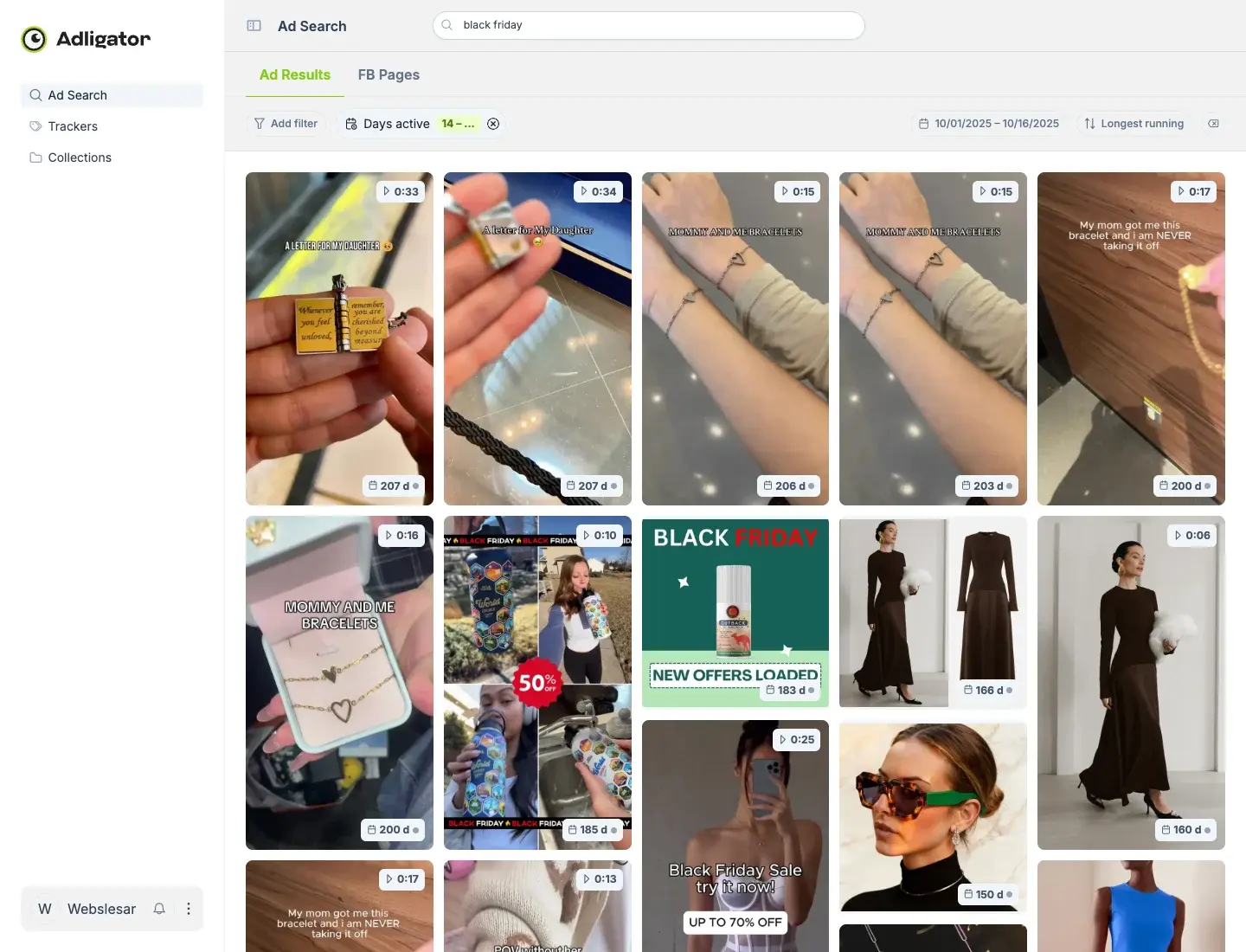 The winner slice in one query: date window Oct 1–16, days active 14+, sorted by longest running. The top early-October survivors were still running 200+ days later.
Early birds vs last-minute launchers: format and offer differences
The two cohorts don't just differ in timing — they're running different playbooks.
Early launchers (October 1–15) skew toward testing material: video is the biggest format at ≈40% of launches (≈740 of ≈1,850), followed by statics (≈26%) and dynamic catalog ads (≈25%). Offers are soft — "early access," waitlists, pre-sale hooks like MadMia's "Black Friday starts early! Up to 60% off selected" running weeks before the event. Big retail joins mid-October: SHEIN's DPA wave across its main, CURVE, and KIDS pages launched October 21–22, weeks before the peak.
Last-minute launchers (Black Friday week) flood every format at once — video, statics, and dynamic ads each blew past 3,000 launches on November 27 alone. The offer language shifts to pure urgency: "ends today," "24 hours only," countdowns. And the advertiser mix changes visibly: national retailers drop full catalog waves (Australia's The Good Guys pushed a same-day DCO wave spanning TVs, dishwashers, and laptops), while thousands of local businesses run their only Meta ad of the year.
For a deeper look at what creative styles are winning this year, see our Facebook ad creative trends breakdown.
The 2026 timing playbook by advertiser type
Black Friday 2026 falls on November 27. Working backwards from the data:
DTC stores:
- Early October: launch creative tests — this is when 2025's long-runners went live. Survival odds are the same later, but a winner found now compounds for 6+ weeks and exits learning before CPMs spike.
- Late October: kill losers, scale the survivors into your BFCM structure. Meta's learning-phase guidance (~50 optimization events per ad set in 7 days) means campaigns scaled now are stable well before the peak.
- November 20–27: switch surviving creatives to urgency offers. Don't launch untested concepts into the most expensive auction of the year.
Affiliates and arbitrage:
- The September evergreen slice is your model — "why wait for Black Friday" pre-sell angles run profitably outside peak CPMs.
- Test aggressively in the October 6–19 window, before volume quintuples. By November you should be scaling proven angles only.
Lead-gen and B2B:
- Your Black Friday is other people's planning season. GNO Partners launched its BFCM-services ad October 9 — catching e-commerce buyers while they planned, then riding demand for 116 days. If you sell to advertisers or merchants, launch in early October.
How to watch competitors' Q4 launches in real time this year
Last year's data sets the baseline; the edge in 2026 comes from seeing your niche's launches as they happen. Two workflows:
- Date-window sweeps. In Adligator, search your niche keyword, set the launch-date filter to the last 7 days, and sort by newest. Repeat weekly from late September — you'll see exactly when your market starts testing, which offers appear, and which competitor ads show winning signals.
- Trackers on named competitors. Create a tracker on a competitor's page and open its Analytics tab: the Launches section shows the page's launch cadence as a calendar heatmap and timeline, so a BFCM ramp-up is visible the week it starts — no manual checking.
 The Analytics tab of our tracker on The Ridge (≈2K ads tracked): the Launches heatmap and timeline expose the brand's cadence — including its November ramp — at a glance.
Set this up before your competitors do: Watch your competitors' Black Friday ads launch in real time — set a tracker in Adligator
For the broader Q4 research stack, our guides on seasonal ad research for Q4 and Meta's Holiday Insights Center cover the complementary tools.
FAQ
Is it too late to start Black Friday ads in November?
Not for launching — survival odds for November launches are roughly the same as October ones. But it is too late to start testing: from November 10, 2025 the library recorded 3,000+ new "black friday" ads every single day, and peak CPMs make every failed test more expensive. Validate in October, launch whenever ready.
How long before Black Friday should ads exit the learning phase?
Meta's guidance is roughly 50 optimization events per ad set within 7 days. Working backwards from Black Friday week, scaled campaigns should be stable by mid-November — so the creatives feeding them need validation in October, at pre-peak testing costs.
Do early Black Friday ads burn out before the peak?
The survivors say no. Early-to-mid October launches that passed 14 days routinely ran through the whole season — 78, 116, even 200+ days in our data. Fatigue is managed by rotating variants, not by delaying an offer that works.
Conclusion
So when to start Black Friday Facebook ads? The data resolves the debate like this: the "November 1" and "3–5 days before" camps are describing what the market does — the flood is real, and your launch will land in it just fine. The "early October" camp is describing what winners do — not because early launches survive more often (they don't), but because an early winner compounds: cheap testing, a finished learning phase, and up to six weeks of runway that a Black Friday-eve launch can never recover.
Test in early October. Scale in late October. Spend November launching only what already works — and watching what everyone else launches.
Ready to put dates on your niche? Watch your competitors' Black Friday ads launch in real time — set a tracker in Adligator
Filter any niche by launch date and longevity — try Adligator free
Sources consulted: Adligator library (all queries dated Aug 24, 2026), Meta Business Help Center (learning-phase documentation), madgicx.com, k6agency.com, leadenforce.com (competing timing advice, cited as the contradiction this study resolves).
Related Reading
- Winning Meta Ads Don't Start in One Country: What 200-Country Blasts Reveal About How Evergreen Creatives Actually Scale
- How to Use Ad Spy Tools for Affiliate Marketing: Find Winning Facebook Offers Before Your Competition
- How to Use Ad Spy Tools for eCommerce: Find Winning Products and Scale Facebook Campaigns Faster
- Video vs Carousel vs Static in Beauty Facebook Ads: We Measured Which Formats Actually Survive
